Open Access Publisher and Free Library
CRIME+CRIMINOLOGY.jpeg

CRIME

Violent-Non-Violent-Cyber-Global-Organized-Environmental-Policing-Crime Prevention-Victimization

Posts tagged legal standards
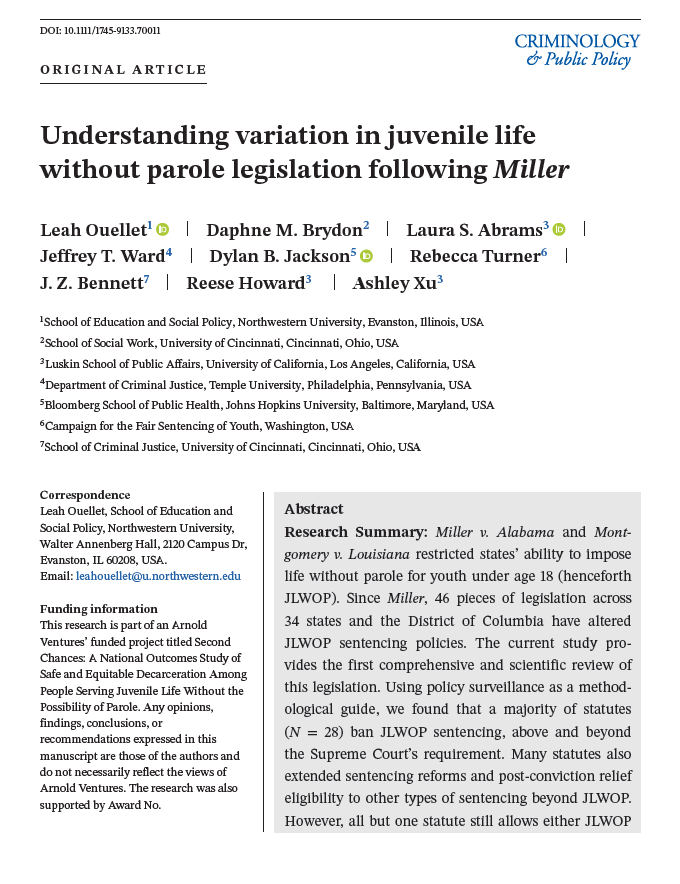
Understanding variation in juvenile life without parole legislation following Miller

By Leah Ouellet, Daphne M. Brydon, Laura S. Abrams, Jeffrey T. Ward, Dylan B. Jackson, Rebecca Turner, J. Z. Bennett, Reese Howard, Ashley Xu


Miller v. Alabama and Montgomery v. Louisiana restricted states’ ability to impose life without parole for youth under age 18 (henceforth JLWOP). Since Miller, 46 pieces of legislation across 34 states and the District of Columbia have altered JLWOP sentencing policies. The current study provides the first comprehensive and scientific review of this legislation. Using policy surveillance as a methodological guide, we found that a majority of statutes (N = 28) ban JLWOP sentencing, above and beyond the Supreme Court's requirement. Many statutes also extended sentencing reforms and post-conviction relief eligibility to other types of sentencing beyond JLWOP. However, all but one statute still allows either JLWOP or life with parole as a sentencing option for minors convicted of homicide crimes and requires between 15 and 40 years, at minimum, to be served before being eligible for release. Grounding our analysis in institutional theory, we argue that the relative punitivity of the JLWOP reforms enacted was associated with measures of JLWOP institutionalization across states (i.e., pre-Miller JLWOP population and pre-Miller sentencing schema), suggesting that states where JLWOP was more routinely used were more resistant to policy reform.

Policy Implications

The current study provides implications for future decarceration efforts. Findings suggest that state legislatures are willing to enact post-conviction relief measures (e.g., judicial review or “second look” measures) for individuals convicted of violent crimes to address over-incarceration, deviating from previous decarceration efforts focused on non-violent, low-level offenses. In spite of the promising window for juvenile justice reform that Miller provided, however, these reforms have taken a relatively modest, incremental approach toward altering extreme youth sentencing practices in the United States. Policy makers and advocates seeking to promote sentencing reform efforts should factor in how highly institutionalized a sentencing practice is in each state, as this might inform effective strategies for policy change.

A Prosecutor's “Ideal” Sexual Assault Case: A Mixed‐Method Approach to Understanding Sexual Assault Case Processing

By John W. Ropp, Jacqueline G. Lee, Laura L. King, Lisa M. Growette Bostaph

Research continues to explore factors that contribute to high rates of attrition among sexual assault cases. Comparatively little is known, however, about prosecutorial, as opposed to police, decision-making in these cases. Using a mixed-method approach to analyze (1) 175 case files from a midsize policing agency in the West with trained sexual assault investigators and (2) detailed prosecutor notes from 52 corresponding cases, we explore patterns in three key outcomes: (a) arrest, (b) referral for prosecution, and (c) charging. Logistic regression results indicate that fewer variables predicted case outcomes compared with previous studies, suggesting that specially trained officers may be more adept at dismissing “rape myth” factors. Qualitative analysis of prosecutorial case notes, however, revealed that prosecutors tended to compare specific case elements to an envisioned “ideal” case, which frequently aligned with some pervasive rape myths prevalent in society. Prosecutors focused heavily on convictability, anticipating how a potential jury would respond to the case. Although specially trained investigators may better disregard extralegal rape-myth factors, these myths still plague decision-making at the prosecutorial stage indirectly via concerns for juror interpretation of the facts. We find strong support for the “downstream” perspective of prosecutorial decision-making.

Criminology, Volume 62, Issue 4, 2024, pages 704-738