
Open Access Publisher and Free Library
CRIME+CRIMINOLOGY.jpeg

CRIME

Violent-Non-Violent-Cyber-Global-Organized-Environmental-Policing-Crime Prevention-Victimization

Posts tagged public protection policing
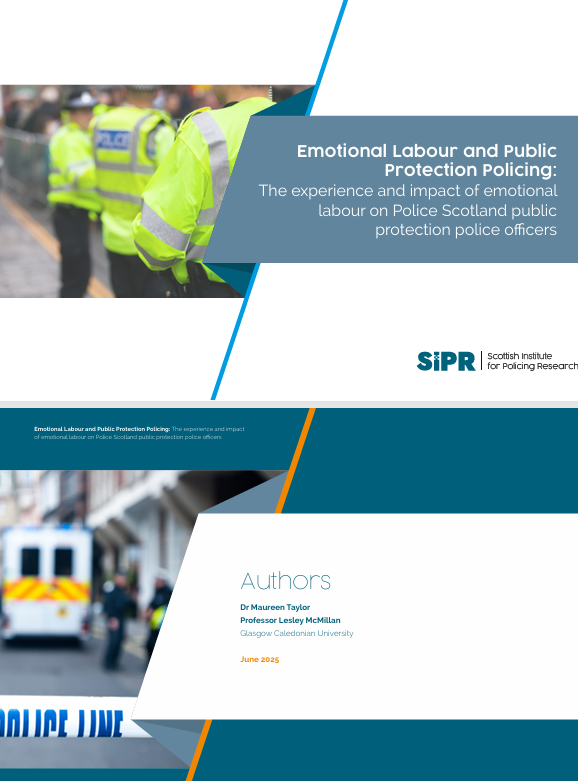
Emotional Labour and Public Protection Policing: The experience and impact of emotional labour on Police Scotland public protection police officers

By Maureen Taylor ahd Lesley McMillan 

  There is a significant body of research that illustrates the emotional demands of policing and the physical and psychological toll this takes on officers and staff. However, the management of these demands, particularly in more specialist roles such as those in public protection policing where the demand may be higher, are less well understood. This research explores the experiences of public protection police officers in Police Scotland through a lens of emotional labour..  The aims of this research were to: • Critically review the literature around the emotional impacts of policing on officers and the role of emotional labour in policing; • Establish the experience of, and impact on, officers involved in the investigation of public protection cases; assess how police officers in roles where emotional labour may be heightened, manage their emotions and the strategies they develop to do so; and • Examine how emotions and emotion management are mediated by organisational, departmental and role values, demands and culture In doing so, the research sought to answer the following research questions: 1. What is the emotional experience of police officers in public protection roles and what impact does it have on them? 2. What emotional labour do officers undertake, and what strategies of emotion management do officers employ? 3. To what extent does the theory of emotional labour explain the experiences of public protection police officers? 4. What role does the prevailing organisational culture play in the emotion management strategies of public protection policing? This report presents the findings from this research and a potential framework for understanding the factors that contribute to resilience within the context of public protection policing    

Edinburgh: Scottish Institute for Policing Research 2025. 32p.   
Police Power Abolition

By Devon W. Carbado 

This Article employs the Law Review’s Discourse symposium on my book, Unreasonable: Black Lives, Police Power, and the Fourth Amendment, as a starting point to foreground and elaborate on an idea that I reference in that text: police power abolition. The Article begins by describing the central insight that motivates Unreasonable—namely, that simply limiting the frequency with which the police interact with Black people could save Black lives. If the police have fewer opportunities to stop and question Black people, they have fewer opportunities to kill us. That observation led me to think about the range of structural forces that facilitate contact between Black people and the police. Fourth Amendment law is one such force. From pedestrian checks, to traffic stops, to stops and frisks, to searches and seizures at the border, Fourth Amendment law permits the police to interact with and enact violence against Black people on the thinnest, most unreasonable of suspicions. The Article does not reprise precisely how Fourth Amendment law performs that racially subordinating work. For that, you will have to read Unreasonable and the broader body of work on which the book is based. Instead, the Article summarizes the core arguments Unreasonable propounds, links them to what I call “police power abolition,” and explains how police power abolition can provide an entry into and render more legible broader discourses about abolition. Throughout the Article, I draw on and react to the generous and generative review essays that participants in this symposium have written about the book. In the context of doing so, I explain why, notwithstanding the limitations of law as space for antiracist interventions, the legal terrain should remain a critical (though not the only or most important) site for advancing

racial justice.

UCLA School of Law, Public Law Research Paper Forthcoming

69 Pages Posted: 20 Nov 2025