
Open Access Publisher and Free Library
CRIME+CRIMINOLOGY.jpeg

CRIME

Violent-Non-Violent-Cyber-Global-Organized-Environmental-Policing-Crime Prevention-Victimization

Posts tagged social structure
OPENING THE BLACK BOX

By Jessica M. Eaglin 

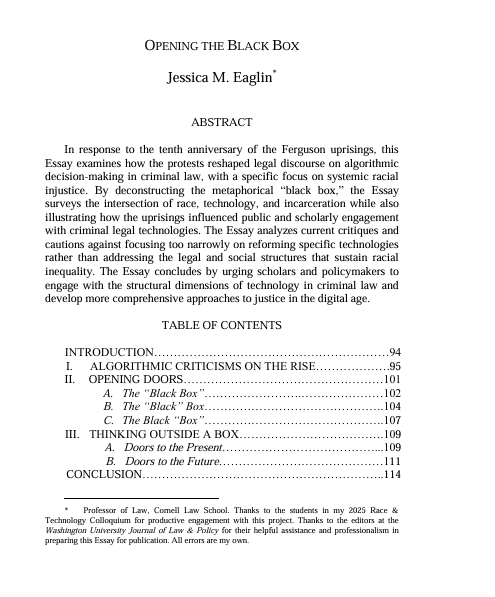
 In response to the tenth anniversary of the Ferguson uprisings, this Essay examines how the protests reshaped legal discourse on algorithmic decision-making in criminal law, with a specific focus on systemic racial injustice. By deconstructing the metaphorical “black box,” the Essay surveys the intersection of race, technology, and incarceration while also illustrating how the uprisings influenced public and scholarly engagement with criminal legal technologies. The Essay analyzes current critiques and cautions against focusing too narrowly on reforming specific technologies rather than addressing the legal and social structures that sustain racial inequality. The Essay concludes by urging scholars and policymakers to engage with the structural dimensions of technology in criminal law and develop more comprehensive approaches to justice in the digital age.

Washington University Journal of Law and Policy, Volume 78 • Issue 1 • 2025 

Social Control and the Gang: Lessons from the Legalization of Street Gangs in Ecuador

 By David C. Brotherton · Rafael Gude

 In 2008, the Ecuadorian Government launched a policy to increase public safety as part of its “Citizens’ Revolution” (La Revolución Ciudadana). An innovative aspect of this policy was the legalization of the country’s largest street gangs. During the years 2016–2017, we conducted ethnographic research with these groups focusing on the impact of legalization as a form of social inclusion. We were guided by two research questions: (1) What changed between these groups and society? and (2) What changed within these groups? We completed field observations and sixty qualitative interviews with group members, as well as multiple formal and informal interviews with government advisors, police leaders and state actors related to the initiative. Our data show that the commitment to social citizenship had a major impact on gang-related violence and was a factor in reducing the nation’s homicide rate. The study provides an example of social control where the state is committed to policies of social inclusion while rejecting the dominant model of gang repression and social exclusion practiced throughout the Americas.  

Critical Criminology, 2020.