

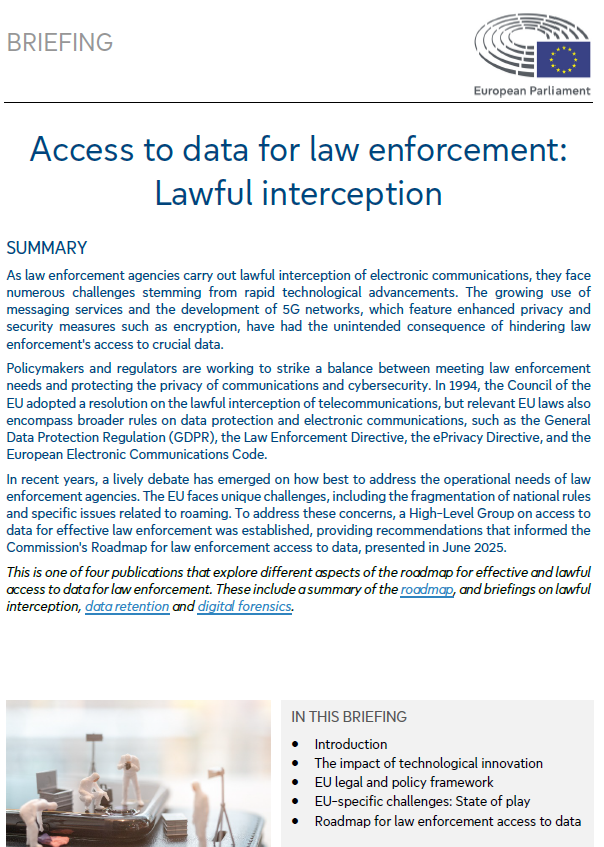
By Piotr Bąkowski
As law enforcement agencies carry out lawful interception of electronic communications, they face numerous challenges stemming from rapid technological advancements. The growing use of messaging services and the development of 5G networks, which feature enhanced privacy and security measures such as encryption, have had the unintended consequence of hindering law enforcement's access to crucial data. Policymakers and regulators are working to strike a balance between meeting law enforcement needs and protecting the privacy of communications and cybersecurity. In 1994, the Council of the EU adopted a resolution on the lawful interception of telecommunications, but relevant EU laws also encompass broader rules on data protection and electronic communications, such as the General Data Protection Regulation (GDPR), the Law Enforcement Directive, the ePrivacy Directive, and the European Electronic Communications Code. In recent years, a lively debate has emerged on how best to address the operational needs of law enforcement agencies. The EU faces unique challenges, including the fragmentation of national rules and specific issues related to roaming. To address these concerns, a High-Level Group on access to data for effective law enforcement was established, providing recommendations that informed the Commission's Roadmap for law enforcement access to data, presented in June 2025. This is one of four publications that explore different aspects of the roadmap for effective and lawful access to data for law enforcement. These include a summary of the roadmap, and briefings on lawful interception, data retention and digital forensics.
Brussels: EPRS | European Parliamentary Research Service, 2025.
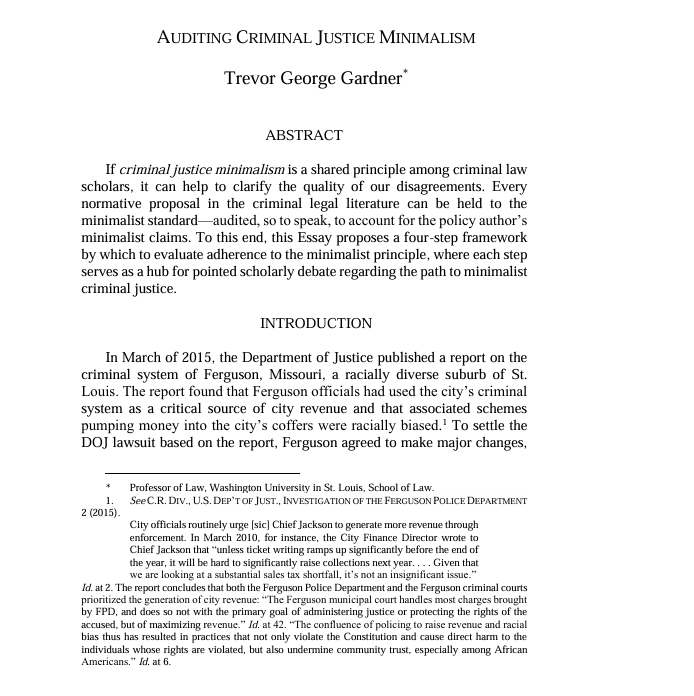
By Trevor George Gardner
If criminal justice minimalism is a shared principle among criminal law scholars, it can help to clarify the quality of our disagreements. Every normative proposal in the criminal legal literature can be held to the minimalist standard—audited, so to speak, to account for the policy author’s minimalist claims. To this end, this Essay proposes a four-step framework by which to evaluate adherence to the minimalist principle, where each step serves as a hub for pointed scholarly debate regarding the path to minimalist criminal justice.
Washington University Journal of Law and Policy, 2025
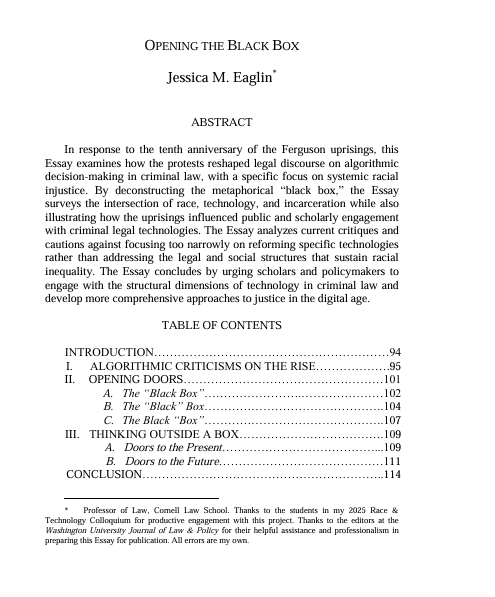
By Jessica M. Eaglin
In response to the tenth anniversary of the Ferguson uprisings, this Essay examines how the protests reshaped legal discourse on algorithmic decision-making in criminal law, with a specific focus on systemic racial injustice. By deconstructing the metaphorical “black box,” the Essay surveys the intersection of race, technology, and incarceration while also illustrating how the uprisings influenced public and scholarly engagement with criminal legal technologies. The Essay analyzes current critiques and cautions against focusing too narrowly on reforming specific technologies rather than addressing the legal and social structures that sustain racial inequality. The Essay concludes by urging scholars and policymakers to engage with the structural dimensions of technology in criminal law and develop more comprehensive approaches to justice in the digital age.
Washington University Journal of Law and Policy, Volume 78 • Issue 1 • 2025
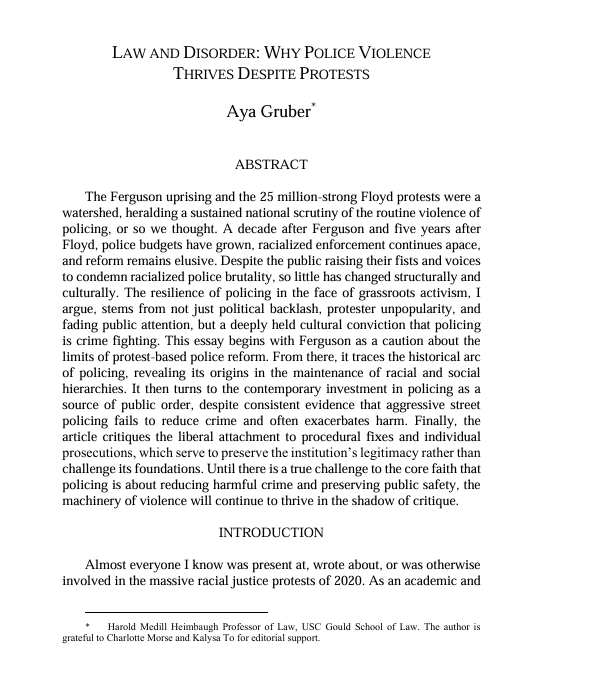
By Aya Gruber
The Ferguson uprising and the 25 million-strong Floyd protests were a watershed, heralding a sustained national scrutiny of the routine violence of policing, or so we thought. A decade after Ferguson and five years after Floyd, police budgets have grown, racialized enforcement continues apace, and reform remains elusive. Despite the public raising their fists and voices to condemn racialized police brutality, so little has changed structurally and culturally. The resilience of policing in the face of grassroots activism, I argue, stems from not just political backlash, protester unpopularity, and fading public attention, but a deeply held cultural conviction that policing is crime fighting. This essay begins with Ferguson as a caution about the limits of protest-based police reform. From there, it traces the historical arc of policing, revealing its origins in the maintenance of racial and social hierarchies. It then turns to the contemporary investment in policing as a source of public order, despite consistent evidence that aggressive street policing fails to reduce crime and often exacerbates harm. Finally, the article critiques the liberal attachment to procedural fixes and individual prosecutions, which serve to preserve the institution’s legitimacy rather than challenge its foundations. Until there is a true challenge to the core faith that policing is about reducing harmful crime and preserving public safety, the machinery of violence will continue to thrive in the shadow of critique
Washington University Journal of Law and Policy, Volume 78 • Issue 1 • 2025
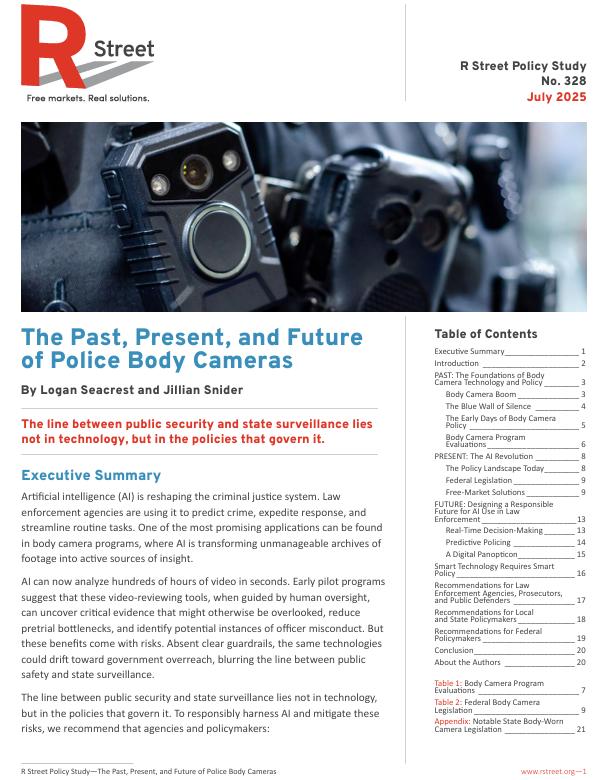
By Logan Seacrest and Jillian Snider
Artificial intelligence (AI) is reshaping the criminal justice system. Law enforcement agencies are using it to predict crime, expedite response, and streamline routine tasks. One of the most promising applications can be found in body camera programs, where AI is transforming unmanageable archives of footage into active sources of insight. AI can now analyze hundreds of hours of video in seconds. Early pilot programs suggest that these video-reviewing tools, when guided by human oversight, can uncover critical evidence that might otherwise be overlooked, reduce pretrial bottlenecks, and identify potential instances of officer misconduct. But these benefits come with risks. Absent clear guardrails, the same technologies could drift toward government overreach, blurring the line between public safety and state surveillance. The line between public security and state surveillance lies not in technology, but in the policies that govern it. To responsibly harness AI and mitigate these risks, we recommend that agencies and policymakers: • Establish and enforce clear use policies. Statewide rules for body camera use and AI governance ensure consistency across jurisdictions, particularly in areas like body camera activation, evidence sharing, and public disclosure. • Pair technology with human oversight. AI should enhance—not replace—human decision-making. Final judgments must rest with trained personnel, supported by independent policy oversight from civilian review boards. • Safeguard civil liberties. Safeguards must be in place to protect individual rights, limit surveillance overreach, and ensure data transparency. For example, limiting facial recognition during constitutionally protected activities like protests will help ensure AI is aligned with democratic ideals. With the right guardrails in place, AI can elevate body cameras from afteraction archival tools to always-on intelligence tools, informing decisions in the moment, when it matters most.
R Street Policy Study No. 328
Washington, DC: R Street, 2025. 25p.

By
María Fernanda Rodríguez, Nicolás Espejo Yaksic
The IBA assumed the challenge of contributing to a profound and urgent transformation, under the conviction that protecting the rights of children is not only a legal and ethical obligation, but also an essential investment in strengthening the rule of law.
As such, this report highlights existing challenges as well as good practices and proposes a roadmap to advance toward a child-centered justice system, as part of the commitment to leave no one behind within the framework of the 2030 Agenda.
Likewise, the report seeks to be a tool for articulation. A meeting point for governments, the judiciary, ombudsmen, prosecutors, civil society, academia, international organizations, but most importantly, for the voices of children and adolescents.
The preparation of this report involved participants from the justice ecosystem across the region. In line with this collective effort, the report includes a detailed analysis of the drafting process of the Ibero-American Common Rules on Restorative Juvenile Criminal Justice, led by the main justice networks and regional bodies.
The report is divided up into the following sections:
Section 1–Regional Context
Section 2–Access to Justice and the Development Agenda: People-Centered and Child-Centered Justice
Section 3–Principles of Child-Centered Justice: Progress in the Region
Section 4–Vision and Regional Agenda