Open Access Publisher and Free Library
CRIME+CRIMINOLOGY.jpeg

CRIME

Violent-Non-Violent-Cyber-Global-Organized-Environmental-Policing-Crime Prevention-Victimization

Posts in Social Sciences
Illegal Logging and Trade in Forest Products in the Russian Federation

By Alexander Fedorov, Alexei Babko, Alexander Sukharenko, Valentin Emelin

Transnational organized environmental crime is a rapidly growing threat to the environment, to revenues from natural resources, to state security and to sustainable development. It robs developing countries of an estimated US$ 70 billion to US$ 213 billion annually or the equivalent of 1 to 2 times global Official Development Assistance. It also threatens state security by increasing corruption and extending into other areas of crime, such as arms and drug smuggling, and human trafficking. Russia possesses enormous forest resources (over 83 billion m³), representing a quarter of the world’s timber reserves. However, illegal logging and forest crime result in enormous monetary losses from the state budget According to data from the Russian Federal Forestry Agency (Rosleshoz), in 2014 alone there were 18,400 cases of the illegal logging of forest plantations—a total volume of 1,308,400 m³—with an estimated value of 10.8 billion rubles. However other estimates vary from 10-20% (Prime Minister’s office) to 50% (Prosecutor General’s office) of total timber harvest. While there has been a reduction in the amount of illegal logging in some regions of the Russian Federation, illegal logging has increased in other regions. Presently, no effective methods have been adopted for assessing the amount of illegal logging in the Russian Federation. The damage caused to forests is not only economic, but also ecological. The report reveals the scale of illegal logging in Russia based on the best available, most up-to-date, expert data. It is hoped that governments will take note and take action.

Arendal, Norway: GRID-Arendal, 2017, 38p.

download
Criminal Incapacitation

By William Spelman

There is nothing uglier than a catfish. With its scaleless, eel-like body, flat, semicircular head, and cartilaginous whiskers, it looks almost entirely unlike a cat. The toothless, sluggish beasts can be found on the bottom of warm streams and lakes, living on scum and detritus. Such a diet is healthier than it sounds: divers in the Ohio River regularly report sighting catfish the size of small whales, and cats in the Mekong River in Southeast Asia often weigh nearly 700 pounds. Ugly or not, the catfish is good to eat. Deep-fried catfish is a Southern staple; more ambitious recipes add Parmesan cheese, bacon drippings and paprika, or Amontillado. Catfish is also good for you. One pound of channel catfish provides nearly all the protein but only half the calories and fat of 1 pound of solid white albacore tuna. Catfish is a particularly good source of alphatocopherol and B vitamins. Because they are both nutritious and tasty, cats are America's biggest aquaculture product. Incapacitation is the channel catfish of crime policy. In a world in which we value elegant solutions to thorny problems, mere imprisonment stands out as illbred and underdressed. And when incapacitation is combined with prediction, even the heartiest eaters scan the menu for an alternative. Some observers have made a cottage industry out of identifying the internal inconsistencies, potential injustices, and sheer gaucherie of selective activities. Predictive scales are of "low validity" and bring with them "unjustified risks of abuse." .

New York: Plenum Press, 1994. 341p.

download
Illegal Logging in the Río Plátano Biosphere: A farce in three acts

By Global Witness

Honduras, a country rich in natural resources and cultural diversity, struggles against poverty and environmental degradation: it is the third poorest country in Latin America and the second poorest in Central America. Poverty is much more acute in a rural context, so forested areas largely coincide with the poorest ones1. The country is well suited to forestry practices, and 41.5% of its territory is currently covered with forests2. However, decades of agricultural colonisation and the expansion of cattle ranching have resulted in extensive deforestation and related environmental degradation, most notably the deterioration of water resources and soil erosion. In a country that is prone to hurricanes and flooding, environmental degradation worsens the impact of these natural disasters. Severe governance failure in the Honduran forest sector is threatening the country’s largest protected area, the UNESCO-accredited Man and the Biosphere Reserve of Río Plátano (hereafter the Río Plátano Biosphere), and the people living in and around it. Corruption at the highest level and a complete lack of accountability have led to environmental destruction and undermined the rights of local people and their efforts towards sustainable forestry. This report makes the case for greater national and international efforts to strengthen forest governance and the rule of law. It is based on Global Witness’ on-the ground research, interviews with key actors and a review of existing official documents and other sources of information. It aims to: (i) document, expose and analyse this case, (ii) identify lessons that can be learned in Honduras and elsewhere and (iii) present a series of recommendations for the various parties involved, in particular the Institute of Forest Conservation and Development (ICF), which is the new Honduran forest authority created by the Forest Law approved on 13 September 2007c.

Washington, DC: Global Witness, 2009. 40p.

download
Illegal Forest Production and Trade: An Overview

By Arnoldo Contreras-Hermosilla

This paper looks at the evidence on the magnitude and impacts of forest illegal acts, examines the vulnerabilities of the forest sector, and proposes a strategy for combating forest crime. Forest crime prominently includes illegal logging but acts against the law also affect other sector operations such as forest products transport, industrial processing, and trade. Almost universally, criminal exploitation of forest products and commerce prevail as large amounts are unlawfully harvested, traded against regulations in domestic markets or smuggled across borders, often with the willing participation of corrupt forest service officials and border police. Illegal activities do not stop at the forest. They travel down the line to operations related to transportation, national and international trade of forest products. A particular form of illegal forest activity, corruption, has come to the forefront of the international debate on forests and is now being openly discussed in various fora because of the increasing awareness of the immense costs associated with it. In this paper, corrupt deeds are illegal actions that:(i) engage public officials; (ii) involve public property and power; (iii) are perpetrated for private gain; (iv) are intentional acts; and (v) are surreptitious. Illegal activities are main threat to global resources. A wide variety of illegal acts, including, among others, illegal logging, illegal trade, arson and unauthorized occupation of forestlands, take place in all kinds of forests, in developing and industrialized economies. Often illegal activities are associated with corruption, involving the willing participation of government officers, usually in complicity with parties of the private sector, in schemes to abuse public property. Illegal acts generate a number of undesirable economic impacts, harm the environment and the most vulnerable sectors of society. To conclude, the improvement of the policy and legislative framework and the proper enforcement of the law may be the most important issue in the future management of forest resources worldwide.

Washington, DC: World Bank, 2002. 61p.

download
Intergovernmental Actions on Illegal Logging: Options for intergovernmental action to help combat illegal logging and illegal trade in timber and forest products

By Duncan Brack and Gavin Hayman

This report presents a brief overview of the range of options for intergovernmental action to help combat illegal logging and trade in illegal timber and forest products. Actions by individual producer and consumer governments could be complemented by international collaboration. Many of the options listed could be phased; and are also not mutually exclusive.

London: Royal Institute of International Affairs , 2001. 28p.

download
Learning Lessons to Promote Forest Certification and Control Illegal Logging in Indonesia

By Luca Tacconi. Krystof Obidzinski. and Ferdinandus Agung

Illegal logging is a cause for widespread concern. It has negative environmental impacts, results in the loss of forest products used by rural communities, creates conflicts, and causes significant losses of tax revenues that could be used for development activities. The Nature Conservancy and World Wide Fund for Nature developed the Alliance to Promote Certification and Combat Illegal Logging in Indonesia to respond to the concern about illegal logging. The Alliance is a three-year initiative that aims to: 1. Strengthen market signals to expand certification and combat illegal logging, 2. Increase supply of certified Indonesian wood products, 3. Demonstrate practical solutions to achieve certification and differentiate legal and illegal supplies, 4. Reduce financing and investment in companies engaged in destructive or illegal logging in Indonesia, 5. Share lessons learned from the project. The Alliance seeks to learn lessons from its ongoing work to inform and adapt its activities, as well as to inform other initiatives seeking to address similar problems. This report is part of this lessons learning process. This report assesses the situation in Indonesia, including a quantitative estimation of illegally produced logs, discusses the causes of illegal logging, and describes the national and international policy and trade context. Then, it considers the work undertaken by the Alliance to address illegal logging in Indonesia; it summarizes the strategy of the Alliance, describes its rationale, and assesses the assumptions underlying the rationale and the objectives. Finally, it summarizes the progress made by the Alliance towards achieving its goal, highlights the lessons that can be learnt from the work in progress, and provides recommendations for the Alliance.

Bogor, Indonesia: Center for International Forestry Research (CIFOR). 2004. 88p.

download
Illegal Logging and Related Timber Trade – Dimensions, Drivers, Impacts and Responses: A Global Scientific Rapid Response Assessment Report

Edited by Daniela Kleinschmit, Stephanie Mansourian, Christoph Wildburger, Andre Purret

Illegal logging and associated timber trade constitute complex and serious challenges for the international community. Various resolutions and decisions on this topic have been passed at the highest levels of international diplomacy, and several UN bodies have been directed to assist in fighting environmental crime. Against this background, IUFRO was mandated by the Collaborative Partnership on Forests (CPF) to undertake a scientific assessment on the topic of illegal logging and related timber trade in the framework of the Global Forest Expert Panels (GFEP) initiative. GFEP responds to key policy questions related to forests by assessing and synthesizing available scientific evidence at a global scale. Assessment reports, prepared by internationally-recognized scientists from around the world, aim to provide decision-makers with the most up-to-date, relevant, objective and accurate scientific information on key issues of high concern in a comprehensive, interdisciplinary and transparent way. In order to capitalize on existing political momentum, the topic of illegal logging and associated timber trade was taken up as a “rapid response” assessment, aiming to complete the scientific report in less than one year’s time. This report entitled “Illegal Logging and Related Timber Trade – Dimensions, Drivers, Impacts and Responses” reflects the rich, yet finely nuanced results of this collaborative international scientific effort. The report synthesizes the many facets of illegality affecting forests and people, including the various definitions of illegal forest activities. Based on available scientific evidence, the report gives an overview of the markets, actors, wood flows and supply chains involved in illegal timber trade. It discusses the impacts of illegal logging and related timber trade across various situations of production and consumption, as well as the drivers behind these illegal activities. The report also presents related governance frameworks and response options, including an analysis of the latest global initiatives to combat illegal timber trade. One particularly novel aspect contained in the report is a criminological analysis of organized forest crime with suggestions from timber forensics. This assessment and the accompanying policy brief provide an authoritative source of information for policymakers and stakeholders involved in the fight against illegal logging and associated timber trade, and it is my sincere hope that they will support effective action in tackling this pressing global problem.

Vienna: International Union of Forest Research Organizations (IUFRO), 2016 . 148p.

download
Illegal Logging: A Market-Based Analysis of Trafficking in Illegal Timber

By William M. Rhodes, Elizabeth P. Allen and Myfanwy Callahan

The literature review revealed that the causes, methods, and perpetrators of illegal timbering differ depending on the economies, societies, ecologies, and legal institutions where logging occurs. To provide a way to simplify and organize this diversity, this report develops a market-based description of present day trade in illegal timber, focusing on the economic and political structures that create the environment and provide the incentives that make illegal logging possible and profitable. Four dominant patterns of economic and political structures (see Table 1 in the report) characterize illegal logging across nations and over time: • Enforcement / Rule of Law • Enforcement / No Rule of Law • Some Enforcement / No Rule of Law • No Enforcement / No Rule of Law This market-based description does not explain everything about the crime, but it nevertheless provides a useful device for organizing the literature and presenting a coherent story about the logging, milling and trafficking of illegal timber.

Cambridge, MA: Abt Associates, 2006. 58p.

download
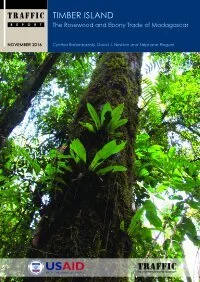
Timber Island: The Rosewood and Ebony Trade of Madagascar

By Cynthia Ratsimbazafy, David J. Newton and Stéphane Ringuet

Madagascar is home to hundreds of endemic rosewood Dalbergia and ebony Diospyros timber species, many of which are in high demand, particularly in Asia, because of their attractive appearance and highly durable properties for carving into furniture and other household items. At least 350,000 trees were illegally felled inside protected areas and at least 150,000 tonnes of logs illegally exported to destinations including China, Malaysia and Mauritius over the five-year period, according to the study: Timber Island: The Rosewood and Ebony Trade of Madagascar. The lack of regulation was compounded by additional factors including widespread poverty, corruption, poor species identification skills at point of harvest and deficient knowledge about timber resources and led to rampant, unregulated felling of precious timber species.

Cambridge, UK: TRAFFIC, 2016. 144p.

download
Siberian and Russian Far East Timber for China: Legal and Illegal Pathways, Players and Trends.

By Anatoly Lebedev

The preservation and sustainable use of Siberian and Russian Far East (RFE) forests is of global importance for a number of reasons. Yet, these forests, which are the traditional environments of many endangered species and indigenous tribes, are now supplying timber to nearby regions and countries that have largely destroyed their own forests. The vast forests of Asian Russia act as reservoirs for oneseventh of the global carbon pool. Russia holds 75 percent of the carbon stored by all of the world’s boreal forests, such that deforestation, after fossil fuel combustion, is the second largest source of carbon dioxide emissions in Russia, as it is worldwide. Properly conserved, Russian forests act as a critical green “lung” for the Earth, second to Brazil’s Amazon. The atmospheric carbon sink process, however, occurs much more slowly in taiga than in the tropical rainforest, as does the process of carbon exportation from organic changes. As a result, this source of carbon storage, after broad-scale commercial logging or forest fires, will also be more slowly restored to its initial function than would be tropical forests.. All across Russia, the past five years have witnessed a revival in domestic timber production, following the collapse of the 1990s, and a drive to achieve the level of volumes extracted during the Soviet period. In the RFE's Primorye Krai (Province), for example, roundwood production rose from 2.2 million cubic meters in 1998 to 3.3 million cubic meters in 2002 and to 3.7 million cubic meters in 2003, and seems to be increasing further under the pressure of growing Chinese and domestic demand. The same trend is exhibited in Khabarovski Krai. Its roundwood production grew from 5 million cubic meters in 1999 to approximately 6.5 million cubic meters in 2002. Iin both Krais there is a clear trend to harvest in formerly reserved, inaccessible, or roadless areas. Not only is the industry, then, launching a sort of "last attack" on formerly used, exhausted, and burnt forests, it is also aggressively pursuing the intact ones, which are already suffering from illegal operations. Expansion of logging and processing capacity over the last 3 to 4 years has not demonstrated a new and improved strategy, but, rather, has resulted in the poor condition found in the remaining commercially available forests and in the constant reduction of timber quality and price.

Washington, DC: Forest Trends, 2005. 48p.

download
Illegal Logging in the Russian Far East: Global Demand and Taiga Destruction

By D.Y. Smirnov, (ed.), A.G. Kabanets, E.A. Lepeshkin, and D.V. Sychikov

Illegal logging of valuable temperate hardwoods has reached crisis proportions in the Russian Far East. Comparative analysis conducted by WWF Russia shows that from the period 2004-2011 the volume of Mongolian oak (the most valuable hardwood species) logged for export to China exceeded authorized logging volumes by 2-4 times. Much of this illegal logging takes place in the habitats of the Amur tiger and leads to their degradation. The materials included in this report are pertinent in the context of new legislation in the European Union, United States and other countries aimed at the exclusion of illegally sourced wood products, given that a signifi cant proportion of the illegal timber logged in the Russian Far East enters such markets in the form of Chinese-manufactured furniture and flooring. This report is applicable for use by public forest agencies, forest industry, NGOs, students and academics and all those who are not indifferent to the fate of Russian forests.

Moscow: World Wildlife Fund Russia, 2013. 43p.

download
The Extent and Causes of Illegal Logging: An Analysis of a Major Cause of Tropical Deforestation in Indonesia

By Charles Palmer

This paper considers the scale and underlying causes of recent high rates of deforestation in Indonesia. Its extent during 1997-98 is analysed using a materials balance model, the results of which demonstrate the seriousness of the problem at a time when the Indonesian economy was suffering the effects of the Asian financial crisis. The behaviour of the principal agents, illegal loggers, is discussed in the context of market and government failures and rent-seeking or corruption. A culture of corruption originated at the top of government during the tenure of ex- President Suharto, leading to market and government failures in the forestry sector, thus resulting in the creation of high levels of rent. A culture of corruption ensures that policy failures cannot be reversed and may lead to further intervention to benefit the status quo. Rent-seeking behaviour then spread to all levels of government, via a lack of good example at the top, leading to the creation of illegal logging networks. Since rent from illegal logging is higher than that for legal logging, there is an incentive for agents to ignore costs associated with sustainable forest management. Illegal logging, and hence inefficient resource use, is further encouraged by institutional failures such as weak enforcement and monitoring capacity, as well as policy failures at the international level too. Consequently, Indonesia’s forests have been intensively deforested for perhaps as long as 30 years, with little or no attention given to sustainable forest management.

London: Centre for Social and Economic Research on the Global Environment, 2001. 33p.

Read/Download

Switching Channels: Wildlife trade routes into Europe and the UK

By David Cowdrey

Illegal wildlife trade routes are difficult to uncover. By their very nature they are covert, sometimes run by organised criminals, and often used to smuggle other commodities such as drugs and guns. This report attempts to uncover some of these complex trade routes into Europe and the UK, as well as the techniques used to smuggle wildlife. It is based on research commissioned by WWF and TRAFFIC, the wildlife trade monitoring network, and independently conducted by the University of Wolverhampton which uses evidence from HM Customs and Excise, the Police and a number of court cases.

Cambridge, UK: TRAFFIC International, 2002. 15p.

download
The Tiger Skin Trail

By Debbie Banks and Julian Newman

This report is a call to action to stop the international illegal trade in tiger and other endangered Asian big cat skins. It draws together information from India, Nepal and China, as source, transit and destination countries. It also highlights the urgent need for governments to improve wildlife crime investigation, analysis, enforcement, communication and cooperation. Parties to the United Nations Convention on International Trade in Endangered Species (CITES) need to demonstrate greater political commitment and treat wildlife crime more seriously. Key range, transit and destination countries need to establish specialised enforcement units capable of combating the organised criminal networks controlling the trade. Professional enforcement agencies need to be involved in ensuring greater cross-border communication and coordination and the international community, both government and non-government, needs to provide adequate technical and financial assistance in mobilising new enforcement initiatives. There can be no doubt that the skin trade is spiralling out of control. On a remote road in the west of the Tibet Autonomous Region (hereafter referred to as Tibet), in October 2003, customs officers at a temporary checkpoint made a startling discovery that lifted the lid on the true scale of the illegal trade in tiger and leopard skins. In a single consignment officers recovered the skins of 31 tigers, 581 leopards and 778 otters. The skins came from India and were on route to Lhasa, capital of Tibet, a major hub for the trade.

London; New York: Environmental Investigation Agency, 2004. 24p.

Read/Download

Eco-Crime and Justice: Essays on Environmental Crime

Edited by Kristiina Kangaspunta; Ineke Haen Marshall

The careless or illegal exploitation of the natural environment is by no means a recent development. Long before former US Vice President Al Gore’s documentary An Inconvenient Truth made the dangers of the nonchalant and predatory use of our planet’s resources painfully real to large audiences, toxic waste was dumped in rivers and oceans, there was clear felling of forests and timber smuggling, and threatened or protected species (both animals and plants) were transported and traded for profit. Some of this took place locally, some of this crossed national borders. Some of this was perfectly legal, and some of this had been declared illegal either by local, national or international statutes. Sometimes the harm done was obvious to even the most casual observer, but very often it was not. Sometimes it was the work of one individual or a small group, but frequently networks or organized crime groups were involved. Occasionally, an individual, community group or NGO voiced their complaint, but more often than not there was a deafening silence. Now the silence has been broken – for reasons we can only speculate about, but which clearly include the ‘greening’ of politics, the emergence of local and global grassroots environmental justice movements, and the growing concern of large corporations with the damaging public relation effects of being viewed as ‘eco-hostile’. A tipping point has been reached where enough voices speak out loud and urgently to place environmental harm as a high priority item on the policy agenda. The publication before you aims to add a strong voice to the debate. The authors hope to contribute to the articulation of a global research agenda on environmental crime; a research agenda based on commitment to the following three principles: (1) Recognition of the value of evidence–based policy-making (over policies based on expediency, political pressures, or purely economic considerations); (2) Willingness to appreciate the importance of theoretical insights drawn from different disciplines to guide policy, and (3) Concern with balancing human and ecological rights. This Introduction provides the context for this effort.

Turin : UNICRI, cop. 2009. 129p.

download
Combating Wildlife Trafficking: Agencies Are Taking a Range of Actions, but the Task Force Lacks Performance Targets for Assessing Progress

By U.S. Government Accountability Office

Illegal trade in wildlife—wildlife trafficking—continues to push some protected and endangered animal species to the brink of extinction, according to the Department of State. Wildlife trafficking undermines conservation efforts, can fuel corruption, and destabilizes local communities that depend on wildlife for biodiversity and ecotourism revenues. This trade is estimated to be worth $7 billion to $23 billion annually. In 2013, President Obama issued an executive order that established the interagency Task Force charged with developing a strategy to guide U.S. efforts on this issue. GAO was asked to review U.S. government efforts to combat wildlife trafficking. This report focuses on wildlife trafficking in Africa, particularly of large animals, and examines, among other things, (1) what is known about the security implications of wildlife trafficking and its consequences, (2) actions Task Force agencies are taking to combat wildlife trafficking, and (3) the extent to which the Task Force assesses its progress. GAO analyzed agency documents and met with U.S. and host country officials in Washington, D.C.; Kenya; South Africa; and Tanzania. What GAO Recommends GAO recommends that the Secretaries of State and the Interior and the Attorney General of the United States, as co-chairs, jointly work with the Task Force to develop performance targets related to the National Strategy for Combating Wildlife Trafficking Implementation Plan. Agencies agreed with GAO’s recommendation.

Washington, GAO, 2016. 58p.

download
International Illegal Trade in Wildlife: Threats and US Policy

By Liana Sun Wyler and Pervaze A. Sheikh

Global trade in illegal wildlife is a growing illicit economy, estimated to be worth at least 5 billion and potentially in excess of 20 billion annually. Some of the most lucrative illicit wildlife commodities include tiger parts, caviar, elephant ivory, rhino horn, and exotic birds and reptiles. Demand for illegally obtained wildlife is ubiquitous, and some suspect that illicit demand is growing. International wildlife smuggling may be of interest to Congress as it presents several potential environmental and national security threats to the United States. Threats to the environment include the potential loss of biodiversity, introduction of invasive species into U.S. ecosystems, and transmission of disease through illegal wildlife trade. National security threats include links between wildlife trafficking and organized crime and drug trafficking. The role of Congress in evaluating U.S. policy to combat wildlife trafficking is broad. Potential issues for Congress include 1 determining funding levels for U.S. wildlife trade inspection and investigation 2 evaluating the effectiveness of U.S. foreign aid to combat wildlife trafficking 3 developing ways to encourage private sector involvement in regulating the wildlife trade 4 using trade sanctions to penalize foreign countries with weak enforcement of wildlife laws 5 incorporating wildlife trade provisions into free trade agreements and 6 addressing the domestic and international demand for illegal wildlife through public awareness campaigns and non-governmental organization partnerships. This report focuses on the international trade in terrestrial fauna, largely excluding trade in illegal plants, including timber, and fish.

Washington, DC: U.S. Congressional Research Service,The Library of Congress, 2008. 52p.

download
Criminal Neglect: Failings in enforcement undermine efforts to stop illegal logging in Indonesia

By Environmental Investigation Agency (EIA) and Kaoem Telapak (KT)

Indonesia’s legal system is failing to act against timber criminals, seriously undermining the country’s top-level efforts to tackle illegal logging and deforestation. New research by EIA and our Indonesian partner Kaoem Telapak reveals that action through the courts was taken against only a handful of companies out of more than 50 proven to have either traded directly or indirectly in illegal timber.

London; Washington, DC: EIA, Bogor, Indonesia: Kaoem Telapak. 2021. 30p.

download
The Italian Job: How Myanmar timber is trafficked through Italy to the rest of Europe despite EU laws

By Environmental Investigation Agency (EIA).

An undercover investigation by the Environmental Investigation Agency has exposed how an entire industry of Italian companies has continued to profit from the sale of valuable timber from Myanmar, even while many other countries have cracked down on the trade and European authorities agree that importing Myanmar timber is a violation of the EU Timber Regulation (EUTR). This trade has been allowed to continue since the military coup in Myanmar of February 2021. When asked, no trader confirmed they would stop importing despite the recent introduction of EU sanctions on the Myanmar Timber Enterprise, the state-owned company that claimed to be the only legal source of timber in the country. The investigation raises serious questions about how Italian and European authorities have allowed the trade to continue, and what action they will take to stop it. Only minimal fines have been imposed on the companies, who have continued to trade despite findings they are breaching the law, and the trade has only continued to increase despite heightened scrutiny on the legal problems with Myanmar timber.

London; Washington, DC: EIA, 2021. 34p.

download
Wildlife and Forest Crime Analytic Toolkit. Revised Edition

By United Nations Office on Drugs and Crime (UNODC)

The present version of the Wildlife and Forest Crime Analytic Toolkit is an initial attempt to provide a comprehensive overview for understanding the main issues related to environmental offences and for analysing preventive and criminal justice responses to wildlife and forest offences in a given country. Efforts have been made to provide a framework through which measures for prevention and response can be analysed and understood as the basis for an effective national response to wildlife and forest offences. The Toolkit is designed mainly to assist government officials in wildlife and forestry administration, Customs and other relevant enforcement agencies. It will help them to conduct a comprehensive analysis of possible means and measures to protect wildlife and forests and monitor their use and thus, to identify technical assistance needs. In this sense, the Toolkit may also be used as training material for law enforcers. In addition, other stakeholders at the international and national levels, as well as civil society, may find the Toolkit useful regarding their daily responsibilities. The Toolkit can be used effectively to address (a) a wide range of wildlife and forest offences, including illegal logging and illegal trade in timber and a lack of adherence to the Convention on International Trade in Endangered Species of Wild Fauna and Flora (CITES) and, (b) the usefulness of the United Nations Convention against Transnational Organized Crime and the United Nations Convention against Corruption.

New York: United Nations, 2012. 212p,

download