Open Access Publisher and Free Library
CRIME+CRIMINOLOGY.jpeg

CRIME

Violent-Non-Violent-Cyber-Global-Organized-Environmental-Policing-Crime Prevention-Victimization

Posts in social sciences
Mexico's Out-Of-Control Criminal Market

By  Vanda Felbab-Brown

  This paper explores the trends, characteristics, and changes in the Mexican criminal market, in response to internal changes, government policies, and external factors. It explores the nature of violence and criminality, the behavior of criminal groups, and the effects of government responses. • Over the past two decades, criminal violence in Mexico has become highly intense, diversified, and popularized, while the deterrence capacity of Mexican law enforcement remains critically low. The outcome is an ever more complex, multipolar, and out-of-control criminal market that generates deleterious effects on Mexican society and makes it highly challenging for the Mexican state to respond effectively. • Successive Mexican administrations have failed to sustainably reduce homicides and other violent crimes. Critically, the Mexican government has failed to rebalance power in the triangular relationship between the state, criminal groups, and society, while the Mexican population has soured on the anti-cartel project. • Since 2000, Mexico has experienced extraordinarily high drug- and crime-related violence, with the murder rate in 2017 and again in 2018 breaking previous records. • The fragmentation of Mexican criminal groups is both a purposeful and inadvertent effect of high-value targeting, which is a problematic strategy because criminal groups can replace fallen leaders more easily than insurgent or terrorist groups. The policy also disrupts leadership succession, giving rise to intense internal competition and increasingly younger leaders who lack leadership skills and feel the need to prove themselves through violence. • Focusing on the middle layer of criminal groups prevents such an easy and violent regeneration of the leadership. But the Mexican government remains   deeply challenged in middle-layer targeting due to a lack of tactical and strategic intelligence arising from corruption among Mexican law enforcement and political pressures that makes it difficult to invest the necessary time to conduct thorough investigations. • In the absence of more effective state presence and rule of law, the fragmentation of Mexican criminal groups turned a multipolar criminal market of 2006 into an ever more complex multipolar criminal market. Criminal groups lack clarity about the balance of power among them, tempting them to take over one another’s territory and engage in internecine warfare. • The Mexican crime market’s proclivity toward violence is exacerbated by the government’s inability to weed out the most violent criminal groups and send a strong message that they will be prioritized in targeting......

Washington, DC: Brookings Institution, 2019. 29p.

download
Building Resilience to Organised Crime: A Policy Review

By Yvon Dandurand, Lucia Bird Ruiz Benitez de Lugo, Kingsley Madueke and Oumar Zombre  

  State-centric approaches to building resilience to organised crime must be complemented with community-based, context-specific responses that challenge organised crime and violence at a local level. Local communities are key elements of the necessary response to the destabilising impacts of organised crime in conflict as well as post-conflict settings. There remains a gap in stakeholder understanding of the elements of community resilience to organised crime, particularly in unstable settings. This report starts to address this gap, by analysing key drivers of community resilience – identified as social capital, community capacity, the role of women, economic capital and infrastructure – in four communities in Nigeria, Guinea-Bissau and Burkina Faso.   

Institute for Security Studies,  2022. 44p.

download
The Responsiveness of Criminal Networks to Intentional Attacks: Disrupting darknet drug trade

ByScott Duxbury and Dana L. Haynie

Physical, technological, and social networks are often at risk of intentional attack. Despite the wide-spanning importance of network vulnerability, very little is known about how criminal networks respond to attacks or whether intentional attacks affect criminal activity in the long-run. To assess criminal network responsiveness, we designed an empirically-grounded agent-based simulation using population-level network data on 16,847 illicit drug exchanges between 7,295 users of an active darknet drug market and statistical methods for simulation analysis. We consider three attack strategies: targeted attacks that delete structurally integral vertices, weak link attacks that delete large numbers of weakly connected vertices, and signal attacks that saturate the network with noisy signals. Results reveal that, while targeted attacks are effective when conducted at a large-scale, weak link and signal attacks deter more potential drug transactions and buyers when only a small portion of the network is attacked. We also find that intentional attacks affect network behavior. When networks are attacked, actors grow more cautious about forging ties, connecting less frequently and only to trustworthy alters. Operating in tandem, these two processes undermine long-term network robustness and increase network vulnerability to future attacks.

  PLoS ONE 15(9):  2020.  

download
Why Incorporating Organised Crime into Analysis of Elite Bargains and Political Settlement Matters:  Understanding prospects for more peaceful, open and inclusive politics 

By Alina Rocha Menocal

  This paper argues that political settlements analysis and an understanding of elite bargains need to incorporate a deeper and more systematic exploration of serious organised crime (SOC), since this affects critical elements related to the nature and quality of elite bargains and political settlements. In particular, the paper examines how SOC affects these issues – from the elites that constitute a bargain or settlement, to violence and stability, to ‘stateness’, or the extent to which a state is anchored in society, state capacity and political will, to legitimacy and electoral politics. The paper draws on insights from a rich body of research on organised crime and its impacts on conflict, violence, governance and development to articulate how SOC can be more thoroughly integrated into research focused on political settlements and/or elite bargains to enhance its analytical depth, quality and accuracy. The paper also outlines lessons and implications that may guide further reflection in conflict and development circles on the nexus between organised crime, elite bargains and political settlements from a thinking and working politically perspective.  

SOC ACE Research Paper No. 15. Birmingham, UK: University of Birmingham. 2022. 41p.

download
Global Shell Games

By Michael G. Findley, Daniel L. Nielson & J. C. Sharman

Every year a staggering number of unidentified shell corporations succeed in hiding perpetrators of terrorist financing, corruption and illegal arms trades, but the degree to which firms flout global identification standards remains unknown. Adopting a unique, experimental methodology, Global Shell Games attempts to unveil the sordid world of anonymous shell corporations. Posing as twenty-one different international consultants, the authors approached nearly 4,000 services in over 180 countries to discover just how easy it is to form an untraceable company. Combining rigorous quantitative analysis, qualitative investigation of responses and lurid news reports, this book makes a significant research contribution to compliance with international law and international crime and terrorism whilst offering a novel, new approach to the field of political science research.

Cambridge, UK; New York: Cambridge University Press, 2014. 250p.

read
Investigating The Russian Mafia

By Joseph D. Serio

In the 1990s, the so-called Russian mafia dominated newspaper headlines, political analysis, and academic articles around the world. It was the new scourge, a threat so massive that it was believed to hold the Russian economy hostage. Former FBI Director Louis Freeh announced that the Russian mafia was a significant threat to the national security of the United States.

Before the end of the decade, Director Freeh reversed himself, saying that in reality the magnitude of the danger from the Russian mafia had been overestimated. Heading into the new millennium, the international hue and cry about gangsters from the former Soviet Union subsided dramatically, particularly after the terrorist attacks of September 11. Al-Qaeda shifted the spotlight from organized crime to terrorism and U.S. homeland security. Has the Russian mafia been eradicated or has it simply fallen below the radar?

Countless books and articles have reported on the Russian mafia in breathless terms bordering on hysteria. Casting a broad net, Serio brings a different, more analytical approach to his exploration of the subject. In Investigating the Russian Mafia, Part I begins by asking a series of basic questions: What did the Soviets understand 'mafia' to mean? Was this a Russian phenomenon or more broadly-based, multi-ethnic groups? How did the media influence the perception of the Russian mafia? What does a close examination of the official statistics reveal about the nature of crime groups in the former Soviet Union?

In Part II, Serio discusses an overview of attitudes and practices of the criminal world, business, and policing, among others, in Russian history. He demonstrates that many of the forces at work in the 1990s did not originate in the Communist era or arise because of the collapse of the USSR. Part III presents a discussion of the crime groups that developed in the post-Soviet era, the challenges that faced the business world, and the law enforcement response.

Durham, NC: Carolina Academic Press, 2008. 324p.

read
King of the Godfathers

By Anthony DeStefano

He was the last of his kind-an old-world mob boss steeped in omert , the mob code of silence. While his arrogant friend John Gotti was being secretly recorded by the FBI, Joseph Massino, head of the Bonanno family, quietly became known as "The Ear" by ordering his men to point to their ear instead of saying his name out loud.

For more than twenty years Massino ran what was called the largest criminal network in the U.S., employing over 250 made men and untold numbers of associates. The Bonanno family was responsible for over 30 murders, even killing a dozen of its own members to settle scores. Massino ran a tight organization, obsessively checking his social club for bugging devices, frustrating FBI surveillance. But in the end Massino would be brought down from the inside, by the underboss who was not only his closest and most trusted friend—but a member of his blood family.

Based on exclusive interviews with Massino's family and closest associates, as well as law enforcement officials and confidential sources, The Last Godfather is an epic inside story from Pulitzer Prizewinning reporter Anthony DeStefano.

New York: Kensington Publishing, 2006. 351p.

read
Trajectories of Handgun Carrying in Rural Communities From Early Adolescence to Young Adulthood

This study found distinct patterns of handgun carrying from adolescence to young adulthood in rural settings. Findings suggest that promoting handgun safety in rural areas should start early. Potential high-risk trajectories, including carrying at high frequencies, should be the focus of future work to explore the antecedents and consequences of handgun carrying in rural areas.

JAMA Netw Open. 2022 Apr 1;5(4):e225127. doi: 10.1001/jamanetworkopen.2022.5127. PMID: 35377427; PMCID: PMC8980900.

read/download
Trends and Disparities in Firearm Fatalities in the United States, 1990-2021

Firearm fatality rates in the United States have reached a 28-year high. Describing the evolution of firearm fatality rates across intents, demographics, and geography over time may highlight high-risk groups and inform interventions for firearm injury prevention.

Objective: To understand variations in rates of firearm fatalities stratified by intent, demographics, and geography in the US.

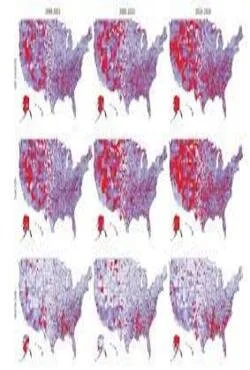
Design, setting, and participants: This cross-sectional study analyzed firearm fatalities in the US from 1990 to 2021 using data from the Centers for Disease Control and Prevention. Heat maps, maximum and mean fatality rate graphs, and choropleth maps of county-level rates were created to examine trends in firearm fatality rates by intent over time by age, sex, race, ethnicity, and urbanicity of individuals who died from firearms. Data were analyzed from December 2018 through September 2022.

Main outcomes and measures: Rates of firearm fatalities by age, sex, race, ethnicity, urbanicity, and county of individuals killed stratified by specific intent (suicide or homicide) per 100 000 persons per year.

Results: There were a total of 1 110 421 firearm fatalities from 1990 to 2021 (952 984 among males [85.8%] and 157 165 among females [14.2%]; 286 075 among Black non-Hispanic individuals [25.8%], 115 616 among Hispanic individuals [10.4%], and 672 132 among White non-Hispanic individuals [60.5%]). All-intents total firearm fatality rates per 100 000 persons declined to a low of 10.1 fatalities in 2004, then increased to 14.7 fatalities (45.5% increase) by 2021. From 2014 to 2021, male and female firearm homicide rates per 100 000 persons per year increased from 5.9 to 10.9 fatalities (84.7% increase) and 1.1 to 2.0 fatalities (87.0% increase), respectively. Firearm suicide rates were highest among White non-Hispanic men aged 80 to 84 years (up to 46.8 fatalities/100 000 persons in 2021). By 2021, maximum rates of firearm homicide were up to 22.5 times higher among Black non-Hispanic men (up to 141.8 fatalities/100 000 persons aged 20-24 years) and up to 3.6 times higher among Hispanic men (up to 22.8 fatalities/100 000 persons aged 20-24 years) compared with White non-Hispanic men (up to 6.3 fatalities/100 000 persons aged 30-34 years). Males had higher rates of suicide (14.1 fatalities vs 2.0 fatalities per 100 000 persons in 2021) and homicide (10.9 fatalities vs. 2.0 fatalities per 100 000 persons in 2021) compared with females. Metropolitan areas had higher homicide rates than nonmetropolitan areas (6.6 fatalities vs 4.8 fatalities per 100 000 persons in 2021). Firearm fatalities by county level increased over time, spreading from the West to the South. From 1999 to 2011 until 2014 to 2016, fatalities per 100 000 persons per year decreased from 10.6 to 10.5 fatalities in Western states and increased from 12.8 to 13.9 fatalities in Southern states.

Conclusions and relevance: This study found marked disparities in firearm fatality rates by demographic group, which increased over the past decade. These findings suggest that public health approaches to reduce firearm violence should consider underlying demographic and geographic trends and differences by intent.

JAMA Netw Open. 2022 Nov 1;5(11):e2244221. doi: 10.1001/jamanetworkopen.2022.44221. PMID: 36445703; PMCID: PMC9709653.

read/download
Murder & Extremism in the United States in 2022

By Pitcavage, Mark

From the document: "[1] Every year, individuals with ties to different extreme causes and movements kill people in the United States; the ADL [Anti-Defamation League] Center on Extremism (COE) tracks these murders. Extremists regularly commit murders in the service of their ideology, in the service of a group or gang they may belong to, or even while engaging in traditional, non-ideological criminal activities. [2] In 2022, domestic extremists killed at least 25 people in the U.S., in 12 separate incidents. […] [3] The 2022 murder totals would have been much lower if not for two high-casualty extremist-related shooting sprees. Only 10 of the 25 deaths occurred outside of those sprees--and one of those 10 deaths occurred in a less lethal mass shooting attempt. [4] The issue of extremist-related mass killings is of growing concern and is the subject of a special section of this report. […] The Center on Extremism has identified 62 extremist-connected mass killing incidents since 1970, with 46 of them being ideologically motivated. […] [5] In 2022, 18 of the 25 extremist-related murders appear to have been committed in whole or part for ideological motives, while the remaining seven murders either have no clear motive or were committed for a non-ideological motive. [6] All the extremist-related murders in 2022 were committed by right-wing extremists of various kinds, who typically commit most such killings each year but only occasionally are responsible for all (the last time this occurred was 2012). […] [7] White supremacists commit the greatest number of domestic extremist-related murders in most years, but in 2022 the percentage was unusually high: 21 of the 25 murders were linked to white supremacists." This document includes charts, tables, and graphs to illustrate the text.

Anti-Defamation League. 2022

download
Trends, Risks, and Interventions in Lethal Violence: Proceedings of the Third Annual Spring Symposium of the Homicide Research

Edited by Carol Block and Richard Block

Papers examining recent and long-term trends in homicide in the United States discuss the relationships among youth violence, guns, and drug law offenses; age patterns in homicide; arrest trends and the impact of demographic changes; and the use of econometric forecasting to correct for missing data. Papers on international and regional violence patterns discuss trends in violence and homicide in the Netherlands and the southern subculture of violence. Nine papers on high-risk groups focus on violence and homicide against women and youth and in different types of workplaces, particularly convenience stores. Five papers focus on intervention strategies based on data analysis; topics include criminal justice sanctions for domestic assault, gun-related violence, violence in public schools in Atlanta, the impacts of exposure to violence on the behavior of inner-city youths and the impact of guidance and employment for adolescents. Further papers consider the use of the National Incident-Based Reporting System and the violence surveillance activities of the Centers for Disease Control. Figures, tables, sample data collection instruments and forms, footnotes, reference lists, and appended conference agenda and lists of participants and working group members

Washington D.C. US Department of Justice. Atlanta, Georgia. 1995. 349p.

read
Shared Skies:Convergence of wildlife trafficking with other illicit activities in the aviation industry

By Ben Spevack

Shared Skies contains new research, carried out by C4ADS, exploring the overlap of methods and routes used in wildlife trafficking and other illicit smuggling crimes such as drugs and weapons. Using this analysis, it gives recommendations to aviation and enforcement agencies on how to strengthen mitigation of wildlife trafficking and the wider spectrum of transnational crime.

An assessment of the routes, networks and methods used for trafficking wildlife and other illicit goods such as drugs and weapons between 2015-2019 shows a high degree of interconnection, which if addressed could prove hugely beneficial to disrupting illicit activities.

Our previous report, Runway to Extinction, touched on the idea that non-wildlife trafficking operations exploit the same vulnerabilities in systems of communication, finance and transport as wildlife traffickers. By taking a closer look at the points of convergence between illicit trades, Shared Skies identifies five levels at which this convergence may occur: shipment, organization, route, hub (such as an airport or city) and jurisdiction, and advises on how this information can be leveraged to disrupt criminal activities across aviation.

The recommendations fall into three broad categories: improving collection and reporting of seizure data; increasing collaboration between aviation and enforcement stakeholders in addressing convergence; and refining mitigation activities to address all illicit commodity types.

Washington, DC: Center for Advanced Defense Studies, 2021. 21p.

read/download
Hitler's First Victims: The Quest for Justice

By Timothy W. Ryback.

From the cover: “Ryback’s account is gripping—and thoroughly chilling—as it provides a snapshot of a moment when the Nazis still required a veil of legality. . . . Diligently researched works such as this are as necessary now as they were decades ago, to keep both memory and vigilance alive." —The Telegraph (London). "Has all the makings of a legal thriller ” —The Boston Globe. "Valuable. . . . Turns the spotlight on the rapid erosion of state power in the early months of Nazi rule. . . . Ryback’s vivid narrative of an ordinary German lawyer's experience makes this feel much more immediate, bringing home the terrible realities of early Nazification.” —The Times Higher Education (London)

NY. Vintage Random House. 2014. 290p.

read
Garden State Gangland: The Rise of the Mob in New Jersey

By Scott M. Deitche

From Chapter 1: To trace the start of traditional organized crime (the mob, the syndicate, the Mafia) in New Jersey, you could begin in a few cities around the state where new immigrant groups at the turn of the twentieth century fell victim to extortion gangs and police indifference. It was in these tight-knit immigrant neighborhoods where the strands and threads of organized-crime groups began. But if there was one focal point, one birthplace where originated the larger, more influential crime figures who would shape both the underworld and overall history of the state through much of the twentieth century, it would be Newark.

London. Rowman & Littlefield. 2018. 299p.

read
Bandits

By Eric Hobsbawm

“Two brief methodological notes. First, it will be clear that I have tried to explain why social banditry is so remarkably uniform a pheno­menon throughout the ages and continents. Can this explanation be tested? Yes, insofar as it predicts, broadly speaking, how bandits will act and what stories people will tell about them in areas hitherto un­studied. The present essay elaborates the ‘model’ originally sketched out in my Primitive Rebels, which was based exclusively on European - mostly Spanish and Italian - material, but does not, I hope, conflict with it. Still, the wider the generalization, the more likely it is that individual peculiarities are neglected. Second, I have relied largely on a rather tricky historical source namely poems and ballads. So far as the facts of banditry are concerned, these records of public memory and myth are of course quite unreliable, however remotely based on real events, though they give much inci­dental information about the social environment of banditry, at least insofar as there is no reason why this should be distorted. But there is a more serious difficulty. How far does the ‘myth' of banditry throw light on the real pattern of bandit behaviour? In other words, how far do bandits live up to the social role they have been assigned in the drama of peasant life ? There is plainly some connection. I hope that in formulating it I have not gone beyond the bounds of common sense.”

London. George Wedenfield & Nicolson Ltd. 1969. 157p.

download
An Empirical Assessment of Homicide and Suicide Outcomes with Red Flag Laws

By Rachel Delafave

This Article empirically illustrates that red flag laws—laws which permit removal of firearms from a person who presents a risk to themselves or others—contribute to a statistically significant decrease in suicide rates, but do not influence homicide rates. I exploit state-level variation across time in the existence of red flag laws between 1990 and 2018 and find that the existence of a risk-based law reduces firearm-related suicides by 6.4% and overall suicides by 3.7%, with no substitution to non-firearm suicides. Red flag laws are not associated with a statistically significant change in homicides rates. Policymakers should consider red flag laws an effective tool to prevent firearm-related suicide, one of the most prevalent preventable causes of death in the United States. In light of this evidence, red flag laws should be more politically successful in the current partisan environment than other forms of gun control legislation because of their targeted nature and potential to balance the interests of gun owners against the negative externalities of gun violence.

52 Loy. U. Chi. L. J. 867 (2021)

download
Online African Organized Crime from Surface to Dark Web

By INTERPOL and ENACT Africa

With the increase in Internet coverage, online trade of illicit goods is likely increasing on the African continent. In recent years, cyber-enabled crimes have increased on the African continent. This has been a result of a combination of factors, including, the improvement of Internet coverage, the wide availability of cyber-tools and the growing flexibility of cybercriminals. As a consequence, online crime nowadays represents a bigger security issue for law enforcement in African member countries than ever before. In this framework, INTERPOL, under the European Union funded ENACT Project, examines through this assessment the issue of cyber and cyber-enabled crimes in Africa in order to help drive a more strategic law enforcement response.

Lyon, France: INTERPOL; ENACT AFRICA, 2020. 79p.

download
Pandemic, Social Unrest, and Crime in U.S. Cities

By Richard Rosenfeld and Ernesto Lopez:   National Commission on COVID-19 and Criminal Justice

This study is the fifth in a series of reports exploring pandemic-related crime changes for the National Commission on COVID-19 and Criminal Justice. Updating that earlier work, this analysis reveals both increases and decreases in crime rates in a sample of United States cities during the first quarter of 2021 compared with the first quarter of 2020. Homicides, aggravated and gun assaults, and motor vehicle thefts increased, while residential burglaries, nonresidential burglaries, larcenies, and drug offenses fell. The timing of the declines in burglaries, larcenies, and drug crimes coincided with the stay-at-home mandates and business closings that occurred in response to the pandemic. Quarantines reduced residential burglary. When businesses are closed, there is no shoplifting. Selling drugs on the street is more difficult when there are fewer people on the street, and drug arrests fall when police reduce drug enforcement because they have prioritized other activities. Our findings show that there was a 26% increase in motor vehicle thefts in the first quarter of 2021 compared to the same period in the previous year, even as other property crimes declined. Motor vehicle thefts may have risen during the pandemic as more people left their vehicles unattended at home rather than in secure parking facilities at work.  

Washington, DC: Council on Criminal Justice, 2021. 

download
Virus-proof Violence: Crime and COVID-19 in Mexico and the Northern Triangle

By The International Crisis Group

Criminal groups in Mexico and the Northern Triangle of Central America (El Salvador, Guatemala and Honduras) have been quick to absorb the shock of the COVID-19 pandemic and seize new opportunities provided by lockdowns, distracted states and immiserated citizens. At first, trade disruptions and movement restrictions forced some criminal outfits to slow illicit activities. But the lull has not lasted. Exchange of illicit goods already appears to be swinging back to normal, while extortion rackets are resurging. As the region’s recent history shows, quick fixes to rein in organised crime and official corruption are very likely to be counterproductive. Instead, governments should concentrate their limited resources to aid the most violent regions and vulnerable people, ideally through regional programs to curb impunity and create alternatives to criminal conduct. After months of lockdowns of varying severity, with disease transmission still uncontrolled and poised to spike again, the threat of rising crime across the region is manifest. Mexico has been afflicted for years by transnational criminal organisations that feed off a lack of economic opportunity and corruption in the state and security forces. The new force in the underworld, the Jalisco Cartel New Generation, has bared its teeth during the pandemic in fights for control of illicit markets such as drug trafficking and “taxing” legal commodities. It has also displayed its paramilitary might in the media. Myriad criminal groups have claimed to be lifelines for local people, largely in bids to widen their support base. Across the north of Central…..

  • America, street gangs that have lorded it over their economically struggling strongholds for years have also found ways to take advantage of the pandemic. After the outbreak, they advertised themselves as champions of communities under lockdown, handing out food baskets and forgiving protection payments. Due to COVID-19 movement restrictions, violence fell briefly in Honduras and Guatemala. But it is now back to or above pre-pandemic levels, while extortion rackets in both countries appear set to intensify. El Salvador is an outlier in that murder rates have stayed close to historical lows for reasons that remain disputed. The government says its security plan has kept violent gangs at bay, while Crisis Group has suggested that gang and government leaders may have struck an informal agreement to scale back violence. But, if such a pact exists, neither side has acknowledged it in public, and sudden spates of killings underline that gangs’ commitment to peace is far from robust. Behind concerns about deteriorating security in Mexico and northern Central America is the realisation that the pandemic (and counter-measures) will worsen the economic and institutional ills underlying the crime wave. The incidence of COVID-19 varies from country to country, but it is hard to imagine that any will avoid a negative impact on livelihoods, public services and the popular mood. Mexico ranks fourth worldwide with its officially reported death toll of over 90,000 – which the government admits is an undercount – while rates of infection in northern Central America stand around the Latin American average. Nonetheless, all four countries are now facing one of the most severe economic contractions in decades, made worse in Central America by the recent devastation left by Hurricane ETA. Expected falls in 2020 GDP, reaching close to 10 per cent in Mexico and El Salvador and causing unemployment to soar across the region, are set to reverse advances in reducing inequality and poverty, weaken public services in poor areas, intensify criminal rivalries and sharpen officials’ motives for consorting with illicit business. 

Brussels:  International Crisis Group, 2020. 37p.

download
Findings from the Violence Outcomes in COVID-19 Era Study (VoCes-19): Baseline Results

By Larrea-Schiavon, Silvana, Lina López-Lalinde, Isabel Vieitez Martínez, Ricardo Regules, Juan Pablo Gutiérrez, René Nevárez, Cristina Mac Gregor, Pablo López, Nicole Haberland, and Thoai Ngô

This report presents findings from the baseline survey of the Violence Outcomes in COVID-19 Era Study (VOCES-19). The study, conducted by Population Council Mexico in collaboration with the National Institute of Youth and the National Center for Gender Equity and Reproductive Health aims to understand the impact of the COVID-19 pandemic and accompanying mitigation measures on the experience and perception of violence among 15–24-year-olds living in Mexico, as well as its effects on other social, economic, and health, related outcomes. The primary objectives for this first survey round were to gather baseline information on several outcomes of interest, assess differential effects by gender, ethnicity, and socioeconomic status, and establish a cohort of adolescents and young adults to measure the impact of the pandemic on young people in Mexico over time.

Mexico: Population Council, 2021. 153p.

download