
The World Set Free
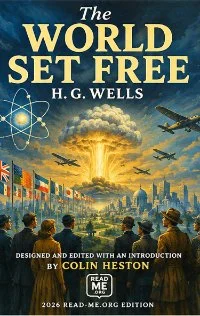
by H.G. Wells. Edited with an Introduction by Colin Heston.
In 1914 H. G. Wells imagined the atomic bomb—and a world forced to confront what such a weapon would mean.
Among Wells’s extraordinary works of scientific speculation, The World Set Free occupies a unique place. Written in 1913 and published in 1914, the novel imagined the release of atomic energy and weapons Wells explicitly called “atomic bombs” decades before Hiroshima and Nagasaki.
But Wells was interested in far more than predicting a new weapon.
Beginning with humanity’s long struggle to harness energy, the novel moves toward the discovery of practical atomic power—and then toward catastrophe. The new energy promises abundance on an unprecedented scale, but nations quickly transform scientific achievement into military power. Atomic war follows, devastating cities and demonstrating that the traditional international order can no longer survive the destructive capacities science has placed in human hands.
From that destruction Wells develops his larger and more controversial argument. If technology has made war potentially catastrophic for civilization itself, must humanity eventually abandon competing sovereign states and construct some form of world government?
The World Set Free is therefore simultaneously scientific romance, future history, political argument, and warning.
Its historical significance is remarkable. Physicist Leó Szilárd, who later played an important role in the development of nuclear physics and the history of the atomic bomb, acknowledged Wells’s novel as an influence on his thinking about atomic chain reactions.
Yet the book’s greatest interest today may lie in the question Wells asks beyond the bomb itself: Can humanity develop political institutions rapidly enough to control the destructive technologies its scientists create?
The uploaded Read-Me.Org edition includes Wells’s important 1921 preface, in which he reconsidered his predictions after the catastrophe of the First World War.
More than a century after Wells wrote it, The World Set Free remains an extraordinary encounter between science fiction and history—a novel that did not merely imagine atomic warfare but helped place the idea into the intellectual world from which the nuclear age eventually emerged.Read-Me.Org Inc. New York-Philadelphia-Australia. 2026. 216p.