Open Access Free Library
Fiction+Mediajpg.jpg

FICTION and MEDIA

CRIME AND MEDIA — TWO PEAS IN A POD

Posts in religion
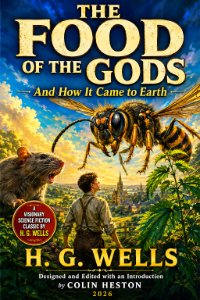
The Food of the Gods and How It Came to Earth

by H.G. Wells. Edited with an Introduction by Colin Heston.

What happens when science makes life bigger—but the world refuses to grow with it?

In The Food of the Gods and How It Came to Earth, H. G. Wells transforms a seemingly absurd scientific experiment into a sweeping and surprisingly modern story about progress, fear, power, and humanity’s resistance to change.

Two scientists, Mr. Bensington and Professor Redwood, develop an extraordinary substance—Herakleophorbia, soon known simply as “the Food”—capable of producing astonishing growth. Intended as little more than an improved food supply, their invention quickly escapes the laboratory. The consequences are spectacular: gigantic plants, monstrous wasps, enormous rats, and eventually human children who grow to dimensions that make ordinary society seem absurdly small.

At first, the giants are treated as curiosities and inconveniences. But as the children mature, their extraordinary strength and intelligence threaten a civilization constructed—physically, politically, and socially—for smaller people. The new generation can lift enormous weights, cross great distances, and contemplate achievements beyond the abilities of ordinary humanity.

Fear soon becomes political. Caterham, the self-proclaimed “Jack the Giant-killer,” rises to power as hostility toward the giants intensifies. Laws restrict their movement, society demands their submission, and the conflict between the old world and the new moves inexorably toward confrontation.

First published in book form in 1904, The Food of the Gods is one of Wells’s most imaginative works of speculative fiction—a novel he described as a “fantasia on the change of scale in human affairs.”Beneath its giant insects, colossal children, scientific mishaps, and dark comedy lies a serious question: When something new outgrows the society that created it, should humanity suppress it—or make room for the future?

This Read-Me.Org Classic Reprint preserves the novel’s original three-book structure and presents Wells’s remarkable vision for a new generation of readers. It includes a new Introduction by Colin Heston.

A classic of early science fiction filled with giant creatures, scientific catastrophe, political satire, social conflict—and H. G. Wells’s unmistakable fascination with the terrifying possibilities of the future.

.Read-Me.Org Inc. New York-Philadelphia-Australia. 2026. 176p.
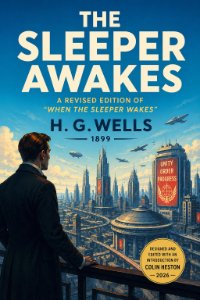
The Sleeper Awakes

by H.G. Wells. Edited with an Introduction by Colin Heston.

What if you fell asleep—and awoke more than two hundred years later to discover that you owned the world?

Graham, an exhausted nineteenth-century man, falls into a mysterious cataleptic trance. When at last he awakens, London has become an immense mechanized metropolis of moving walkways, towering structures, mass communications and flying machines. But the greatest shock is not technological. During his extraordinary sleep, Graham's modest fortune has multiplied through compound interest until he has become the richest man alive—and, at least in name, the Master of the World.

Yet ownership is not power. Graham discovers that a ruling Council has governed in his name while millions of ordinary people live under a rigid system of economic and political control. His awakening threatens the entire structure. Revolution erupts, and Graham is forced to choose between the calculating Ostrog, who believes the masses must be controlled, and a population determined to overthrow its masters.

First published in 1899 as When the Sleeper Wakes, Wells substantially revised the novel in 1910 under the title The Sleeper Awakes. He removed much of the original romantic subplot, tightened the later chapters, reconsidered the story's flying machines, and gave the struggle between rulers and ruled a darker and more ambiguous conclusion.

More than a century later, Wells's vision remains startling. Concentrated wealth, manipulation of public opinion, mass entertainment, technological surveillance, economic inequality and political elites who claim to know what is best for the people make The Sleeper Awakes one of the great precursors of modern dystopian fiction.

This new Read-Me.Org edition presents Wells's revised text, newly reset and lightly corrected for typographical consistency, while retaining the language and character of the original. It also includes a new Introduction by Colin Heston and five public-domain period illustrations by Henri Lanos, the celebrated illustrator of the original 1899 publication.

For readers of The Time Machine, The War of the Worlds, Nineteen Eighty-Four, Brave New World and other classics of speculative and dystopian fiction, The Sleeper Awakes reveals H. G. Wells not merely as a prophet of technology, but as a remarkably prescient critic of wealth, power and the politics of the modern mass society.

Read-Me.Org Inc. New York-Philadelphia-Australia. 2026. 174p.

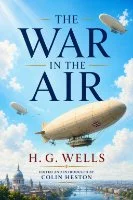
The War In The Air

by H.G. Wells. Edited with an Introduction by Colin Heston.

H. G. Wells imagined the nightmare of modern aerial warfare before the modern airplane had truly arrived.

First published in 1908, The War in the Air: And Particularly How Mr. Bert Smallways Fared While It Lasted is one of Wells’s most startling works of speculative fiction—a sweeping story of technological progress, global conflict, and the terrifying consequences of inventions that humanity may be clever enough to create but not wise enough to control.

Bert Smallways is no soldier, statesman, or scientific genius. He is an ordinary, ambitious young bicycle mechanic whose enthusiasm for the new age of machines leads him into an extraordinary adventure. By accident, Bert finds himself swept into the world of experimental aviation and then carried aboard a German aerial armada crossing the Atlantic to attack the United States.

What begins with the excitement and comedy of early flight rapidly becomes something much darker.

Wells imagines fleets of gigantic airships, military aeroplanes, battles fought above oceans and cities, the destruction of New York, international retaliation, and finally a conflict so widespread that the political, commercial, and technological foundations of civilization begin to collapse.

Written years before the First World War demonstrated the military importance of aviation, The War in the Air is remarkable for the questions it asks. What happens when technological change moves faster than political institutions can respond? Can a weapon that can destroy an enemy actually secure victory? What becomes of civilians when the battlefield expands into the sky above their homes? And what happens when every great power possesses the ability to strike beyond traditional frontiers?

Yet this is not simply a novel of machines and warfare. At its center is Bert Smallways—bewildered, resourceful, comic, frightened, and unmistakably human—trying to survive a catastrophe whose causes are far beyond his understanding or control.

More than a century after its first appearance, Wells’s warning has lost little of its force. Aircraft, missiles, nuclear weapons, drones, cyberwarfare, and autonomous military technologies have changed the instruments, but the fundamental problem remains: human beings continually acquire new powers before they have necessarily acquired the wisdom to govern them.

This new Read-Me.Org Classic Reprint reproduces Wells’s historic novel in a freshly reset edition, supplemented by period public-domain aviation illustrations and a new Introduction by Colin Heston that places the book in its historical setting while examining its continuing relevance to warfare, technology, and the uncertain future of civilization.

A classic of early science fiction, future-war literature, and political prophecy, The War in the Air remains both a gripping adventure and one of H. G. Wells’s most disturbing warnings about the price of uncontrolled progress.

.Read-Me.Org Inc. New York-Philadelphia-Australia. 2026. 210p.

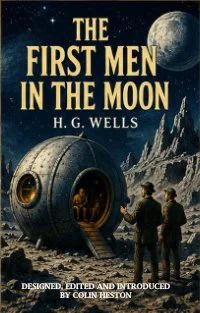
The First Men in the Moon

by H.G. Wells. Edited with an Introduction by Colin Heston.

H. G. Wells takes humanity beyond Earth in one of the earliest—and still one of the most imaginative—novels of lunar exploration.

When the eccentric scientist Mr. Cavor invents Cavorite, an extraordinary substance capable of shielding matter from gravity, his commercially minded neighbor Mr. Bedford immediately recognizes its possibilities. Together they construct a spherical spacecraft and embark upon an experiment that carries them farther than either man intended: all the way to the Moon.

But Wells's Moon is no lifeless wilderness. Beneath its strange surface lies an enormous subterranean world of caverns, vegetation and astonishing forms of life. Most remarkable of all are the Selenites, an advanced insect-like civilization whose society has developed along principles utterly different from those of humanity.

What begins with the exuberance of scientific discovery gradually becomes something much more unsettling. Bedford sees opportunity, wealth and conquest; Cavor seeks knowledge and understanding. Their reactions to the Selenites allow Wells to turn the adventure back upon its readers. Who, after all, is truly alien? What happens when one civilization encounters another that it neither understands nor controls? And what might an intelligent extraterrestrial species conclude after learning about human warfare, greed and empire?

First published in book form in 1901, The First Men in the Moon was the culmination of the extraordinary sequence of scientific romances that included The Time Machine, The Island of Doctor Moreau, The Invisible Man and The War of the Worlds. It combines humor, adventure, speculation and social criticism with an imaginative vision of extraterrestrial life that helped shape modern science fiction.

This Read-Me.Org Classic Reprint presents Wells's original narrative for a new generation of readers, together with an introduction placing the novel in its literary and historical setting. The edition preserves Wells's extraordinary mixture of Victorian adventure and remarkably modern speculation about alien intelligence, specialization, colonialism and humanity's place in the universe.

A classic voyage beyond Earth—and an encounter with a world stranger, larger and more sophisticated than its human visitors ever imagined.

Read-Me.Org Inc. New York-Philadelphia-Australia. 2026. 184p.

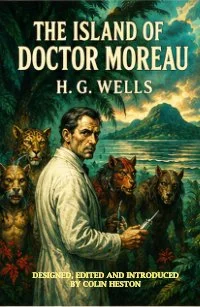
The Island Of Doctor Moreau

by H.G. Wells. Edited with an Introduction by Colin Heston.

What separates the human being from the animal—and what happens when science attempts to erase the boundary?

Shipwrecked and close to death, Edward Prendick is rescued from the Pacific and carried aboard a strange schooner transporting an assortment of animals to an unnamed island. His relief at surviving soon gives way to suspicion. The island is inhabited by the mysterious Doctor Moreau, a brilliant scientist whose notorious experiments forced him to abandon civilized society.

Then Prendick discovers what Moreau has been doing.

Hidden within the island is the terrible House of Pain, where Moreau has attempted to transform animals into beings resembling men and women. His creations walk upright, speak, obey commandments and struggle to suppress their animal instincts. They call themselves the Beast Folk.

And they live according to the Law.

First published in 1896, The Island of Doctor Moreau followed The Time Machine and became one of H. G. Wells's most disturbing scientific romances. Written during the fierce Victorian controversy surrounding vivisection and experimental biology, the novel pushes scientific ambition to its most horrifying conclusion. Moreau is not simply a conventional mad scientist. He is more frightening than that: an intelligent investigator who has convinced himself that knowledge justifies suffering and that scientific curiosity need recognize no moral boundary.

Yet Wells's real target extends far beyond the laboratory. The Beast Folk imitate humanity through speech, ritual, prohibition and fear. When Moreau's authority begins to collapse, so does the Law that has restrained them. The resulting nightmare forces Prendick to confront an even more disturbing possibility—that civilization itself may be only a thin covering over humanity's own animal inheritance.

More than a century after its publication, the questions raised by Doctor Moreau have become more rather than less provocative. Genetic engineering, biotechnology, animal experimentation and the power of scientists to manipulate living organisms give Wells's nightmare a striking contemporary resonance.

Part science fiction, part Gothic horror and part philosophical investigation, The Island of Doctor Moreau asks questions that remain profoundly uncomfortable: How far should science be permitted to go? Does the ability to alter life confer the right to do so? And how certain are we that the boundary between civilization and savagery is as secure as we imagine?

This Read-Me.Org Classic Reprint presents Wells's original 1896 narrative, together with a new introduction exploring the scientific, ethical and evolutionary questions behind one of the darkest masterpieces of early science fiction.

.Read-Me.Org Inc. New York-Philadelphia-Australia. 2026. 135p.

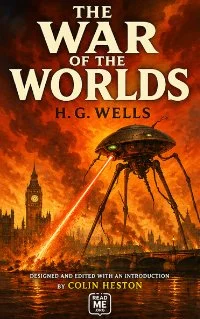
The War Of The Worlds

by H.G. Wells. Edited with an Introduction by Colin Heston.

They came from Mars—and suddenly humanity was no longer the dominant species on Earth.

When a strange cylinder crashes into the English countryside, curious spectators gather around the crater. What emerges changes the world forever.

The Martians have arrived.

Armed with terrifying technology, towering fighting machines, deadly Heat-Rays, and poisonous Black Smoke, the invaders sweep aside human resistance with shocking ease. Soldiers, artillery, cities, governments, and the certainties of Victorian civilization collapse before an enemy whose scientific superiority appears overwhelming.

Through the experiences of an unnamed narrator struggling across a devastated England, H. G. Wells creates one of literature’s greatest stories of invasion, survival, panic, and social breakdown.

First published in 1898, The War of the Worlds helped establish the modern alien-invasion story, but Wells intended much more than spectacular science fiction. Behind the Martian machines lies a provocative reversal of imperial power. What does conquest look like when the technologically superior invader is no longer European—and humanity itself becomes the apparently inferior population?

Wells strips civilization of its confidence with astonishing speed. Refugees choke the roads. Authority disintegrates. Ordinary people flee for their lives. Humanity discovers that intelligence, technology, and military power do not necessarily guarantee survival.

More than a century after its publication, The War of the Worlds retains its extraordinary power because its central question remains unsettlingly simple:

What if something arrived that we could not defeat?

This Read-Me.Org edition brings Wells’s revolutionary scientific romance to contemporary readers while preserving the extraordinary imagination, urgency, and menace of the original.

.Read-Me.Org Inc. New York-Philadelphia-Australia. 2026. 207p.

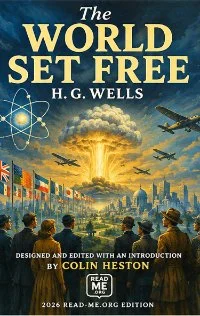
The World Set Free

by H.G. Wells. Edited with an Introduction by Colin Heston.

In 1914 H. G. Wells imagined the atomic bomb—and a world forced to confront what such a weapon would mean.

Among Wells’s extraordinary works of scientific speculation, The World Set Free occupies a unique place. Written in 1913 and published in 1914, the novel imagined the release of atomic energy and weapons Wells explicitly called “atomic bombs” decades before Hiroshima and Nagasaki.

But Wells was interested in far more than predicting a new weapon.

Beginning with humanity’s long struggle to harness energy, the novel moves toward the discovery of practical atomic power—and then toward catastrophe. The new energy promises abundance on an unprecedented scale, but nations quickly transform scientific achievement into military power. Atomic war follows, devastating cities and demonstrating that the traditional international order can no longer survive the destructive capacities science has placed in human hands.

From that destruction Wells develops his larger and more controversial argument. If technology has made war potentially catastrophic for civilization itself, must humanity eventually abandon competing sovereign states and construct some form of world government?

The World Set Free is therefore simultaneously scientific romance, future history, political argument, and warning.

Its historical significance is remarkable. Physicist Leó Szilárd, who later played an important role in the development of nuclear physics and the history of the atomic bomb, acknowledged Wells’s novel as an influence on his thinking about atomic chain reactions.

Yet the book’s greatest interest today may lie in the question Wells asks beyond the bomb itself: Can humanity develop political institutions rapidly enough to control the destructive technologies its scientists create?

The uploaded Read-Me.Org edition includes Wells’s important 1921 preface, in which he reconsidered his predictions after the catastrophe of the First World War.

More than a century after Wells wrote it, The World Set Free remains an extraordinary encounter between science fiction and history—a novel that did not merely imagine atomic warfare but helped place the idea into the intellectual world from which the nuclear age eventually emerged.Read-Me.Org Inc. New York-Philadelphia-Australia. 2026. 216p.

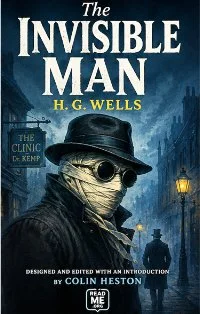
The Invisible Man: A Grotesque Romance

by H.G. Wells. Edited with an Introduction by Colin Heston.

A hidden garden behind a green door. A valley where the blind rule. A magic shop where every trick is real. A crystal window onto Mars.

H. G. Wells is celebrated for The Time Machine, The War of the Worlds, and The Invisible Man, but his short fiction reveals the full breadth of his imagination. In these pages, ordinary men and women stumble across impossible discoveries, strange inventions, terrifying creatures, and worlds that exist just beyond the boundaries of everyday experience.

The Door in the Wall and Other Stories brings together forty of Wells's finest short stories, including every story from his definitive 1911 collection The Country of the Blind and Other Stories together with the additional tales from The Stolen Bacillus and Other Incidents that Wells himself later left behind. The result is the most complete single-volume gathering of his greatest short fiction from the remarkable decade in which he transformed modern speculative storytelling.

Here are unforgettable classics such as:

  • The Door in the Wall

  • The Country of the Blind

  • The Crystal Egg

  • The Magic Shop

  • The New Accelerator

  • The Star

  • The Man Who Could Work Miracles

  • The Empire of the Ants

  • The Red Room

  • The Remarkable Case of Davidson's Eyes

Alongside these famous masterpieces are comic tales, Gothic horrors, scientific romances, social satires, mysteries, and fantasies that display Wells at his most inventive and entertaining.

Whether imagining alien visions, miraculous powers, invisible thresholds, or the unexpected consequences of scientific discovery, Wells continually asks a question that became the foundation of modern science fiction: What would happen if the impossible were suddenly true?

Complete, authoritative, and newly introduced for modern readers, this volume is an essential collection for fans of classic science fiction, fantasy, horror, and one of the greatest imaginative writers in English literature.

Read-Me.Org Inc. New York-Philadelphia-Australia. 2026. 172p.

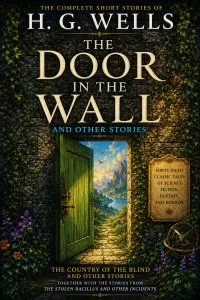
The Door in the Wall: And Other Stories

by H.G. Wells. Edited with an Introduction by Colin Heston.

A hidden garden behind a green door. A valley where the blind rule. A magic shop where every trick is real. A crystal window onto Mars.

H. G. Wells is celebrated for The Time Machine, The War of the Worlds, and The Invisible Man, but his short fiction reveals the full breadth of his imagination. In these pages, ordinary men and women stumble across impossible discoveries, strange inventions, terrifying creatures, and worlds that exist just beyond the boundaries of everyday experience.

The Door in the Wall and Other Stories brings together forty of Wells's finest short stories, including every story from his definitive 1911 collection The Country of the Blind and Other Stories together with the additional tales from The Stolen Bacillus and Other Incidents that Wells himself later left behind. The result is the most complete single-volume gathering of his greatest short fiction from the remarkable decade in which he transformed modern speculative storytelling.

Here are unforgettable classics such as:

  • The Door in the Wall

  • The Country of the Blind

  • The Crystal Egg

  • The Magic Shop

  • The New Accelerator

  • The Star

  • The Man Who Could Work Miracles

  • The Empire of the Ants

  • The Red Room

  • The Remarkable Case of Davidson's Eyes

Alongside these famous masterpieces are comic tales, Gothic horrors, scientific romances, social satires, mysteries, and fantasies that display Wells at his most inventive and entertaining.

Whether imagining alien visions, miraculous powers, invisible thresholds, or the unexpected consequences of scientific discovery, Wells continually asks a question that became the foundation of modern science fiction: What would happen if the impossible were suddenly true?

Complete, authoritative, and newly introduced for modern readers, this volume is an essential collection for fans of classic science fiction, fantasy, horror, and one of the greatest imaginative writers in English literature.

Read-Me.Org Inc. New York-Philadelphia-Australia. 2026. 360p.

The Gold Coast Regiment In The East African Campaign

By Hugh Clifford.. Introduction by Graeme Newman

The East African Campaign of the First World War remains one of the most demanding and least understood theatres of that global conflict. Far removed from the trenches of Europe, it unfolded across vast expanses of dense bush, swamps, mountains, and savannah—lands where climate, terrain, and disease were often deadlier adversaries than the enemy’s rifles. In this harsh environment, the soldiers of the Gold Coast Regiment distinguished themselves with a fortitude and endurance that earned them a lasting place in the annals of imperial military history.

The Gold Coast Regiment, drawn predominantly from the peoples of West Africa and led by British officers, brought to East Africa a unique blend of discipline, adaptability, and martial tradition. Their participation in the long pursuit of General Paul von Lettow‑Vorbeck’s elusive Schutztruppe represented both a severe test of their abilities and a defining moment in their collective identity. The campaign demanded not only courage under fire but also the capacity to march extraordinary distances, survive with minimal supplies, and maintain cohesion amid the ravages of tropical disease and the unpredictable rhythms of guerrilla warfare.

Sir Hugh Clifford, K.C.M.G.—administrator, colonial governor, and a man deeply familiar with West Africa—brings a rare perspective to this narrative. His closeness to the region and its peoples lends the work a depth of understanding that extends beyond the purely military. Clifford’s account is not merely a chronicle of battles and maneuvers; it is also a tribute to the character, loyalty, and steadfastness of the African soldiers who served with such distinction. He illuminates how, in the face of profound hardship, these men forged bonds of trust and cooperation with their officers, contributing decisively to the eventual success of British and Allied arms in the region.

This book therefore stands as both a historical record and a testament—an effort to ensure that the bravery and sacrifices of the Gold Coast Regiment are neither forgotten nor overshadowed by more widely known campaigns. In revisiting their story, readers gain insight not only into a pivotal chapter of African military history but also into the wider, often overlooked global dimensions of the First World War. The narrative that follows invites us to honour the endurance, resilience, and unyielding spirit of a regiment that marched far from home and left an indelible mark on the course of the war in Africa.

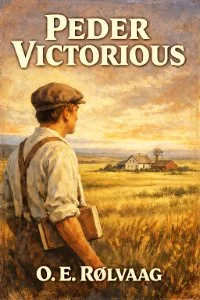
Peder Victorious

By O. E. Rølvaag (Author), Colin Heston (Introduction)

Peder Victorious by O. E. Rølvaag is a powerful continuation of the prairie saga that began with Giants in the Earth, shifting the focus from the physical hardships of pioneer settlement to the inner conflicts of the immigrant’s American-born son. Set within a Norwegian farming community in the Dakota Territory, the novel follows young Peder Holm as he comes of age amid the competing claims of ancestral faith and American ambition. Intelligent and driven, Peder embraces education and opportunity, yet his aspirations strain against the religious intensity and cultural conservatism that define his mother’s world. Rølvaag portrays with psychological depth the tension between generations, the fragility of cultural inheritance, and the cost of assimilation. The prairie remains vast and elemental, but the central struggle unfolds within the human heart, where identity, loyalty, and belief are tested. Both intimate and epic in scope, the novel offers a searching exploration of what it means to be victorious in a land that promises freedom while quietly demanding transformation.

Nearly a century after its publication, Peder Victorious by O. E. Rølvaag remains strikingly relevant in an era defined by global migration, cultural pluralism, and debates over national identity. The novel’s portrayal of second-generation tension—between inherited faith and modern ambition, communal loyalty and individual advancement—mirrors the lived experience of many contemporary families navigating assimilation in North America, Europe, and beyond. Peder’s divided consciousness anticipates what sociologists now describe as bicultural identity formation, in which success within dominant institutions can coexist with a sense of estrangement from ancestral tradition. At a time when questions of belonging, integration, and cultural continuity are again politically and socially charged, Rølvaag’s work offers a sober reminder that assimilation is not a frictionless process but a psychological and moral negotiation whose costs and gains are unevenly distributed across generations.

Read-Me.Org Inc. New York-Philadelphia-Australia. 2026. 240p.

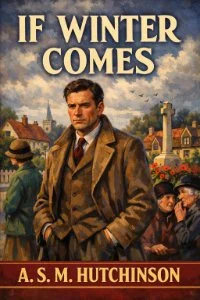
If Winter Comes

By A. S. M. Hutchinson. Introduction by Colin Heston.

When If Winter Comes appeared in 1921, it entered a literary moment marked by exhaustion, reassessment, and a profound unease about the moral and emotional consequences of the First World War. Written by A. S. M. Hutchinson, the novel achieved immediate popularity on both sides of the Atlantic, resonating with readers who recognized in its restrained drama a faithful portrait of postwar disillusionment. Today, the book stands as one of the most representative middle-class English novels of the early 1920s, combining psychological realism with a quietly devastating critique of social conformity.

At the center of If Winter Comes is Mark Sabre, a man neither heroic nor villainous, but painfully ordinary—an embodiment of the conscientious, educated Englishman caught between private integrity and public expectation. Sabre’s tragedy unfolds not through sensational events but through accumulated compromises: the erosion of affection within marriage, the pressures of respectability, and the moral cowardice of a community that prizes appearances above truth. Hutchinson’s great achievement is to dramatize these pressures with such precision that the reader comes to see how social cruelty can be enacted without overt malice, simply through silence, gossip, and moral indifference.

The novel reflects a society struggling to redefine itself after catastrophe. Although the war remains largely offstage, its psychological presence is unmistakable. Characters speak and act as if something fundamental has been broken: faith in institutions, confidence in moral authority, and trust in traditional roles. Hutchinson does not frame this as a generational revolt, as some of his modernist contemporaries did, but rather as a slow moral suffocation. The England of If Winter Comes is orderly, polite, and profoundly unforgiving—a place where deviation from accepted norms is punished less by law than by social annihilation.

Stylistically, Hutchinson occupies a middle ground between Edwardian realism and the emerging psychological novel. His prose is clear, controlled, and often deceptively simple. Sentiment is present, but carefully disciplined; emotional climaxes arise organically from character rather than authorial intrusion. This restraint partly explains the book’s enduring power. Hutchinson trusts the reader to perceive the cruelty embedded in everyday interactions and to grasp the cumulative weight of small injustices. The result is a novel that feels at once intimate and inexorable.

Equally important is Hutchinson’s treatment of marriage and masculinity. Mark Sabre is not undone by vice or ambition but by a moral rigidity that prevents him from acting decisively in his own defense. In this sense, If Winter Comes anticipates later twentieth-century explorations of male emotional paralysis. Sabre’s passivity—his belief that decency alone will protect him—proves to be a fatal misconception. Hutchinson exposes how a culture that rewards restraint and silence can become complicit in personal destruction.

Upon publication, the novel’s success was amplified by its adaptation into a widely seen stage play and later film versions, cementing its reputation as a defining postwar narrative. Yet its popularity should not obscure its seriousness. Beneath its accessible surface lies a sharp moral inquiry into responsibility, courage, and the cost of social obedience. Hutchinson does not offer easy consolation; the title itself suggests a stoic endurance rather than renewal, implying that survival may require a reckoning with loss rather than its denial.

Read today, If Winter Comes remains strikingly contemporary. Its depiction of reputational ruin, public shaming, and institutional indifference speaks to modern anxieties about social judgment and moral isolation. Hutchinson’s novel reminds us that cruelty need not be loud to be lethal, and that the gravest tragedies often occur not in moments of drama but in the long, quiet seasons of neglect. As such, this book endures not merely as a historical artifact of postwar Britain, but as a timeless study of how societies fail their most conscientious members when compassion yields to convention.

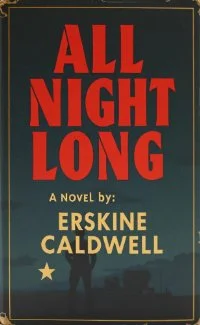
All Night Long: A Novel of Guerrilla Warfare in Russia

By Erskine Caldwell. Designed and Edited with an Introduction  by Colin Heston

When All Night Long appeared in 1942, Erskine Caldwell was already one of the most widely read—and most controversial—American novelists of his generation. Known primarily for his unsparing portrayals of poverty, violence, and moral stress in the American South, Caldwell here turned his attention outward, to a global conflict unfolding at unprecedented scale. Subtitled A Novel of Guerrilla Warfare in RussiaAll Night Long represents Caldwell’s direct literary engagement with the Second World War at the moment when its outcome remained deeply uncertain and when the Soviet Union, newly allied with the United States, had become a central symbol of resistance to fascist aggression.

Caldwell’s Russia is not a romanticized abstraction nor a detailed ethnographic portrait. Instead, it functions as a stark moral landscape shaped by occupation, deprivation, and constant threat. Villages, forests, and frozen terrain become arenas of endurance rather than scenery. The emphasis falls on night operations, secrecy, hunger, exhaustion, and the psychological toll of living in a perpetual state of danger. The title itself—All Night Long—signals this temporal and emotional register: war as an unbroken vigil, a continuous strain that erodes the boundary between action and survival.

For modern readers, the novel occupies an intriguing position in Caldwell’s body of work and in twentieth-century war literature more broadly. It stands apart from his Southern novels in geography but not in theme. As in Tobacco Road or God’s Little Acre, Caldwell examines how extreme conditions strip life down to its essentials and expose the structures—economic, political, or military—that govern human behavior. In All Night Long, the setting is international, but the underlying concerns remain consistent: power, exploitation, resilience, and the cost of endurance.

Read today, All Night Long also invites reflection on the evolving representation of guerrilla warfare itself. Long before such conflicts became a dominant feature of late-twentieth- and early-twenty-first-century military discourse, Caldwell recognized the strategic and moral complexity of irregular resistance. His novel anticipates later debates about asymmetrical warfare, civilian involvement, and the blurred lines between combatant and noncombatant—issues that continue to shape global conflicts.

Ultimately, All Night Long is less a novel about Russia per se than a novel about resistance under occupation. It captures a historical moment when global war demanded new forms of solidarity and new narrative frameworks to explain them. Caldwell’s achievement lies in his ability to translate that vast struggle into an intimate, unrelenting account of human persistence, sustained through darkness, danger, and the long hours of night.

NY.Book League of America. 1942. Read-Me.Org Inc. Australia, New York & Philadelphia. 2025. 161p.

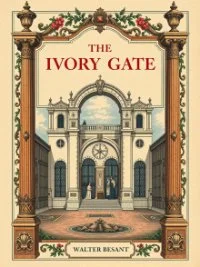
The Ivory Gate

By Walter Besant. Introduction by Colin Heston.

First published in 1893, The Ivory Gate stands among the late novels of Walter Besant, a writer whose career was defined by a sustained engagement with the moral, social, and psychological pressures of modern urban life. Appearing at the close of the Victorian era, the novel reflects both Besant’s long-standing commitment to social realism and his increasing interest in the interior life of the individual—especially the fragile boundary between aspiration and illusion.
The title itself announces the book’s governing metaphor. In classical and medieval literature, the “ivory gate” is the passage through which false dreams pass into waking life, as opposed to the gate of horn, from which true dreams emerge. Besant adapts this image to late-nineteenth-century conditions, using it to explore the seductive power of unrealized hopes, romantic delusions, and social fantasies that shape—and often distort—human conduct. The novel is less concerned with overt villainy than with self-deception: the quiet, persistent capacity of individuals to misread their circumstances and to substitute imagined futures for lived realities.
For modern readers, the novel remains strikingly relevant. Its exploration of illusion, self-fashioning, and the tension between inner fantasy and external reality resonates with contemporary concerns about identity, expectation, and social pressure. While its Victorian idiom and moral framework are firmly rooted in the nineteenth century, its psychological insights anticipate later treatments of self-deception and emotional displacement.
This new edition invites readers to reconsider The Ivory Gate not simply as a period piece, but as a thoughtful and understated meditation on the human tendency to live in dreams of our own making. In tracing the quiet tragedies that arise when those dreams eclipse judgment, Besant offers a work of enduring moral seriousness—one that illuminates both the anxieties of his age and the persistent vulnerabilities of our own.

A READ-ME.ORG CLASSIC REPRINT. New York-Philadelphia-Australia. 2025. 321p.

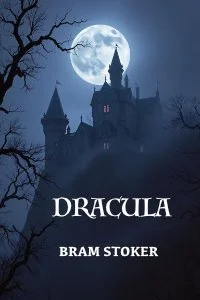
Dracula

By Bram Stoker

Bram Stoker's Dracula, first published in 1897, remains one of the most iconic and influential novels in the Gothic literary tradition. More than a simple horror story, Dracula is a rich tapestry of Victorian anxieties, cultural tensions, and symbolic complexity. Through its epistolary structure and vivid characters, the novel explores themes of modernity versus antiquity, sexuality and repression, imperialism, and the supernatural. It is a work that not only defined the vampire genre but also reflected the fears and fascinations of its time.

The late 19th century was a period of profound transformation in Britain. The Industrial Revolution had ushered in an age of technological innovation and scientific progress, while the British Empire stood at the height of its global influence. Yet beneath this veneer of confidence lay deep-seated anxieties about degeneration, foreign invasion, and the erosion of traditional values. Dracula captures these tensions through its central antagonist, Count Dracula, a foreign aristocrat who threatens the sanctity of British society. His arrival in England symbolizes a reverse colonization, where the East invades the West, challenging notions of cultural superiority and national security.

Stoker’s use of the epistolary format—comprising diaries, letters, newspaper articles, and ship logs—serves to ground the supernatural elements of the story in a framework of realism and documentation. This narrative technique reflects the Victorian obsession with empirical evidence and rationality, even as the characters confront a force that defies scientific explanation. The juxtaposition of modern tools such as typewriters and phonographs with ancient folklore and religious symbols underscores the novel’s central conflict between progress and the past.

One of the most compelling aspects of Dracula is its exploration of sexuality and repression. Victorian society was marked by strict moral codes, particularly regarding gender roles and sexual behavior. The novel subverts these norms through the seductive and transgressive nature of vampirism. Characters like Lucy Westenra and Mina Harker become battlegrounds for these tensions, as their encounters with Dracula blur the lines between victimhood and desire. The act of bloodsucking, laden with erotic undertones, becomes a metaphor for the loss of innocence and the threat of moral corruption.

Religion plays a crucial role in the narrative, often positioned as the ultimate defense against the vampire’s evil. Crucifixes, holy water, and sacred rites are employed alongside scientific reasoning, suggesting a synthesis of faith and logic in the fight against darkness. This duality reflects the Victorian struggle to reconcile religious belief with the rise of secularism and scientific thought.

Dracula also engages with the theme of identity and duality. Count Dracula himself embodies contradictions: he is both man and monster, aristocrat and predator, host and parasite. His ability to transform into animals and control the elements adds to his mystique and reinforces his role as a symbol of the uncanny. The characters who oppose him—Jonathan Harker, Van Helsing, Dr. Seward, and others—represent various facets of Victorian society, from legal and medical professions to religious authority, united in their mission to restore order.

The legacy of Dracula is vast and enduring. It established many of the conventions of vampire fiction and inspired countless adaptations across literature, film, and popular culture. Count Dracula has become a cultural archetype, embodying both fear and fascination. The novel’s rich symbolism and thematic depth continue to invite critical analysis, from psychoanalytic and feminist readings to postcolonial and queer interpretations.

In conclusion, Bram Stoker’s Dracula is far more than a tale of terror. It is a mirror reflecting the complexities of its time, a narrative that intertwines the rational and the irrational, the modern and the ancient, the sacred and the profane. Its enduring power lies in its ability to evoke fear while provoking thought, making it a masterpiece of Gothic literature and a cornerstone of cultural history.

Read-Me.Org Inc. New York-Philadelphia-Australia. 2025. 284p.

Vittoria


By George Meredith (Author), Colin Heston (Introduction)

Vittoria, published in 1867, is one of George Meredith’s most ambitious historical novels and serves as a sequel to his earlier work Sandra Belloni (originally titled Emilia in England). While Sandra Belloni explored the struggles of an Italian-born heroine within the confines of English provincial society, Vittoria shifts the scene entirely to Italy during one of the most turbulent and significant periods of the 19th century—the Italian Risorgimento, the movement for national unification and independence from foreign rule.
In Vittoria, Meredith combines the personal and the political, weaving a narrative in which the inner development of the heroine, Vittoria, mirrors the aspirations and tumult of the Italian national cause. The novel is set during the events of 1848, a year of revolutionary fervor across Europe, when Italy was in the throes of armed uprisings against Austrian dominance. Through the story of Vittoria, a gifted opera singer who becomes involved in the nationalist struggle, Meredith addresses questions of patriotism, duty, identity, and the costs of freedom. Ultimately, Vittoria is a novel about courage—the courage to defy oppression, to embrace love in the face of danger, and to live a life that is aligned with one’s highest convictions. It is both a stirring narrative of revolution and an enduring meditation on the responsibilities that come with freedom. For readers willing to engage with its intellectual demands, Vittoria offers a richly rewarding experience—a testament to Meredith’s belief that literature should challenge as well as enlighten.

Read-Me.Org Inc. New York-Philadelphia-Australia. 2025. 358p.

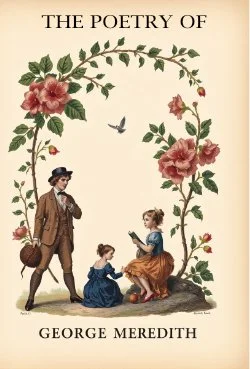
The Poetry Of George Meredith

By George Meredith (Author), Colin Heston (Introduction) Format: Kindle Edition

George Meredith’s poetry stands as one of the most intellectually challenging and idiosyncratic contributions to Victorian literature. Published in 1888 by Macmillan and Co., The Poetry of George Meredith collects his poetic output into a single volume, offering readers a comprehensive view of a body of work that was often overshadowed by his accomplishments as a novelist. While Meredith’s fiction earned him widespread recognition during his lifetime, his poetry was a more private, cerebral pursuit—revered by literary peers but frequently misunderstood or overlooked by the broader reading public.
To approach Meredith’s poetry is to enter a realm where language serves not merely as ornament but as a crucible for thought. His verse rejects the lush musicality and emotional immediacy typical of many of his contemporaries in favor of a dense, elliptical style that demands intellectual engagement. Meredith himself was acutely aware of how unconventional his poetic voice was, famously describing his work as being written for those “whose heads are used to thinking.” His lines often eschew smoothness for compression, sacrificing surface harmony in pursuit of precision, depth, and psychological or philosophical insight.

Read-Me.Org Inc. New York-Philadelphia-Australia. 2025. 501p.

An Amazing Marriage

By George Meredith. Introduction by Colin Heston

When An Amazing Marriage was published in 1895, George Meredith stood at the summit of his literary career, celebrated as one of the most intellectually formidable and stylistically daring novelists of the Victorian age. By this time, Meredith had forged a reputation for works that combined psychological subtlety, social satire, and philosophical inquiry, appealing more to the discerning literary elite than to the broader Victorian reading public. An Amazing Marriage emerges as one of his last full-length novels and, fittingly, revisits many of the themes that had preoccupied him throughout his life—gender relations, the institution of marriage, the constraints of social conventions, and the inner lives of women.

The very title, An Amazing Marriage, signals Meredith's ironic stance toward the Victorian ideal of marriage. Rather than a romantic or sentimental union, marriage is often portrayed in his works as a contested arena, where conflicting expectations, social pressures, and personal ambitions collide. In this novel, Meredith offers a biting critique of the marital conventions of his era, presenting a union that is both remarkable and troubling in its complexity.
Although An Amazing Marriage is less frequently read today than Meredith’s earlier masterpieces, it remains a vital document of the tensions that defined late-Victorian society. Its psychological acuity, progressive gender politics, and sharp critique of social hypocrisy retain their resonance in the modern era, where debates about marriage, gender roles, and personal autonomy continue to evolve.
For contemporary readers, the novel offers both a window into the anxieties of the past and a mirror reflecting the enduring challenges of balancing love, freedom, and social expectation. Aminta’s journey toward self-realization, with all its attendant risks and uncertainties, anticipates the narratives of countless women in the century that followed.

Read-Me.Org Inc. New York-Philadelphia-Australia. 2025. 213p.

Abe's Yarns and Stories

By Alexander K. McClure (Author), Colin Heston (Introduction)

Abe’s Yarns and Stories, edited by Alexander K. McClure and first published in 1901 by the International Publishing Company, is a unique and enduring contribution to the cultural memory of Abraham Lincoln. Rather than a conventional biography, this volume presents Lincoln through the lens of his own storytelling—anecdotes, jokes, parables, and recollections that he used to communicate, persuade, and connect with people from all walks of life. The book is both a literary and historical artifact, capturing the essence of Lincoln’s personality and the oral tradition that helped shape his public image. McClure, a journalist and political figure who knew Lincoln personally, compiled this collection not only to entertain but to preserve the wit and wisdom of a man whose humor was as integral to his leadership as his moral conviction.
What makes Abe’s Yarns and Stories particularly compelling is its blend of folklore and fact. While some of the anecdotes may be apocryphal or embellished, they reflect the way Lincoln was remembered and revered by those who knew him and those who came after. The book thus serves as a bridge between history and myth, illustrating how Lincoln’s legacy was shaped not only by his deeds but by the stories told about him. McClure’s editorial voice is respectful and admiring, but he allows Lincoln’s own words and the voices of his contemporaries to take center stage. The result is a portrait that is intimate, humanizing, and deeply American. His rich self-education and his storytelling formed the foundation of a presidency that not only preserved the Union but also reshaped the American identity. They allowed him to lead not just with policy, but with wisdom and heart—qualities that continue to define his legacy.

Read-Me.Org Inc. New York-Philadelphia-Australia. 2025. 360p.

The Portygee

By Joseph Crosby Lincoln . Designed and Edited with an Introduction by Colin Heston

Joseph C. Lincoln's 1920 novel The Portygee holds a unique place in his body of work. Known for his warm-hearted Cape Cod tales celebrating small-town life, moral decency, and New England character, Lincoln here expands his focus to address questions of heritage, identity, and belonging in a changing America. While retaining the gentle humor and richly textured settings that made him popular with early 20th-century readers, The Portygee engages more directly with themes of cultural difference and assimilation—offering a nuanced portrayal of prejudice, generational misunderstanding, and the search for personal integrity.

The novel’s title refers to the derogatory local slang for “Portuguese,” used to identify individuals of Portuguese descent who had settled along the Massachusetts coast in significant numbers by the late 19th and early 20th centuries. Through this lens, Lincoln examines not only the resilience of the American immigrant but also the sometimes unspoken tensions that lie beneath the surface of even the most tight-knit communities. It is a story of collision—between old and new, native and newcomer, tradition and ambition.

Read-Me.Org Inc. New York-Philadelphia-Australia. 2025. 262p.