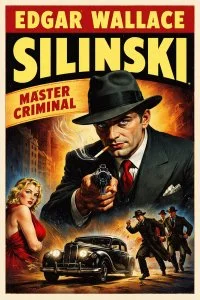
By Edgar Wallace. Introduction by Colin Heston
In Silinski – Master Criminal, Wallace constructs the titular character not as a creature of impulse, but as a precursor to the modern white-collar sociopath, defined by what can be termed "organized intellect." Unlike the flamboyant villains of Gothic tradition, Silinski’s power is derived from his mastery of systems—legal, financial, and social. He treats crime as a rigorous administrative discipline, employing a level of detachment that mirrors the very corporate structures he seeks to exploit. This intellectualization of villainy creates a chilling paradox: Silinski is most dangerous when he is at his most rational. Wallace highlights this by contrasting the frantic, reactive energy of the police with Silinski’s own glacial composure. His "mastery" is not merely a matter of successful theft, but of an informational asymmetry where he remains several steps ahead of the law by treating the world as a chessboard of predictable variables. Consequently, the tension of the novel arises not from the "whodunnit" element, but from the terrifying efficiency of a mind that has completely divorced morality from logic.
The conclusion of the narrative solidifies the "super-criminal" archetype not as a mere antagonist, but as a necessary mirror to the evolution of the modern state. By weaving together the threads of bureaucratic mastery and economic manipulation, Wallace posits that the transition of the criminal from the physical to the cerebral reflects a broader societal shift toward abstraction. Silinski represents the dark potential of the burgeoning 20th century: the realization that true power is no longer found in the strength of one's arm, but in the reach of one's influence over the systems that sustain public life. As the novel draws to its close, the resolution of the plot serves as a pyrrhic victory for the law, acknowledging that while one man may be stopped, the systemic vulnerabilities he exposed remain inherent to the fabric of global society. Ultimately, Silinski – Master Criminalstands as a definitive exploration of the modern villain, suggesting that in an age of complexity, the most profound threat to order is the very intelligence required to maintain it.
Read-Me.Org Inc. New York-Philadelphia-Australia. 2026. 188p.