Open Access Publisher and Free Library
Fiction+Mediajpg.jpg

FICTION and MEDIA

CRIME AND MEDIA — TWO PEAS IN A POD

Posts in Social Inequality
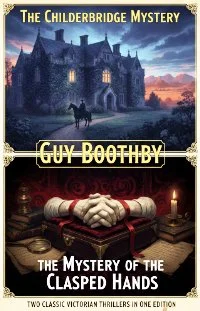
The Mystery of the Clasped Hands & The Childerbridge Mystery: Two Novels

by Guuy Boothby (Author), Colin Heston (Introduction)

In this combined edition, readers are presented with two quintessential examples of the late Victorian "shocker" from the pen of Guy Boothby, a writer who defined the era’s taste for fast-paced, sensational mystery. The first novel in this volume, The Mystery of the Clasped Hands, originally published in 1901 by F.V. White & Co., serves as a dark exploration of the macabre and the forensic. The story begins with a truly visceral hook: a wedding gift that contains the severed, preserved hands of a woman. It is a classic example of the Victorian obsession with reputation and the legal system, as the protagonist, Godfrey Tring, finds himself trapped in a web of circumstantial evidence. Boothby expertly depicts how quickly a gentleman’s life can be dismantled by a single accusation, making the legal system itself a source of mounting dread. This work highlights Boothby's skill in using sensational artifacts to drive a plot that forces the reader to question whether innocence alone is enough to survive a vengeful conspiracy.
Published just a year later in 1902, The Childerbridge Mystery shifts the focus toward the "sins of the father" trope and the intersection of colonial wealth and domestic stability. When wealthy Australian squatter William Standerton returns to England to establish himself at Childerbridge Manor, he brings with him a fortune that carries the shadow of his past. The mystery is not merely a puzzle of logic but a psychological examination of how the "New World" of the colonies—often viewed by Victorians as a place of lawless opportunity—inevitably catches up with the refined "Old World" of the English gentry. Boothby uses the tranquil setting of a country estate to highlight the tension between a man’s desire for a respectable future and the inescapable reach of his history.
Bound together, these two novels illustrate the common threads of Boothby’s literary legacy: the fragility of social identity, the weight of previous associations, and a relentless narrative pace that bridges the gap between 19th-century Gothic horror and the structured detective fiction of the 20th century. Whether dealing with a grisly forensic artifact or a haunted family legacy, Boothby provided his audience with a perfect blend of the familiar and the shocking. This edition serves as a testament to a writer who, though often overlooked today, once stood as a master of the mystery genre, capturing the collective anxieties of a world on the brink of change.

Peder Victorious

By O. E. Rølvaag (Author), Colin Heston (Introduction)

Peder Victorious by O. E. Rølvaag is a powerful continuation of the prairie saga that began with Giants in the Earth, shifting the focus from the physical hardships of pioneer settlement to the inner conflicts of the immigrant’s American-born son. Set within a Norwegian farming community in the Dakota Territory, the novel follows young Peder Holm as he comes of age amid the competing claims of ancestral faith and American ambition. Intelligent and driven, Peder embraces education and opportunity, yet his aspirations strain against the religious intensity and cultural conservatism that define his mother’s world. Rølvaag portrays with psychological depth the tension between generations, the fragility of cultural inheritance, and the cost of assimilation. The prairie remains vast and elemental, but the central struggle unfolds within the human heart, where identity, loyalty, and belief are tested. Both intimate and epic in scope, the novel offers a searching exploration of what it means to be victorious in a land that promises freedom while quietly demanding transformation.

Nearly a century after its publication, Peder Victorious by O. E. Rølvaag remains strikingly relevant in an era defined by global migration, cultural pluralism, and debates over national identity. The novel’s portrayal of second-generation tension—between inherited faith and modern ambition, communal loyalty and individual advancement—mirrors the lived experience of many contemporary families navigating assimilation in North America, Europe, and beyond. Peder’s divided consciousness anticipates what sociologists now describe as bicultural identity formation, in which success within dominant institutions can coexist with a sense of estrangement from ancestral tradition. At a time when questions of belonging, integration, and cultural continuity are again politically and socially charged, Rølvaag’s work offers a sober reminder that assimilation is not a frictionless process but a psychological and moral negotiation whose costs and gains are unevenly distributed across generations.

Read-Me.Org Inc. New York-Philadelphia-Australia. 2026. 240p.

The La Chance Mine Mystery

By S. Carleton. Introduction by Colin Heston.

The 1920 publication of The La Chance Mine Mystery by S. Carleton, the pseudonym for Susan Morrow Jones, represents a pivotal moment in the evolution of the North American thriller. By weaving the Victorian Gothic tradition into the rugged landscape of the Canadian wilderness, Carleton created a narrative that serves as a sophisticated precursor to modern psychological suspense. In contemporary literature, this work remains highly relevant as a masterclass in atmospheric isolation, where the "frozen North" acts not merely as a setting but as a primary antagonist. This technique mirrors modern "Environment as Character" tropes seen in current survivalist fiction, reminding readers that the primitive fear of being trapped in a vast, uncaring wilderness transcends technological advancement and remains a powerful literary hook.

From a criminological perspective, the novel offers a compelling study of frontier anomie. In the absence of formal state policing, the isolated mine becomes a vacuum where white-collar crimes like corporate fraud and title theft inevitably devolve into violence. This lack of social control forces characters into a state of informal justice, predating modern investigative frameworks through "bushcraft forensics." In an era before chemical analysis or DNA, Carleton’s characters rely on environmental reconstruction—analyzing the crust of snowdrifts or the set of a footprint—to determine the timing of a crime. This reliance on natural preservation within a crime scene provides a proto-historical look at how physical environment shapes both criminal opportunity and the subsequent forensic analysis used to untangle it.

The social dynamics of the mine also provide deep insights into early 20th-century victimology. Carleton highlights a hierarchy of vulnerability, focusing on how marginalized laborers and isolated individuals are targeted by those with institutional power. In this setting, victims are often chosen specifically because their disappearances can be conveniently blamed on the harsh climate rather than foul play. This exploration of "invisible victims" and structural exploitation resonates with modern social justice themes regarding labor and corporate overreach. By subverting the "hard-boiled" male tropes of her time, Carleton used her unique perspective as a female author to provide an emotional depth and keen eye for power imbalances that continue to inform the DNA of modern suspense and elevated horror.

Read-Me.Org Inc. New York-Philadelphia-Australia. 2026. 192p.

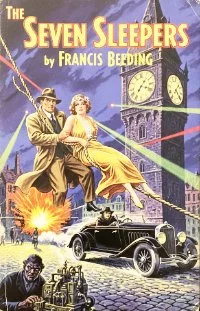
The Seven Sleepers

By Francis Beeding. Introduction by Colin Heston.

In the shadows of a Europe still scarred by the Great War, a new and more terrifying conspiracy awakens. When Thomas Preston arrives in Geneva, he expects nothing more than a quiet diplomatic mission. Instead, he is thrust into a lethal game of cat-and-mouse after stumbling upon the secrets of the "Seven Sleepers"—a clandestine cabal of German industrialists and embittered generals plotting to shatter the fragile peace of the League of Nations.

Equipped with a terrifying hidden technology and a ruthless determination to rewrite the Treaty of Versailles, the Sleepers have already set their clock for a second global cataclysm. Preston’s only hope lies with the enigmatic Colonel Alastair Granby of British Intelligence. From high-speed chases across the continent to the inner sanctums of hidden laboratories, they must race to dismantle the conspiracy before the world is plunged back into the abyss of total war.

Originally published in 1925, The Seven Sleepers is the pulse-pounding debut of Francis Beeding’s most famous hero. It is a classic of the "clubland" thriller era, blending atmospheric suspense with the high-stakes espionage that defined a generation.

NU. Little Brown & Co. 1925.. New York-Philadelphia-Australia.. Read-Me.Org Inc. 2026. 182p.

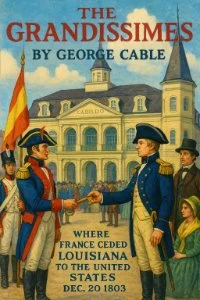
The Grandissimes: A Story of Creole Life

By George W. Cable

The Grandissimes: A Story of Creole Life stands among the most vivid and penetrating literary portraits of early New Orleans—its tangled ancestries, its hierarchies of caste and color, and its rich cultural complexity at the turn of the nineteenth century. First published in 1880, George W. Cable’s novel announced the arrival of a distinctive Southern voice: one capable of blending romance, social critique, historical reconstruction, and an almost anthropological attention to the manners and moral contradictions of Creole society.

Cable, himself native to New Orleans, wrote at a moment when the American public was only beginning to recognize the significance of Louisiana’s unique heritage. The city had passed from French to Spanish control, then back to France, then suddenly into the hands of the United States through the Louisiana Purchase. In Cable’s imagination, this swirl of sovereignties—compounded by the interwoven legacies of France, Spain, Africa, the Caribbean, and Indigenous peoples—created a society unlike any other on the continent. The Grand–issimes dramatizes this world at a moment of profound transition, when old loyalties struggled against the pressures of Americanization, and when the boundaries of race, class, and honor were both fiercely guarded and constantly transgressed.

At its center stands the old Creole family of the Grandissimes, whose branches include both the proud white aristocracy and a free man of color who bears the same name—a blood relationship that must not, in respectable society, be spoken aloud. Through this intricate family history, Cable exposes the contradictions of slavery, the moral compromises of privilege, and the tragic limitations imposed on people of mixed heritage. Yet the novel is anything but a simple moral allegory. Its pages teem with humor, local color, memorable characters, and a richly textured atmosphere that evokes the city’s architecture, dialects, festivals, and customs with unmatched fidelity.

Cable’s realism—rare among Southern writers of his generation—caused both admiration and controversy. His depictions of racial injustice were received with anger in parts of the post-Reconstruction South, and his advocacy for Black civil rights would eventually drive him to relocate to the North. Today, his work is recognized as foundational: a precursor to later explorations of New Orleans identity by Kate Chopin, Lafcadio Hearn, Lyle Saxon, and many others.

This edition of The Grandissimes invites readers to rediscover Cable’s great novel not merely as an historical document but as a living work of art. Its themes of belonging, cultural collision, and the moral weight of inherited systems remain deeply resonant. In tracing the fate of a family—and of a city—at a crossroads, Cable offers a vision both critical and compassionate, illuminating a world whose complexities still echo through the streets of New Orleans today.

Read-Me.Org Inc. New York-Philadelphia-Australia. 2025. p.248.

The Inner Beams

By Afshin rad

The document The Inner Beams by Afshin Rad is a historical novel set in East Berlin during the final years of the Cold War, focusing on the brutal atmosphere created by the East German Ministry of State Security, the Stasi. The narrative combines political history with a deeply personal story, illustrating how authoritarianism corrodes ordinary lives. It opens with a preface explaining the power and reach of the Stasi, an organization that employed nearly a hundred thousand agents and twice as many informants under the chilling slogan that anyone who “thinks differently” is an enemy.

The story follows Nadia, a young, marginalized woman surviving on the fringes of society through prostitution while raising her daughter Maya. Despite her poverty, stigmatization, and abuse at the hands of neighbors and strangers, she displays resilience and a rebellious spirit. Her life becomes entangled with the violence and hypocrisy of both the state and the church. She is alternately vilified and desired, caught between accusations of being a spy and exploitation by priests who hide their own corruption.

As events unfold, Nadia becomes a victim of the Stasi’s cruelty. She is imprisoned, tortured, and left for dead, only to be saved by a compassionate old man who hides her and helps her plan to reclaim her daughter, who has been taken by Party officials. Their efforts culminate in a daring but tragic attempt to rescue the child from a powerful regime family. The old man sacrifices his life to protect Nadia, while she herself endures near-death encounters in the collapsing state.

Against the backdrop of the Berlin Wall’s fall and the chaos of 1989, Nadia’s fate is sealed in both tragedy and symbolic triumph. Though she dies violently, her memory and sacrifice become a posthumous inspiration. Her grave, once marked with disdain, is later reclaimed as a shrine to freedom, with an epitaph honoring her rebellious spirit.

The work blends history, fiction, and allegory to show how individuals—especially the marginalized and forgotten—resist oppression and become unwilling martyrs of liberty. Through Nadia’s story, the book captures the human cost of totalitarianism while leaving readers with a sense of dignity, defiance, and the enduring value of freedom.

Read-Me.Org Inc. New York-Philadelphia-Australia. 2025. 77p.

The Count Of Monte-Cristo: Volume Two


By Alexandre Dumas (Author), G. Staal (Illustrator), J.A. Beauce (Illustrator), & 2more Format: Kindle Edition

Few novels have captured the imagination of readers across generations as powerfully as The Count of Monte Cristo. First published in 1844, this sweeping tale of betrayal, revenge, and redemption is the work of Alexandre Dumas, one of France’s most celebrated literary figures. Set against the backdrop of post-Napoleonic France, the novel follows the transformation of Edmond Dantès, a young sailor whose promising future is shattered by the treachery of those he trusted. Wrongfully imprisoned in the Château d’If, Dantès emerges years later not as the man he once was, but as the enigmatic and wealthy Count of Monte Cristo—determined to exact justice on those who wronged him. At once a thrilling adventure and a profound exploration of human nature, The Count of Monte Cristodelves into themes of vengeance, justice, mercy, and the enduring power of hope. Dumas weaves a rich tapestry of characters and subplots, each contributing to the novel’s intricate moral landscape. His storytelling is both grand in scope and intimate in detail, offering readers a journey that is as emotionally resonant as it is exhilarating.
This two volume edition is based on the five volume 1888 English edition. It retains all text as in the original and includes most of the illustrations preserving the spirit and elegance of Dumas’s original edition, while making the novel accessible to contemporary readers. This version is most likely that of an anonymous translator who translated the work from the French for the publisher Chapman and Hall in 1846. There have been many translations in dozens of languages, and some in the 20th century basically rewriting the novel in modern prose and almost always considerably abridged.

Read-Me.Org Inc. New York-Philadelphia-Australia. 2025. 501 p.

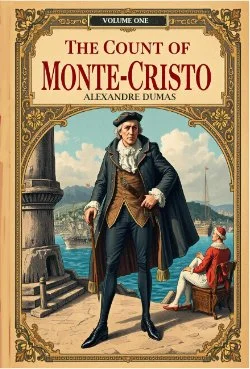
The Count Of Monte-Cristo: Volume One


By Alexandre Dumas (Author), G. Staal (Illustrator), J.A. Beauce (Illustrator), & 2more Format: Kindle Edition

Few novels have captured the imagination of readers across generations as powerfully as The Count of Monte Cristo. First published in 1844, this sweeping tale of betrayal, revenge, and redemption is the work of Alexandre Dumas, one of France’s most celebrated literary figures. Set against the backdrop of post-Napoleonic France, the novel follows the transformation of Edmond Dantès, a young sailor whose promising future is shattered by the treachery of those he trusted. Wrongfully imprisoned in the Château d’If, Dantès emerges years later not as the man he once was, but as the enigmatic and wealthy Count of Monte Cristo—determined to exact justice on those who wronged him. At once a thrilling adventure and a profound exploration of human nature, The Count of Monte Cristodelves into themes of vengeance, justice, mercy, and the enduring power of hope. Dumas weaves a rich tapestry of characters and subplots, each contributing to the novel’s intricate moral landscape. His storytelling is both grand in scope and intimate in detail, offering readers a journey that is as emotionally resonant as it is exhilarating.
This two volume edition is based on the five volume 1888 English edition. It retains all text as in the original and includes most of the illustrations preserving the spirit and elegance of Dumas’s original edition, while making the novel accessible to contemporary readers. This version is most likely that of an anonymous translator who translated the work from the French for the publisher Chapman and Hall in 1846. There have been many translations in dozens of languages, and some in the 20th century basically rewriting the novel in modern prose and almost always considerably abridged.

Read-Me.Org Inc. New York-Philadelphia-Australia. 2025. 456 p.

Round Up: The Stories Of Ring W. Lardner

By Ring W. Gardner (Author), Colin Heston (Preface) Format: Kindle Edition

Round Up gathers together the taut, muscular stories of Ring W. Lardner, a writer whose work bridges the divide between the mythologized West and its harsher, less forgiving realities. In these pages, Lardner is neither sentimental nor nostalgic. He strips the Western narrative to its barest elements, presenting us with a landscape that is both expansive and claustrophobic, and characters who are caught between the lure of freedom and the inevitability of fate.
Lardner’s contribution to the American short story lies in his ability to invest the familiar tropes of frontier life with psychological depth and moral ambiguity. His cowboys and ranchers are not mere archetypes; they are restless souls negotiating loyalty, isolation, and survival in a world where law and justice are provisional at best. The violence in these stories is never gratuitous—it is sudden, often senseless, and always carries a human cost. Lardner understands that the West was not only a place but also an idea, one that promised reinvention yet often delivered ruin.
What sets Lardner apart from many of his contemporaries is his prose: terse, unsentimental, yet charged with a quiet lyricism. His narratives move with the inevitability of a gathering storm, his dialogue as spare as the plains he describes. The result is a body of work that feels astonishingly modern in its refusal of easy resolutions.
In an era when the Western genre risks being dismissed as an artifact of popular culture, Round Up demands reconsideration. These are not mere adventure tales or moral fables. They are stories of a liminal world, where the boundaries between civilization and wilderness, justice and vengeance, myth and memory, blur and collapse. Lardner’s West is not simply the West that was; it is also the West as it continues to haunt the American imagination.

The Shaving Of Shagpat

By George Meredith (Author)

Set in an imaginary Oriental landscape, The Shaving of Shagpat follows the humble barber Shibli Bagarag, who embarks on an epic quest to perform the symbolic and dangerous act of shaving Shagpat—a powerful figure whose enchanted, unshorn hair represents the tyranny of falsehood and delusion over the minds of men. The narrative is populated with genies, enchantresses, magical cities, and perilous tasks, weaving a tapestry of adventure that operates on both the literal and allegorical planes. At first glance, The Shaving of Shagpat appears to be a whimsical fantasy—an exotic romance filled with the familiar trappings of Eastern fable. Yet beneath the surface lies a sophisticated commentary on the nature of truth, illusion, and the moral evolution of the individual. Meredith uses the framework of fantasy not merely to entertain but to craft a parable about the necessity of intellectual courage and the struggle for personal enlightenment.

For contemporary readers, the book remains a fascinating artifact of literary daring—a playful yet profound reminder that the struggle against illusion, whether in the form of personal vanity or societal falsehood, is both eternal and essential. In The Shaving of Shagpat, Meredith offers not only an enchanting fable but also an enduring meditation on the human condition.

Read-Me.Org Inc. New York-Philadelphia-Australia. 2025. 242p.

Should Media Coverage Affect Sentencing?

By Paul McGorrery

In sentencing an offender, courts take many factors into account, such as the seriousness of the offence, the offender’s prior record, their age, whether they pleaded guilty and many others. In Australia, courts do this through an approach known as instinctive synthesis, meaning they consider all the factors that can justify a sentence being more or less severe and then arrive at a final outcome. One of the factors that courts may take into account is whether the offender has already been punished in some fashion outside the criminal justice process. Known as extra-curial punishment3 (or extra judicial or natural5 punishment) this can take various forms such as visa cancellation,6 loss of chosen career, injury to the offender8 and hardship to the offender’s family. This report is concerned with just one form of extra-curial punishment: adverse media coverage, in particular, of people. The media and the courts have an important and symbiotic relationship, but sometimes their interests can diverge. The media have an interest in reporting on criminal justice matters because they are often stories of considerable interest to their audiences. In reporting on those stories, the media often concentrate their attentions ‘on the exceptional and unusual among serious crimes’, which can lead to ‘intense and often emotive media reporting’ about sentencing. This can run the risk of undermining, rather than promoting, confidence in the justice system.

Courts in turn have an interest in having their decisions reported. Confidence in the judicial arm of the criminal justice system relies on a combination of community awareness about what courts do, the transparency of their work, and the apparent fairness of their decisions, which can only be scrutinised if there is transparency and community awareness. Moreover, the sentencing purpose of general deterrence – whereby the sentencing of one offender is thought to deter other people from engaging in similar behaviour – is realistically only achievable (if at all) if the media and/or government operate as the conduit between the courts and the community. While some courts have taken the very laudable step of making most of their sentencing remarks publicly available, many people do not even have time to read media summaries, let alone original source material like sentencing remarks, especially in the social media age. So the community realistically only becomes aware of sentencing decisions through the media. The difficulty is balancing the need for fair coverage (the courts’ priority) with the need for interesting coverage (the media’s priority). Justice Harper has described the relationship as like a ‘Greek tragedy’ because ‘[e]ach is forced by its circumstances to face the other off, with neither having the flexibility necessary to reach a satisfactory working compromise’.

Malbourne: Sentencing Advisory Council (VIC), 2022. 24p.

The Early Modern Dutch Press in an Age of Religious Persecution: The Making of Humanitarianism

By David de Boer

For victims of persecution, attracting international awareness of their plight is often a matter of life and death. This book uncovers how in seventeenth-century Europe, persecuted minorities first learned how to use the press as a weapon to combat religious persecution. To mobilize foreign audiences, they faced an acute dilemma: how to make people care about distant suffering? This study argues that by answering this question, they laid the foundations of a humanitarian culture in Europe. The book reveals how, as consuming news became an everyday practice for many Europeans, the Dutch Republic emerged as an international hub of printed protest against religious violence. It traces how a diverse group of people, including Waldensian refugees, Huguenot ministers, Savoyard officeholders, and many others, all sought access to the Dutch printing presses to raise transnational solidarity for their cause. By examining their publicity strategies, this study deepens our understanding of how people tried to confront the specter of religious violence that had haunted them for generations.

UA Open. Oxford, UK: Oxford University Press, 2023. 225p.

Sitting in Darkness: Mark Twain's Asia and Comparative Racialization

By Hsuan L. Hsu

Perhaps the most popular of all canonical American authors, Mark Twain is famous for creating works that satirize American formations of race and empire. While many scholars have explored Twain’s work in African Americanist contexts, his writing on Asia and Asian Americans remains largely in the shadows. In Sitting in Darkness, Hsuan Hsu examines Twain’s career-long archive of writings about United States relations with China and the Philippines. Comparing Twain’s early writings about Chinese immigrants in California and Nevada with his later fictions of slavery and anti-imperialist essays, he demonstrates that Twain’s ideas about race were not limited to white and black, but profoundly comparative as he carefully crafted assessments of racialization that drew connections between groups, including African Americans, Chinese immigrants, and a range of colonial populations. Drawing on recent legal scholarship, comparative ethnic studies, and transnational and American studies, Sitting in Darkness engages Twain’s best-known novels such as Tom Sawyer, Huckleberry Finn, and A Connecticut Yankee in King Arthur’s Court, as well as his lesser-known Chinese and trans-Pacific inflected writings, such as the allegorical tale “A Fable of the Yellow Terror” and the yellow face play Ah Sin. Sitting in Darkness reveals how within intersectional contexts of Chinese Exclusion and Jim Crow, these writings registered fluctuating connections between immigration policy, imperialist ventures, and racism.

New York: NYU Press.2015.

5 Grams: Crack Cocaine, Rap Music, and the War on Drugs

By Dimitri A. Bogazianos

In 2010, President Barack Obama signed a law repealing one of the most controversial policies in American criminal justice history: the one hundred to one sentencing disparity between crack cocaine and powder whereby someone convicted of “simply” possessing five grams of crack—the equivalent of a few sugar packets—had been required by law to serve no less than five years in prison. In this highly original work, Dimitri A. Bogazianos draws on various sources to examine the profound symbolic consequences of America’s reliance on this punishment structure, tracing the rich cultural linkages between America’s War on Drugs, and the creative contributions of those directly affected by its destructive effects.

Focusing primarily on lyrics that emerged in 1990s New York rap, which critiqued the music industry for being corrupt, unjust, and criminal, Bogazianos shows how many rappers began drawing parallels between the “rap game” and the “crack game." He argues that the symbolism of crack in rap’s stance towards its own commercialization represents a moral debate that is far bigger than hip hop culture, highlighting the degree to which crack cocaine—although a drug long in decline—has come to represent the entire paradoxical predicament of punishment in the U.S. today.

UA Open. New York; London: NYU Press, 2011. 216p.