Open Access Publisher and Free Library
Fiction+Mediajpg.jpg

FICTION and MEDIA

CRIME AND MEDIA — TWO PEAS IN A POD

The King's English: A Guide to Modern Usage

By Kingsley Amis

From the cover: Throughout his notable career as a novelist, poet and literary critic, Kingsley Amis was often concerned — the less understanding some might say obsessed--with the use and abuse of the English language. Do we know what the words we employ really mean? Do we have the right to use them fi we don't? Should an "exciting" new program be allowed to "hit” your television screen? When is it acceptable to split an infinitive? And just when is one allowed to begin a sentence with "and"? The enemies of fine prose may dismiss such issues as tiresome and pedantic, but Kingsley Amis, like all great novelists, depended upon these very questions to separate the truth from the lie, both in literature and in life. A Parthian shot from one of the most important figures in postwar British fiction, this volume represents Amis's last word on the state of the language. More frolicsome than Fowler's Modern Usage, lighter than the Oxford English Dictionary, and replete with the strong opinions that have made Amis so popular- and so controversial….”

NY. St. Martin’s Press. 1997. 272p.

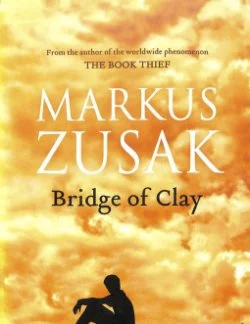
Bridge of Clay

By Markus Zusak

The Dunbar boys bring each other up in a house run by their own rules a family of ramshackled tragedy their mother is dead their father has fled they love and fight and learn to reckon with the adult world. It is Clay, the quiet one, who will build a bridge; for his family, for his past, for his sins. He builds a bridge to transcend humanness. To survive A miracle and nothing less. Markus Zusak makes his long-awaited return with a profoundly heartfelt and inventive novel about a family held together by stories, and a young life caught in the current: a hoy in search of greatness, as a cure for a painful past. ‘Brilliant and hugely ambitious...the kind of book that can be life changing.” The New York Times. “‘Unsettling, thought-provoking, life affirming, triumphant and tragic, this is a novel of breathtaking scope, masterfully told.” Guardian. ‘Zusak’s novel is a highwire act of inventiveness and emotional suppleness’ The Australian.

Australia. Picador Macmillan. 2018. 581p.

Turning

By Tim Winton

In the 1990s Tim Winton made his mark through tough spare stories about youth and promise; of early age parenthood and the challenges of loyalty. Now almost 20 years since his last collection he returns to the form with 17 overlapping stories of second thoughts and mid-life regret set in the brooding small town world of coastal WA. Brilliantly crafted and as tender as they are confronting these ellagic stories examine the darkness and frailty of ordinary people and celebrate the moments when the light shines through.

Picador. Australia. Pan Macmillan. 2004. 317p.

Innocence

By Pierre Magnan

Translated from the French by Patricia Clancy. “It is June 1945. The war is over. As dawn breaks over the hills of Provence, Pierrot, a 15-year-old boy, stumbles across the body of Capitaine Patrocle, a local hero of the Resistance. He has been murdered. In his wallet Pierrot finds a letter written on blue paper, which he conceals beneath his beret. It provides the key to the dramatic events that lie at the heart of this haunting story of illicit passions and pitiless revenge, and leads, ultimately, to the boy’s association with the beautiful Madame Henry and his introduction to the mysteries of love. “ ‘Magnan’s evocation of sun-baked landscapes and small-town Provencal life, still smarting from
the Occupation and the Vichy betrayals, is superb.’ The Times.

London.. Vintage. 1999. 254p.

Code Name Verity

By Elizabeth Wein

“Harrowing and wholly believable, Code Name Verity wrecked me. It ii a book as unexpected, beautiful, and enduring as tle friendship at its heart. The story's brutality is almost inti­mate. It's depictions ol heroism are so real and vibrant, they live beyond the page. You will want to clutch these characters to youi in the hopes of keeping them safe, and your heart will break knowing that you can't." —Leigh Bardugo. New York Times best-selling author of Shadow and Bone.

NY. Hyperion. 2013. 371p.

The Buddha in the Attic

By Julie Otsuka

Winner of the Pen Faulkner Award for Fiction 2012. National Book Award Finalist 2011. From the cover. Between the wars a group of young, non-English-speaking Japanese women travelled by boat to America. They were picture brides, clutching photos of husbands-to-be whom they had yet to meet. Julie Otsuka tells their extraordinary, heartrending story in this spellbinding and poetic account
of strangers lost and alone in a new and deeply foreign land. “Harrowing. Otsuka tells a powerful, affecting story that ensures a largely forgotten voice is heard once more.” Scotsman. ‘Poignant, fascinating and tragic’ Easy Living

NY. Penguin. 2011. 130p.

Imperium

By Robert Harris

From the cover: “Ancient Rome - ‘a city of glory built on a river of filth teems with ambitious and ruthless men. None is more  brilliant than Marcus Cicero. A rising young lawyer, backed by a shrewd wife, he decides to gamble everything on one of the most dramatic courtroom battles of all time. Win it, and he could win control of Rome itself. Lose it, and he is finished forever. Internationally acclaimed for its storytelling power and historical accuracy, Robert Harris’s new novel is an epic account of the timeless struggle for power and the sudden disintegration of society.”

London.. Random House. 2006. 495p.

History Of Florence And Of The Affairs Of Italy

By Niccolo Machiavelli

From Chapter 1: The people who inhabit the northern parts beyond the Rhine and the Danube, living in a healthy and prolific region, frequently increase to such vast multitudes, that part of them are compelled to abandon their native soil, and seek a habitation in other countries. The method adopted, when one of these provinces had to be relieved of its superabundant population, was to divide into three parts, each containing an equal number of nobles and of people, of rich and of poor. The third upon whom the lot fell, then went in search of new abodes, leaving the remaining two-thirds in possession of their native country. These migrating masses destroyed the Roman empire by the facilities for settlement which the country offered when the emperors abandoned Rome, the ancient seat of their dominion, and fixed their residence at Constantinople…..

London. M. Walter Dunne. 1901.

Getting Even

By Woody Allen

From the cover. In Getting Even Woody Allen revenges himself upon such significant subjects as death, obe­sity, organized crime, the invention of the sandwich, adult education, laundry lists of famous people, and Latin American revolu­tionaries. Here is Woody Allen at his philo­sophical deepest: •    "... Death is an acquired trait.'' •    "If man were immortal, do you realize what his meat bills would be?" •    "Why pork was proscribed by Hebraic law is still unclear, and some scholars believe that the Torah merely suggested not eating pork at certain restaurants." •    "Eternal Nothingness is OK if you're dressed for it." •    "My mind can never know my body although it has become quite friendly with my legs."

NY. Random House. 1978. 124p.

The First Circle

By Alexander Solzhenitsyn

Translated from the Russian by Michael Guybon. “*The First Circle asks to be compared to Dostoevsky. Solzhenitsyn is in the great story-telling tradition. When he introduces a character, he fills in the complete background. His portrait of a Soviet prosecutor and his family circle is unforgettable. So are chapters devoted to the brooding Stalin. A future generation of Russians will be able to come to terms with their history through books like Dr. Zhivago and The First Circle.'“ David Pryce-Jones, Financial Times.

London Collins. Fontana Books. 1970. 680P.

File No. 113

By Emile Gaboriau

Illustrated by W. Glackens. From Chapter 1: In the Paris evening papers of Tuesday, February 28, 1866, under the head of Local Items, the following announcement appeared: " A daring robbery, committed against one of our most eminent bankers, M. André Fauvel, caused great excitement this morning throughout the neighborhood of Rue de Provence. " The thieves, who were as skilful as they were bold, succeeded in making an entrance to the bank, in forcing the lock of a safe that has heretofore been considered impregnable, and in possessing themselves of the enormous sum of three hundred and fifty thousand francs in bank-notes…”

NY. Charles Scribner’s Sons. 1903. 540p.

Abolition Science Fiction

By Phillip Crocket Thomas.

Abolition Science Fiction is a new, free collection of sci fi short stories written by activists and scholars involved in prison abolition and transformative justice in the UK. The stories are not all explicitly about prison abolition, but all of them explore the underlying question of how we can live well together, tackling complex topics like violence, revenge, responsibility, care, and community. As such they can help us imagine a future where we respond to harm without exclusion and punishment, illustrating Ruth Wilson Gilmore’s contention that ‘abolition requires that we change one thing: everything.’ Alongside the stories are extracts from discussions from the workshops where we wrote and shared the stories. There are also creative writing exercises and discussion prompts, included to help readers explore ideas about abolition and transformative justice in creative ways. The book is aimed both at those curious about abolition and at seasoned activists who want to explore abolition through creative writing. The book is free and can be downloaded below. There is a limited number of print copies available, to request one please email abolitionscifi [at] gmail [dot] com.

Abolition Science Fiction. 2022. 94p.

The Devil's Dictionary

By Ambrose Bierce

From the Preface: The Devil's Dictionary was begun in a weekly paper in 1881, and was continued in a desultory way and at long intervals until 1906. In that year a large part of it was published in covers with the title The Cynic's Word Book, a name which the author had not the power to reject nor the happiness to approve. To quote the publishers of the present work: “This more reverent title had previously been forced upon him by the religious scruples of the last newspaper in which a part of the work had appeared, with the natural consequence that when it came out in covers the country already had been flooded by its imitators with a score of‘cynic’ books - The Cynic’s This, The Cynic's That and The Cynic's t’Other. Most of these books were merely stupid, though some of them added the distinction of silliness. Among them, they brought the word ‘cynic’ into disfavour so deep that any book bearing it was discredited in advance of publication.”

Hertfordshire. Wordsworth Editions Limited. 1996. 243p.

One Day In The Life Of Ivan Denisovich

By Alexander Solzhenitsyn

Translated from the Russian by Ralph Parker. With an Introduction by Marvin L. Kalb. Foreword By Alexander Tvardovsky. From the cover: This extraordinary novel is one of the most significant and outspoken literary documents ever to come out of Soviet Russia. It is both a brutally graphic picture of life in a Stalinist work camp and a moving tribute to man's will to prevail over relentless dehumanization. A masterpiece of modern Russian fiction, ONE DAY IN THE LIFE OF IVAN DENISOVICH first brought to world attention the work of Alexander Solzhenitsyn, brilliant author of THE CANCER WARD and THE FIRST CIRCLE.

Alexander Solzhenitsyn was born in 1918, a year after the Bolsheviks stormed to; power through­out Russia. He studied at the University of Rostov and served with distinction in the Russian Army dur­ing World War II. In 1945 he was arrested and im­prisoned in a labor camp for eight years because he allegedly made a derogatory remark about Stalin. He was released in 1953 after the death of Stalin, but was forced to live in Central Asia, where he remained until Premier Khrushchev’s historic “secret speech” denounced Stalin in 1956. Rehabilitated in 1957, Solzhenitsyn moved to Ryazan, married a chemistry student, and began to teach mathematics at the local school. In his spare time, he started to write. This novel is his first published work.

NY. A Signet Classic from New American Library. 1963. 158p.

The Dictionary Of Dangerous Words

By Digby Anderson

A dictionary like no other!

"This book will shortly replace a university;education and it's cheaper." John Cleese.

The dictionary of dangerous words from access to zionist via exclusion, partner and self-esteem.

Contributors: Alice Thomas, Ellis Frederick Forsyth, Simon Heffer, Peter Hitchens, Andrew Roberts, Auberon Waugh, Michael Wharton, and many Others

London. Social Affairs Unit. No Date. 129p.

Cop this Lot

By Nino Culotta

From the cover: Cop This Lot by Nino Culotta (John O’Grady) is the hilarious sequel to the well-known They’re a Weird Mob. In Cop This Lot we enjoy once more the magnificent humour that comes from genuine Australian dialogue, and the lovable charac­ter of Nino, the friendly Italian migrant bent on becoming a 'dinkum Aussie’. A new note of hilarity is reached when Nino’s workmates, Joe and Dennis, accompany him on a visit to Nino’s parents in Italy. Their struggles with the Continental way of life enable Nino to get his own back, and provide countless laughs for the reader. Illustrated by WEP

Sydney. Ure Smith. 1960. 216p.

Chicago Manual of Style 13th Edition

Prepared by the Editorial Staff of the University of Chicago Press.

For over seventy-live years the University of Chicago Press Manual of Style has been the standard reference tool for authors, editors, copywriters, and proofreaders. Updated many times since 1906, it now goes into its thirteenth edition—the first revision since 1969, and the first to introduce a change in title. Bowing to what has become nearly universal usage, we now call the Manual what everybody else calls it. The Chicago Manual of Style—or, for short, The Chicago Manual.

Two pervasive features characterize the present edition: it reflects the impact of the new technology on the entire editing and publishing process, and it spells out, in greater detail and with many more examples, the procedures with which it deals. It is, in short, much more a “how-to” book for authors and editors than was its predecessor. In chapter 2, on manuscript preparation and copyediting, for example, new sections have been added on how to mark a manuscript and how to mark type specifications on a script. Chapter 12 (“Tables”), completely rewritten, begins with advice on how to make a table from raw data. Chapters 15 through 17, on documentation, have been reorganized and greatly expanded, offering many more alternative methods of citation and a wealth of examples. In chapter 18 (“Indexes”), clear step-by-step
procedures for the mechanics of index making are set forth. The terminology and methodology of technological advances (in word processing, computerized electronic typesetting, and the like) are reflected most prominently in chapter 20, “Composition, Printing, and Binding” (new to this edition), and in the Glossary. Other notable features of the present edition are chapter 4 (“Rights and Permissions”), rewritten in light of the new copyright law, and chapter 9 (“Foreign Languages”), which includes a new table of diacritics, a pinyin (Chinese) conversion chart, and data on several more languages.

Throughout, The Chicago Manual aims to give clear and straightforward guidelines for preparing and editing copy—with the emphasis on the sensible, the practical, and the economical. As did its predecessors, the thirteenth edition of the Manual states the style preferences of the University of Chicago Press and reflects the current practices and requirements of the great majority of American publishers.

Chicago. University of Chicago Press. 1982. 718p.

Cancer Ward

By Aleksandr Solzhenitsyn.

From the jacket: Cancer Ward, which has been compared to the master­piece of another Nobel Prize winner, Thomas Mann's The Magic Mountain,examines the relationships of a group of people in a provincial Soviet hospital in 1955, two years after Stalin's death. Through their stories, Aleksandr Solzhenitsyn has created a vivid portrait of life in the So­viet Union. Alexsandr Solzhenitsyn, winner of the 1970 Nobel Prize in Literature, was born in 1918. In 1945, while a captain in the Soviet Army, he was arrested—for criticiz­ing Stalin in a letter to a friend—and sentenced to an eight-year term in a labor camp and permanent exile. In exile, he became a patient in a cancer ward, and later re­covered. Although he was allowed to publish One Day in the Life of Ivan Denisovich in 1962, Solzhenitsyn was expelled from the Soviet Writers Union in 1969. When the KGB discovered the manuscript of The Gulag Archi­pelago, it became imperative for Solzhenitsyn to have the book published in the West. The authorities retaliated in 1974 by exiling him from the Soviet Union. He settled in the United States in 1976 and now lives in Vermont.

NY. Farrar, Straus and Giroux. 1968. 630p.

Aesop's Fables

Translated Into English By Samuel Croxall.

This version is beautifully illustrated and contains “New applications, Morals etc. by the Rev. Geo. Tyler Townsend, editor of the “Arabian Nights’ Entertainments.” Eighty original Illustratiiona.

London” Frederick Warne and Co. Strand. ca. 1885. 161p.

The Politics of Social Media Manipulation

Edited by Richard Rogers and Sabine Niederer

Disinformation and so-called fake news are contemporary phenomena with rich histories. Disinformation, or the willful introduction of false information for the purposes of causing harm, recalls infamous foreign interference operations in national media systems. Outcries over fake news, or dubious stories with the trappings of news, have coincided with the introduction of new media technologies that disrupt the publication, distribution and consumption of news -- from the so-called rumour-mongering broadsheets centuries ago to the blogosphere recently. Designating a news organization as fake, or <i>der Lügenpresse</i>, has a darker history, associated with authoritarian regimes or populist bombast diminishing the reputation of 'elite media' and the value of inconvenient truths. In a series of empirical studies, using digital methods and data journalism, the authors inquire into the extent to which social media have enabled the penetration of foreign disinformation operations, the widespread publication and spread of dubious content as well as extreme commentators with considerable followings attacking mainstream media as fake.

Amsterdam: Amsterdam University Press, 2020. 257p.