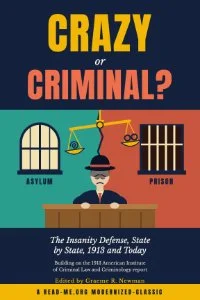
Edited by Graeme R. Newman
When is a person too mentally ill to be blamed for a crime? What happens to a defendant who cannot understand his own trial? And what should society do with someone a jury acquits because he was insane?
In 1913, Committee B of the American Institute of Criminal Law and Criminology tried to answer these questions for the whole country. Under the chairmanship of Edwin R. Keedy, its members, among them Adolf Meyer, William A. White and Morton Prince, gathered every statute on insanity in criminal cases from the 48 states and the District of Columbia. The result was a unique snapshot of American law on six questions: the test of responsibility, competency to stand trial, commitment of incompetent defendants, the verdict when insanity is proved, commitment after acquittal, and discharge from the hospital.
This edition reprints that collection in full, corrected against the original printing. Each state's 1913 statutes are followed by a summary of its practice in 2026 under the same six headings, and Alaska and Hawaii are added so every state is covered. Readers can follow a single state across more than a century or compare all of them at once. They can see where M'Naghten survives, where the defense has been narrowed or abolished, how "guilty but mentally ill" verdicts spread, and how release passed from governors and legislatures to courts and review boards.
A new introduction and conclusion by Graeme R. Newman, Distinguished Professor Emeritus at the University at Albany, place the collection in historical context, and review and discussion questions make the book ready for classroom use. It is an essential reference for students, lawyers, forensic clinicians and anyone puzzled by one of the hardest questions in criminal justice.
Read-Me.Org Inc. New York-Philadelphia-Australia. 2026. 142.p