By Steven Schuetz, et al.
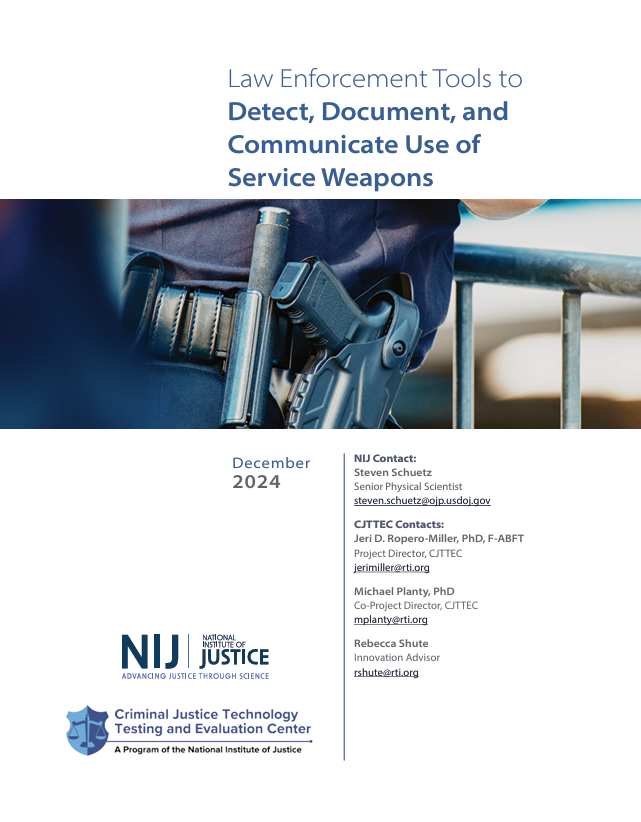
Context Service weapon activity, including instances where an officer’s firearm is drawn, pointed, or discharged, plays an important role in understanding events transpiring during a police–public encounter. Detection, documentation, and communication of these events in a way that is accurate, timely, and dependable is vital for enhancing transparency and accountability of law enforcement service weapon use. About this Report The National Institute of Justice (NIJ) requested the Criminal Justice Technology Testing and Evaluation Center (CJTTEC) to investigate the landscape of commercially available and emerging technologies that could meet this need. CJTTEC conducted a review of technologies capable of detecting when a service weapon has been unholstered, pointed, or discharged; documenting when a law enforcement officer discharges their service weapon (or initiating documentation such as body-worn camera (BWC) recordings in such incidents); and communicating the information to dispatchers. CJTTEC’s methodology to understand this technology landscape included secondary research (e.g., reviewing patents, trade literature, press releases, news articles, and publications) and primary research with technology experts, product representatives, and researchers. This brief provides a high-level summary of technology systems capable of documenting, detecting, and communicating service weapon activity, focusing specifically on technology integrated into or onto the weapon, in a holster, in a BWC, in a wearable device, or in environmental sensing tools. Conclusion Although no single commercially available tool is capable of detecting, documenting, and communicating service weapon activity, law enforcement agencies may be able to rely on a suite of products to help them address these needs. Key Takeaways ¡ Agencies are facing increased pressure to document service weapon activity. From 2015 through 2020, on average, an estimated 1,769 people were injured annually—979 fatally and 790 nonfatally— from shootings by police in the United States.1 Because of the impact that officer-involved shootings (OISs) have on the community, law enforcement agencies are facing increased public pressure and policy mandates to document service weapon activity. ¡ There is a need for tools or technologies that can objectively detect, document, and communicate service weapon activity. OISs are stressful incidents that can occur quickly and under poor visual circumstances, which can impact accurate documentation of events. Further, obtaining reliable service weapon activity data can be challenging because of noncompliance with body-worn camera (BWC) policies, lack of BWCs, or inaccurate witness and officer accounts. ¡ There is no single commercially available product that meets service weapon activity needs. No single product can currently (1) detect service weapon activity, such as recording actual shots fired in an incident involving law enforcement weapons; (2) document the activity, such as initiating BWC recordings; and (3) communicate information about service weapon activity to police dispatchers. ¡ Agencies can rely on a suite of products to address these needs or choose specific products, each with strengths and limitations. Available technologies may be integrated into or onto the weapon, in a holster, in a BWC, in a wearable device, or in environmental sensing tools. Weapon-integrated tools offer the most functionality to detect and document multiple types of service weapon activity during a use-of-force incident, but many of these products, such as those developed by Armaments Research Company and Yardarm, are not commercially available. These products often lack the capability to communicate updates in real-time with dispatch. Holster-integrated tools can sense officer unholstering activity, activate BWC, and communicate with dispatch, but they cannot detect activity related to pointing or firing a weapon. BWCs, activated by multiple types of triggers, can document audio and video of the incident and communicate with dispatch, but they cannot specifically detect officer firearm activities (e.g., weapon unholstering, pointing, gunshot detection). Wearable devices can detect officer firearm activities, document metadata, and communicate with dispatch, but most products are still in a development phase for law enforcement applications. Environmental sensing tools may detect and document activities transpiring within a certain area, including shots fired in an incident, and communicate information to dispatch, but they cannot detect or attribute gunshot activities specifically to an officer's service weapon. ¡ Technology advancements and independent testing, evaluation, and implementation research are needed to accelerate adoption. Technology developers are currently working through several technical hurdles and are leveraging insights from BWC to improve technology uptake. Some commercially available products have been evaluated for performance, but more studies are needed as technologies are further developed and released into the market.
Criminal Justice Testing (and Evaluation Consortium, 2024. 15p.