

Open Access Free Library
CRIMINAL JUSTICE.jpeg

CRIMINAL JUSTICE

CRIMINAL JUSTICE-CRIMINAL LAW-PROCDEDURE-SENTENCING-COURTS

Posts tagged Policing practices
European Police Systems

By Raymond B. Fosdick

European Police Systems

Raymond B. Fosdick (1915)

Published in 1915, European Police Systems is a pioneering comparative study of law enforcement in the major nations of Europe during the early twentieth century. Based on extensive travel and firsthand investigation, Raymond B. Fosdick examined how police organizations in England, France, Germany, Austria-Hungary, Italy, Belgium, and the Netherlands were structured, governed, and employed to maintain public order.

Fosdick explores the fundamental differences between the British tradition of local policing and the more centralized police systems of Continental Europe. He analyzes police recruitment, training, discipline, detective work, administrative organization, and the relationship between police authority and civil liberty. Drawing upon interviews with police officials and direct observation of police operations, he provides a detailed portrait of the institutions responsible for public safety in some of Europe's most important cities.

Written on the eve of the First World War, the book captures a European society in transition while addressing questions that remain relevant today: How much power should the police possess? What forms of accountability are most effective? How can governments maintain order while preserving the freedoms of citizens?

Combining careful scholarship with vivid observation, European Police Systems became a landmark work in the study of policing and public administration. More than a historical record, it offers valuable insight into the origins of modern police institutions and the enduring challenges of balancing authority, efficiency, and democratic governance.

New York. Century. 1915 . p.410.
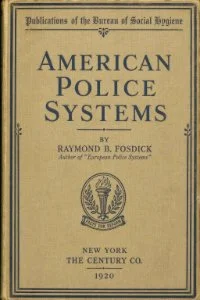
American Police Systems

By Raymond B. Fosdick

American Police Systems (1920) by Raymond B. Fosdick is a landmark study of law enforcement in the United States during the early twentieth century. Drawing on extensive research and firsthand observation, Fosdick examines the organization, responsibilities, and challenges of American police departments, comparing them with policing models in Europe. The book explores issues such as crime prevention, public order, police administration, and the evolving relationship between law enforcement and the communities they serve.

A valuable resource for historians, criminologists, and students of public administration, American Police Systems offers a fascinating snapshot of policing at a pivotal moment in American history. Its insights into reform, professionalism, and accountability remain relevant to contemporary discussions about law enforcement and public policy.

Read-Me.Org Inc. New York-Philadelphia-Australia. 2026. p.429.

A New Private Law of Policing

By Cristina Tilley

American law and American life are asymmetrical. Law divides neatly in two: public and private. But life is lived in three distinct spaces: pure public, pure private, and hybrid middle spaces that are neither state nor home. Which body of law governs the shops, gyms, and workplaces that are formally accessible to all, but functionally hostile to Black, female, poor, and other marginalized Americans? From the liberal mid-century onward, social justice advocates have treated these spaces as fundamentally public and fully remediable via public law equity commands. This article takes a broader view. It urges a tort law revival in the campaign for just middle spaces, taking as its exemplar the problem of racially oppressive policing. Inequitable policing arises from both system-level policies and personal officer biases. Public law can remake systems, but struggles to remake people. Consequently, this piece argues that the legal quest for humane policing has overemphasized public law litigation under 42 U.S.C. Section 1983 and underemphasized the private law of tort. Personal injury law, specifically the intentional infliction of emotional distress (IIED) tort, has untapped potential to influence the private bias of officers and the communities they serve. IIED invites individuation of Black litigants, self-reflection on the meaning of racial dignity in middle spaces, and construction of shared norms about civilian humanity—a panoply of exercises social psychologists have identified as the essential tools of anti-bias work. Returning to broader themes, the article builds on the example of inequitable policing to petition for full private law partnership in the bid for twenty-first century social justice.

Brooklyn Law Review , Vol. 89, No. 2, 2024

U Iowa Legal Studies Research Paper No. 2024-08