Open Access Publisher and Free Library
CRIMINAL JUSTICE.jpeg

CRIMINAL JUSTICE

CRIMINAL JUSTICE-CRIMINAL LAW-PROCDEDURE-SENTENCING-COURTS

Washing Away Crime: Money Laundering in the Western Balkans

By Anesa Agovic

Money laundering remains a key enabler of organized crime in the Western Balkans, allowing criminal networks to legitimize illicit profits and integrate them into the formal economy. This report examines current trends, typologies and vulnerabilities shaping the region’s illicit financial flows.

The study outlines how systemic corruption, weak regulatory oversight, and a sizeable informal economy create fertile ground for laundering proceeds from drug trafficking, firearms smuggling, human trafficking, migrant smuggling, tax evasion and cyber-enabled crime. Key sectors, including construction, real estate and cash-intensive businesses, are often exploited, with typologies such as bulk cash smuggling, corporate layering, trade-based money laundering, underpriced real estate transactions and loan-back schemes featuring prominently.

Professional enablers, such as notaries, accountants, attorneys, and even entertainment celebrities, facilitate the integration of dirty money. The infiltration of law enforcement, misuse of remittance channels and the rise of digital currencies further complicate detection and prosecution.

The report also explores gender dynamics, highlighting the increasing role of women in money laundering activities. While some women play direct roles in financial transactions, others support criminal networks through their positions in professional sectors.

Hotspots for money laundering are often found in capitals, major cities and tourist destinations, where high-value real estate transactions and significant cash flows occur. The impact of global affairs, such as geopolitical shifts and technological advances, has amplified existing vulnerabilities.

The study calls for intensifying the prosecution of money laundering as a standalone crime, strengthening asset recovery, and reinforcing transparency across financial systems. Enhanced cooperation at the regional and international levels is vital to tackle transnational laundering schemes effectively.

This publication is part one of a two-part study of illicit finance and anti-money laundering in the Western Balkans, produced by the GI-TOC’s Observatory of Illicit Economies in South Eastern Europe with the support of the UK government’s Integrated Security Fund.

Understanding the methods and networks behind money laundering empowers governments, law enforcement, prosecutors, policymakers and civil society to disrupt the cycle of organized crime. The report underscores that combating money laundering requires addressing its root causes, from organized corruption to the misuse of legal entities and professional enablers, and demands more resilient institutions, independent regulatory bodies and robust civil society oversight.

Geneva, SWIT: Global Initiative Against Transnational Organized Crime. 2025. 72p.

download
Minneapolis Community Safety Ecosystem Asset and Gap Analysis: Findings and Action Plan

By Alexander Heaton, Michael Thompson, Freya Rigterink

The Minneapolis Safe and Thriving Communities Report and Plan provides a vision for the future of community safety and wellbeing. The plan also delivered an actionable framework for how Minneapolis can design and build a robust continuum of services and solutions that work “upstream” to prevent social challenges from manifesting as crime and disorder; “midstream” to respond to acute law, order, and safety incidents; and “downstream” to help heal trauma and build resilience for communities in the aftermath of these challenges. The service continuum in the plan was grouped in three categories:  Preventive: Services such as peacemakers, violence prevention, diversion, etc., that address near-term social, health, and economic challenges before they manifest as criminal behavior.  Responsive: Services that address community safety incidents in real time through virtual response, civilian response, multi-disciplinary co-response, and sworn officer response.  Restorative: Services that over the long term heal trauma from violence, address the root causes of community safety challenges, and help build the capacity for community resilience. These three categories of services form a service ecosystem to holistically and equitably “wrap around” individuals, families, and communities to bring new solutions to neighborhood safety challenges and foster thriving families and communities. Through rigorous and in-depth analysis of current Minneapolis community safety services and programs, and the systems that govern them, this Findings and Action Plan identifies existing barriers and opportunities for advancing the City’s community safety goals. The analysis focuses, amongst other areas, on opportunities to improve community safety services and efficiency; address equity issues in service delivery and provision; promote transparency and use of evidence-based practices; and improve the integration of resources into a holistic ecosystem with coordinated and accountable governance structures.

Policing Project at NYU School of Law

Minneapolis: City of Minneapolis Government, 2024.142p.

download
The Hidden Web of Criminal Legal System Fines and Fees in Kentucky

By ASHLEY SPALDING, PAM THOMAS, PATIENCE MARTIN, SCOTT WEST and KAYLEE RAYMER

A new report from the Kentucky Center for Economic Policy reveals how this convoluted and opaque system extracts millions from the communities least able to bear the burden — including nearly $60 million collected from a single standard court fee imposed on all cases between 2022 and 2024. The report also highlights $91.4 million in unpaid court debt as of 2019, underscoring the long-term impact of these obligations. Geography also plays a role, with counties often charging fees that vary widely across the state, meaning that the same offense and same court experience can have very different costs, depending on where a person is arrested.

The authors offer a set of urgent policy recommendations, including eliminating jail as a consequence for unpaid fines and fees, implementing ability-to–pay assessments, and increasing data transparency and accountability across the system.

Berea: Kentucky Center for Economic Policy, 2025. 27p

download
Policy Shifts in Pretrial Detention: Lessons from the 2019 Harris County, Texas Misdemeanor Bail Policies

By Lindsay Bass-Patel.

Since 2019, Harris County, Texas, the third largest urban jurisdiction in the United States, has eliminated a required cash bail schedule for misdemeanors, as a result of the ODonnell v. Harris County settlement. Instead, most people arrested for misdemeanors are now entitled to be released promptly without a hearing. People charged with misdemeanors that potentially present public safety risks (e.g., repeat DWIs, family violence, prior bond violations or outstanding warrants) are not automatically released, but they receive a bail hearing, where they are represented by a public defender. This report analyzes how the system has changed after these misdemeanor-focused changes were enacted, including public safety outcomes; shares accounts of people experiencing the system since these changes; and examines how these changes can guide other jurisdictions. Looking at the period before the new bail policies (2015-2019) and the period since the institution of the new bail policies (2019-2024),

Durham, NC: The Wilson Center for Science and Justice at Duke Law, 2025. 31p.

download
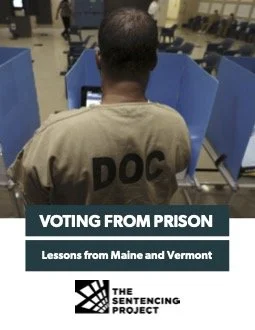
Voting From Prison: Lessons From Maine and Vermont

By Kristen M. Budd, Rachel Didner-Jollie

Only two U.S. states – Maine and Vermont – do not disrupt the voting rights of their citizens who are completing a felony-level prison sentence.1 Incarcerated Mainers and Vermonters retain their right to cast absentee ballots in elections. Because of the states’ unique place in the voting rights landscape, The Sentencing Project examined how their Departments of Corrections facilitate voting. We sought to determine experiences and lessons to share nationally as momentum builds in states, such as Illinois, Maryland, and Oregon, to expand voting rights to people completing a felony-level sentence in prison or jail.2

Voting is one prosocial way to maintain a connection to the community, which is particularly important during incarceration, and it helps to build a positive identity as a community member.3 The right to vote is also an internationally recognized human right.4 While voting is a cornerstone of American democracy, an estimated 1 million citizens cannot vote because they are completing a felony-level sentence in prison.5 Given racial disparities in incarceration, people of color are disproportionately blocked from the ballot box due to voting bans for people with a felony-level conviction.6

This first-of-its-kind research is a culmination of a multi-year inquiry in Maine and Vermont about how voting rights are implemented in prisons. The Sentencing Project sought to answer two interrelated questions:

What are incarcerated residents’ views about voting and the voting process?

What are the facilitators and barriers to implementing voting rights within the Department of Corrections, according to Department of Corrections staff and other stakeholders?7

Past research has found low voter turnout among people incarcerated in these states, despite incarcerated residents retaining their voting rights while completing a felony-level sentence.8 This suggests that, in practice, the absentee ballot voting process may be more complex in correctional settings.9

Our findings are based on 21 interviews with staff from the Maine and Vermont Departments of Corrections and other stakeholders who collaborated with these agencies in voting rights work, as well as our survey of incarcerated Mainers and Vermonters in which 132 incarcerated people participated. This investigation revealed:

Nearly three quarters (73%) of incarcerated survey respondents said that voting during incarceration is important to them.

Almost half (49%) of incarcerated respondents said that they did not know how to vote at their facility.

Facilitators that supported voting within the Departments of Corrections included:

Involvement of the Secretary of State’s Office, non-profit groups, and individual volunteers.

Cooperation from the Departments of Corrections’ administration and staff.

Coordination of in-person voter registration drives to assist incarcerated residents with the voter registration process.

Barriers that hindered voting within the Departments of Corrections included:

Incarcerated residents’ lack of knowledge about their voting rights and how to navigate the multiple-step process to vote absentee.

Limited information about candidates to inform voters and a lack of guidance on voting dates and deadlines.

A lack of staff training on incarcerated residents’ voting rights and how to assist incarcerated residents with voting.

Additional logistical challenges included:

Limited access to the paperwork needed to vote (e.g., registration forms, ballot requests).

Delays caused by prison mail and mail external to the facility.

A lack of person-power or capacity by corrections staff and other stakeholders to conduct voting rights work across all facilities.

Based on these findings, The Sentencing Project recommends providing more equitable access to voting and democracy during imprisonment by:

Establishing on-site polling locations in all correctional facilities that have eligible voters.

Expanding education for incarcerated residents about their voting rights and how to vote using an absentee ballot method.

Training corrections staff on incarcerated residents’ voting rights and on the process of assisting residents who are voting from prison.

Increasing access to candidates and candidate information, including hosting candidate forums within the prison.

Permitting and providing access to official government websites as additional avenues to register to vote, request ballots, track ballots, and learn about state and local ballot initiatives.

Such a vision for voting in prisons is attainable. A movement is already underway to increase access to the ballot in jails.10 Due to the fluidity of jail populations – where an average stay is 32 days – coordinating voting efforts in jails can be even more complex.11 Yet, even with such hurdles, turnout in jails with on-site polling locations has surpassed citywide turnout rates in places like Cook County, Illinois and Washington, DC.12 The successful implementation of jail-based voting demonstrates that prison-based voting is possible. Every eligible American citizen should be able to cast a ballot in elections regardless of conviction or incarceration status. In the words of one incarcerated resident in Maine, “I believe strongly [that] voting is a fundamental right for every American citizen. Being incarcerated does not mean you forfeit that right so I voted in here and will most definitely vote out of here.”

Washington, DC: The Sentencing Project, 2025. 36p.

download
Collaboration, Understanding, and Support: The Innovative Employment Solutions Program and a New Approach to Workforce Development for People Affected by the Justice System

By Douglas Phillips, Gabriel Weinberger, Michelle S. Manno

Evidence shows that employment can help keep people on parole or probation from coming back in contact with the justice system. But people who have a history of such involvement may lack educational credentials or have little work history, and must contend with employers’ bias against hiring them. Furthermore, they may require additional support—such as housing or transportation—to be ready to handle the demands of employment.

The Los Angeles County Innovative Employment Solutions Program (INVEST), established in February 2018, is designed to address the range of employment and supportive-service needs people on probation may have and support them in pursuing their employment and career goals. It operates at selected career centers in Los Angeles County. The program combines features of traditional workforce programs with some additional components. Most notably, it offers intensive training to prepare staff members to work with people on probation, collaboration between probation officers and employment staff members who work together in the same space, and additional funding for supportive services.

This report presents the findings of an evaluation of the INVEST program, which consisted of an implementation study and an outcomes study. The implementation study finds that the INVEST program is being implemented as intended, making a variety of employment services and training and educational opportunities available to clients, along with supportive services. It also finds that clients do not always take advantage of program services. The program services most frequently used are those related to finding employment quickly and services that take place as part of enrollment or very soon thereafter. Only about one-third of INVEST clients enrolled in any type of training program, and fewer than half of INVEST received any type of supportive service. This pattern suggests that people receiving services from INVEST need income from employment quickly, and may need financial support to be able to participate in education or training.

The outcomes study tracks employment and earnings for 1,232 INVEST clients who enrolled between March 1, 2018, and February 28, 2021, and compares their results with those of a group who were referred to INVEST but did not enroll. People who enrolled in INVEST had higher employment rates (by 12 percentage points) and higher earnings (by $1,931) over the course of a follow-up year (beginning about a year after enrollment and ending about two years after enrollment). This difference overwhelmingly reflects results among one subgroup of individuals who did not have any reported earnings when they enrolled. However, the comparison group for this part of the study was not constructed rigorously, so it is difficult to say with any confidence that the INVEST program is the reason for these improvements.

It was also not possible to construct a rigorous comparison group for outcomes related to involvement in the legal system. Compared with a similar group in another MDRC study in Los Angeles County, INVEST clients were less likely to be involved in the legal system in the year after enrolling. About three-quarters of INVEST clients avoided any arrest during that year.

Future research using a more rigorous study design—that was able to draw on more comprehensive data—could help to determine the program’s impacts on employment, earnings, and involvement in the criminal legal system, and to identify whom the program helps most.

New York: MDRC, 2025, 62p.

download
A New International Approach to Beating Serious and Organised Crime

By Crest Advisory and The Tony Blair Institute for Global Change

It almost feels like a cliché to say that serious and organised crime (SOC) is evolving rapidly and continuously in scale, shape and sophistication. However, after five years leading INTERPOL’s global operational responses to crime and terrorism, I’ve seen first-hand how far these escalating threats are outstripping our well-intentioned but linear, dated and fragmented response mechanisms.

In any losing battle, it is necessary to draw back and reconsider one’s approach. That is why it is time for us to recognise that SOC is no longer simply a criminal-justice matter alone – it has become a societal threat, and it is time it was treated with the seriousness, focus and renewal of tactics this demands.

My time as Executive Director of Police Services at INTERPOL fundamentally changed not just the way I see crime but the way I see the business models behind that crime. I came into this role from specialist commands at New Scotland Yard and geographic leadership as Chief Constable of Essex. But when I began looking at crime through its actual drivers and enablers – technology, transport, communication and broader logistical systems – it became impossible to ignore just how far our current models were falling short.

The implications are profound. This unique role offered a rare perspective and it was an immense privilege. Whether it was the fallout of the Afghan government’s collapse on drug flows and human trafficking, or the levels of sophistication, reach and ruthlessness of West African organised crime groups, the conclusion was the same: the criminal threats have moved on, and we haven’t.

Working internationally, it is clear how SOC embeds itself in our economies, institutions and in some cases governance and political systems. These subtle, malign networks are built to avoid law-enforcement attention, to adapt on the fly, to exploit our media and political distractions, and our global obsession with “perimeter” mindsets. The reality is that not only is law enforcement often too busy and too consumed by existing threats to notice the emergence of new, more sinister ones, but its global architecture is fractured, duplicative and falling behind.

Nowhere is this as evident as in the use of technology, which has become the ultimate enabler for SOC. From AI and deepfakes to encrypted comms and crypto flows, organised crime groups are exploiting every tool at their disposal. They’re using entrepreneurial models to recruit, move money, manage their supply chains and to attack at speeds and volumes that overwhelm traditional policing models.

This paper makes the case plainly: in the face of such technically enabled criminal business models, if we don’t treat our data and computing power as strategic assets, we are choosing to lose.

Law enforcement is still chasing symptoms, not systems. Exceptional individuals working in law enforcement are constrained by legacy tools, bureaucratic structures and performance frameworks that were created for a bygone age. Prosecutions take years. Trials are complex and juries are expected to seize complex legal and evidential issues. Meanwhile, the criminal networks regenerate.

This paper highlights the urgent need for a bolder, more strategic and proactive set of tools that sit beyond law enforcement – including sanctions, online disruption and new global mechanisms that match the transnational nature of the threat. It is refreshing because it challenges the orthodoxy and questions the institutional inertia that prevents us from taking a fundamentally different tack: one that focuses on enablers, is rooted in disruption and built on bold, trusted partnerships.

Arrests alone will never dismantle criminal economies. Organised crime functions as an economy, and must be considered and tackled accordingly. This will require disrupting logistics, targeting financial facilitators, and redirecting seized assets to strengthen the very systems needed to fight back.

This situation also means the private sector must at long last be integrated into the frontline response. Finance, tech, logistics and data systems are being exploited daily, yet their operators remain on the sidelines, or are brought in through fragmented, ad hoc efforts. These sectors can see the damage, and wish to help, yet we just haven’t made it easy for them. This paper rightly calls for their operational integration, as part of a strategic design, as essential and included partners, not as an afterthought.

No matter how imperfect or distasteful, we must be willing to put a value on serious and organised criminal harms, exactly in the way we do with other global security threats. Too often politicians avoid attaching a price to abuse and exploitation as it highlights the scale of what is happening to the public and the media. But if we’re serious about resourcing a meaningful and sustainable response, we can no longer afford to look away. Influence, funding and political attention follow data. A serious response must follow the same logic.

In the same vein, we cannot afford to ignore the geopolitics of SOC. Today on the global stage and even at a domestic level, consensus is hard-won in a world defined by distrust, instability and polarised politics. But that’s no excuse to retreat. Democracies cannot afford to treat SOC as an abstract or future concern. We must learn the lessons from across the world – just because it is difficult to see, does not mean it is not already here, not already shaping global systems, and it demands a response as strategic, coordinated and relentless as the threat itself.

The path forward will not be easy, but the case for change is clear. Conventional structures and risk-averse strategies will not meet the moment. It is time for a new mindset: one that treats data and computing power as strategic assets, accepts disruption as vital tools, and one that is willing to experiment with new institutional models that break with convention.

The ideas set out here reflect that new mindset. They propose not incremental reform, but a fundamental rethink of how the international community responds to SOC. The goal is not simply to cope with today’s threat landscape, but to get ahead of it.

This moment demands strategic ambition and operational realism, and, above all, urgency. Criminals relish our adherence to old models. SOC has already shaped the world around us.

Our response must now do the same

London: Crest Advisory and The Tony Blair Institute for Global Change, 2025. 48p.

download
Notification of Concerns Regarding the Federal Bureau of Prisons’ Policies Pertaining to the Use of Restraints on Inmates

By The U.S. Department of Justice, OFFICE OF THE INSPECTOR GENERAL

The purpose of this memorandum is to advise the Director of the Federal Bureau of Prisons’ (BOP) of the Department of Justice (DOJ or Department) Office of the Inspector General’s (OIG) concerns regarding the BOP’s policies and practices pertaining to the use of restraints on inmates. The OIG identified these concerns in connection with our investigators’ reviews of allegations by multiple BOP inmates at multiple BOP institutions that they were placed in restraints while confined to a bed or chair for extended periods and were assaulted or otherwise mistreated while in restraints. Some of these inmates were placed in fourpoint restraints, which are restraints using four points of contact—both wrists and both ankles—to confine an inmate to a bed, and others were placed in restraints on both wrists and ankles while confined to a chair. Some inmates reportedly suffered long-term injuries after prolonged placement in restraints. For example, one inmate suffered injury requiring the amputation of part of the inmate’s limb after being kept in restraints for over 2 days. We found that shortcomings in BOP’s policies and practices contributed to the concerns we identified and limited the availability of evidence that could either corroborate or refute inmates’ accounts of what happened while they were in restraints, thereby impairing the OIG’s ability to investigate allegations of misconduct by BOP employees. Specifically, we identified the following shortcomings: Lack of clarity in BOP policy as to the meaning of four-point restraints and lack of clear guidance regarding restraint, medical, and psychology checks of inmates in restraints that are not considered four-point restraints; Policies and practices that allow inmates to be kept in restraints for prolonged periods, sometimes leading to long-term injuries, and that require only limited oversight by BOP regional offices while inmates are in restraints; Inadequate guidelines to memorialize what occurred during restraint checks, including the absence of a requirement that BOP staff video and audio record restraint checks; and Inadequate guidelines to document medical checks of inmates in restraints. Clearer and more robust policies would assist the BOP in protecting inmates from abusive treatment, shielding staff from false allegations, deterring misconduct by staff, and holding staff who engage in misconduct accountable. Since the OIG reviewed the allegations that formed the basis of this memorandum, the BOP has made updates to its policies regarding the use of force and application of restraints, including new training guidelines for confrontation avoidance and de-escalation tactics. While these updates are an improvement to the BOP’s policies, additional policy revisions are needed to address the OIG’s concerns. In this memorandum, the OIG makes six recommendations to address the concerns we identified. Separately, the OIG is continuing to conduct an audit related more broadly to the BOP’s oversight of its use of restraints.

Washington, DC: The U.S. Department of Justice, OFFICE OF THE INSPECTOR GENERAL2025. 22p.

download
Comparing the Uses and Benefits of Stationary Cameras Versus Body-Worn Cameras in a Local Jail Setting

By Brittany C. Cunningham, Bryce E. Peterson, Daniel S. Lawrence, Michael D. White, James R. Coldren, Jr., Jennifer Lafferty, Keri Richardson

With funding from the National Institute of Justice (2018-75-CX-0019), CNA examined the impact BWCs provided to correctional deputies within the Loudoun County Adult Detention Center (LCADC) in Virginia. The study aimed to contribute to the body of knowledge on the implementation and impact of BWCs in jail settings and to assess the degree to which BWCs affect correctional deputy safety, serious events, resident injuries, and cost effectiveness. The LCADC implemented the Watchguard VISTA BWCs provided by Motorola Solutions. This study is supported by several other publications. First, we conducted an analysis of the changes in deputies' attitudes toward the BWC program over the course of the yearlong study period (November 2020 to October 2021) (Peterson et al., 2023). Second, we investigated the impact of BWCs on the prevalence and dynamics of RTR events, including deputy control methods and resident resistance levels (Lawrence et al., 2023a). Third, we assessed the impact BWCs had on the number of resident injuries and how RTR event characteristics affect the likelihood of an injury occurring (Lawrence et al., 2023b). The final research report of the grant provides a comprehensive summary of the project and its numerous findings (Cunningham et al., 2023) The LCADC, operated by the Loudoun County Sheriff’s Office, provides jail services to Loudoun County, Virginia, which is the third most populous county in the state, with a population of nearly 421,000 in 2020 (US Census Bureau, 2023). The facility houses maximum-, medium-, and minimum-security level residents and includes work release, workforce, drug treatment, and mental health programs. Most LCADC residents are pretrial detainees, with approximately 20 percent serving sentences for misdemeanor or felony convictions. During the evaluation period, the facility had an average daily population of 222 residents of which 81 percent were male and 51 percent were white, 24 percent were Black, 21 percent were Hispanic, and 3 percent were Asian. During this time, more than 80 percent of residents had a length of stay under two weeks, while only 4 percent of residents had a length of stay over six months. The LCADC is staffed by 124 individuals, including 102 front-line deputies and 22 supervisors, the majority of whom are white and male. Staff supervise eight housing units that have one to four housing pods (20 pods in the entire facility), in addition to four general units that include the medical unit, hallways, intake unit, and transportation between the facility and outside locations (e.g., county courthouse, offsite medical facilities)

Arlington, CA: CNA , 2023. 16p.

download
From Incarceration to Encampment: Why So Many Ontario Prisoners End Up Homeless

By Safiyah Husein, Capryce Taylor, Jacqueline Tasca, Meaghan Costa, Reza Ahmadi

John Howard Society of Ontario

“At least 10% of Ontario’s homeless population went directly from an Ontario jail to life on the streets.”

This report outlines actionable recommendations and best practices to reduce homelessness among individuals with experiences of incarceration. The insights provided are based on comprehensive discussions with people with lived experience, housing providers, community service agencies and policy professionals.

Kingston: John Howard Society of Ontario, 2025. 36p.

download
The Sociology of Police Behavior

By Rashawn Ray, Connor Powelson, Genesis Fuentes, and Long Doan

Black Americans are 3.5 times and Black teenagers are 21 times more likely to be killed by police than their White counterparts. Generally, protective factors such as social class do little to reduce this disparity, as high-income Black Americans are just as likely to be killed by police as low-income Black Americans. Given these outcomes, it is unsurprising that the bulk of sociological research on policing examines disparities in policing outcomes between Black and Brown communities and individuals and their White counterparts. We begin by outlining this important research. In addition to focusing on the consequences of (over)policing, sociologists can make unique contributions to our understanding of the empirical limitations of contemporary policing data and the macro-, meso-, and micro-level mechanisms that contribute to policing inequalities. While we draw upon some research in other disciplines, sociologists can and should do more in these areas. Accordingly, the end of this review focuses on future directions and theoretical possibilities by centering emerging research that pivots sociology to a more direct focus on overcoming the methodological limits of police research and contributing to meaningful behavioral, organizational, and policy changes.

ANNUAL REVIEW OF SOCIOLOGY Volume 50, 2024

download
The Study of Racism and Policing in the United States

By Spencer Piston,1 Kaneesha R. Johnson,2 Selma Hedlund,3 and Chas Walker

We begin this article by discussing two moments, in the late 1800s and late 1900s, in which the racist views of influential political scientists fundamentally shaped research on policing. In contrast, today’s scholarship, breaking sharply with research of the past, does not attempt to justify racist policing but to study it. The dominant approach today follows a racial disparities framework, which maps out the uneven allocation of police harms. As we discuss, these studies have made valuable contributions to the field and to real-world efforts to resist the damage done by police. At the same time, however, the racial disparities framework has limitations that make it difficult for scholars to understand racist police oppression. We conclude by arguing that, to take the next step forward, future scholarship should follow the lead of and expand upon work that centers the voices of the highly policed.

Annu. Rev. Political Sci. 2025. 28:499–519

download
Post-Visit Briefing: Monitoring Visit to Washington Correctional Facility (March 26–27, 2024)

By The Correctional Association of New York (CANY)

The Correctional Association of New York (CANY) has released a report on Washington Correctional Facility, a medium-security prison for men located in Washington County, NY. The report details findings from interviews with incarcerated individuals, analysis of administrative data, meetings with staff, and observations made by CANY during a monitoring visit in March 2024.Key findings include:

73% of incarcerated individuals interviewed reporting witnessing or experiencing verbal, physical, or sexual abuse.

The facility had a 21% vacancy rate in January 2024, which resulted in high rates of mandatory overtime and reduced operations, such as limited access to recreation for incarcerated individuals.

Grievance filing rates were lower than other medium-security prisons. No individuals interviewed reported that they felt the grievance process was fair.

Many incarcerated people reported positive experiences with vocational (e.g., welding, custodial maintenance) and academic programs. The facility administration expressed concern about low rates of attendance.

New York: Correctional Association of New York, 2025. 66p

download
Incarceration on Rikers Island in the Aftermath of the New York State Corrections Officers Strike

By Kellyann Bock & Michael Rempel

Following a statewide corrections officer strike in February 2025 and the termination of over 2,000 officers, New York State prisons have been unable to accept timely transfers of people sentenced to state time. This brief analyzes the resulting surge in the “state-ready” population on Rikers Island—those awaiting transfer to prison—which rose more than eight-fold from 101 to 875 people from February to June 2025. As of the end of June 2025, these individuals accounted for 11% of the total jail population and are responsible for 89% of February-to-June 2025 jail population growth. In short, the jail population would have changed little in the first half of 2025 if not for the ripple effects of the corrections officer strike.

New York : Data Collaborative for Justice, 2025. 7p.

download
Minimal Impact: Analyzing State Sentencing Reforms and Racial Disparities in Selected State Prison Populations

By Georgia State University, the Crime and Justice Institute, and the Council on Criminal Justice

Over the past 20 years, most American states have adopted a wide range of changes to their criminal sentencing statutes. The goals of the reforms varied. Some targeted certain offenses for greater or lesser penalties. Others aimed to cut correctional costs, expand alternatives to incarceration, and reduce recidivism. Few laws were enacted explicitly to reduce racial and ethnic disparities. Still, many policymakers hoped they would do just that, and the starkly disproportionate incarceration of Black people has been a central component of the national conversation about criminal justice reform.

New York: Council on Criminal Justice, 2024.

download
Literature and Epistemic Injustice: Power and Resistance in the Contemporary Novel

By Sarah Colvin

A vital resource for anyone interested in literature and politics, this is the first in-depth study of epistemic injustice as a concept for literary studies. Focusing on contemporary fiction in an age of post-truth, it shows how eight novels set in different global contexts reveal epistemic injustice as an authoritarian practice and offer an aesthetics of resistance. Epistemic injustice valorises the thinking of those in power while suppressing other people’s knowledge; it declares some people omniscient and others targets for violence. This book tracks how the novels make tangible its strategic use and effects while suggesting – in their form as well as their content – that something else is possible. Bridging political philosophy and literary analysis in clear prose, this study offers exciting new stimuli for reading groups and general readers as well as for students of literature.

Oxford: Routledge, 2025. 258p.

download
Global Trends in Law Enforcement - Theory and Practice

By Stamatakis, Nikolaos

Global Trends in Law Enforcement - Theory and Practice is a thought-provoking collection of studies that define contemporary policing on a global scale. As the world becomes increasingly interconnected, law enforcement agencies face unprecedented challenges, from rapidly advancing technology to the complexities of transnational crime. This comprehensive volume brings together diverse perspectives from leading scholars and practitioners, offering a rich tapestry of insights that illuminate the evolving landscape of law enforcement. The present book is an indispensable resource for academics, practitioners, policymakers, and students seeking a deep understanding of the rapidly evolving world of law enforcement. As a definitive guide to global trends, Global Trends in Law Enforcement - Theory and Practice paves the way for a new era of informed and effective policing in an interconnected world.

London: IntechOpen, 2024.

download
Good Governing 

By Rodriguez, Daniel B. 

Good Governing: The Police Power in the American States is a deep historical and legal analysis of state police power, examining its origins in the founding period of the American public through the 20th century. The book reveals how American police power was intended to be a broad, but not unlimited, charter of regulatory governance, designed to implement key constitutional objectives and advance the general welfare. It explores police power's promise as a mechanism for implementing successful regulatory governance and tackling societal ills, while considering key structural issues like separation of powers and individual rights. This insightful book will shape understanding of the neglected state police power, a key part of constitutional governance in the U.S.

Cambridge, UK: Cambridge University Press, 2024. 

download
Community Vigilantes in Metropolitan Kano 1985-2005 

By Rasheed Olaniyi

Kano is a city where a multi-layered form of community policing was established in the era of the rollback of the state in social provisioning in the midst of ever-increasing armed banditry and crime. Between 1985 and 2005, vigilante groups were established in almost all the neighbourhoods of Kano with the support of the traditional authority and community leaders. However, government interference, political instrumentalisation and inadequate support undermined its critical rote. Part of the rationale for the Police Community Relations Committee (PCRC) in Sabongari lies not in the efficacy of such initiative in reducing the incidence of crime but to confer a sense of identity, control of crime and security. The contradiction in PCRC could be located in the pathological fixation of police on corruption, which alienated and depressed the public from providing valuable information for crime control. The activities of vigilante groups and Hisba have reduced the high rate of juvenile delinquency in metropolitan Kano. The litmus test for Hisba in the implementation of Sharia law would be how it could reconcile the social diversity in a multicultural society such as Kano to ensure security and social harmony. The study concludes that the gap between different forms of vigilante groups, conflicting political motivations and the near discordant relations with the police, produced a dysfunctional mechanism for crime control.

Ibadan: IFRA-Nigeria: 2005

download
Rape Unresolved: Policing Sexual Offences in South Africa

By Dee Smythe

More than 1 000 women are raped in South Africa every day. Around 150 of those women will report the crime to the police. Fewer than 30 of the cases will be prosecuted and no more than 10 will result in a conviction. This translates into an overall conviction rate of 4–8 per cent of reported cases. What happens to all the other cases?

Rape Unresolved is concerned with the question of police discretion and how its exercise shapes the criminal justice response to rape in South Africa. Through a detailed, qualitative review of rape dockets and victim statements, as well as interviews with detectives, prosecutors, magistrates and rape counsellors, the author provides key insights into police responses to rape.

A complex picture emerges, of myths and stereotypes, of skills deficits, of disengagement by police as well as victims. Responsibility for the investigation of the cases – and their ultimate failure – is shifted onto the complainants, who must constantly prove their commitment to the criminal justice process in order to be taken seriously.

The vast majority of rape victims who approach the criminal justice system in South Africa do not receive justice or protection. This book uncovers the fault line between the state’s rhetorical commitment to addressing sexual violence through legal guarantees and the actual application of these laws.

Cape Town: University of Cape Town, 2022. 

download