
Open Access Publisher and Free Library
CRIMINAL JUSTICE.jpeg

CRIMINAL JUSTICE

CRIMINAL JUSTICE-CRIMINAL LAW-PROCDEDURE-SENTENCING-COURTS

Posts tagged transparency
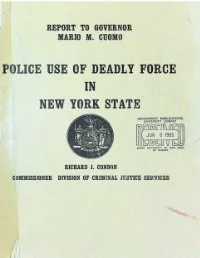
Police Use Of Deadly Force In New York State: A Report To Governor Mario M. Cuomo

Richard J. Condon Commissioner Division Of Criminal Justice Services

Police Use of Deadly Force in New York State: A Report to Governor Mario M. Cuomo (1985) offers one of the earliest systematic examinations of how and why lethal force was deployed by law enforcement across the state during a period of intense public scrutiny. Commissioned at a time when debates over police accountability, training standards, and civil rights were gaining national prominence, the report evaluates legal frameworks, departmental policies, and patterns of police–citizen encounters to assess the necessity and proportionality of deadly force incidents. Drawing on case reviews, agency surveys, and statistical analyses, it seeks to identify structural weaknesses and propose reforms aimed at reducing unnecessary violence and strengthening public trust.

Viewed from today’s perspective, the report stands as an important precursor to contemporary discussions about policing and the appropriate limits of state power. In the decades since its publication, nationwide movements such as Black Lives Matter, advances in data transparency, increased availability of video evidence, and evolving constitutional standards have intensified scrutiny of deadly force practices. Modern debates continue to revolve around issues the 1985 report identified early on: the need for clear and consistent use‑of‑force policies, robust training in de‑escalation, improved data collection, and stronger mechanisms of accountability. As current policymakers and communities grapple with how to balance public safety, civil liberties, and equitable treatment, this historical report offers valuable insight into the longstanding nature of these challenges and the enduring need for thoughtful, evidence‑based reform.

If you'd like, I can also turn this into a full foreword, integrate it into a larger document, or tailor the tone for academic, policy, or public audiences.

NY. Division Of Criminal Justice Services. 1985. p.273.

download
The Hidden Web of Criminal Legal System Fines and Fees in Kentucky

By ASHLEY SPALDING, PAM THOMAS, PATIENCE MARTIN, SCOTT WEST and KAYLEE RAYMER

A new report from the Kentucky Center for Economic Policy reveals how this convoluted and opaque system extracts millions from the communities least able to bear the burden — including nearly $60 million collected from a single standard court fee imposed on all cases between 2022 and 2024. The report also highlights $91.4 million in unpaid court debt as of 2019, underscoring the long-term impact of these obligations. Geography also plays a role, with counties often charging fees that vary widely across the state, meaning that the same offense and same court experience can have very different costs, depending on where a person is arrested.

The authors offer a set of urgent policy recommendations, including eliminating jail as a consequence for unpaid fines and fees, implementing ability-to–pay assessments, and increasing data transparency and accountability across the system.

Berea: Kentucky Center for Economic Policy, 2025. 27p

download
Anti-Corruption Collective Action: A Typology for a New Era

By Scarlet Wannenwetsch


Since its first use by the World Bank in 2008, the concept of “anti-corruption Collective Action” has evolved into a well-established best practice to prevent corruption and strengthen business integrity. This paper captures the specific characteristics of anti-corruption Collective Action that have emerged over time and translates them into an easy-to-grasp typology that reflects both the variety and unifying principles that make up the Collective Action ecosystem. It aims to: • spark new impetus for engagement; • open the concept to new stakeholders, topics and environments; and • support existing initiatives in developing their long-term visions and aims. In addition to supporting practitioners, updating the typology will also help strengthen the case for Collective Action as a normative corruption prevention practice 


  This Working Paper presents an updated typology for anti-corruption Collective Action, a concept first defined by the World Bank in 2008. The new typology aims to reflect the realities and evolution of Collective Action, which is now becoming a well-established best practice for preventing corruption and strengthening business integrity. The paper seeks to enhance understanding, encourage broader stakeholder engagement and support the long-term visions of existing initiatives. The typology builds on the key characteristics of Collective Action that have developed into common denominators over time: • Private-sector engagement: Collective Action is primarily driven by businesses, often in collaboration with governments and civil society. • Focus on addressing corruption: Initiatives target corruption and corruption-related risks. • Commitment to raising integrity standards: Collective Action aims to level the playing field through sustained engagement and concrete actions. Using these common characteristics, the paper identifies three distinct categories of Collective Action initiatives: 1. Engagement-focused initiatives: Centered on trust building, knowledge sharing and collaborative efforts to strengthen business integrity. 2. Standard-setting initiatives: Developing industry- or country-specific anti-corruption frameworks, codes of conduct and best practices. 3. Assurance-focused initiatives: Incorporating external verification, compliance certification and monitoring mechanisms to ensure accountability. These categories operate within a Collective Action ecosystem, where initiatives are interconnected and capable of evolving and transitioning between categories. The paper highlights the importance of trust, commitment and private-sector leadership. It also identifies challenges, such as avoiding free riding and ensuring credibility. The paper finds that Collective Action has evolved into a dynamic and adaptable approach that must remain flexible and responsive to context. Rather than prescribing rigid methodologies, a broader focus on the Collective Action ecosystem is necessary to help stakeholders effectively engage. Currently, Collective Action faces a critical juncture: the growing number of high-level commitments is contrasted with challenges in translating them into practical collaboration between the public and private sectors. A key concern is preventing Collective Action from becoming a mere tick-box exercise rather than a meaningful mechanism to drive business integrity To safeguard its impact, a robust ecosystem anchored by an active community of practice must guide how governments, regional organisations and international bodies integrate Collective Action into their anti-corruption frameworks. To successfully “mainstream” Collective Action, the community must adopt a shared language and further provide clarity of concept. The typology presented in this paper serves as a building block. There is still a long way to go, requiring concerted efforts from the Collective Action community to come together to define and drive what meaningful progress looks like.   


Working Paper 56, 


Basel, SWIT: Basel Institute on Governance. 2025. 39p.

Download