
Open Access Publisher and Free Library
HUMAN RIGHTS.jpeg

HUMAN RIGHTS

Human Rights-Migration-Trafficking-Slavery-History-Memoirs-Philosophy

Posts tagged international
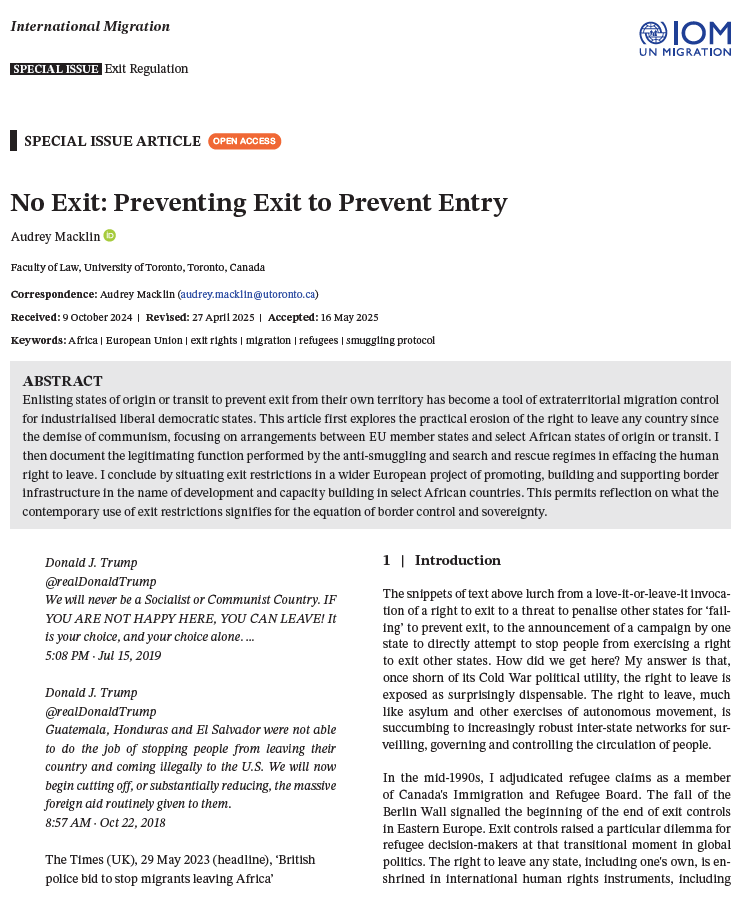
No Exit: Preventing Exit to Prevent Entry

By Audrey Macklin

Enlisting states of origin or transit to prevent exit from their own territory has become a tool of extraterritorial migration control for industrialised liberal democratic states. This article first explores the practical erosion of the right to leave any country since the demise of communism, focusing on arrangements between EU member states and select African states of origin or transit. I then document the legitimating function performed by the anti-smuggling and search and rescue regimes in effacing the human right to leave. I conclude by situating exit restrictions in a wider European project of promoting, building and supporting border infrastructure in the name of development and capacity building in select African countries. This permits reflection on what the contemporary use of exit restrictions signifies for the equation of border control and sovereignty.

International Migration, June 2025
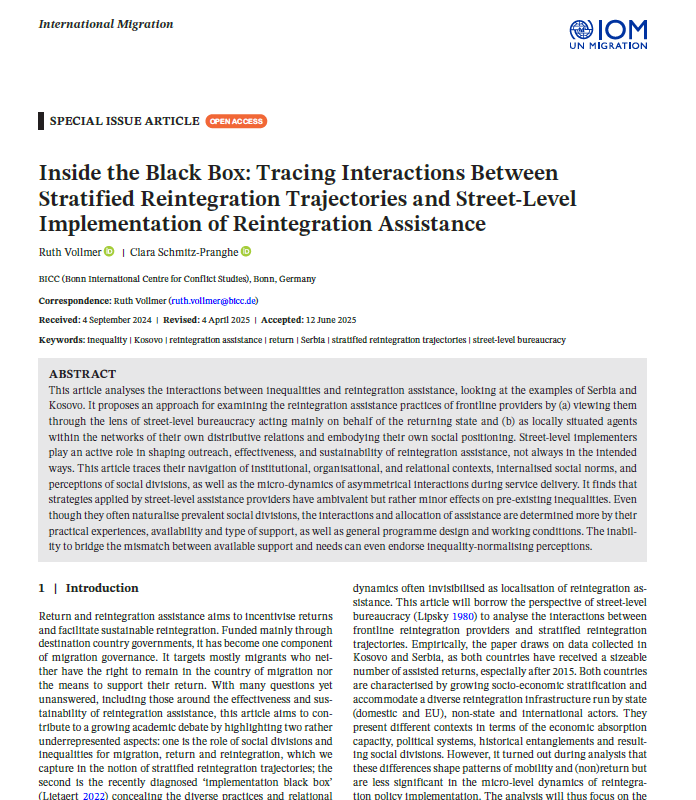
Inside the Black Box: Tracing Interactions Between Stratified Reintegration Trajectories and Street‐Level Implementation of Reintegration Assistance

By Ruth Vollmer, Clara Schmitz-Pranghe


This article analyses the interactions between inequalities and reintegration assistance, looking at the examples of Serbia and Kosovo. It proposes an approach for examining the reintegration assistance practices of frontline providers by (a) viewing them through the lens of street-level bureaucracy acting mainly on behalf of the returning state and (b) as locally situated agents within the networks of their own distributive relations and embodying their own social positioning. Street-level implementers play an active role in shaping outreach, effectiveness, and sustainability of reintegration assistance, not always in the intended ways. This article traces their navigation of institutional, organisational, and relational contexts, internalised social norms, and perceptions of social divisions, as well as the micro-dynamics of asymmetrical interactions during service delivery. It finds that strategies applied by street-level assistance providers have ambivalent but rather minor effects on pre-existing inequalities. Even though they often naturalise prevalent social divisions, the interactions and allocation of assistance are determined more by their practical experiences, availability and type of support, as well as general programme design and working conditions. The inability to bridge the mismatch between available support and needs can even endorse inequality-normalising perceptions.

International MigrationVolume 63, Issue 4

August 2025