Open Access Publisher and Free Library
HUMAN RIGHTS.jpeg

HUMAN RIGHTS

Human Rights-Migration-Trafficking-Slavery-History-Memoirs-Philosophy

Posts tagged conflict
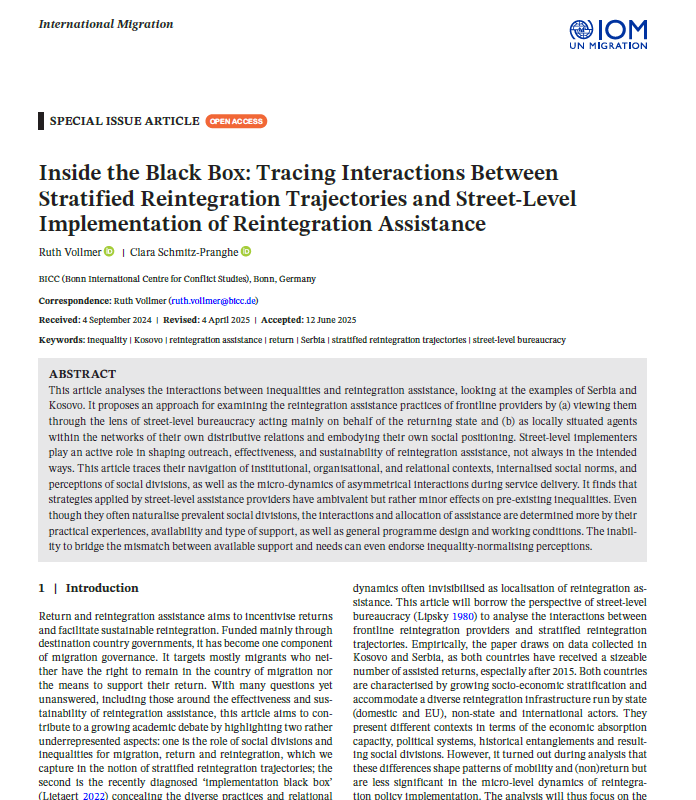
Inside the Black Box: Tracing Interactions Between Stratified Reintegration Trajectories and Street‐Level Implementation of Reintegration Assistance

By Ruth Vollmer, Clara Schmitz-Pranghe


This article analyses the interactions between inequalities and reintegration assistance, looking at the examples of Serbia and Kosovo. It proposes an approach for examining the reintegration assistance practices of frontline providers by (a) viewing them through the lens of street-level bureaucracy acting mainly on behalf of the returning state and (b) as locally situated agents within the networks of their own distributive relations and embodying their own social positioning. Street-level implementers play an active role in shaping outreach, effectiveness, and sustainability of reintegration assistance, not always in the intended ways. This article traces their navigation of institutional, organisational, and relational contexts, internalised social norms, and perceptions of social divisions, as well as the micro-dynamics of asymmetrical interactions during service delivery. It finds that strategies applied by street-level assistance providers have ambivalent but rather minor effects on pre-existing inequalities. Even though they often naturalise prevalent social divisions, the interactions and allocation of assistance are determined more by their practical experiences, availability and type of support, as well as general programme design and working conditions. The inability to bridge the mismatch between available support and needs can even endorse inequality-normalising perceptions.

International MigrationVolume 63, Issue 4

August 2025
Critical Incident Preparedness Toolkit. Assessing Capacity to Respond to Active Assailant Events

By Sara Giunti, Andrea Guariso, Mariapia Mendola, Irene Solmone 

In advanced economies, increasing population diversity often fuels hostile attitudes toward immigrants and political polarization. We study a short educational program for highschool students aimed at promoting cultural diversity and improving attitudes toward immigration through active learning. To identify the impact of the program, we designed a randomized controlled trial involving 4,500 students from 252 classes across 40 schools in northern Italy. The program led to more positive attitudes and behaviors toward immigrants, especially in more mixed classes. In terms of mechanisms, the intervention reduced students’ misperception and changed their perceived norms toward immigration, while it had no impact on implicit bias, empathy, or social contacts. Our findings suggest that anti-immigrant attitudes are primarily driven by sociotropic concerns rather than individual intergroup experience, and that educational programs combining critical thinking with cross-group discussion can correct them. 

  IZA DP No. 17978


Bonn:  IZA – Institute of Labor Economics , 2025. 71p.

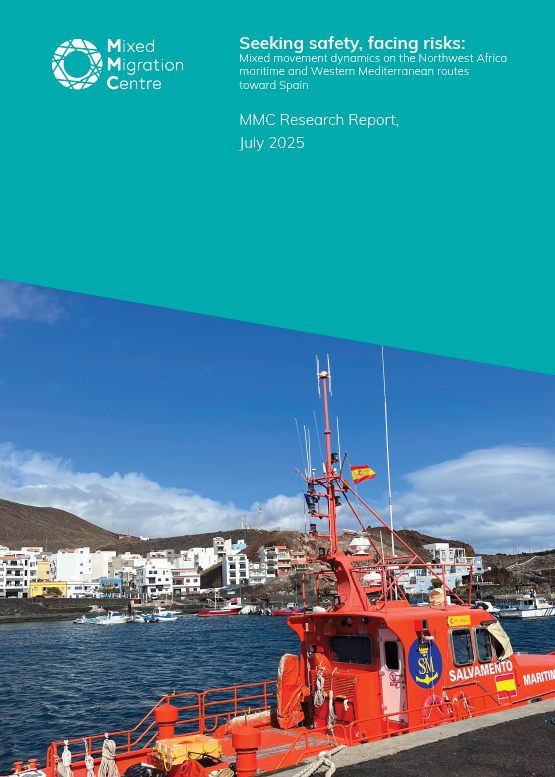
Seeking safety, facing risks. Mixed movement dynamics on the Northwest Africa maritime and Western Mediterranean routes toward Spain

By Giulia Bruschi

While most of the immigration towards Spain come from South American countries, the Western Mediterranean and the Atlantic remain the most important mixed migration routes from Africa toward Spain, and Europe more in general.

The steady increase in irregular arrivals via the Canary Islands since 2020 has catalysed the attention of EU policymaking and has continued to strain the reception system in the Canary Islands. In 2025, crackdowns on departures from Mauritania led to a reduction in irregular crossings. However, the Atlantic remains one of the deadliest sea crossings worldwide, and the land journeys to embarkation points also remain fraught with risks.

Meanwhile, the Western Mediterranean route continues to be used by migrants from West African countries, who must cross North Africa to reach the Mediterranean shores, and also poses several risks.

In this context, throughout 2024, MMC, in partnership with UNHCR, interviewed 497 migrants recently arrived in Spain via the Canary Islands, the Mediterranean, or via the land crossing in Ceuta and Melilla. The interviews aimed to explore their migration drivers, journeys, as protection risks in transit, asylum and onward movement intentions from Spain.

Mixed Migration Centre, 2025. 31p.

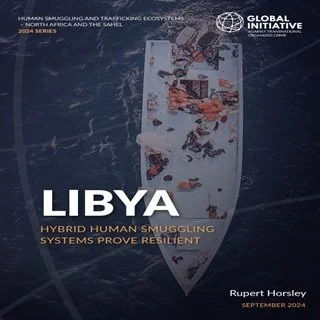
Libya: Hybrid Migration Systems Underpin Resilience of Human Smuggling

By Rupert Horsley

Human smuggling across these regions continues to evolve rapidly. Since the COVID-19 pandemic, significant changes have emerged in the volume and direction of migratory flows and smuggling networks. These shifts are closely linked to ongoing political, economic and security developments, including protracted conflict, governance crises and economic uncertainty.

Since 2016, the GI-TOC has monitored the political economy of human smuggling and trafficking in North Africa and the Sahel. This work was expanded and formalised in 2018 with the establishment of the North Africa and Sahel Observatory (NAS-Obs). Through annual country reports and thematic studies, the Observatory has provided a detailed understanding of the actors, routes and dynamics shaping mobility and exploitation in the region.

The 2025 series features country reports on Libya, Niger, Chad and Tunisia. Together, they capture the current transformations in human smuggling across both regions: from the persistence of hybrid smuggling systems in Libya, to evolving migration routes through Niger and Chad, and the increasing mobility of Sudanese refugees across North Africa. The reports also analyse the political and security contexts driving these trends, including the deepening conflict in Sudan, ongoing instability in Libya, and growing pressures along Tunisia’s coastal migration routes.

Geneva: Global Initiative Against Transnational Organized Crime, . 2025. 36p.

AFGHANISTAN: A MODERN HISTORY

MAY CONTAIN MARKUP

by ANGELO RASANAYAGAM

AFGHANISTAN: A MODERN HISTORY by ANGELO RASANAYAGAM presents a comprehensive overview of the tumultuous past of Afghanistan, delving into the intricate tapestry of its political, social, and cultural evolution. Rasanayagam navigates through centuries of Afghan history, shedding light on the diverse influences that have shaped the nation into what it is today. From the Great Game to the Soviet invasion, and the rise of the Taliban to the U.S. intervention, this book provides a nuanced understanding of the complexities that define Afghanistan's contemporary reality. A must-read for anyone seeking a deeper grasp of one of the world's most enigmatic nations.

London. J. B. Tauris & Co. Ltd.. 2010. 327p.