Open Access Publisher and Free Library
PUNISHMENT.jpeg

PUNISHMENT

PUNISHMENT-PRISON-HISTORY-CORPORAL-PUNISHMENT-PAROLE-ALTERNATIVES. MORE in the Toch Library Collection

Sentencing Offenders the Right Way: On the Importance of Relating Penal Theory and Penal Practice

By Jesper Ryberg

The ethics of punishment constitutes an area of research that has recently been through a significant expansion, both in breadth and depth. But why is such research important? And how can it be conducted in the most fruitful way? In this article it is argued, first, that the study of penal ethics is important in order to inform penal practice. However, second, it is shown that there are both theoretical and political obstacles to the possibility of delivering genuine action guidance to practitioners. Finally, four recommendations are presented that may help to ensure that research within the ethics of punishment is carried out in a manner that is consistent with the basic justification for its very existence, namely that it is needed to provide moral guidance of penal practices in the real world.

Crim Law Forum 36, 191–204 (2025).

download
Extradition and Whole Life Sentences

By Dirk van Zyl Smit & Christopher Seeds

Sentences of life imprisonment without a prospect of adequate review and release are prohibited in States party to the European Convention on Human Rights. Should the same principle apply when extradition is sought to States not party to the Convention? In Sanchez Sanchez v United Kingdom (2022), the Grand Chamber of the European Court of Human Rights applied a less strict standard for potential extraditees facing life without parole. We analyse this decision and its repercussions in light of the history of international cooperation in extreme punishment cases between Europe and the USA and recent interpretations of the new standard. The article concludes with an assessment of the level of proof litigants must present to satisfy the Sanchez Sanchez test and of how the law could continue to prevent inhuman and degrading treatment of extraditees facing life sentences.

Crim Law Forum 35 1–37 (2024).

download
“Rape Does Not Happen Like That Anymore”: Addressing Focal Concerns Surrounding Sexual Violence Among Incarcerated Persons

By Creaig A. Dunton, Hayden P. Smith, and Frank Ferdik

Unanimously passed by Congress in 2003, the Prison Rape Elimination Act (PREA) was designed to eradicate sexual violence from the American correctional system. Although sexual victimization is a significant issue in correctional facilities, there are other urgent concerns that weigh heavily on the minds of those in custody. To understand these focal concerns, open-ended survey data were collected from (N = 852) incarcerated persons who were serving sentences in four state prisons located in the Southeastern United States during a period of PREA implementation. Respondents cited staff shortages, enforced lockdowns, low-quality food, and inadequate rehabilitative services as focal concerns. Incarcerated persons utilized the PREA prompt as a proxy to share their concerns about safety, climate, and institutional issues. Results are discussed with reference to best practices for improving conditions of confinement to create safe carceral facilities.

download
Big Brother Babysitter: The Carceral Logic of Family Surveillance Apps

By Eleni Manis, Aaron Thomas, Erin McFadden, Hope Romaine, Sarah Roth, Sophia Wright, and Corinne Worthington

In this report, S.T.O.P. details how family surveillance apps transfer surveillance used for probation and parole to familial contexts, enabling abusive parents and intimate partners. Courts have even opportunistically used Life360, one family surveillance app, to enforce probation. The report calls on regulators to reign in family surveillance apps based on federal and state wiretap laws, and demands developers prioritize user safety if they refuse to pull the apps entirely.

Key Findings Include:

  • Family surveillance apps like Life360 repurpose the surveillance typically used to enforce probation and parole. In fact, some courts use Life360 in lieu of apps branded as probation or parole tools.

  • Family surveillance apps frequently function as stalkerware, enabling abusers to track their targets anywhere they go. These apps can enable abusive parents, intimate partner violence, and other crimes.

  • Most family surveillance apps track more data than needed to serve their core functions, compounding safety risks for tracked individuals.

  • Short of pulling family surveillance apps entirely, developers should implement anti-abusability measures recommended by advocates for survivors of domestic abuse.

download
Probation and parole in the United States, 2023

By Danielle Kaeb

This report presents findings on persons under community supervision on probation or parole in the United States in 2023. It includes characteristics of the U.S. community supervision population such as sex, race or ethnicity, and most serious offense. The report provides statistics on movements onto and off community supervision, and details types of exits, such as completing one’s term of supervision, being incarcerated, absconding, or other unsatisfactory outcomes while in the community. Findings are based on data from BJS’s Annual Probation Survey, Annual Parole Survey, and Federal Justice Statistics Program. This report is the 32nd in a series that began in 1981.

Highlights

At yearend 2023, an estimated 3,772,000 adults were under community supervision (probation or parole), up 27,900 (0.7%) from January 1, 2023.

From yearend 2013 to yearend 2023, among comparable agencies, the total adult community supervision population declined 23%.

During 2023, the number of adults on parole declined from 700,800 to 680,400 (down 2.9%).

The probation population increased for a second consecutive year in 2023, from 3,064,200 on January 1 to 3,103,400 on December 31 (up 1.3%).

Washington, DC: U.S. Department of Justice Office of Justice Programs Bureau of Justice Statistics, 2025. 43p.

download
Associative Life and Incarceration

By Grace Y. Li

Prison has been used for diverse purposes and has taken on an array of social meanings, becoming so malleable as to form a permanent fixture of government. Despite the variety of ends toward which imprisonment has been deployed, the practice always relies on one central mechanism: control over the associative lives of the incarcerated. The exercise of this control marks an unalterable, essential feature of prison. Regardless of what other brutalities it entails, imprisonment necessarily means removing people from their homes and communities and limiting their possibilities for relationships with people outside, as well as compelling association with others inside. This Essay presents an analytical framing of incarceration as a tool of associative control.Using the associative lens, the Essay levies a unifying critique of effects of prison that are typically treated in isolation. It also offers a critical comparison of incarceration to its justice system alternatives, which mirror incarceration in their assertion of associative control over people in their custody but diverge in their particular associative goals: they seek to promote social bonds while incarceration seeks to limit them. In this sense, the prison works against the larger goals of the criminal justice system. The Essay argues all these carceral forms engage in associative overreach, but that the associative control is a reformable aspect of “community corrections” but not of prison. In this way, the associational lens informs the debate about prison abolition versus reform: the prison’s associational harms cannot be reformed, and if they are unjustifiable, the prison is too.The prison is instructive as a site of extreme associative control, but the associative lens is more broadly applicable. It can act as a synthesizing frame to understand harms and functions of family regulation, disability, immigration, and more.

 Ohio State Legal Studies Research Paper No. 936,  2025.

download
Gaining Ground: How States Abolish or Restrict Application of the Death Penalty for Drug Offences

By Giada Girelli

The death penalty is an ineffective and inhumane punishment, and a prohibited one when imposed for drug offences. Still, as of 2024 it is retained in over 30 countries, and its implementation as a tool of drug control is a key driver of the use of capital punishment worldwide. At a time when its use is intensifying, by the part of an increasingly restricted but radical group of countries, it is critical to interrogate why and how governments around the world have abolished this measure or taken steps towards reducing its application. Such an assessment is key to understanding which actors and factors – social, political, cultural, economic – have influenced these processes, and which legal and policy steps were adopted to achieve that goal. In turn, this can offer important lessons to advocates, policymakers and practitioners on effective pathways to remove or restrict the application of the death penalty for drug offences in practice; as a step towards total death penalty abolition, and towards drug policies centred around dignity, health and rights. After a brief overview of the death penalty for drug offences, which builds upon Harm Reduction International (HRI) The Death Penalty for Drug Offences: Global Overview series (hereinafter: Global Overview), this report is divided into two main parts. The first one is a review of 17 case studies of countries and territories which have removed the death penalty for drug offences from their laws, or adopted reforms aimed at reducing its use. The second is an analysis of commonalities in and recurring features of these experiences, with a focus on agents of change, narratives, other influencing processes, and the role of transparency. The report closes with some recommendations for policymakers, experts and activists, building on the lessons that can be learnt from these case studies. 1. 2 OBJECTIVES AND METHODOLOGY This report reviews and analyses case studies of national developments which aimed to or had the effect of removing or restricting the use of the death penalty for drug offences. A primary purpose is to provide a comparative review of driving forces that practitioners and abolitionist activists can draw upon to develop strategies aimed at restricting use of the death penalty for drug offences in their own country. Attention is thus limited to (a) countries and territories with laws prescribing death as a punishment for drug offences at some point in their history; and (b) legal, policy, judicial or other developments which had at least the potential of restricting the use of this punishment; considering developments related to the death penalty for drug offences specifically, as well as developments related to the death penalty generally in countries where this punishment was prescribed for drug crimes. The death penalty is an ineffective and inhumane punishment, and a prohibited one when imposed for drug offences. Still, as of 2024 it is retained in over 30 countries, and its implementation as a tool of drug control is a key driver of the use of capital punishment worldwide. At a time when its use is intensifying, by the part of an increasingly restricted but radical group of countries, it is critical to interrogate why and how governments around the world have abolished this measure or taken steps towards reducing its application. Such an assessment is key to understanding which actors and factors – social, political, cultural, economic – have influenced these processes, and which legal and policy steps were adopted to achieve that goal. In turn, this can offer important lessons to advocates, policymakers and practitioners on effective pathways to remove or restrict the application of the death penalty for drug offences in practice; as a step towards total death penalty abolition, and towards drug policies centred around dignity, health and rights. After a brief overview of the death penalty for drug offences, which builds upon Harm Reduction International (HRI) The Death Penalty for Drug Offences: Global Overview series (hereinafter: Global Overview), this report is divided into two main parts. The first one is a review of 17 case studies of countries and territories which have removed the death penalty for drug offences from their laws, or adopted reforms aimed at reducing its use. The second is an analysis of commonalities in and recurring features of these experiences, with a focus on agents of change, narratives, other influencing processes, and the role of transparency. The report closes with some recommendations for policymakers, experts and activists, building on the lessons that can be learnt from these case studies. 1. 2 OBJECTIVES AND METHODOLOGY This report reviews and analyses case studies of national developments which aimed to or had the effect of removing or restricting the use of the death penalty for drug offences. A primary purpose is to provide a comparative review of driving forces that practitioners and abolitionist activists can draw upon to develop strategies aimed at restricting use of the death penalty for drug offences in their own country. Attention is thus limited to (a) countries and territories with laws prescribing death as a punishment for drug offences at some point in their history; and (b) legal, policy, judicial or other developments which had at least the potential of restricting the use of this punishment; considering developments related to the death penalty for drug offences specifically, as well as developments related to the death penalty generally in countries where this punishment was prescribed for drug crimes. For these reasons, this report does not attempt to provide a comprehensive, exhaustive overview of all domestic developments in all relevant countries and territories which had the potential or effect to restrict recourse to the death penalty for drug offence. Rather, it only describes and reviews some relevant developments, selected based on their perceived relevance for practitioners and experts, as well as availability of sufficient information and access to informants. 

London: Harm Reduction International, 2024. 70

download
Righting Wrongful Detention August 2025 Report on people wrongfully detained by the Department of Home Affairs 1 July 2023 – 30 June 2024

By The Office of the Commonwealth Ombudsman

This report is part of the Ombudsman's ongoing own motion investigation into instances where the Department of Home Affairs (the Department) has detained people it suspects to be unlawful non-citizens, but later identifies they were not unlawful and releases them from detention. It covers 11 cases of wrongful detention the Department identified between 1 July 2023 and 30 June 2024, including the wrongful detention of an Australian citizen. In one case, the person was wrongfully detained for one year and six months. Under section 189 of the Migration Act 1958 (the Act) an officer must detain a person they 'know or reasonably suspect' to be an unlawful non-citizen. While a decision to detain a person may have been lawful because an officer held the required reasonable suspicion at the time, in each of the cases considered in this report, their detention was wrong because that suspicion was later found to be incorrect. Wrongfully depriving a person of their liberty is serious. We commend the Department’s commitment to continually improving its policies and procedures to mitigate the risk of wrongful detention. However, since we began monitoring the issue in 2005, we have observed the same types of errors are causing people to be wrongfully detained. In addition, the Department has not improved the way it addresses its mistakes with the individuals it has wrongfully detained. The Department does not offer people it has wrongfully detained any form of redress, formal apology, or financial compensation. Although the Department may identify and acknowledge the mistake to the individual, the onus is on the individual to navigate the complex and often costly process of lodging a civil claim to seek damages for unlawful detention through the judicial system. Furthermore, because affected individuals are only informed verbally (rather than in writing) that an error has occurred on their release, they may not be aware of their ability to make such a claim or have access to the information required to support it. Of the 11 individuals who were wrongfully detained in this reporting period, only one has made a civil claim for unlawful detention.  

 Canberra:  The Office of the Commonwealth Ombudsman, 2024. 35p.

download
Punishment, Pupils, And School Rules

By John Tillson and Winston C. Thompson.

In this chapter we analyze general views on punishment in order to consider what behavioural requirements schools may establish for students and which (if any) they may enforce through punishment, during compulsory education. Punishment, as we use the word, is the intentional imposition of burdensome treatment on someone – usually on the rule breaker – for having broken a rule, partly because the treatment is burdensome. By carefully analyzing various aspects of punishment, we aim to identify principles that should guide and constrain which behaviours schools punish, and how and why they punish them. In brief, we develop the following principles regarding legitimate requirements that can be made of students and the ways punishment may be used to enforce them. Before children are autonomous, schools may establish both paternalistic, and other-regarding requirements, but not requirements imposed from within comprehensive conceptions of the good. 2 They may punish children in order to ensure a fair distribution of the burdens and benefits of social arrangements. Schools may punish children for paternalistic reasons, including developmental reasons, but not for reasons of general deterrence. When children become autonomous, compulsory schooling may establish only other-regarding requirements of student conduct. 3 They may punish to ensure a fair distribution of the burdens or benefits of social arrangements; this includes punishing for reasons of general deterrence, due to children’s responsible choices enhancing their liability, as well as for other-regarding developmental reasons.

Pedagogies of Punishment: The Ethics of Discipline in Education.. Bloomsbury Academic. 2023. pp. 35-62

download
Promises and Punishment

By Martin Dufwenberg , Flora Li , and Alec Smith

We study the effect of communication on beliefs and behavior in a three-stage trust game with punishment. We propose a novel behavioral mechanism, frustrationdependent anger, that links unmet payoff expectations with the willingness to forgo material payoffs to punish others. We conjecture that communication works through this mechanism to raise expectations about the likelihood of belief-dependent costly punishment and to increase trust, cooperation, and efficiency. In an experiment we allow communication in the form of a single pre-play message. We measure beliefs and our design permits the observation of promises and deception. The results are consistent with the theory that costly punishment results from belief-dependent anger and frustration. Promises drive the effect of communication on beliefs and broken promises lead to higher rates of costly punishment.

Preliminary draft. September 13, 2018

download
The Palace of Death

By H. M. Fogle. Intrdosction by Graeme Newman

At once a chronicle and a funeral dirge, The Palace of Death stands as a haunting testament to early twentieth-century American penal culture. Published in 1909 by an Ohio penitentiary official, H. M. Fogle's volume compiles 59 firsthand accounts of incarceration and execution—each rendered with chilling precision and accompanied by stark photographic documentation. The period covers the execution by hanging and the transition to the electric chair, all in considerable detail. These narratives propel the reader through the twilight of life, revealing how society confronts its most extreme judgments. Yet, behind the factual veneer lies a provocative tension: does Fogle intend to expose the tragedy of fallen humanity, or to feed a voyeuristic appetite for death? In this liminal space between documentation and spectacle, the work demands not only attention, but moral inventory.

Read-Me.Org Inc. New York-Philadelphia-Australia. 2025. p.229.

download free
Kindle $3.50 -- paperback -$11.99
Unlocking Virginia’s Workforce: The Economic Case for Higher Education in Prison

By The Justice Policy Institute

As Virginia faces a critical labor shortage and rising incarceration costs, the state also sits on an untapped resource: thousands of incarcerated individuals eligible for federal Pell Grants who are eager to learn, work, and contribute to their communities. Unlocking Virginia’s Workforce makes the economic and moral case for expanding access to higher education in Virginia’s prisons and offers a comprehensive policy blueprint for reform.

This report outlines the high cost inaction, presenting data-driven arguments for how postsecondary education reduces recidivism, strengthens families, and helps meet the state’s urgent workforce needs. It highlights policy gaps and systemic barriers – from outdated technology infrastructure to racial, gender, and geographic inequities – and offers concrete recommendations for Virginia’s elected officials, education institutions, employers, and corrections leaders.

Drawing on lessons from across the country and the lived experience of incarcerated learners, Unlocking Virginia’s Workforce shows how aligning prison education with the state’s economic priorities can reduce public spending, grow the talent pipeline, and build a more inclusive Commonwealth.

Washington, DC: Justice Policy Institute, 2025. 59p.

download
Australia's Prison Dilemma. Research Paper

By The  Productivity Commission

Australia is locking up a record number of people. Our imprisonment rate has grown steadily since the 1980s and is around its highest level in a century (figure 1). On 30 June 2020, more than 40 000 Australians were in prison. Many more flow through the prison system each year. Over one third of prisoners are on remand, waiting for trial or sentencing. And nearly 60 per cent have been in prison before The increase in imprisonment cannot be explained solely by changes in either the amount or type of crime. It is, at least in part, a policy choice. As a policy, imprisonment serves multiple objectives — deterring crime, removing dangerous individuals from the community, punishing and rehabilitating offenders, and supporting the rule of law. But it is also expensive. This raises a key economic question for policy makers. Is the current policy of increased use of imprisonment producing benefits for Australia that outweigh the costs? And what, if any, are the alternatives? In this paper — the Productivity Commission’s first venture into research on the criminal justice system — we highlight the information, data and options that policy makers need to answer these questions. The Commission has used an economic approach to help guide policy makers in weighing up the benefits of criminal justice policies against their costs. Even though this is only one perspective, it provides valuable insights into the complex trade-offs facing policy makers   

Canberra: Productivity Commission, 2021. 159p.

download
Identifying Drivers of Absconding

By Maja Vlajnic, Caitlin Flood, Rachel Schmidt, and Amanda Coscia 

To identify the factors that drive parole and probation revocations, the Crime and Justice Institute, conducted a comprehensive assessment of community supervision policies and practices in Colorado, Florida, Mississippi, and Montana.  In this report, the authors present their findings and identify areas of opportunity for reform. Among other barriers, the report highlights the lack of transportation and financial obligations as significant challenges to successful completion. Participants reported that the excessive costs of supervision, and fines and fees significantly impacted their experience on supervision. Additionally, 42 percent of people who had their probation revoked for absconding had a suspended or revoked license.

Boston: The Crime and Justice Institute (CJI) , 2025. 35p

download
Assessment of the Urgent Challenges in Minnesota’s Prison System

By The Center for Crime and Justice Institute

To understand the scope and the urgency of these challenges in Minnesota, state leaders sought assistance from the Crime and Justice Institute (CJI), funded by Arnold Ventures, to examine aspects of the state’s criminal justice system. This assessment included an examination of past and current prison population trends, prison conditions in the oldest prison facilities, and the costs associated with potential solutions. CJI analyzed publicly available data, performed statutory analysis, and interviewed criminal justice practitioners and stakeholders, including system-impacted individuals, attorneys, legislators, and staff at advocacy organizations.

The United States built its first prison in 1773 in an old copper mine. 1 The nation’s criminal justice system has grown and evolved, yet many facilities that the system continues to rely on were built in the 19th and early 20th centuries. Minnesota is an example of this, with over 2,000 individuals housed in two facilities built more than 100 years ago. 2 Continued use of these facilities is problematic as their structures prohibit the programming necessary for effective rehabilitation, and the conditions within their walls create dangerous safety and health hazards for staff and those incarcerated. 3 Since 1990, Minnesota’s prison population rose steadily until it peaked at over 10,000 people in 2016. The prison population declined during the COVID-19 pandemic, as it did nationally. However, post-pandemic, the population climbed, from 7,300 incarcerated people in 2021 to 8,277 in January 2025. 4,5 As of January 2025, the 109-year-old prison in Stillwater houses more than 1,100 people, and the 135-year-old prison in St. Cloud houses nearly 950 people.6,7 The dangerous conditions within these two facilities present an urgent need to act. Since 2023, there have been major disruptions in operations at both facilities. Individuals in custody refuse to return to their cells, and violent incidents that necessitate lockdowns further create stress and frustration inside the prison gates.8,9,10 This assessment found: • While Minnesota’s prison population and incarceration rate are below the national average, they are rising at a faster pace than the national rate. 11 • Stillwater and St. Cloud house a significant number of incarcerated individuals whom other facilities would have to accommodate if either facility had to shut down. 12 • The conditions at these facilities limit opportunities for programming, education, vocational training, and, thus, the ability for incarcerated individuals to earn credit to receive time off their sentences and to prepare to integrate successfully into their communities. 13,14 • While the recent passage of the Minnesota Rehabilitation and Reinvestment Act (MRRA) and other similar pieces of legislation are expected to reduce the amount of time incarcerated individuals serve in the state and, ultimately, the size of the overall prison system,15 these impacts will not be immediate. As the state waits to see these legislative efforts bear fruit, immediate steps are necessary to improve public safety, reduce recidivism, and improve the safety of the people who live and work in the prison system. This examination, which includes ways other states addressed similar challenges, will enable state leaders to make informed decisions about potential next steps to achieve these goals.

Boston: The Crime and Justice Institute (CJI)2025. 20p.

download
Formerly Incarcerated Women and Reentry: Trends, Challenges, and Recommendations for Research and Policy

By Holly Ventura Miller, 

This report for the US Congress Committees on Appropriations, published by the Department of Justice (DOJ), Office of Justice Programs (OJP), National Institute of Justice (NIJ), provides an overview on formerly incarcerate women experiencing reentry. The report reviews the literature related to female offending, victimization, and reentry and examines the extent and nature of women’s involvement in the justice system, with a focus on gender-specific pathways to crime as well as female reentry and rehabilitation. The report describes current trends in female reentry, describes the challenges faced by incarcerated women, and reviews the extant literature related to the effectiveness of reentry programming for women. Finally, the report concludes with suggestions for future research, along with specific recommendations for policy and practice. DOJ provides this report on formerly incarcerated women and reentry consonant with the House Report 116-101 accompanying the Consolidated Appropriations Act, 2020 (P.L. 116- 93). 

U.S. Department of Justice Office of Justice Programs FY 2020 Report to the Committees on Appropriations 

Washington, DC: U.S. Department of Justice Office of Justice Programs National Institute of Justice, 2021. 51p.

download
The St. Louis Police Partnership: An Individualized Focused Deterrence Implementation Guide
download

By Paige Vaughn and Richard Rosenfeld

Focused deterrence is a particularly promising approach for significantly reducing gang, group, and individual criminal behavior. Typical focused deterrence approaches involve bringing together individuals at high risk for violence in face-to-face group interventions, usually called “offender notification meetings” or “call-ins.” In the St. Louis Police Partnership, individuals at high risk for violence were instead targeted using customized, individual in-person meetings with detectives and parole officers assigned to the program. This novel approach was found to be effective using a randomized controlled trial evaluation. This implementation guide summarizes the basic features of the St. Louis Police Partnership, discusses challenges and lessons learned, and details key steps that must be taken to implement similar programs effectively in other jurisdictions  

Arlington, VA:CNA,  2024. 17p.

Why Domestic Violence Offenders Don’t Give Up Their Guns

By Natalie Nanasi

Perpetrators of intimate partner violence are barred by federal law and many states' laws from possessing firearms. While such prohibitions enjoy popular support, they are sporadically and inconsistently enforced, placing the lives of survivors at risk when offenders do not voluntarily comply. Many experts, including this author, have offered legal and policy solutions to increase the likelihood that perpetrators of domestic violence will either willingly relinquish their guns or otherwise be dispossessed of them. But these proposals may have been premature.

This Article is the first to take a step back and inquire why offenders do not surrender their firearms as ordered and what might incentivize them to do so. Understanding the worldviews and lived experiences of those subject to domestic violence gun prohibitions is a critical, and to-date ignored, first step to formulating viable solutions.

The Article is based on original empirical research conducted with perpetrators of intimate partner violence enrolled in a Batterer Intervention Program in Texas. The research reveals a range of novel findings based on both survey responses and in-depth interviews. The data show that most men subject to domestic violence firearm regulations are aware that they are prohibited possessors. They are reluctant to comply with the law, however, due to the atypically high levels of violence--including gun violence--they have experienced in their lifetimes, which has led them to conclude that firearms are necessary to protect themselves and their loved ones from harm. Respondents also identify closely with a stereotypically masculine identity that leads them to associate gun ownership with power and control; have strong (but not necessarily accurate) opinions about the Second Amendment; and are enmeshed in cultures where gun-carrying is the norm.

These insights about the men who are impacted by domestic violence gun regulations can help us promulgate laws and policies that offenders will be more inclined to comply with and are more likely to be enforced and enforceable. And importantly, successfully removing firearms from the hands of abusers can bring us one step closer to ending the epidemic of intimate partner violence gun fatalities in the United States.

36 Yale J. of L. & Feminism 51 (2025)

download
Paying for One’s Own Incarceration: National Landscape of “Pay-to-Stay” Fees

By Campaign Zero

This report examines the practice of pay-to-stay fees, which involves charging individuals—both adults and youths—in correctional facilities for costs relating to their incarceration. Pay-to-stay fees not only affect individuals during their time of incarceration but can also result in post-release debt. While the report considers the overarching issues with pay-to-stay fees broadly, it looks more specifically at the imposition of room and board and medical fees at the state level for incarcerated adults and youths serving a sentence. Based on an in-depth literature review, discussions with other researchers, and interviews with people directly impacted by pay-to-stay fees, we argue that these fees are highly problematic for several reasons. Specifically, pay-to-stay fees: Impose excessive financial burdens on incarcerated individuals and their families, many of whom are already economically strained before and during incarceration; Serve as significant barriers to accessing basic goods and services during incarceration, such as medical care; Hinder successful reentry after a person has served their sentence; and Are ineffective fiscal policies that fail to generate significant revenue or meaningfully impact states’ budgets. Despite the lasting harms that pay-to-stay fees pose, these policies are pervasive across the country. Based on our analysis of qualitatively coded state statutes and corrections department policies related to pay-to-stay fees between June 2022 and December 2023, we found that 48 states allow for the imposition of at least one category of pay-to-stay fees 26 states explicitly allow for both room & board and medical fees for both adults and youths who are incarcerated Only the states of California and Illinois have repealed fees for all categories in state correctional facilities Given the widespread prevalence of pay-to-stay fees, we conclude the report by urging correctional systems and state & local governments across the country to explicitly ban the imposition of these fees and work towards dismantling the broader web of legal fines and fees that trap individuals in cycles of incarceration and debt.

Campaign Zero, 2025, 33p.

download
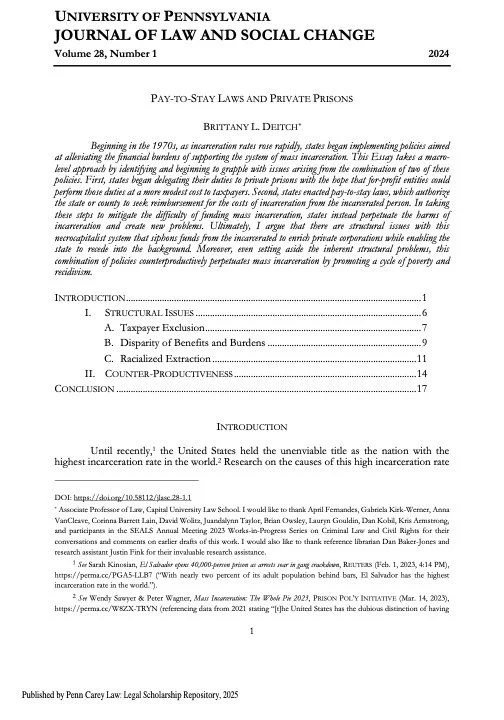
PAY-TO-STAY LAWS AND PRIVATE PRISONS

By BRITTANY L. DEITCH

Beginning in the 1970s, as incarceration rates rose rapidly, states began implementing policies aimed at alleviating the financial burdens of supporting the system of mass incarceration. This Essay takes a macro-level approach by identifying and beginning to grapple with issues arising from the combination of two of these policies. First, states began delegating their duties to private prisons with the hope that for-profit entities could perform those duties at a more modest cost to taxpayers. Second, states enacted pay-to-stay laws, which authorize the state or county to seek reimbursement for the costs of incarceration from the incarcerated person. In taking these steps to mitigate the difficulty of funding mass incarceration, states instead perpetuate the harms of incarceration and create new problems. Ultimately, I argue that there are structural issues with this necro-capitalist system that siphons funds from the incarcerated to enrich private corporations while enabling the state to recede into the background. Moreover, even setting aside the inherent structural problems, this combination of policies counterproductively perpetuates mass incarceration by promoting a cycle of poverty and recidivism

UNIVERSITY OF PENNSYLVANIA JOURNAL OF LAW AND SOCIAL CHANGE Volume 28, Number 1 2024.

download