
Open Access Publisher and Free Library
TERRORISM.jpeg

TERRORISM

Terrorism-Domestic-International-Radicalization-War-Weapons-Trafficking-Crime-Mass Shootings

Posts in Nihilistic Violence
A German Catastrophe; On the Brink of World War One

by Friedrich Von Bernhardi (Author), Allen Powles (Translator), Graeme Newman (Introduction)

On the eve of global catastrophe, Friedrich von Bernhardi set down one of the most provocative and unsettling arguments of the modern age.A German Catastrophe: On the Brink of World War I previously publised as Germany and the Next War (1912) is not simply a study of military preparedness—it is a bold and uncompromising declaration that war is inevitable, necessary, and even morally justified.

Written in the tense years before World War I, this controversial work offers a rare window into the mindset of pre-war Europe. Bernhardi rejects the ideals of international peace and diplomacy, arguing instead that struggle between nations is the driving force of history. Drawing on the language of Social Darwinism, he presents war as the means by which stronger nations assert their destiny and shape the future.

For readers today, this book is both a historical document and a warning. It reveals the intellectual currents that helped propel Europe toward one of the deadliest conflicts in human history, while raising enduring questions about power, nationalism, and the ethics of war.

This Read-Me.Org edition, under its revised title, invites a reading that is at once critical and reflective. The new title—A German Catastrophe: On the Brink of World War I—captures the tragic irony of Bernhardi’s argument: a confident assertion of national destiny that, in retrospect, stands at the threshold of devastation. It encourages us to approach the text not as a guide, but as a warning.

In making this work accessible to a contemporary audience, Read-Me.Org reaffirms its commitment to presenting historically significant texts in a form that promotes careful engagement and informed interpretation. Bernhardi’s book endures not because it offers solutions, but because it compels us to confront enduring questions about power, morality, and the choices that shape the course of history.

Read-Me.Org Inc. New York-Philadelphia-Australia. 2026. p.217.

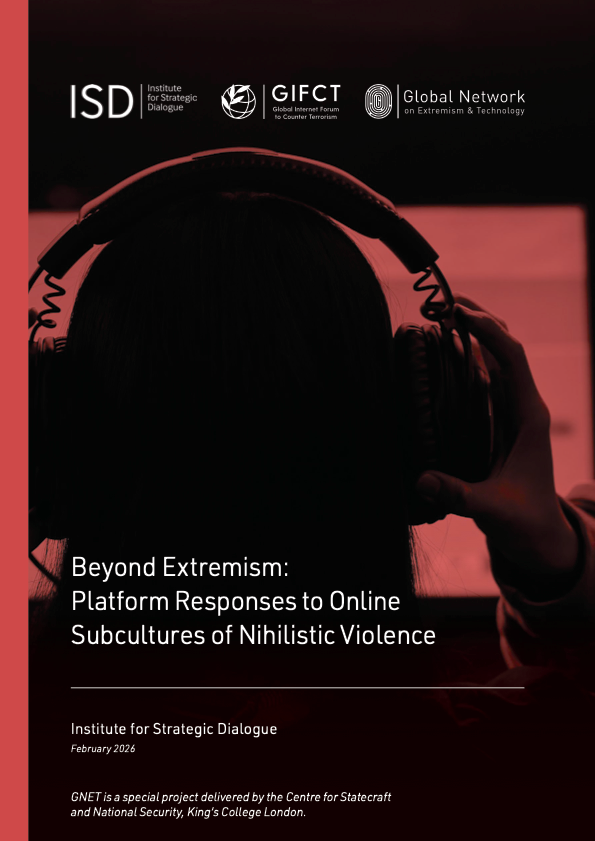
Beyond Extremism: Platform Responses to Online Subcultures of Nihilistic Violence 

By the Institute for Strategic Dialogue

Key Findings • While occupying parallel digital spaces and producing similar types of harm, online subcultures of nihilistic violence are distinct from ideologically motivated extremism. This unique threat requires bespoke platform interventions rather than expansions and adaptations of existing terrorism‑ and violent extremism‑focused frameworks. • Nihilistic violence ecosystems are decentralised, cross‑platform and highly agile, leveraging mainstream and fringe platforms for grooming, propaganda and operational coordination. Platform strategies should not look to respond to the threat as new forms of dangerous organisations, but rather to understand this phenomenon as a more dynamic threat from nihilistic violent subcultures, of which ‘groups’ like 764 and the True Crime Community are just the latest manifestation. • Nihilistic violent communities produce a much broader range of harms than ideologically motivated extremist networks, spanning sexual exploitation, cybercrime and various forms of real‑world targeted violence, including self‑harm, animal abuse, interpersonal violence and mass casualty attacks such as school shootings. • New platform policies are not necessarily required to mitigate the threat, given that many of these harms are already covered in platform community guidelines. However, these should be knitted together as part of a cohesive platform strategy, as enforcement against ecosystems of nihilistic violence is currently fragmented and reactive, enabling ban evasion and rapid regrouping.