Open Access Publisher and Free Library
TERRORISM.jpeg

TERRORISM

Terrorism-Domestic-International-Radicalization-War-Weapons-Trafficking-Crime-Mass Shootings

Posts in war and peace
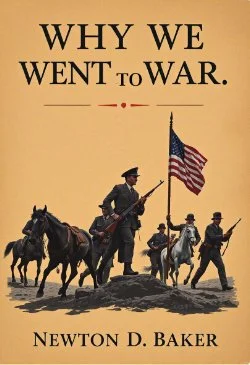
Why We Went To War

By Newton D. Baker, Edited by Ciolin Heston

Newton Diehl Baker’s Why We Went to War, published in 1921, is one of the most important contemporary American explanations of the nation’s entry into the First World War. Baker, who served as Secretary of War from 1916 to 1921 under President Woodrow Wilson, occupied a unique position at the very center of America’s wartime transformation. Once known as a progressive mayor of Cleveland and a disciple of Wilsonian reform, Baker became, almost overnight, the chief administrator responsible for raising, training, and mobilizing an army that grew from a modest peacetime force into one of the most formidable fighting powers of the modern age. His book represents both a justification and a reflection—part political defense, part historical testimony—on why the United States took the fateful step of joining a conflict from which it had long sought to remain apart.

For modern readers, Why We Went to War should be approached both as a primary document and as an act of persuasion. Baker was not an impartial historian; he was a participant and advocate, a defender of Wilsonian ideals at a moment when those ideals were under attack. His words reveal not only the official reasoning of the Wilson administration but also the mindset of a generation of progressives who believed that the United States, through sacrifice and leadership, could help reorder the world toward democracy and peace.

In the end, Baker’s book is as much about America’s identity as about the Great War. It reflects a moment when the nation stood at the crossroads between its traditional reluctance to become entangled in European affairs and its emerging role as a world power. To understand why the United States entered World War I is to understand not only the international provocations of the time but also the ideals, anxieties, and ambitions of a nation coming of age on the world stage.

Read-Me.Org Inc. New York-Philadelphia-Australia. 2025. p. 165.

download free
kindle $1.99 -- paperback $7.99
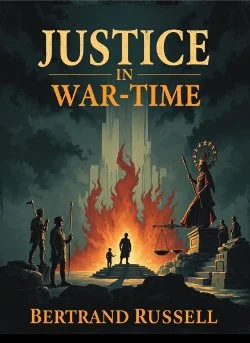
Justice in War-Time

By Bertrand Russell . Introduction by Colin Heston.

This collection of essays is not merely a pacifist manifesto; it is a profound philosophical inquiry into the nature of justice, the psychology of conflict, and the responsibilities of individuals—especially thinkers and educators—in times of national crisis. Russell, a mathematician and philosopher by training, brings to bear his analytical precision and moral clarity in dissecting the arguments used to legitimize war. His opposition to World War I was not rooted in naïve idealism but in a deep conviction that war, particularly modern industrial war, represents a failure of reason and humanity.

The book opens with an appeal to the intellectuals of Europe, urging them to resist the tide of militarism and to uphold the values of truth and justice even when doing so is unpopular or dangerous. Russell believed that intellectuals had a duty to question the narratives presented by their governments and to advocate for peace, not as a passive withdrawal but as an active moral stance. This appeal is followed by essays such as “The Ethics of War,” “War and Non-Resistance,” and “Why Nations Love War,” each of which explores different dimensions of the war impulse—from philosophical arguments to psychological and sociological observations.

One of the most striking aspects of Justice in War-time is Russell’s willingness to confront uncomfortable truths. He examines the role of imperialism, economic interests, and historical rivalries in fueling conflict, and he critiques the Entente policy and the diplomatic maneuvers that led to war. His essay “The Danger to Civilization” warns of the long-term consequences of war on democratic institutions, civil liberties, and the moral fabric of society.

In the broader context of Russell’s life and work, Justice in War-time marks a pivotal moment. It reflects his transition from a primarily academic philosopher to a public intellectual deeply engaged with the political and ethical issues of his time. The book also foreshadows themes that would recur in his later writings on peace, nuclear disarmament, and civil liberties.

Today, Justice in War-time remains a powerful reminder of the importance of moral courage and intellectual integrity. In an age where war continues to be justified through appeals to patriotism, security, and national interest, Russell’s essays challenge us to ask deeper questions: What is justice? Who benefits from war? And what is the role of the individual in resisting injustice?

Read-Me.Org Inc. New York-Philadelphia-Australia. 2025. 191p.

download free
kindle $2,99 -- paperback $8.99