
Open Access Publisher and Free Library
CRIME+CRIMINOLOGY.jpeg

CRIME

Violent-Non-Violent-Cyber-Global-Organized-Environmental-Policing-Crime Prevention-Victimization

Posts tagged Youth Justice
Exploited to exploiter? Preventing the unjust criminalisation of victims of child criminal exploitation in the transition to adulthood

By The Alliance for Youth Justice

The briefing, funded by the Barrow Cadbury Trust, examines what happens as exploited children turn 18, exploring how responses across safeguarding and criminal justice fail to keep pace with ongoing risk and harm. It sets out principles and practical steps to ensure protection continues into young adulthood and to prevent the unjust criminalisation of victims.

While awareness of CCE has grown, responses for children remain inconsistent and are too often led by punishment. At 18, those weaknesses are magnified. Support frequently falls away, thresholds for help rise, and young adults are more likely to be treated as perpetrators than recognised as victims. As parliament considers the Crime and Policing Bill’s new offence of child criminal exploitation (CCE), there is a critical opportunity to improve the response for victims – but a growing risk that exploited young adults will be prosecuted as perpetrators.

The briefing is informed by an evidence review and consultation with professionals, legal practitioners, academics, civil servants, and sector experts and identifies several urgent issues:


Automatically Charging Youth as Adults

By Olivia Naugle

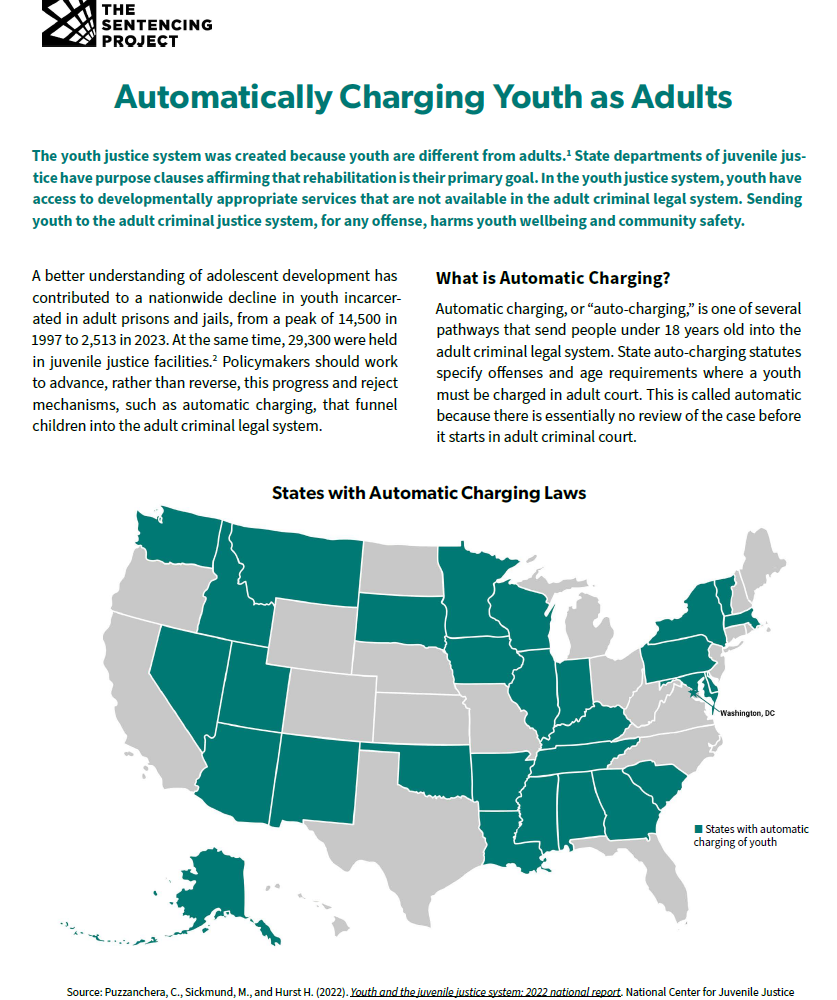
The youth justice system was created because youth are different from adults.1 State departments of juvenile justice have purpose clauses affirming that rehabilitation is their primary goal. In the youth justice system, youth have access to developmentally appropriate services that are not available in the adult criminal legal system. Sending youth to the adult criminal justice system, for any offense, harms youth wellbeing and community safety.

Sport and physical activity as an intervention for reintegration and resettlement: key mechanisms for policy and practice

By Haydn Morgan and Andrew Parker

  Recent years have witnessed a growing interest at a policy level regarding the intentional use of sport and physical activity as a key component within interventions designed to support individuals who have become connected with, or are vulnerable to, engagement in the criminal justice system (Meek, 2018; Norman et al., 2024). Despite growing evidence to support the instrumental use of sport and physical activity within such interventions, both in custodial and in community settings (Morgan and Parker, 2023), there remain significant misconceptions regarding the ‘power of sport’ to prevent and/or divert engagement with crime or support efforts to rehabilitate and address reoffending. These misconceptions are largely based on assumptions regarding the ‘life lessons’ that (automatically and universally) transfer from the sport domain to other contexts. However, the evidence is clear that there are other key mechanisms in play, beyond participation, that enable sport and physical activity interventions to impact criminal justice outcomes. The aim of this paper is to introduce some of the mechanisms that have been identified in previous research which contribute to the effective implementation of sport-based criminal justice interventions. In addition, since there has been relatively limited academic consideration of how sport and physical activity might be integrated into policy and practice around probation and resettlement, the paper offers suggestions for how these mechanisms may be integrated into efforts to support probation and youth justice services.

Manchester, UK:  HM Inspectorate of Probation. 2024, 14pg