
Open Access Publisher and Free Library
CRIME+CRIMINOLOGY.jpeg

CRIME

Violent-Non-Violent-Cyber-Global-Organized-Environmental-Policing-Crime Prevention-Victimization

Posts tagged youth attitudes
Rikers Island and Mental Health: Pathways Toward Community-Based Diversion and Jail Population Reduction

By

María Fernanda Rodríguez, Nicolás Espejo Yaksic

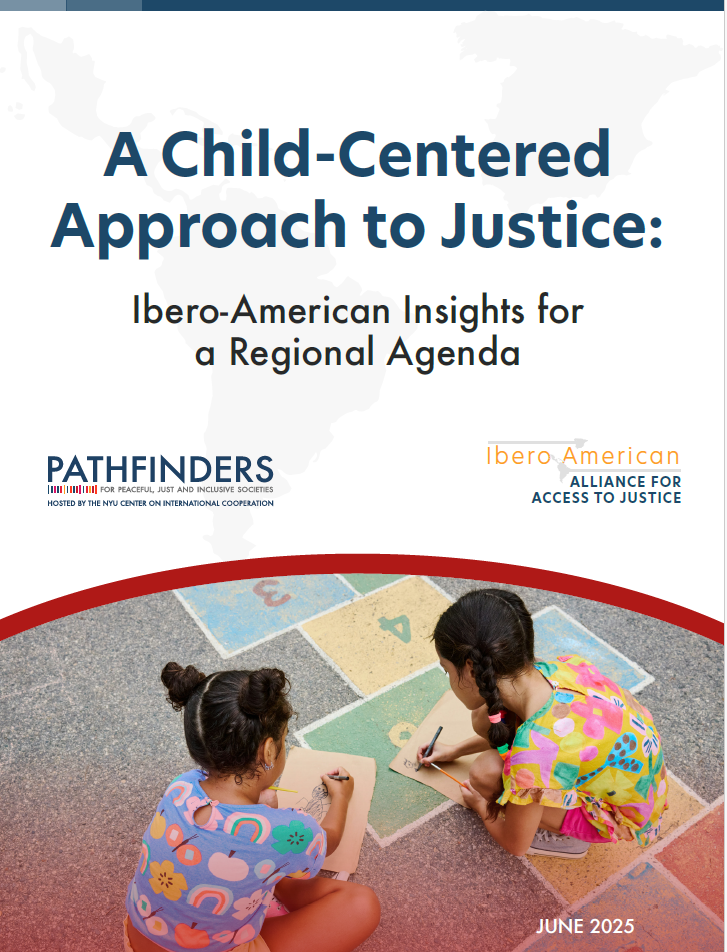
The IBA assumed the challenge of contributing to a profound and urgent transformation, under the conviction that protecting the rights of children is not only a legal and ethical obligation, but also an essential investment in strengthening the rule of law.

As such, this report highlights existing challenges as well as good practices and proposes a roadmap to advance toward a child-centered justice system, as part of the commitment to leave no one behind within the framework of the 2030 Agenda.

Likewise, the report seeks to be a tool for articulation. A meeting point for governments, the judiciary, ombudsmen, prosecutors, civil society, academia, international organizations, but most importantly, for the voices of children and adolescents.

The preparation of this report involved participants from the justice ecosystem across the region. In line with this collective effort, the report includes a detailed analysis of the drafting process of the Ibero-American Common Rules on Restorative Juvenile Criminal Justice, led by the main justice networks and regional bodies.

The report is divided up into the following sections:

Section 1–Regional Context

Section 2–Access to Justice and the Development Agenda: People-Centered and Child-Centered Justice

Section 3–Principles of Child-Centered Justice: Progress in the Region

Section 4–Vision and Regional Agenda


Research on College in Prison and After Release

By Ericka B Lewy, et al.

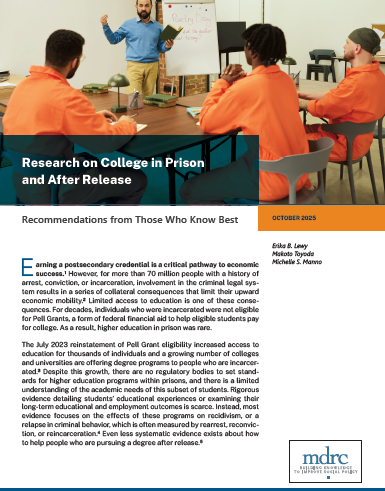
Earning a postsecondary credential is a critical pathway to economic success. However, for more than 70 million people with a history of arrest, conviction, or incarceration, involvement in the criminal legal sys­tem results in a series of collateral consequences that limit their upward economic mobility. Limited access to education is one of these conse­quences. For decades, individuals who were incarcerated were not eligible for Pell Grants, a form of federal financial aid to help eligible students pay for college. As a result, higher education in prison was rare.

The July 2023 reinstatement of Pell Grant eligibility increased access to education for thousands of individuals, and a growing number of colleges and universities are offering degree programs to people who are incarcer­ated. Despite this growth, there are no regulatory bodies to set stand­ards for higher education programs within prisons, and there is a limited understanding of the academic needs of this subset of students. Rigorous evidence detailing students’ educational experiences or examining their long-term educational and employment outcomes is scarce. Instead, most evidence focuses on the effects of these programs on recidivism, or a relapse in criminal behavior, which is often measured by rearrest, reconvic­tion, or reincarceration. Even less systematic evidence exists about how to help people who are pursuing a degree after release.

Within this context, MDRC drew on existing research to identify opportunities to build more evi­dence about best practices to assist students who are pursuing higher education in prison and after release. To inform a research agenda that would be useful to program practitioners, policymakers, researchers, and students, the research team had several dozen conversations with college pro­gram staff members, college administrators, academic researchers, state officials, people working to assist individuals while incarcerated or who have recently been released, and students.

Youth Perspectives on Online Safety , 2023

By Thorn and BSG

Thorn’s annual report of Youth Perspectives on Online Safety represents the fifth year of data collection on youth behaviors and attitudes toward online safety topics. This year expands Yinclude emerging threats such as AI-generated CSAM (“deepfake nudes”) and sextortion.

El Segundo, California , Thorn, 2024. 54p.