
Open Access Publisher and Free Library
CRIME+CRIMINOLOGY.jpeg

CRIME

Violent-Non-Violent-Cyber-Global-Organized-Environmental-Policing-Crime Prevention-Victimization

Posts tagged policymaking
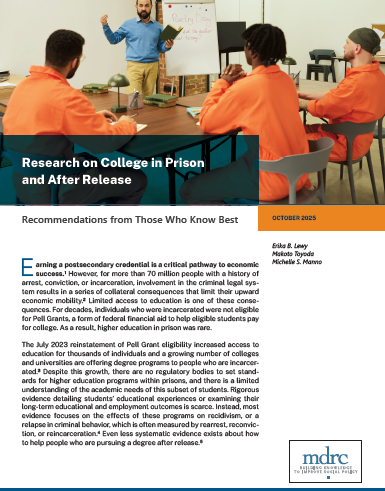
Research on College in Prison and After Release

By Ericka B Lewy, et al.

Earning a postsecondary credential is a critical pathway to economic success. However, for more than 70 million people with a history of arrest, conviction, or incarceration, involvement in the criminal legal sys­tem results in a series of collateral consequences that limit their upward economic mobility. Limited access to education is one of these conse­quences. For decades, individuals who were incarcerated were not eligible for Pell Grants, a form of federal financial aid to help eligible students pay for college. As a result, higher education in prison was rare.

The July 2023 reinstatement of Pell Grant eligibility increased access to education for thousands of individuals, and a growing number of colleges and universities are offering degree programs to people who are incarcer­ated. Despite this growth, there are no regulatory bodies to set stand­ards for higher education programs within prisons, and there is a limited understanding of the academic needs of this subset of students. Rigorous evidence detailing students’ educational experiences or examining their long-term educational and employment outcomes is scarce. Instead, most evidence focuses on the effects of these programs on recidivism, or a relapse in criminal behavior, which is often measured by rearrest, reconvic­tion, or reincarceration. Even less systematic evidence exists about how to help people who are pursuing a degree after release.

Within this context, MDRC drew on existing research to identify opportunities to build more evi­dence about best practices to assist students who are pursuing higher education in prison and after release. To inform a research agenda that would be useful to program practitioners, policymakers, researchers, and students, the research team had several dozen conversations with college pro­gram staff members, college administrators, academic researchers, state officials, people working to assist individuals while incarcerated or who have recently been released, and students.
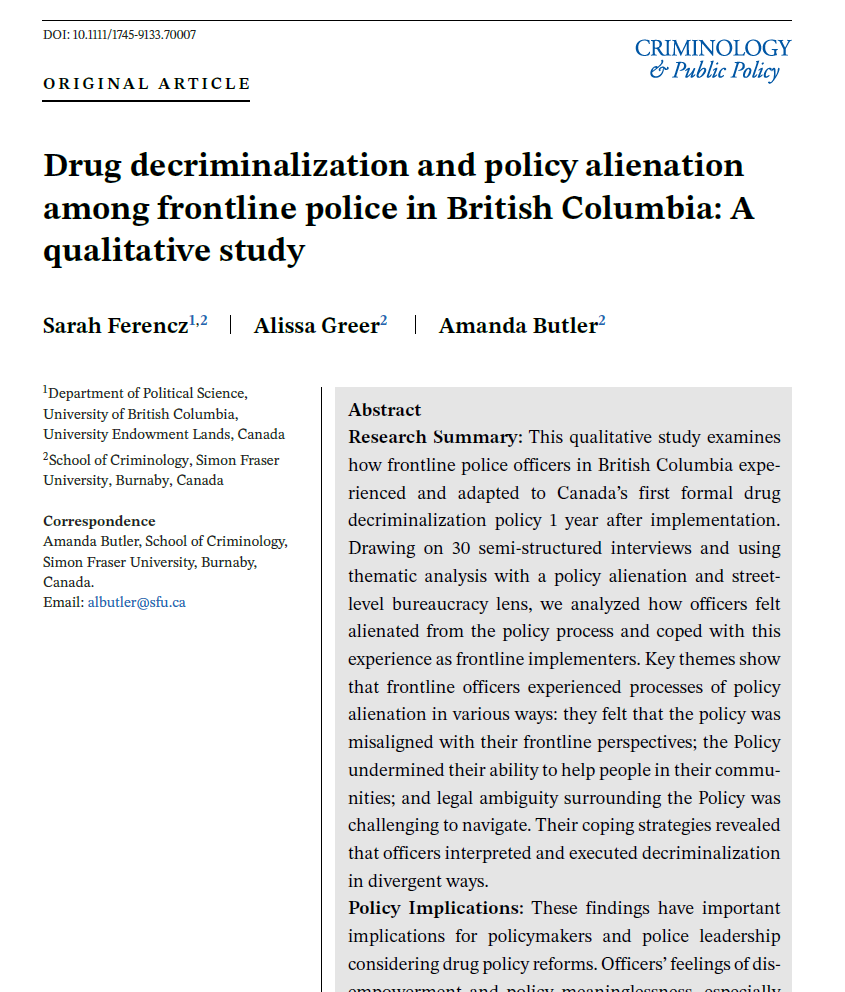
Drug decriminalization and policy alienation among frontline police in British Columbia: A qualitative study

By Sarah Ferencz, Alissa Greer, Amanda Butler

This qualitative study examines how frontline police officers in British Columbia experienced and adapted to Canada's first formal drug decriminalization policy 1 year after implementation. Drawing on 30 semi-structured interviews and using thematic analysis with a policy alienation and street-level bureaucracy lens, we analyzed how officers felt alienated from the policy process and coped with this experience as frontline implementers. Key themes show that frontline officers experienced processes of policy alienation in various ways: they felt that the policy was misaligned with their frontline perspectives; the Policy undermined their ability to help people in their communities; and legal ambiguity surrounding the Policy was challenging to navigate. Their coping strategies revealed that officers interpreted and executed decriminalization in divergent ways.

Policy Implications

These findings have important implications for policymakers and police leadership considering drug policy reforms. Officers’ feelings of disempowerment and policy meaninglessness, especially in contexts of legal ambiguity, may lead to inconsistent or inequitable enforcement. Strengthening communication across police ranks is critical. Middle managers may help translate reform goals, identify resource gaps, and support effective coping strategies. Legal clarity should extend beyond policy updates to help officers reconcile overlapping laws and reduce liability concerns. While there are limits to policy consultation with frontline officers within the hierarchical structure of police institutions, reform efforts should still engage with frontline officers’ working logics. Training should address harmful attitudes and misunderstandings of drug use, clarify legal boundaries, and mitigate unintended harms of enforcement. Ultimately, effective drug policy reform in a multi-jurisdictional system requires acknowledging how frontline officers interpret and shape 

 policy within institutional constraints.

Community Solutions to Insecurity Along the Uganda–Kenya Border

By Karamoja–Turkana and the Community Research Team 

Ipoln the Karamoja and Turkana border regions of Uganda and Kenya, there is widespread violence including armed robbery, rape, and human rights abuses, yet community complaints about failures of governance remain largely unaddressed. This Policy Briefing highlights how different insecurities reinforce one another in ways exacerbated by the international border. It stresses the need for fulfilment of the two governments’ commitments to cross-border solutions, and suggests that international policy actors can help communities gain leverage with governments towards building trustworthy and effective peace and security institutions.

IDS Policy Briefing 214,

Brighton, UK: Institute of Development Studies, 2023. 4p.