Open Access Publisher and Free Library
CRIME+CRIMINOLOGY.jpeg

CRIME

Violent-Non-Violent-Cyber-Global-Organized-Environmental-Policing-Crime Prevention-Victimization

Posts in Social Sciences
The American boy and the social evil, from a physician's standpoint

By Robert N. Willson.

“The following pages are published in the earnest hope that they may assist in the preservation of the American home circle through their influence upon the boy and the young man. Each of the four chapters was prepared for those who listened to it, and with no idea that it would eventually find its way into print. I have now arranged them in permanent form for the purpose of more widely introducing a difficult and delicate subject in a plain but thoroughly clean way. For years I have felt the need, as an individual and a physician, of a simple, and yet scientifically accurate, presentation of the world's great blemish, its causes, and effects, in such a form that I might safely place it in the hands of the American boy and girl. Each of the chapters comprising this little volume has been chosen with this end in view. Each has been utilized, moreover, in response to a desire, expressed openly and often, by men and women who have the integrity of American manhood deeply at heart.”

Philadelphia, Chicago, The J.C. Winston company , 1905. 174p.

A New Conscience and an Ancient Evil

By Jane Addams.

“Published in 1912 on the heels of Twenty Years at Hull-House and at the height of Jane Addams's popularity, "A New Conscience and an Ancient Evil" assesses the vulnerability of the rural and immigrant working-class girls who moved to Chicago and fell prey to the sexual bartering of what was known as the white slave trade. Addams offers lurid accounts--drawn from the records of Chicago's Juvenile Protection Association--of young women coerced into lives of prostitution by men who lurked outside hotels and sweatshops. Because they lacked funds for proper recreation, Addams argues, poor and socially marginalized women were susceptible to sexual slavery, and without radical social change they would perhaps be "almost as free" as young men. In addition to promoting higher wages and better living conditions, Addams suggests that a longer period of public education for young women would deter them from the dangers of city life. Despite its appeal to middle-class readers eager for tales of sexual excess and the rape of innocence, the press and prominent intellectuals criticized A New Conscience and an Ancient Evil for being disproportionately hysterical to its philosophical weight.”

New York: Macmillan, 1912. 219p.

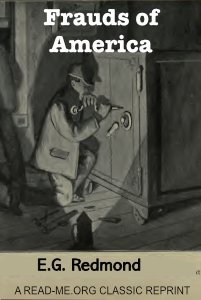
Frauds of America

By E.G. Redmond.

Or, Beware of shams, how they are worked and how to foil them - the tricks and methods of all kinds of frauds and swindlers, from the petty sneak-thief to the cleverest schemes of the expert bank robber, fully exposed for the protection of the American public. “For the protection of the community in general from all classes of depredators this book is intended. The methods of catching victims by fraudulent and swindling practices has never before been given in full to the public. We have now for the first time, in this book, given a truthful and reliable expose of the multifarious schemes, swindles and dodges practiced on the American public. Scarcely a day passes but the press reports depredations of one kind or another from all parts of the country. The burglar, safe-breaker, sneak-thief, swindler, confidence man, forger, check-raiser and counterfeiter are ever on the alert, and the reason these rascals are usually successful is owing to the fact that the public is unacquainted with the "* way they work. This book exposes all manner of thievery, swindling, robbery, etc. —the modus operandi—in a plain and practical way. For the protection of the people of America from all classes of thieves and rascals this work is written. It is the result of years of careful application and untiring work by experts, and will be found of inestimable value to the public. It is not a detective story, or work of fiction, but a book of facts, instructive, interesting and educational.”

Naperville, IL: J.L. Nichols & Co.1902. 411p.

Psychology and Crime

By Thomas Holmes.

“Year after year our Prison Commissioners, in presenting their reports, have not failed to impress upon the State the great part physical and mental afflictions play in the production of crime. So far, the information given by the Prison Commissioners has produced little or no effect neither have their representations led to any alteration in the treatment of unfortunate individuals whose infirmities are in reality the root cause of their delinquency.”

London: J.M. Dent & Sons., 1912. 88p.

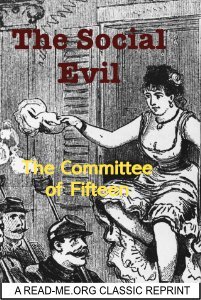
The Social Evil

By The Committee of Fifteen

With special reference to conditions existing in the city of New York. . “In the fall of 1900, the city of New York was startled by discoveries in regard to the spread of the Social Evil in certain districts, and as to the extent of flagrant offences against public morality and common decency. A meeting of citizens was held at the Chamber of Commerce in November, as a result of which the Committee of Fifteen was called into existence. The objects which the Committee of Fifteen undertook to accomplish were thereupon stated as follows : (1) To institute a searching inquiry, uninfluenced by partisan considerations, into the causes of the present alarming increase of gambling and the Social Evil in this city, and to collect such evidence as shall establish the connection between existing conditions and those who, in the last analysis, are responsible for these conditions. (2) To publish the results of such investigations in order to put our fellow-citizens in possession of facts, and to enable them to adopt such corrective measures as may be needed. (3) To promote such legislation as shall render it less difficult to reach offenders, and as shall put an end to the shifting and division of responsibility in the local administration of the laws relating to vice and crime, to the end that public officers and their subordinates may be held to a strict accountability for their acts. (4) To suggest and promote the provision of more wholesome conditions and surroundings, in order to lessen the allurements and incentives to vice and crime.”

New York: G.P. Putnam's Sons, 1902. 188p.

Observations on the phrenological development of Burke, Hare, and other atrocious murderers

By Thomas Stone, M.D

Measurements of the Heads of the most notorious thieves Confined in the Edinburgh jail and bridewell, And of various individuals, English, Scotch, and Irish, Presenting an extensive series of facts subversive of phrenology. Read before the royal medical society of Edinburgh. ““Assail our facts, and we are undone; Phrenology admits of no exceptions.”(Phrenological Journal, vol. iii. p. 256).

Edinburgh: Robert Buchanan, 1829. 85p.

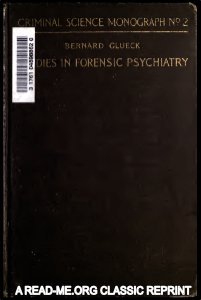
Studies in Forensic Psychiatry

By Bernard Glueck.

“ Forensic Psychiatry is a classic psychology history text by Bernard Glueck. When, in 1810, Franz Joseph Gall said: "The measure of culpability and the measure of punishment can not be determined by a study of the illegal act, but only by a study of the individual committing it," he expressed an idea which has, in late years, come to be regarded as a trite truism. This called forth as an unavoidable consequence a more lively interest on the part of various social agencies in the personality of the criminal, with the resultant gradually increasing conviction that the suppression of crime is not primarily a legal question, but is rather a problem for the physician, sociologist, and economist.”

Boston: Little, Brown, & Co. 1916. 269p.

The Psychology of Murder

By Andreas Bjerre.

A Study in Criminal Psychology. “The subject has attracted many writers before Bjerre—philosophers, doctors, lawyers and essayists. But Bjerre has approached the problem from an entirely new point of view. He has not contented himself with wide generalizations, or with the treatment of such second-hand material as criminal statistics, reports of trials, hospital and prison journals or other superficial data, however obtained He has devoted many years of his life to first-hand study in Swedish prisons in order by constant personal association with criminals to solve the riddles hidden away in the dark places of their psychic lives.” (Preface).

Longmans, Green and Co. ltd., 1927. 182p.

Sidelights on Criminal Matters

By John Cuthbert Goodwin.

“There is good—much good—in every man, and in every woman. Even in cases where it seems non-existent it is but shyly waiting to be coaxed up to the surface. Some there may be, others there will be, who will see in this volume, as in the daily newspapers, the stage, the kinema, and in parts of the Old Testament itself, a veiled incentive towards wrongdoing. With the sensitive, the apprehensive, and all who, speaking perhaps with authority, and not as the scribes, see a healthy purpose in nothing and a sinister motive in everything, I do not attempt to argue. Crime is a difficult subject to handle in such a manner that its presentation satisfies all, offends none, and withholds secrets which prudence demands should remain secrets, but I have endeavoured to incorporate in my mosaic of deeds and misdeeds nothing that is not already known to the criminal but unknown to the majority of the public. I would, however, assure my readers that they need not expect a tedious pageant of ancient exposures masquerading as palate-tickling novelties.”

London: Hutchinson & Co., 1923. 336p.

Pathological Lying, Accusation, and Swindling

By William Healy and Mary Tenney Healy.

A Study in Forensic Psychology. “Careful studies of offenders make group-types stand out with distinctness. Very little advancement in the treatment of delinquents or criminals can be expected if typical characteristics and their bearings are not understood. The group that our present work concerns itself with is comparatively little known, although cases belonging to it, when met, attract much attention. It is to all who should be acquainted with these striking mental and moral vagaries, particularly in their forensic and psychological significances, that our essay is addressed. In some cases vital for the administration of justice, an understanding of the types of personality and of behavior here under discussion is a prime necessity. The whole study of characterology or the motivation of conduct is extremely new, and there are many indications of immense values in uncovered fields. Some appreciation of this fact may be gained from the following pages which show the possibility of tracing one form of behavior to its source.”

Boston: Little, Brown and Co., 1917. 286p.

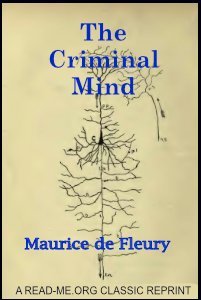
The Criminal Mind

By Maurice de Fleury.

“The science of the human brain has assumed such importance within a quarter of a century, it has so quickly reached so high a degree of precision, it results from so thorough and unanimous an agreement among biologists of all countries, it throws so strong a light upon the phenomena of the mind, that it would now be quite impossible to dispense with it in treating of general psychology, and more especially of criminal psychology. That knowledge—attended at first sight with disconcerting difficulties and alarms, by reason of its complexity—may, nevertheless, be easily simplified and placed within the reach of the least studious minds. For those who go deeply into it, the knowledge of the functions of the brain quickly assumes the pure lines, the harmonious proportions and the symmetrical arrangement of a typical French gardzn, with its straight walks, cut out in the dim forest of the old classical psychology.! Let us walk together in that garden, keeping a few plans, mere rudimentary drawings, under our eyes, lest we should lose our way. Here is one, in the first place, which represents the topography, the geography of one half of the brain,” or, to employ the phrase in use, the cerebral localizations on the left hemisphere.”

London: Downey & Co., 1901. 196p.

Abnormal Man

By Arthur Macdonald.

Being Essays on Education and Crime and Related Subjects, With Digests of Literature and a Bibliography. The present work may perhaps be considered as an introduction to abnormality in general, giving a description, diagnosis, and synthesis of human abnormalities, which seem to be constant factors in society.

Washington, DC: U.S. Bureau of Education, Government Printing Office, 1893. 463p.

Crime and Criminals 1887

By J. Sanderson Christison.

“Last winter I contributed a series of articles to the Chicago Tribune under the caption of "Jail Types," which were so favorably noticed, both in Europe and America, that my friends have urged their appearance in book form. With some typographical corrections, the articles are here presented in their original text, with a number of additional sketches. While they do not constitute a systematic treatise on the subject of criminology, they present the points of most importance in a form and style intended to attract and interest the general reader, who will find much to reflect upon in the line of duty as a member of society at large.” (from Preface)

Chicago: THE W. T. Keener Co. 1897 117p.

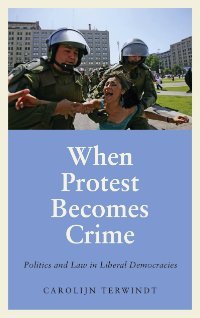
When Protest Becomes Crime

By Carolijn Terwindt.

Politics and Law in Liberal Democracies.How does protest become criminalised? Applying an anthropological perspective to political and legal conflicts, Carolijn Terwindt urges us to critically question the underlying interests and logic of prosecuting protesters. The book draws upon ethnographic research in Chile, Spain, and the United States to trace prosecutorial narratives in three protracted contentious episodes in liberal democracies. Terwindt examines the conflict between Chilean landowners and the indigenous Mapuche people, the Spanish state and the Basque independence movement, and the United States' criminalisation of 'eco-terrorists.' Exploring how patterns and mechanisms of prosecutorial narrative emerge through distinct political, social and democratic contexts, Terwindt shines a light on how prosecutorial narratives in each episode changed significantly over time. Challenging the law and justice system and warning against relying on criminal law to deal with socio-political conflicts, Terwindt's observations have implications for a wide range of actors and constituencies, including social movement activists, scholars, and prosecutors.

London: Pluto Press, 2020. 305p.

Piracy in World History

Edited by Stefan Amirell, Hans Hägerdal, Bruce Buchan.

In a modern global historical context, scholars have often regarded piracy as an essentially European concept which was inappropriately applied by the expanding European powers to the rest of the world, mainly for the purpose of furthering colonial forms of domination in the economic, political, military, legal and cultural spheres. By contrast, this edited volume highlights the relevance of both European and non-European understandings of piracy to the development of global maritime security and freedom of navigation. It explores the significance of ‘legal posturing’ on the part of those accused of piracy, as well as the existence of non-European laws and regulations regarding piracy and related forms of maritime violence in the early modern era. The authors in Piracy in World History highlight cases from various parts of the early-modern world, thereby explaining piracy as a global phenomenon.

Amsterdam: Amsterdam University Press, 2021. 290p.

Contemporary Criminological Issues: Moving Beyond Insecurity and Exclusion

Edited by Carolyn Côté-Lussier, David Moffette, and Justin Piché.

Contemporary Criminological Issues tackles some of today’s most pressing social issues, from the criminalization of Indigenous peoples to interpersonal violence, border control, and armed conflicts. This book advances cutting-edge theories and methods, with the aim of moving beyond the scholarship that reproduces insecurity and exclusion. The breadth of approaches encompasses much of the current critical criminological scholarship, serving as a counterpoint to the growth of managerial and administrative criminologies and the rise of explicitly exclusionary and punitive state policies and practices with respect to ‘crime’ and ‘security.’ This edited collection featuring two books, one in English and one in French, includes important contributions to knowledge and public policy by eminent experts and emerging scholars.

Ottawa: University of Ottawa Press, 2020. 322p.

Intergenerational transmission of criminal and violent behaviour

By Sytske Besemer.

The apple doesn't fall far from the tree', 'Like father like son', 'Chip off the old block'. All these idioms seem to suggest that offspring resemble their parents and this also applies to criminal behaviour. This dissertation investigates mechanisms that might explain why children with criminal parents have a higher risk of committing crime. Several explanations for this intergenerational transmission have been contrasted, such as social learning (imitation of behaviour), official bias against certain families, and transmission of risk factors. Sytske Besemer investigated this in England as well as in the Netherlands. She answers questions such as: does it matter when the parents committed crime in the child's life? Do more persistent offenders transmit crime more than sporadic offenders? Do violent offenders specifically transmit violent behaviour or general crime to their children? Might the police and courts be biased against certain families? Could a deprived environment explain why parents as well as children show criminal behaviour? Does parental imprisonment pose an extra risk? This dissertation is the first study to specifically investigate these mechanisms of intergenerational continuity. The study is scientifically relevant because of its breadth, integration of conviction data as well as data on self-reported offending and environmental risk factors, its comparative design and the long periods over which transmission is investigated. Furthermore, the dissertation has important policy implications. It demonstrates how penal policy designed to reduce criminal behaviour might actually increase this behaviour in the next generation. This is especially important since Western countries such as the United Kingdom and the Netherlands show an increasing trend towards more punitive policies.

Leiden: Sidestone Press, 2012. 198p.

Everyday Crime, Criminal Justice and Gender in Early Modern Bologna

By Sanne Muurling.

Female protagonists are commonly overlooked in the history of crime; especially in early modern Italy, where women’s scope of action is often portrayed as heavily restricted. This book redresses the notion of Italian women’s passivity, arguing that women’s crimes were far too common to be viewed as an anomaly. Based on over two thousand criminal complaints and investigation dossiers, Sanne Muurling charts the multifaceted impact of gender on patterns of recorded crime in early modern Bologna. While various socioeconomic and legal mechanisms withdrew women from the criminal justice process, the casebooks also reveal that women – as criminal offenders and savvy litigants – had an active hand in keeping the wheels of the court spinning.

Leiden; Boston: Brill, 2021. 265p.

Macrocriminology and Freedom

By John Braithwaite.

How can power over others be transformed to ‘power with’? It is possible to transform many institutions to build societies with less predation and more freedom. These stretch from families and institutions of gender to the United Nations. Some societies, times and places have crime rates a hundred times higher than others. Some police forces kill at a hundred times the rate of others. Some criminal corporations kill thousands more than others. Micro variables fail to explain these patterns. Prevention principles for that challenge are macrocriminological.

Freedom is conceived in a republican way as non-domination. Tempering domination prevents crime; crime prevention reduces domination. Many believe a high crime rate is a price of freedom. Not Braithwaite. His principles of crime control are to build freedom, temper power, lift people from poverty and reduce all forms of domination. Freedom requires a more just normative order. It requires cascading of peace by social movements for non-violence and non-domination. Periods of war, domination and anomie cascade with long lags to elevated crime, violence, inter-generational self-violence and ecocide. Cybercrime today poses risks of anomic nuclear wars.

Braithwaite’s proposals refine some of criminology’s central theories and sharpen their relevance to all varieties of freedom. They can be reduced to one sentence. Strengthen freedom to prevent crime, prevent crime to strengthen freedom.

Canberra: Australian National University Press, 2022. 814p.