Open Access Free Library
CRIME+CRIMINOLOGY.jpeg

CRIME

Violent-Non-Violent-Cyber-Global-Organized-Environmental-Policing-Crime Prevention-Victimization

Posts tagged psychiatry
LAW AND PSYCHIATRY: Cold War or Entente Cordiale? Reader's Guide

by Graeme Newman (Author), Sheldon Glueck (Author)

If a man kills because he is certain his victim is plotting against him, and he knows killing is against the law, is he responsible?

In 1962, Sheldon Glueck of the Harvard Law School gave four lectures at Tulane University on one of the hardest questions in criminal law: where to draw the line between the wicked and the ill. Law and Psychiatry: Cold War or Entente Cordiale? reviews the tests of legal insanity, says what is wrong with each, proposes a new one, and argues that lawyers and psychiatrists are quarreling over too small a prize.

This Reader's Guide explains his arguments in plain language, supplies the legal background, and shows what has changed since. Inside are a lecture map, a worked example applying six tests to three imaginary defendants, common misreadings, and discussion questions.

A companion to the original, for students, teachers and curious readers.

Read-Me.Org Inc. New York-Philadelphia-Australia. 2026. p.64.
Studies in Forensic Psychiatry

By Bernard Glueck. Designed and Edited with an Introduction by Graeme R. Newman and Claude.

In 1916, psychiatrist Bernard Glueck made a case that was still radical for its time: that prisons and asylums needed trained psychiatrists on staff, not as outside consultants, but as clinicians embedded in the institution itself. Writing from the criminal department of the Government Hospital for the Insane in Washington, D.C., Glueck laid out five detailed case studies that argued, one patient at a time, for a new way of understanding the criminal mind.

Inside, you'll find:

  • A clinical study of psychogenic psychosis in prisoners — the theory that mental breakdown behind bars is often a meaningful reaction to arrest, trial, and confinement, not simply organic illness

  • An extended case-by-case analysis of malingering, and the difficult problem of separating feigned symptoms from genuine mental illness

  • A study of "litigious paranoia" — the compulsive, self-representing plaintiff who turns the courtroom into an extension of his delusion

  • A landmark early psychoanalytic case history of kleptomania

Glueck went on to found the first psychiatric clinic ever established inside an American prison, at Sing Sing, and later served as a psychiatric expert in the Leopold and Loeb trial. He was also the elder brother of criminologist Sheldon Glueck — making this book a companion volume to Read-Me.Org's editions of War Criminals and Probation and Criminal Justice.

This new edition includes a substantial original introduction by Graeme R. Newman, assessing Glueck's century-old argument against the present day: what holds up in modern correctional psychiatry, what doesn't, and a hard look at whether American prisons have actually delivered on the promise Glueck was making in 1916 — including current data on the ongoing shortage of psychiatric staffing across U.S. correctional systems.

A Read-Me.Org Classic Reprint. This is a corrected and reformatted edition of the 1916 first edition (Little, Brown, and Company), prepared from a public domain source text under a Creative Commons Attribution 4.0 International License. AI-assisted tools were used in the production of this edition, as disclosed on our website.

Read-Me.Org Inc. New York-Philadelphia-Australia. 2026. p.165.

Studies in Forensic Psychiatry

By Bernard Glueck.

“ Forensic Psychiatry is a classic psychology history text by Bernard Glueck. When, in 1810, Franz Joseph Gall said: "The measure of culpability and the measure of punishment can not be determined by a study of the illegal act, but only by a study of the individual committing it," he expressed an idea which has, in late years, come to be regarded as a trite truism. This called forth as an unavoidable consequence a more lively interest on the part of various social agencies in the personality of the criminal, with the resultant gradually increasing conviction that the suppression of crime is not primarily a legal question, but is rather a problem for the physician, sociologist, and economist.”

Boston: Little, Brown, & Co. 1916. 269p.

Mental Conflicts and Misconduct

By William Healy.

“The great value of understanding] the foundations of conduct is clearly shown by such living facts as are gathered together in this volume. Bearing upon one type of causation of misconduct, we have here not only a rational psychological theory, but also abundant concrete material. An important field is opened before us, especially interesting because of the revelation (a) of potent subconscious mental mechanisms working ac- cording to definite laws of mental life, and (6) of types of hidden early experiences which definitely evoke these mental processes that are forerunners of misconduct. Troublesome behavior, originating in the experiences and mechanisms here under discussion, ranges widely from mere faults of social attitude to severe delinquency and crime dependent upon uncontrolled anti-social motivation or impulse. Cases having this causation occur so frequently that specific knowledge of their nature should be part of the equipment of all who have to pass judgment or to advise concerning misdoing and misdoers.” Boston: Little, Brown and Co. 1917. 330p.

The Criminal Mind

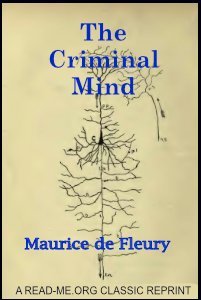
By Maurice de Fleury.

“The science of the human brain has assumed such importance within a quarter of a century, it has so quickly reached so high a degree of precision, it results from so thorough and unanimous an agreement among biologists of all countries, it throws so strong a light upon the phenomena of the mind, that it would now be quite impossible to dispense with it in treating of general psychology, and more especially of criminal psychology. That knowledge—attended at first sight with disconcerting difficulties and alarms, by reason of its complexity—may, nevertheless, be easily simplified and placed within the reach of the least studious minds. For those who go deeply into it, the knowledge of the functions of the brain quickly assumes the pure lines, the harmonious proportions and the symmetrical arrangement of a typical French gardzn, with its straight walks, cut out in the dim forest of the old classical psychology.! Let us walk together in that garden, keeping a few plans, mere rudimentary drawings, under our eyes, lest we should lose our way. Here is one, in the first place, which represents the topography, the geography of one half of the brain,” or, to employ the phrase in use, the cerebral localizations on the left hemisphere.”

London: Downey & Co., 1901. 196p.

Abnormal Man

By Arthur Macdonald.

Being Essays on Education and Crime and Related Subjects, With Digests of Literature and a Bibliography. The present work may perhaps be considered as an introduction to abnormality in general, giving a description, diagnosis, and synthesis of human abnormalities, which seem to be constant factors in society.

Washington, DC: U.S. Bureau of Education, Government Printing Office, 1893. 463p.

Crime and Criminals 1887

By J. Sanderson Christison.

“Last winter I contributed a series of articles to the Chicago Tribune under the caption of "Jail Types," which were so favorably noticed, both in Europe and America, that my friends have urged their appearance in book form. With some typographical corrections, the articles are here presented in their original text, with a number of additional sketches. While they do not constitute a systematic treatise on the subject of criminology, they present the points of most importance in a form and style intended to attract and interest the general reader, who will find much to reflect upon in the line of duty as a member of society at large.” (from Preface)

Chicago: THE W. T. Keener Co. 1897 117p.

The Criminal

By Havelock Ellis.

The “science” of criminality as presented by the famous psychiatrist Havelock Ellis. Lavishly illustrated with empirical and physical evidence to support his theories, findings and other truth claims. In this 4th edition (1910) of The Criminal first published in 1890, Ellis is pleased that there is “an approximation to general agreement” concerning his findings.

London. New York. Walter Scott Publishing. (1910) 494 pages.