Open Access Publisher and Free Library
CRIME+CRIMINOLOGY.jpeg

CRIME

Violent-Non-Violent-Cyber-Global-Organized-Environmental-Policing-Crime Prevention-Victimization

Posts in social sciences
The Enemy Within: Homicide and Control in Eastern Finland in the Final Years of Swedish Rule 1748-1808

By Anu Koskivirta

"This work explores the quantitative and qualitative development of homicide in eastern Finland in the second half of the eighteenth century and the early years of the nineteenth. The area studied comprised northern Savo and northern Karelia in eastern Finland. At that time, these were completely agricultural regions on the periphery of the kingdom of Sweden. Indeed the majority of the population still got their living from burn-beating agriculture. The analysis of homicide there reveals characteristics that were exceptional by Western European standards: the large proportion of premeditated homicides (murders) and those within the family is more reminiscent of modern cities in the West than of a pre-modern rural society. However, there also existed some archaic forms of Western crime there. Most of the homicides within the family were killings of brothers or brothers-in law, connected with the family structure (the extended family) that prevailed in the region. This study uses case analysis to explore the causes for the increase in both familial homicide and murder in the area. One of the explanatory factors that is dealt with is the interaction between the faltering penal practice that then existed and the increase in certain types of homicide.

Helsinki: Finnish Literature Society / SKS, 2003. 217p.

download
Torture, Humiliate, Kill: Inside the Bosnian Serb Camp System

By Hikmet Karčić

Half a century after the Holocaust, on European soil, Bosnian Serbs orchestrated a system of concentration camps where they subjected their Bosniak Muslim and Bosnian Croat neighbors to torture, abuse, and killing. Foreign journalists exposed the horrors of the camps in the summer of 1992, sparking worldwide outrage. This exposure, however, did not stop the mass atrocities. Hikmet Karčić shows that the use of camps and detention facilities has been a ubiquitous practice in countless wars and genocides in order to achieve the wartime objectives of perpetrators. Although camps have been used for different strategic purposes, their essential functions are always the same: to inflict torture and lasting trauma on the victims. Torture, Humiliate, Kill develops the author’s collective traumatization theory, which contends that the concentration camps set up by the Bosnian Serb authorities had the primary purpose of inflicting collective trauma on the non-Serb population of Bosnia and Herzegovina. This collective traumatization consisted of excessive use of torture, sexual abuse, humiliation, and killing. The physical and psychological suffering imposed by these methods were seen as a quick and efficient means to establish the Serb “living space.” Karčić argues that this trauma was deliberately intended to deter non-Serbs from ever returning to their pre-war homes. The book centers on multiple examples of experiences at concentration camps in four towns operated by Bosnian Serbs during the war: Prijedor, Bijeljina, Višegrad, and Bileća. Chosen according to their political and geographical position, Karčić demonstrates that these camps were used as tools for the ethno-religious genocidal campaign against non-Serbs. Torture, Humiliate, Kill is a thorough and definitive resource for understanding the function and operation of camps during the Bosnian genocide.

Ann Arbor: University of Michigan Press, 277p.

download
Environmental Crime in the Amazon Basin: a Typology for Research, Policy and Action

By Adriana Abdenur, Brodie Ferguson, Ilona Szabo de Carvalho, Melina Risso and Robert Muggah

According to the world’s top scientific experts, deforestation and degradation are up 25 percent in the first six months compared to last year. More forests are being cleared in 2020 than at any point in the past 15 years.

Although spectacular levels of illegal burning have occupied global headlines, a host of other less visible but equally significant environmental crimes are being committed throughout the Amazon basin every day. Such crimes not only impact biodiversity and the global climate, but are virtually always associated with social ills ranging from corruption to slavery and violence.

A new paper from the Igarape Institute – Environmental Crime in the Amazon Basin: a Typology for Research, Policy and Action – introduces a typology to help better understand the scope and scale of the problem and its extensive social and environmental impacts. To date, one of the principal barriers to better policing of the Amazon is the confusion and ambiguity of what is, and is not, a crime. Different countries apply different interpretations which can frustrate investigations and the enforcement of existing laws. The new paper is designed to provide greater clarity to policy makers, law enforcement agencies, civil society actors, and companies committed to curbing environmental crime.

Rio de Janeiro - RJ - Brasil, Igarapé Institute, 2020. 29p.

download
The Ecosystem of Environmental Crime in the Amazon: an analysis of illicit rainforest economies in Brazil

By Laura Trajber Waisbich, Melina Risso, Terine Husek and Lycia Brasil

Researchers analyzed data from 369 the Federal Police (PF) operations carried out between 2016 and 2021

Environmental crimes are rarely committed isolated from other offenses. Amazon deforestation is not only largely illegal but also driven by a diverse array of offenders through markets contaminated with crimes that despoil the environment, such as illegal logging, illegal mining (especially gold), land grabbing and unsustainable farming. There are a wide array of violations, from environmental, to tax evasion and interpersonal violence from assault to homicide.

The document provides an overview of this biome of Amazon crimes drawn from a detailed analysis of 369 Brazilian Federal Police operations carried out between 2016 and 2021. The police operations found that organized crime was behind half of environmental crimes they investigated, while illegal possession of firearms, ammunition and explosives turned up in almost one in five police operations

The analysis also highlights another strategic failing: lack of data, institutional weaknesses and insufficient political will. All are vital to holding violators accountable for their actions, most critically when the crimes include stealing public lands for illegal farming and ranching – an important driver of illegal deforestation.

Rio de Janeiro - RJ - Brasil, Igarapé Institute, 2022. 41p.

download
A Shallow Flood: The Diffusion of Heroin in Eastern and Southern Africa

By Jason Eligh

The flow of heroin from Asian production points to the coastal shores of eastern and southern Africa is not new. Whereas the first heroin transit routes in the region in the 1970s relied heavily on maritime transport to enter the continent, a number of transport modes and urban centres of the interior have increasingly become important features in the current movement of heroin in this region. Interior transit hubs and networks have developed around air transport nodes that use regular regional and international connections to ship heroin. As regional air routes proliferated and became more efficient, their utility and value for the heroin trade increased as well. Heroin is also consolidated and shipped over a frequently shifting network of overland routes, moving it deeper into the African interior in a south-westerly direction across the continent.

Consequently, a shallow flood of heroin has gradually seeped across the region, and this has had a significant impact on the many secondary towns found along the continent’s transcontinental road networks. These places, in turn, have spawned their own small local heroin markets, and become waypoints in rendering sustainable the now chronic, metered progression of heroin’s resolute geographic diffusion across the region.

Geneva: Global Initiative Against Transnational Organized Crime, 2020. 100p.

download
Neighborhood Crime and Travel Behavior: An Investigation of the Influence of Neighborhood Crime Rates on Mode Choice – Phase II

By Christopher E. Ferrell, Shishir Mathur, Justin Meek and Matthew Piven

There are considerable environmental and public health benefits if people choose to walk, bicycle, or ride transit, instead of drive. However, little work has been done on the effects of neighborhood crimes on mode choice. Instinctively, we understand that the threats posed by possible criminal activity in one’s neighborhood can play a major role in the decision to drive, take transit, walk or ride a bicycle, but so far little empirical evidence supports this notion, let alone guides public infrastructure investments, land use planning, or the allocation of police services. This report--describing Phase 2 of a research study conducted for the Mineta Transportation Institute on crime and travel behavior--finds that high crime neighborhoods tend to discourage residents from walking or riding a bicycle. When comparing a high crime to a lower crime neighborhood the odds of walking over choosing auto decrease by 17.25 percent for work trips and 61 percent for non-work trips. For transit access to work trips, the odds of choosing walk/bike to a transit station over auto decrease by 48.1 percent. Transit trips, on the other hand, are affected by neighborhood crime levels in a similar way to auto trips, wherein high crime neighborhoods appear to encourage transit mode choice.

San Jose, CA: Mineta Transportation Institute, 2012. 104p.

download
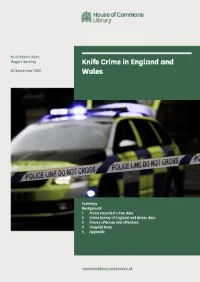
Knife crime England Wales

By Grahame Allen and Megan Harding

“Knife” crime, a crime involving an object with a blade or sharp instrument, is a persistent concern and disproportionately impacts the young and disadvantaged. Various remedies have been tried over the years. The Library Briefing Paper Knives and Offensive Weapons (SN00330) discusses the legislation which governs the carrying (possession) and sale of knives and other offensive weapons.

London: House of Commons Library, 2021. 37p.

download
Online Victimization: A Report on the Nation's Youth

By David Finkelhor; Kimberly J. Mitchell and Janis Wolak

In its fiscal year 1999 Appropriations Bill, the U.S. Congress directed the National Center for Missing and Exploited Children to undertake the first national survey on the risks faced by children on the Internet, focusing on unwanted sexual solicitations and pornography; in fulfilling this mandate, this report examines the problem and provides a base-line understanding of the risks in order to help policymakers, law enforcement, and families better understand the risks and respond effectively. The survey found that a large fraction of youth were encountering offensive experiences on the Internet, and the offenses and offenders were even more diverse than previously thought. Although most sexual solicitations failed, their quantity was alarming. The primary vulnerable population is teenagers…. social scientists should cooperate with Internet technologists to explore various social and technological strategies for reducing offensive and illegal behavior on the Internet. Further, laws are needed to help ensure offensive acts that are illegal in other contexts will also be illegal on the Internet

Alexandria, VA: National Center for Missing and Exploited Children, 2020. 63p.

download
Turning the Tide Against Online Child Sexual Abuse

By Michael Skidmore, Beth Aitkenhead and Rick Muir

The internet has enabled the production and consumption of Child Sexual Abuse Material (CSAM) on an industrial scale. It has also created new opportunities for adults to sexually abuse and exploit children. The volume of online child sexual abuse offences is now so great that it has simply overwhelmed the ability of law enforcement agencies, internationally, to respond. However, there is nothing pre-determined about this situation. Public policy can make a difference. This report looks at what can be done to help “turn the tide” on online Child Sexual Abuse (CSA). It does this by first describing the scale and nature of online CSA, second, assessing the ability of the police and law enforcement to investigate these crimes, third, by examining the service provided to victims of online CSA and, finally by looking at what more can be done to prevent online CSA in the first place.

London: The Police Foundation UK, 2022. 95p.

download
Increasing the Efficacy of Investigations of Online Child Sexual Exploitation: Report to Congress

By Brian Neil Levine

Nothing in history has transformed the character and practice of child sexual exploitation more than the internet. Individuals who commit child sex crimes use internet services, social networks, and mobile apps to meet minors and each other in ways they cannot in person and to groom victims by normalizing abusive sexual acts. Many of those who commit child sex crimes deceive, coerce, and sexually extort child victims with threats that too often are realized. Individuals who commit child sex crimes use the internet to arrange in-person meetings for hands-on abuse, and they use it to remotely coerce young children to selfproduce sexual and sadistic acts. Whether the abuse is hands-on or remote, the images or videos in which an individual captures their rape of a child are referred to as child sexual abuse materials (CSAM). An ever-growing set of online services are misused daily for the upload and immediate distribution of CSAM, supporting worldwide sharing. The harms to victims of child sexual abuse and exploitation are lifelong.

download
Bribery and Corruption: Navigating the Global Risks

By Brian Loughman and Richard Sibery

As businesses continue to expand globally into new and emerging markets, bribery and corruption risks have increased exponentially. Bribery and Corruption offers a comprehensive look at this growing problem, and at the Foreign Corrupt Practices Act (FCPA) and other international anti-bribery and corruption conventions. Presenting hypothetical examples of situations companies will face, along with practical solutions, the book offers detailed global guidance on a region and country-specific basis.

The FCPA prohibits US companies and their subsidiaries from bribing foreign officials, either directly or indirectly through intermediaries, for the purpose of obtaining or retaining business. It also requires companies to keep accurate records of all business transactions and maintain an effective system of internal accounting controls. Internationally, the Organization of Economic Cooperation and Development's (OECD's) anti-bribery convention has been adopted by 38 countries and creates legally binding standards related to bribery of foreign public officials.

Hoboken, NJ: Wiley, 2012. 417p.

download
Ransomware. Defending Against Digital Extortion

By Allan Liska and Timothy Gallo

The biggest online threat to businesses and consumers today is ransomware, a category of malware that can encrypt your computer files until you pay a ransom to unlock them. With this practical book, you'll learn how easily ransomware can infect your system and what steps you can take to stop the attack before it sets foot in your network. Security experts Allan Liska and Timothy Gallo explain how the success of these attacks has spawned not only several variants of ransomware, but also a litany of ever-changing ways they're delivered to targets. You'll learn pragmatic methods for responding quickly to a ransomware attack, as well as how to protect yourself from becoming infected in the first place"

Sebastopol, CA: O'Reilly Media, 2017. 174p.

download
Organized Crime, Conflict, and Fragility: A New Approach

By Rachel Locke

Transnational organized crime (TOC) is a global challenge posing serious threats to our collective peace and security. But in conflict-affected and fragile states the threats of transnational organized crime present particular and insidious challenges requiring new and innovative responses. Not only does TOC undermine the strength of the state, it further affects the critical and often contested relationship between the state and society. In fragile and conflict-affected states it is precisely the degraded nature of this relationship that often prevents progress toward greater peace and prosperity. While there is now an established correlation between conflict and state fragility, much less is understood about the relationship between transnational organized crime, conflict, and fragility. This report examines the dynamics between conflict, state fragility, and TOC, demonstrating how the three fit together in an uneasy triumvirate, and it presents ideas for a more effective response. Roughly half of all illicit transactions in the world are taking place in countries experiencing a range of weak enforcement mechanisms, low levels of economic well-being, insufficient government capacity, and significant societal divisions. In these contexts, transnational criminal networks further erode state legitimacy by incentivizing corruption, infiltrating state structures, and competing with the state in the provision of services. Yet the dominant approach to tackling organized crime, what I term a “law-and-order” approach, frequently fails to account for the complex dynamics associated with criminal networks in fragile and conflict-affected contexts. This approach, which is primarily focused on security, sanctions, and the rule of law, is rarely tailored to the needs of countries suffering from severe governance deficits or those with a history of conflict. On the contrary, it has the potential to reinforce historical enmities between the state and its citizens and notions of state power as coercive control rather than legitimate representation

New York: International Peace Institute, July 2012. 24p.

download
Organised Crime Index Africa 2019

By ENACT Africa

Lives are lost, forests and oceans are pillaged beyond the point of replenishment, animals are slaughtered, women, men, girls and boys are held in situations of violent abuse and exploitation. Customs officials receive bribes to turn their backs to a shipment of drugs. Police officers and soldiers sell their weapons on to street gangs. Politicians accept kickbacks, fix contracts and sell concessions to criminal groups and unethical corporations, so that they can profit from resources that were intended to improve the development opportunities of citizens. The harms caused by organised crime are widespread and profound. Yet because it is almost always obscured in the 'underworld', hidden in the shadows of remote borderlands, concealed in secrecy jurisdictions or felt most keenly by underserved communities, organised crime is a threat too easily overlooked. 'Organised crime' is not a term that has tended to be used in the African context. However, as the political economy of the continent is evolving and intertwining with other geopolitical and globalisation dynamics, the term is currently being applied to the continent with increasing frequency – and urgency. It describes everything from a range of illicit activities and actors, from human smuggling by militia groups along the North African coast, to the consorts and cronies aligned with heads of state.

ENACT Africa; 2019. 130p.

download
The Perversion of Virtue: Understanding Murder-suicide

By Thomas Joiner

Of the approximately 38,500 deaths by suicide in the U.S. annually, about two percent--between 750 and 800--are murder-suicides. The horror of murder-suicides looms large in the public consciousness--they are reported in the media with more frequency and far more sensationalism than most suicides, and yet we have little understanding of this grave form of violence.

In The Perversion of Virtue, leading suicide researcher Thomas Joiner explores the nature of murder-suicide and offers a unique new theory to explain this nearly unexplainable act: that murder-suicides always involve the wrongheaded invocation of one of four interpersonal virtues: mercy, justice, duty, and glory. The parent who murders his child and then himself seeks to save his child from a fatherless life of hardship; the wife who murders her husband and then herself seeks to right the wrongs he committed against her, and so on. Murder-suicides involve the gross misperception of when and how these four virtues should be applied.

Drawing from extensive research as well as real examples from the media, Joiner meticulously examines, deconstructs, and finally rebuilds our understanding of murder-suicide in such a way that brings tragic reason to what may seem an unfathomable act of violence. Along the way, he dispels some of the most enduring myths of suicide--for instance, that suicide is usually an impulsive act (it is almost always pre-meditated), or that alcohol or drugs are involved in most suicides (usually they are not).

Oxford, UK: Oxford University Press, 2014. 264p.

download
Gambling, Crime and Society

By James Banks

This book explores the manifold actual, possible and probable interconnections between gambling and crime in the context of the increased availability of wagering activities across many regions of the world. It examines the impact of the proliferation and propinquity of land-based betting establishments on crime, the role of organised crime in the provision of both licit and illicit forms of gambling, as well as problem gambling, crime and the administration of criminal justice. It also assesses the links between gambling, sport and corruption and the dimensions of crime that takes place in and around internet gambling sites. A thought-provoking study, this will be of particular interest to scholars in the fields of sociology, criminology and social policy.

London: Palgrave Macmillan, 2017. 247p.

download
Opioids: Treating an Illness, Ending a War

By Nazgol Ghandnoosh and Casey Anderson

More people died from opioid-related deaths in 2015 than in any previous year. This record number quadrupled the level of such deaths in 1999. Unlike the heroin and crack crises of the past, the current opioid emergency has disproportionately affected white Americans—poor and rural, but also middle class or affluent and suburban. This association has boosted support for preventative and treatment-based policy solutions. But the pace of the response has been slow, critical components of the solution—such as health insurance coverage expansion and improved access to medication assisted treatment—face resistance, and there are growing efforts to revamp the failed and costly War on Drugs.

This report examines the sources of the opioid crisis, surveys health and justice policy responses at the federal and state levels, and draws on lessons from past drug crises to provide guidance on how to proceed.

Washington, DC: The Sentencing Project, 2017. 35p.

download
Tackling Drug Markets and Distribution Networks in the UK : A review of the recent literature

By Tim McSweeney, Paul J. Turnbull, and Mike Hough

This summary sets out the main findings from a review of the recent literature on strategies to tackle illicit drug markets and distribution networks in the UK. The report was commissioned by the UK Drug Policy Commission and has been prepared by the Institute for Criminal Policy Research, School of Law, King’s College London. The main literature searches for this review were conducted during late September 2007 using a number of search terms and bibliographic data sources. In drawing together the evidence for this review we aimed to answer four broad questions: • What is the nature and extent of the problem? • What are current UK responses? • What are effective strategies for dealing with these issues? • Where are the gaps in our knowledge and understanding? This review restricted itself to domestic measures for tackling the drugs trade. As well as production control (e.g. assisting the Afghan government to implement its National Drug Control Strategy), there are a range of measures as part of the current drug strategy that are aimed at tackling drug markets and distribution networks within the UK’s borders.

London: The UK Drug policy Commission, 2008. 90p.

download
A Fresh Approach to Drugs: the final report of the UK Drug Policy Commission

By The UK Drug Policy Commission

In this report, UKDPC proposes a radical rethink of how we structure our response to drug problems. It analyses the evidence for how policies and interventions could be improved, with recommendations for policymakers and practitioners to address the new and established challenges associated with drug use.

London: The UK Drug Policy Commission, 2012.173p.

download
Crime and Violence in Central America's Northern Triangle: How U.S. Policy Responses are Helping, Hurting, and Can Be Improved

By Cristina Eguizábal, Matthew C. Ingram, Karise M. Curtis, Aaron Korthuis, Eric L. Olson and Nicholas Phillips

Throughout the spring and summer of 2014, a wave of unaccompanied minors and families from Central America began arriving at the U.S.-Mexican border in record numbers. During June and July over 10,000 a month were arriving. The unexpected influx triggered a national debate about immigration and border policy, as well as an examination of the factors compelling thousands of children to undertake such a treacherous journey. Approximately two-thirds of these children are from Central America’s Northern Triangle—El Salvador, Guatemala, and Honduras. According to interviews with the children their motives for migrating ranged from fleeing some of the world’s highest homicide rates, rampant extortion, communities controlled by youth gangs, domestic violence, impunity for most crimes, as well as economic despair and lack of opportunity. Many hoped to reunite with family members, especially parents, who are already in the United States. The wave of migrants has underscored chronic problems in the region that stem back decades. It is often assumed that international drug trafficking explains the surge in violence since 2009, but other important factors are also at play. Drug trafficking is certainly a factor, especially in areas where criminal control of territory and trafficking routes is contested, but drugs do not explain the entirety of the complex phenomenon. Other factors have also contributed. While there are important differences among the three countries, there are also common factors behind the violence. Strong gang presence in communities often results in competition for territorial and economic control through extortion, kidnapping and the retail sale of illegal drugs. Threats of violence and sexual assault are often tools of neighborhood control, and gang rivalries and revenge killings are commonplace. Elevated rates of domestic abuse, sexual violence, and weak family and household structures also contribute as children are forced to fend for themselves and often chose (or are coerced into) the relative “safety” of the gang or criminal group. Likewise, important external factors such a weak capacity among law enforcement institutions, elevated levels of corruption, and penetration of the state by criminal groups means impunity for crime is extraordinarily high (95 percent or more), and disincentives to criminal activity are almost non-existent. Public confidence in law enforcement is low and crime often goes unreported.

Washington DC: Wilson Center, Latin America Program, 2015. 296p.

download