Open Access Publisher and Free Library
CRIME+CRIMINOLOGY.jpeg

CRIME

Violent-Non-Violent-Cyber-Global-Organized-Environmental-Policing-Crime Prevention-Victimization

Posts in social sciences
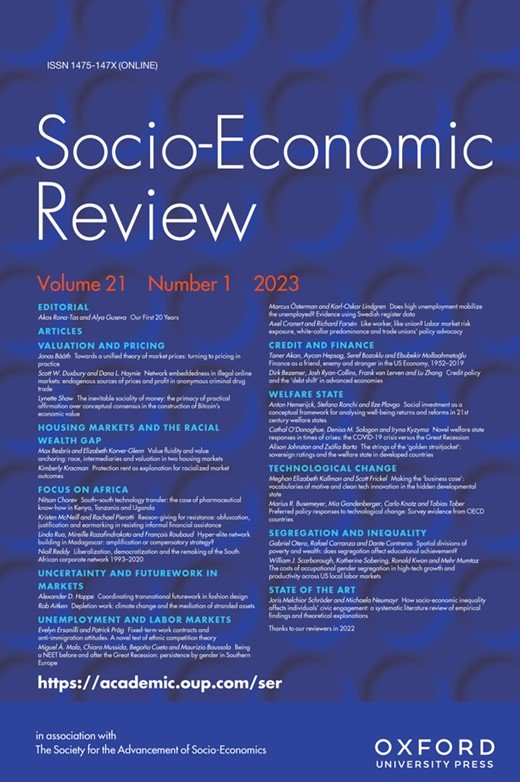
Network embeddedness in illegal online markets: endogenous sources of prices and profit in anonymous criminal drug trade

By Scott W. Duxbury and Dana L. Haynie

Although economic sociology emphasizes the role of social networks for shaping economic action, little research has examined how network governance structures affect prices in the unregulated and high-risk social context of online criminal trade. We consider how over-embeddedness—a state of excessive interconnectedness among market actors—arises from endogenous trade relations to shape prices in illegal online markets with aggregate consequences for short-term gross illegal revenue. Drawing on transaction-level data on 16 847 illegal drug transactions over 14months of trade in a ‘darknet’ drug market, we assess how repeated exchanges and closure in buyer– vendor trade networks nonlinearly influence prices and short-term gross revenue from illegal drug trade. Using a series of panel models, we find that increases in closure and repeated exchange raise prices until a threshold is reached upon which prices and gross monthly revenue begin to decline as networks become over-embedded. Findings provide insight into the network determinants of prices and gross monthly revenue in illegal online drug trade and illustrate how network structure shapes prices in criminal markets, even in anonymous trade environments.

Socio-Economic Review, 2023, Vol. 21, No. 1, 25–50

Download
How police body-worn cameras can facilitate misidentification of domestic and family violence victims as offenders

By  Iliadis Mary, Harris Bridget, Vakhitova Zarina, Woodlock Delanie, Flynn Asher, Tyson Danielle

Police body-worn camera (BWC) technologies—affixed to a vest, sunglasses or cap—are deployed by all Australian police agencies, including in frontline responses to domestic and family violence (DFV). This paper presents the findings from the first Australian study focused on how women DFV victim-survivors view and experience BWCs in police call-outs and legal proceedings. Informed by a national survey of 119 victim-survivors, it explores two key concerns relating to the potential consequences of BWC footage: (1) it may facilitate misidentification of the primary aggressor, and (2) perpetrators may use the BWC to present (false) evidence of themselves as blameless. 

Australia, Australian Institute of Criminology. 2024, 15pg

download
Online Fraud: What does the public think?

By Amber Evans, Strategy & Insight Manager | Fernanda Reynoso-Serna, Analyst | Freya Smith, Analyst | Dr Ellie Brown, Head of Strategy | Sophie Davis

Most people are more worried about being affected by online fraud than other crimes, such as knife crime, burglary and sexual offences, according to a new large-scale survey – which also highlights the emotional impact of being an online fraud victim. The research, funded by the Dawes Trust, was based on a nationally representative sample of over 3,313 adults across England and Wales as part of a survey conducted by data organisation WALR. The vast majority of those polled, 92%, said online fraud was a very big or quite big problem in the UK. When asked what crimes they were most worried about being affected by, 55% said online fraud, 44% burglary and 47% knife crime. The poll also found that younger people (aged 18-34) were most likely to be affected by online fraud, with 32% reporting having been a victim in the last twelve months compared to 16% of over-35s. However, half of those questioned believed the elderly were most at risk. Of those who had been victims of online fraud: 20% said their physical health had suffered, 32% reported a psychological impact, 42% were affected financially, 47% experienced an emotional impact, including feeling embarrassed, angry or ashamed. 23% of all victims said they had experienced anxiety, 12% experienced disturbed sleep and 11% experienced depression as a result of the online fraud. The survey also shows that just over half of victims reported the fraud to either the police or Action Fraud. Victims were more likely to contact their bank (41%) than to go to the police (32%) or Action Fraud (28%), the UK’s national fraud reporting centre.

London: Crest Advisory, 2023. 32p.

download
Potential impact of eliminating illicit trade in cigarettes: a demand-side perspective 

By Mark Goodchild , Jeremias Paul, Roberto Iglesias, Annerie Bouw, Anne-Marie Perucic

Background The Protocol to Eliminate Illicit Trade in Tobacco Products (the Protocol) entered into force in September 2018, and commits Parties to implement a package of measures to combat this global problem. The aim of this study is to assess the potential impact of eliminating illicit cigarettes on consumption, use and tax revenues. Methods We identified 36 countries where an independent (non-industry sponsored) study of the illicit cigarette market was available. We developed a conceptual framework for describing how the elimination of illicit cigarettes might impact on demand (consumption and use) and applied this framework to our sample of countries to assess the impact of eliminating illicit cigarettes across different settings. Findings Illicit cigarettes account on average for 11.2% of the market in these 36 countries. The elimination of illicit cigarettes would reduce total cigarette consumption by 1.9% across these countries. The decrease in ’group A’ countries—where illicit cigarettes are >15% of the market—would average 4.1%. The smoking rate would decrease by 1.0% in relative terms including by 2.2% in group A countries. Tax revenues from the legal sale of cigarettes would increase by 11.2% including by 25.1% in group A countries. Conclusions The illicit cigarette market reflects a complex interplay between supply and demand, with an array of different country conditions. Regardless of the situation, our study highlights the contribution that the elimination of illicit trade can make to tobacco control through demand reduction while at the same time generating significant tax revenues. 

Switzerland: World Health Organization, 2020, 8p.

download
De-Linking Tobacco Taxation and Illicit Trade in Africa

By Max Gallien

Africa has become a growth market for the tobacco industry, as people in the global North have started to smoke much less. The prevalence of smoking in Europe since the 1990s has dropped by one-third, and even further in the Americas (44%). Over the same period, smoking levels in Africa have increased by over 50% (Reitsma et al. 2017).1 Africa’s youth, in particular, is overrepresented among new smokers (N. Ramanandraibe and A.E. Ouma 2011; Blecher and Ross 2013). This is part of a wider shift in tobacco consumption from richer to poorer countries – it has been projected that 6.8 million of a global total of 8.3 million tobacco-related deaths will occur in low- and middle-income countries by 2030 (Mathers and Loncar 2006). Africa is not only facing rising health care costs connected to tobacco consumption, but also the loss of lives, particularly men, as a consequence of smoking-related diseases.

Brighton, UK: Institute of Development Studies, Summary Brief Number 22, 2020. 8p.

download
No Smoking Gun: Tobacco Taxation and Smuggling in Sierra Leone

By Max Gallien , Giovanni Occhiali

Objective: To evaluate the common industry claim that higher tobacco taxation leads to higher levels of smuggling, particularly in a limited state capacity setting. Design:This paper evaluates the effects of a tobacco tax increase in Sierra Leone on smuggling by using gap analyses. Its models are based on multiple rounds of the Demographic and Health Survey and customs data as well as newly collected data on cigarette prices. Results: The paper shows that despite a substantial increase in cigarette taxation, and despite the absence of other formal tobacco control policies, smuggling has not increased in Sierra Leone. Its primary model shows a decrease in cigarette smuggling by 16.74% following the tax increase, alongside a decrease in cigarette consumption more widely and an increase in tax revenue. Conclusions: By presenting a low income and lower enforcement capacity case study, this paper provides novel and critical evidence to the debate on the tax smuggling link. Furthermore, it points to new questions on how states in these contexts can limit cigarette smuggling.

Published Online First: Tobacco Control, 02 June 2022, DOI:10.1136/tobaccocontrol-2021-057163

download
Channeling Contraband: How States Shape International Smuggling Routes

By Max Gallien and Florian Weigand

Although  smuggling is  commonly  assumed to happen  in remote and difficult-to-access borderlands, in reality, smuggling is most prevalent in areas that states tightly control, including formal border crossings. To understand this puzzle, this article explores the relationship between states and smugglers at international borders. Based on extensive empirical research in various borderlands in North Africa and Southeast Asia, it argues that different kinds of smugglers prefer different types of relationships with the state. The article outlines six ideal types of such relationships. It contends that these types of relationships are the dominant factor in how different smuggling networks choose routes along a border. The findings have implications for our understanding of smuggling and policies that aim at addressing smuggling, especially regarding the effects of border fortifications and corruption prevention. bordFor over 400 kilometers, the border between Tunisia and Libya stretches across deserts, lakes, and mountains. The border provides a source of income for one of the largest smuggling economies in North Africa, with trading in everything from gasoline, fabrics, and electronics to cigarettes and narcotics. Its length and terrain make the border difficult to control for both Tunisian and Libyan security forces, and offer plenty of opportunities for the thousands of smugglers who cross the border everyday to stay undetected or leverage their superior knowledge of the terrain in high-speed car chases with soldiers and customs officers. And yet, most of these smugglers have chosen two particular points in the border to conduct their business: the formal border crossings as Ras Jedir and Dhiba. In fact, differ-ent smuggling networks prefer different routes: while those trading in mobile phones, bananas, or alcohol have typically preferred to play cat and Mouse.

SECURITY STUDIES, 2021, VOL. 30, NO. 1, 79–106

download
Patterns of Symbolic Violence: The Motif of ‘Gypsy’ Child-theft across Visual Media

By Mladenova, Radmila

Drawing on a number of paradigmatic works of art, the book explores the motif of ‘gypsy’ child-theft and its visualisations. The analytical focus is on the colour coding of bodies in texts and images and their racialised/anti-gypsy uses. Offering a comprehensive survey of the motif’s adaptations to different visual media, the author elaborates on its multiple layers of meaning and functions. The analysis starts with a critical review of Cervantes’ tale “La gitanilla”, moving through seventeenth-century Dutch history painting to take a cursory look at nineteenth-century printed images, and end up with an annotated filmography of 49 cinematic works.

Heidelberg: Heidelberg University Publishing (heiUP), 2019. 122p.

Download
Economic Crime and Illicit Finance in Russia’s Occupation Regime in Ukraine

By David Lewis

Despite Ukraine's ongoing counter-offensive, in September 2023 Russia still controlled around 17% of Ukrainian territory, an area roughly the size of Denmark. Russia's occupation of these Ukrainian territories relied primarily on repression and violence, but economic levers also played an important role in consolidating Russian rule. This paper details Russia's illicit economic activity in the occupied territories and calls for more international attention to this aspect of Russia's invasion. Since Russia occupied large parts of south-eastern Ukraine in March 2022, it has worked rapidly to incorporate these regions into Russia's economic and financial system. Key elements in this 'economic occupation' include: • The seizure of many Ukrainian businesses and assets. The occupation authorities 'nationalised' many companies and re-registered them as Russian businesses with new management. • The imposition of the Russian currency, financial and tax system, and the forced closure of Ukrainian banks. • The forcible takeover of farms or pressure on farmers to cooperate with the occupation authorities. Russian officials oversaw the illegal export of Ukrainian grain from the occupied territories. • The reconstruction of cities such as Mariupol, the city destroyed by Russian forces in spring 2022, in a multi-billion-dollar government programme that is profiting well-connected Russian companies. These acts were all illegal under Ukrainian law and some may constitute potential war crimes under international law. There should be more attention paid to these economic crimes internationally – with clear warnings for Russian business about the consequences under international law of seizing Ukrainian businesses and assets. Although international sanctions have targeted many officials in the Russian occupation structures, the approach should be more coordinated and systematic to raise the costs of Russian occupation. More international attention now would also assist in eventual reintegration and reconstruction of these regions. For example, a database of business seizures and economic crimes in the occupied territories would help to resolve legal issues and ensure business restitution in the aftermath of the war, while also serving as a potential basis for sanctions and eventual prosecutions. The economic aspects of occupation also raise complex questions of transitional justice for those who lived under Russian occupation. Ukrainian society is discussing how to define and respond to acts of collaboration in the occupied territories. International experience could help to inform legal and political solutions that meet the needs of justice but also seek to unite post-war Ukrainian society  

SOC ACE Research Paper No 20. 

Birmingham, UK: University of Birmingham , 2023. 43p.

Download
Online Fraud Schemes: A Web of Deceit

By Europol

Europol's spotlight report on online fraud highlights that online fraud schemes represent a major crime threat in the EU and beyond as online fraudsters generate multiple billions in illicit profits every year to the detriment of individuals, companies and public institutions.
Fraud schemes are perpetrated with the intention of defrauding victims of their assets using false and deceitful pretexts, or with the use of cyberattack techniques. This results in the voluntary or involuntary transfer of personal or business information, money or goods to criminals.

From ATM attacks and account takeovers to skimming and shimming, the wide availability of crime-as-a-service has made this criminal activity more accessible. Criminals show great versatility and adaptability in adjusting their modi operandi and modelling their narratives around socio-economic trends as well as current crises, taking advantage of emergency situations to create charity scams.

This report is an accompanying module to Europol’s IOCTA, which aims at providing and understanding of modern cybercrime to equip law enforcement with the knowledge to tackle it and keep people safe. It delves into the complexities of online fraud schemes and sheds light on how different schemes overlap and victimise targets multiple times.

Key findings:

Relay attacks targeting payment card chips (shimming) are increasingly detected.

Charity scams leveraging emergency situations have increased. This was visible during the COVID-19 pandemic, the Russian invasion of Ukraine and the earthquake in Türkiye and Syria.

Logical attacks on ATMs still occur in the EU, with criminal networks testing ways to exploit new vulnerabilities at the ATMs they target.

Fraudsters display sophisticated modi operandi, which are usually a combination of different types of fraud. Victims of fraud are often re-victimised within the same criminal scheme.

Social engineering techniques that fraudsters use have been growing in complexity. Criminals adapt their techniques according to the profile of the victim and the typology of fraud.

Spotlight Series Report.

The Hague: EUROPOL, 2023. 20p.

Download
social sciencesRead-Me.Org
Sexual victimisation, peer victimisation, and mental health outcomes among adolescents in Burkina Faso: a prospective cohort study

By Kirsty S Lee, Dieter Wolke, Till Bärnighausen, Lucienne Ouermi, Mamadou Bountogo, Guy Harling

Background Sexual victimisation and peer victimisation are pervasive and increase risk for mental illness. Longitudinal studies that compare their unique and cumulative effects are scarce and have been done predominantly in highincome countries. The aims of this study were to examine the prevalence, prospective associations, and gender differences in sexual and peer victimisation and mental health in a low-income, African setting. Methods In this prospective cohort study, data were obtained from the 2017 ARISE Adolescent Health Study, a population-representative, two-wave, prospective study of adolescents (aged 12–20 years) from Burkina Faso. A random sample of adolescents was drawn from ten villages, selected to capture the five main ethnic groups, and from one of the seven sectors of Nouna town, Burkina Faso, at two timepoints: Nov 12 to Dec 27, 2017, and Nov 15 to Dec 20, 2018. Standardised interviews were conducted in French or a local language by trained researchers. We measured victimisation exposure as sexual victimisation, peer victimisation, and polyvictimisation, using lifetime frequency of exposure, and we measured mental health symptoms and disorders using the Kutcher Adolescent Depression Scale, the Primary Care Post-Traumatic Stress Disorder screen IV and 5, and a question on lifetime selfharm and number of incidents in the past year. We calculated prevalence of victimisation and mental health symptoms and disorders at the two timepoints, and we used lifetime victimisation at the first timepoint to predict mental health at the second timepoint using logistic and negative binomial regressions. Gender differences were examined using interaction terms. Findings Of 2544 eligible adolescents, 1644 participated at time 1 and 1291 participated at time 2. The final sample with data at both timepoints included 1160 adolescents aged 12–20 years (mean 15·1, SE 0·2), of whom 469 (40·4%) were girls and 691 (59·6%) were boys. The majority ethnic group was Dafin (626 [39·1%]), followed by Bwaba (327 [20·5%]), Mossi (289 [16·0%]), Samo (206 [13·0%]), Peulh (166 [9·7%]), and other (30 [1·6%]). After survey weight adjustment, sexual victimisation (weighted percentages, time 1, 256 [13·8%] of 1620; time 2, 93 [7·2%] of 1264) and peer victimisation (weighted percentages, time 1, 453 [29·9%] of 1620; time 2, 272 [21·9%] of 1264) were common, whereas polyvictimisation was more rare (weighted percentages, time 1, 116 [6·6%] of 1620; time 2, 76 [5·7%] of 1264). Longitudinally, sexual victimisation was associated with probable clinical disorder (adjusted odds ratio 2·59, 95% CI 1·15–5·84), depressive symptoms (adjusted incidence rate ratio [aIRR] 1·39, 95% CI 1·12–1·72), and symptoms of post-traumatic stress disorder (aIRR 2·34, 1·31–4·16). Peer victimisation was associated with symptoms of posttraumatic stress disorder (aIRR 1·89, 1·13–3·17) and polyvictimisation was associated with depressive symptoms (aIRR 1·34, 1·01–1·77). Girls reported more sexual victimisation (weighted percentages, 130 [17·3%] of 681 vs 126 [11·4%] of 939), boys reported more peer victimisation (weighted percentages, 290 [33·1%] of 939 vs 163 [25·2%] of 681), and there was a significant interaction between lifetime victimisation and gender for probable clinical disorder (F [degrees of freedom 7, sample 376] 2·16; p=0·030). Interpretation Sexual and peer victimisation were common in the study setting and increased risk for mental health problems. Adolescent girls who have been sexually victimised are especially at risk of mental health problems. Interventions targeting sexual and peer violence in low-income settings are needed.  

Lancet Psychiatry 2024; 11: 134–42

Download
Killer Fandom: Fan Studies and the Celebrity Serial Killer

By Judith May Fathallah

Killer Fandom is the first long-form treatment of serial killer fandom. Fan studies have mostly ignored this most moralized form of fandom, as a stigmatized Bad Other in implicit tension with the field’s successful campaign to recuperate the broader fan category. Yet serial killer fandom, as Judith May Fathallah shows in the book, can be usefully studied with many of the field’s leading analytic frameworks. After tracing the pre-digital history of fans, mediated celebrity, and killers, Fathallah examines contemporary fandom through the lens of textual poaching, affective community, subcultural capital, and play. With close readings of fan posts, comments, and mashups on Tumblr, TikTok, and YouTube, alongside documentaries, podcasts, and a thriving “murderabilia” industry, Killer Fandom argues that this fan culture is, in many ways, hard to distinguish from more “mainstream” fandoms. Fan creations around Aileen Wuornos, Jeffrey Dahmer, Ted Bundy, and Richard Ramirez, among others, demonstrate a complex and shifting stance toward their objects—marked by parodic humor and irony in many cases. Killer Fandom ultimately questions—given our crime-and violence-saturated media culture—whether it makes sense to set Dahmer and Wuornos “fans” apart from the rest of us.

Bethlehem, PA: Media Studies Press, 2023. 259p.

Download
Concealing for Freedom: The Making of Encryption, Secure Messaging and Digital Liberties

By: Ksenia Ermoshina and Francesca Musiani

Concealing for Freedom: The Making of Encryption, Secure Messaging and Digital Liberties sets out to explore one of the core battlegrounds of Internet governance: the encryption of online communications. Current debates around encryption have fundamental implications for our individual liberties and collective presence on the Internet. Encryption of communications at scale and in increasingly usable ways has become a matter of public concern, especially since Edward Snowden’s 2013 revelations. A new cryptographic imaginary is taking hold, which sees encryption as a necessary precondition for the formation of networked publics. At the same time, there have been major evolutions and accelerations in the field of secure communications, prompted in part by the cryptography community’s renewed efforts to create next-generation secure messaging protocols and applications. It is vital that we unveil the very recent, and sometimes less recent history of these protocols and their key applications. The book takes on this task, in order to show how the opportunities and constraints they provide to Internet users came about, and how both developer communities and institutions are working towards making them available for the largest possible audience. It explores how efforts towards this goal are built upon interwoven stories about technical development and architectural choices, about community-building – and about Internet governance and politics. In doing so, the book focuses on the experience of encryption in a wide variety of contemporary secure messaging protocols and tools, and looks at the implications of these endeavors for the “making of” digital liberties on the Internet. Concealing for Freedom provides two key empirical and theoretical contributions. Firstly, it enriches a social sciences-informed understanding of encryption. It does so by examining how different solutions of cryptography for secure communications are created, developed, enacted, and governed, and what this diverse experience of encryption, operating across many different sites, means for online civil liberties. Secondly, it contributes to understanding the social and political implications of particular design choices when it comes to the technical architecture of digital networks, in particular their degree of (de-)centralization. The book explores developers’ actions and their interactions with other stakeholders, for instance users, security trainers, standardising bodies, and funding organizations. It also examines their interactions with the technical artifacts they develop, in which a core common objective is to create tools that “conceal for freedom” even as how this objective is met differs according to technical architectures, the user publics being targeted and the tools’ underlying values and business models.

Manchester, UK: Mattering Press, 2022. 274p.

Download
Non-Fatal Shooting Crosswalk Study: FINAL REPORT

By Alaina De Biasi Edmund F. McGarrell Scott E. Wolfe

Historically, crime in the United States has been measured by the Uniform Crime Reporting (UCR) system administered by the Federal Bureau of Investigation (FBI). In this system, local, county, state, Tribal and federal law enforcement agencies submit summary crime data on incidents and arrests to the UCR system. Crime patterns and trends can then be analyzed and tracked at local, state, and national levels. 

United States, Michigan Justice Statistics Center, School of Criminal Justice, Michigan State University. 2023. 33pg

download
Racial Isolation, School Police, and the “School-To-Prison Pipeline”: An Empirical Perspective on the Enduring Salience of “Tipping Points”

By Michael Heise

Two broad trends inform public K-12 education’s current trajectory. One involves persisting (and recently increasing) school racial isolation which helps account for an array of costs borne by students, schools, and communities. A second trend, involving a dramatically increasing police presence in schools, is evidenced by a rising school resource officer (“SRO/police”) presence in schools. Increases in the magnitude of a school’s SRO/police presence correspond with increases in the school’s propensity to engage law enforcement agencies in student disciplinary matters which, in turn, help fuel a growing school-to-prison pipeline problem. While these two broad trends propel two distinct research literatures, these research literatures do not meaningfully engage with one another. Empirical research is largely silent on the degree to which, if at all, variation in a school’s racial isolation level influences how its SRO/police presence interacts with the school’s propensity to report student discipline issues to law enforcement agencies. This Article examines whether variation in school racial isolation levels informs whether a school’s SRO/police presence influences the school’s law enforcement reporting rates. Results from this study imply that any such influence is confined to schools where non-white student enrollment ranges from 11% to 50%. The research literature on tipping points provides one helpful interpretative lens to better understand why this specific school racial isolation band systematically differs from others when it comes to SRO/police presence’s influence on a school’s propensity to report student discipline matters to law enforcement agencies.

Buffalo Law Review Vol. 71, No. 2 (2023)

download
Global Risks Report 2024

By World Economic Forum

The Global Risks Report explores some of the most severe risks we may face over the next decade, against a backdrop of rapid technological change, economic uncertainty, a warming planet and conflict. As cooperation comes under pressure, weakened economies and societies may only require the smallest shock to edge past the tipping point of resilience.

Geneva, SWIT: World Economic Forum, 2024. 124p

download
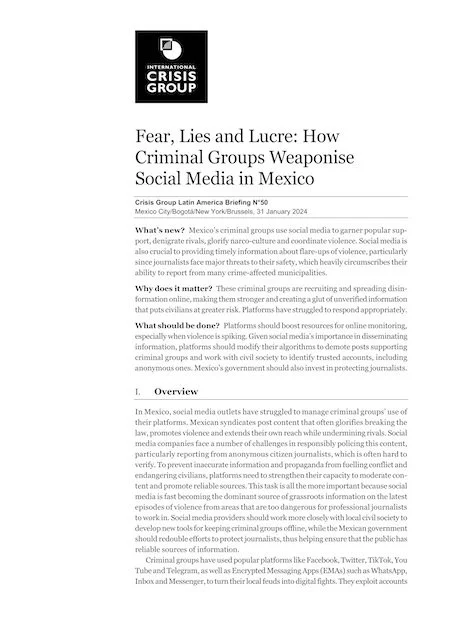
Fear, Lies and Lucre: How Criminal Groups Weaponise Social Media in Mexico

By International Crisis Group

What’s new? Mexico’s criminal groups use social media to garner popular support, denigrate rivals, glorify narco-culture and coordinate violence. Social media is also crucial for providing timely information about flare-ups of violence, particularly since journalists face major threats to their safety, which heavily circumscribes their ability to report from many crime-affected municipalities.

Why does it matter? These criminal groups are recruiting and spreading disinformation online, making them stronger and creating a glut of unverified information that puts civilians at greater risk. Platforms have struggled to respond appropriately.

What should be done? Platforms should boost resources for online monitoring, especially when violence is spiking. Given social media’s importance in disseminating information, platforms should modify their algorithms to demote posts supporting criminal groups and work with civil society to identify trusted accounts, including anonymous ones. Mexico’s government should also invest in protecting journalists.

Brussels: Crisis Group, 2024

download
Sheltering Injustice: A Call for Georgia to Stop Criminalizing People Experiencing Homelessness ref

By Southern Poverty Law Center

Access to safe, stable housing is a human right. In the United States, however, the deprivation of this right leads to inequitable housing access. As a result, in addition to people with disabilities and members of the LGBTQ+ community, people of color — especially Black people — are more likely to experience homelessness or be at risk of homelessness. Compounding this issue, people of color and people with disabilities are also overrepresented in the criminal legal system because of mass incarceration. This intersection of housing inaccessibility and criminalization has resulted in the pernicious practice of the criminalization of people experiencing homelessness, a pressing issue across the country — including in the Deep South. In 2023, for example, Georgia enacted a law that forces cities and other localities to enforce bans on public camping, putting thousands of Georgians living unsheltered at risk of arrest for performing basic survival activities like rest, eating and asking for help.

Montgomery, AL Southern Poverty Law Center, 2024

download
Homelessness, Offending, Victimization, and Criminal Legal System Contact   

By Bill McCarthy and John Hagan

There is now a sizable literature on connections between homelessness, crime, and criminal legal system contact. We review studies on these relationships, focusing mostly on links between the adversity that often characterizes homelessness—the need for shelter, food, and income—and offending, victimization, and involvement with the criminal legal system. We concentrate on multivariate studies from the United States and Canada and consider research on youth and adults. We begin with a short discussion of some of the challenges of studying these relationships. We follow our review of research on homeless conditions with a summary of research that has used data from homeless samples to advance a broad array of explanations of crime; a collection that includes strain, routine activities and lifestyle exposure, differential association, social control, rational choice, life course, and criminal capital theories.

Annual Review of Criminology, Volume 7, Page 257 - 281

download
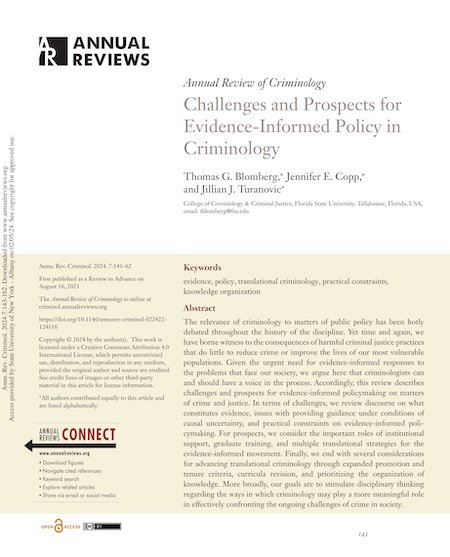
Challenges and Prospects for Evidence-Informed Policy in Criminology

By Thomas G. Blomberg, Jennifer E. Copp, and Jillian J. Turanovic

The relevance of criminology to matters of public policy has been hotly debated throughout the history of the discipline. Yet time and again, we have borne witness to the consequences of harmful criminal justice practices that do little to reduce crime or improve the lives of our most vulnerable populations. Given the urgent need for evidence-informed responses to the problems that face our society, we argue here that criminologists can and should have a voice in the process. Accordingly, this review describes challenges and prospects for evidence-informed policymaking on matters of crime and justice. In terms of challenges, we review discourse on what constitutes evidence, issues with providing guidance under conditions of causal uncertainty, and practical constraints on evidence-informed policymaking. For prospects, we consider the important roles of institutional support, graduate training, and multiple translational strategies for the evidence-informed movement. Finally, we end with several considerations for advancing translational criminology through expanded promotion and tenure criteria, curricula revision, and prioritizing the organization of knowledge. More broadly, our goals are to stimulate disciplinary thinking regarding the ways in which criminology may play a more meaningful role in effectively confronting the ongoing challenges of crime in society.

Annual Review of Criminology, Volume 7, Page 143 - 162

download