

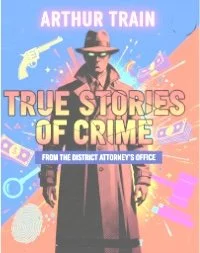
By Arthur Train. Introduction by Graeme R. Newman
The transition of the American legal system from the rough-and-tumble nineteenth century into the more structured, investigative era of the early twentieth century is nowhere more vividly captured than in Arthur Train’s True Stories of Crime from the District Attorney’s Office. As an Assistant District Attorney for New York County during a period of rapid urbanization and social upheaval, Train occupied a unique vantage point that allowed him to witness the collision of old-world criminal archetypes with the emerging complexities of modern life. This collection of narratives serves as a clinical yet deeply compelling autopsy of the era’s most notorious legal battles, offering readers a rare glimpse into the machinery of justice at a time when forensic science was in its infancy and the power of the prosecutor’s office was expanding into new, uncharted territories.
Train’s work is particularly significant for its early exploration of what would eventually be termed white-collar crime. While the public imagination of 1908 was often captured by tales of blunt violence and physical daring, Train directs his focus toward the "super-criminal"—the manipulative mastermind who utilized the administrative and financial structures of the city as their primary tools of exploitation. Through these accounts, we see the emergence of a new kind of threat that required a equally sophisticated response from the legal establishment. Train describes a landscape where economic desperation and social isolation were the primary drivers of criminal behavior, yet he also highlights the systemic vulnerabilities that allowed institutional fraud to flourish. By documenting these cases, he provides a foundation for the study of victimology, illustrating how the legal system often struggled to keep pace with the evolving ingenuity of those who sought to undermine it.
Beyond their historical and legal value, these stories possess a narrative vitality that reflects the tension between the sensationalism of early tabloid journalism and the rigorous demands of the courtroom. Train’s prose is informed by his experiences on the front lines of the District Attorney’s office, where the outcome of a trial often hinged as much on rhetorical flair and personal intuition as it did on physical evidence. In revisiting these cases today, we are invited to consider the persistent challenges of defining and delivering justice within a complex bureaucracy. Train does not shy away from the moral ambiguities of his profession, and his reflections on the nature of guilt and the limitations of the law remain strikingly relevant. This volume stands not only as a record of forgotten crimes but as an enduring meditation on the social fabric of a metropolis in flux, capturing the moment when the modern era of criminal justice truly began.
Read-Me.Org Inc. 2026. 184p.
