
Open Access Publisher and Free Library
Fiction+Mediajpg.jpg

FICTION and MEDIA

CRIME AND MEDIA — TWO PEAS IN A POD

Posts tagged frontier
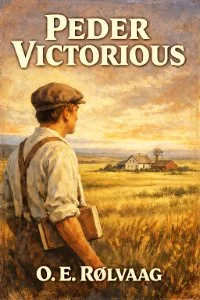
Peder Victorious

By O. E. Rølvaag (Author), Colin Heston (Introduction)

Peder Victorious by O. E. Rølvaag is a powerful continuation of the prairie saga that began with Giants in the Earth, shifting the focus from the physical hardships of pioneer settlement to the inner conflicts of the immigrant’s American-born son. Set within a Norwegian farming community in the Dakota Territory, the novel follows young Peder Holm as he comes of age amid the competing claims of ancestral faith and American ambition. Intelligent and driven, Peder embraces education and opportunity, yet his aspirations strain against the religious intensity and cultural conservatism that define his mother’s world. Rølvaag portrays with psychological depth the tension between generations, the fragility of cultural inheritance, and the cost of assimilation. The prairie remains vast and elemental, but the central struggle unfolds within the human heart, where identity, loyalty, and belief are tested. Both intimate and epic in scope, the novel offers a searching exploration of what it means to be victorious in a land that promises freedom while quietly demanding transformation.

Nearly a century after its publication, Peder Victorious by O. E. Rølvaag remains strikingly relevant in an era defined by global migration, cultural pluralism, and debates over national identity. The novel’s portrayal of second-generation tension—between inherited faith and modern ambition, communal loyalty and individual advancement—mirrors the lived experience of many contemporary families navigating assimilation in North America, Europe, and beyond. Peder’s divided consciousness anticipates what sociologists now describe as bicultural identity formation, in which success within dominant institutions can coexist with a sense of estrangement from ancestral tradition. At a time when questions of belonging, integration, and cultural continuity are again politically and socially charged, Rølvaag’s work offers a sober reminder that assimilation is not a frictionless process but a psychological and moral negotiation whose costs and gains are unevenly distributed across generations.

Read-Me.Org Inc. New York-Philadelphia-Australia. 2026. 240p.
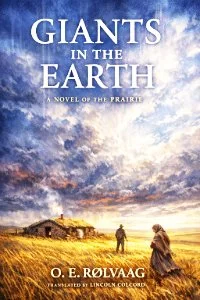
Giants in the Earth

O. E. Rølvaag, Preface by Colin Heston.

The struggle of the immigrant is often told through the lens of triumph—of cities built and fortunes made—but in O. E. Rølvaag’s Giants in the Earth, we are invited into a far more intimate and devastating arena: the psychological and spiritual cost of taming a wilderness. First published in Norwegian in 1924 as I de dage and later meticulously translated into English by Lincoln Colcord in collaboration with the author, this novel remains the definitive epic of the American prairie. It is not merely a story of farming; it is a saga of the human psyche stretched to its breaking point against an indifferent landscape.
At the heart of the narrative lies a profound dichotomy between the two protagonists, Per Hansa and Beret. Per Hansa embodies the archetype of the pioneer, fueled by a restless, creative energy that views the desolate plains of South Dakota not as a wasteland, but as a kingdom waiting to be claimed. To him, the "Giants" are physical obstacles to be conquered through grit and vision. Conversely, Beret represents the tragic reality of displacement. She is haunted by the Great Plain, a space so vast and empty that she feels God cannot find her there. For Beret, the "Giants" are the invisible, malevolent forces of the Earth itself, punishing those who dare to disturb its ancient, heavy silence.
The English version of Giants in the Earth is a rare literary achievement born of a unique partnership. Lincoln Colcord, a writer of the sea, found a common language with Rølvaag, a writer of the "sea of grass." Their collaboration ensured that the stark, rhythmic beauty of Rølvaag’s Norwegian—steeped in biblical cadence and Old World folklore—was preserved for an English-speaking audience. Colcord understood that the oceanic quality of the prairie was more than a metaphor; it was a physical reality where the winds howling across the Dakota territory carried the same weight and terror as a North Atlantic gale.
Rølvaag does not romanticize the pioneer experience. He documents the relentless succession of plagues—locusts, blizzards, and the suffocating loneliness of the sod house—forcing the reader to confront the sobering question of what is lost when a culture uproots itself. While Per Hansa builds the physical foundations of a new nation, Beret bears the burden of the cultural and emotional cost. Her descent into religious melancholy serves as a poignant reminder that while the land may be conquered, the soul is often the casualty of that conquest. She famously remarks that the Great Plain drinks the blood of Christian men and is never satisfied.
Nearly a century since its translation, Giants in the Earth stands as a pillar of American literature because it refuses to offer easy answers. It is a masterpiece of realism and a haunting work of the imagination that captures the birth of a modern identity forged in a crucible of isolation. As you turn these pages, you are witnessing a history that is as much about the internal landscape of the mind as it is about the external map of the frontier.

Read-Me.Org Inc. New York-Philadelphia-Australia. 2026. 373p.