Open Access Publisher and Free Library
Fiction+Mediajpg.jpg

FICTION and MEDIA

CRIME AND MEDIA — TWO PEAS IN A POD

Posts in Migration
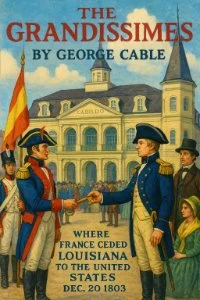
The Grandissimes: A Story of Creole Life

By George W. Cable

The Grandissimes: A Story of Creole Life stands among the most vivid and penetrating literary portraits of early New Orleans—its tangled ancestries, its hierarchies of caste and color, and its rich cultural complexity at the turn of the nineteenth century. First published in 1880, George W. Cable’s novel announced the arrival of a distinctive Southern voice: one capable of blending romance, social critique, historical reconstruction, and an almost anthropological attention to the manners and moral contradictions of Creole society.

Cable, himself native to New Orleans, wrote at a moment when the American public was only beginning to recognize the significance of Louisiana’s unique heritage. The city had passed from French to Spanish control, then back to France, then suddenly into the hands of the United States through the Louisiana Purchase. In Cable’s imagination, this swirl of sovereignties—compounded by the interwoven legacies of France, Spain, Africa, the Caribbean, and Indigenous peoples—created a society unlike any other on the continent. The Grand–issimes dramatizes this world at a moment of profound transition, when old loyalties struggled against the pressures of Americanization, and when the boundaries of race, class, and honor were both fiercely guarded and constantly transgressed.

At its center stands the old Creole family of the Grandissimes, whose branches include both the proud white aristocracy and a free man of color who bears the same name—a blood relationship that must not, in respectable society, be spoken aloud. Through this intricate family history, Cable exposes the contradictions of slavery, the moral compromises of privilege, and the tragic limitations imposed on people of mixed heritage. Yet the novel is anything but a simple moral allegory. Its pages teem with humor, local color, memorable characters, and a richly textured atmosphere that evokes the city’s architecture, dialects, festivals, and customs with unmatched fidelity.

Cable’s realism—rare among Southern writers of his generation—caused both admiration and controversy. His depictions of racial injustice were received with anger in parts of the post-Reconstruction South, and his advocacy for Black civil rights would eventually drive him to relocate to the North. Today, his work is recognized as foundational: a precursor to later explorations of New Orleans identity by Kate Chopin, Lafcadio Hearn, Lyle Saxon, and many others.

This edition of The Grandissimes invites readers to rediscover Cable’s great novel not merely as an historical document but as a living work of art. Its themes of belonging, cultural collision, and the moral weight of inherited systems remain deeply resonant. In tracing the fate of a family—and of a city—at a crossroads, Cable offers a vision both critical and compassionate, illuminating a world whose complexities still echo through the streets of New Orleans today.

Read-Me.Org Inc. New York-Philadelphia-Australia. 2025. p.248.

download free
kindle $2.99 -- paperback $9.99
The Portygee

By Joseph Crosby Lincoln . Designed and Edited with an Introduction by Colin Heston

Joseph C. Lincoln's 1920 novel The Portygee holds a unique place in his body of work. Known for his warm-hearted Cape Cod tales celebrating small-town life, moral decency, and New England character, Lincoln here expands his focus to address questions of heritage, identity, and belonging in a changing America. While retaining the gentle humor and richly textured settings that made him popular with early 20th-century readers, The Portygee engages more directly with themes of cultural difference and assimilation—offering a nuanced portrayal of prejudice, generational misunderstanding, and the search for personal integrity.

The novel’s title refers to the derogatory local slang for “Portuguese,” used to identify individuals of Portuguese descent who had settled along the Massachusetts coast in significant numbers by the late 19th and early 20th centuries. Through this lens, Lincoln examines not only the resilience of the American immigrant but also the sometimes unspoken tensions that lie beneath the surface of even the most tight-knit communities. It is a story of collision—between old and new, native and newcomer, tradition and ambition.

Read-Me.Org Inc. New York-Philadelphia-Australia. 2025. 262p.

download
kindle $1.99 -- paperback $9.99