Open Access Free Library
Fiction+Mediajpg.jpg

FICTION and MEDIA

CRIME AND MEDIA — TWO PEAS IN A POD

Posts in american history
Cape Cod Stories

By Joseph C. Lincoln . Designed and Edited by Colin Heston.

*Cape Cod Stories* by Joseph C. Lincoln is a charming collection of short stories that vividly captures the spirit, humor, and character of life in small-town Cape Cod at the turn of the 20th century. The stories are narrated by a local character, often Cap’n Jonadab or his friend, and revolve around the fictional town of East Wellmouth, a stand-in for the many quaint villages that dot the Cape. Each tale is steeped in the dialect, customs, and eccentricities of the region, offering a nostalgic and affectionate portrayal of New England coastal life. The collection includes stories such as “Two Pairs of Shoes,” “The Count and the Manager,” “The South Shore Weather Bureau,” “The Dog Star,” “The Mare and the Motor,” “The Mark on the Door,” “The Love of Lobelia ’Ankins,” “The Meanness of Rosy,” “The Antiquers,” “His Native Heath,” and “Jonesy.” These stories often center on humorous misunderstandings, romantic entanglements, and the clash between tradition and modernity. For example, in “The Mare and the Motor,” the arrival of a newfangled automobile causes a stir in the community, leading to a series of comic events that highlight the tension between old ways and new technologies. In “The Count and the Manager,” a visiting European nobleman becomes entangled in local affairs, revealing both the pretensions and the down-to-earth wisdom of the Cape Codders. Lincoln’s characters are often crusty but kind-hearted, with a deep sense of community and a wry sense of humor. The stories are rich in local color, with detailed descriptions of the landscape, the sea, and the rhythms of daily life. Lincoln’s prose is warm and engaging, drawing readers into a world where values like honesty, hard work, and neighborliness prevail. While the stories are light-hearted and often comedic, they also reflect deeper themes of change, identity, and the enduring strength of community bonds. Through these tales, Lincoln preserves a way of life that was already beginning to fade, offering readers both entertainment and a poignant reminder of the past.

Read-Me.Org Inc. New York-Philadelphia-Australia. 2025. p.144.

Big Mogul

By Joseph Crosby Lincoln. Edited with an Introduction by Introduction by Colin Heston

The Big Mogul is a warm, character-driven novel set in a small New England town, where the rhythms of coastal life and the intricacies of human relationships unfold with gentle humor and emotional depth. The story centers on Foster Townsend, a wealthy, proud, and somewhat cantankerous man who is grappling with the loneliness that has settled over his life following the death of his beloved wife. His grand mansion, once filled with warmth and companionship, now feels hollow and cold. In an effort to fill this emotional void, he considers inviting his estranged niece, Esther, to live with him. Esther, who has been raised by her aunt Reliance after the death of her parents, represents a potential new beginning for Foster, though he is unsure how to bridge the emotional distance between them.

As the narrative unfolds, the novel explores the evolving relationship between Foster and Esther, marked by moments of awkwardness, affection, and gradual understanding. Their interactions are shaped by Foster’s brusque demeanor and Esther’s quiet resilience, and the story gently reveals how both characters begin to heal and grow through their connection. The novel also delves into the broader community dynamics of the town, where long-standing feuds, gossip, and the quirks of small-town life add texture and humor to the story. A subplot involving young love between members of two feuding families adds a layer of romantic tension and serves as a counterpoint to the more mature emotional journey of Foster and Esther.

Lincoln’s writing is imbued with a nostalgic affection for Cape Cod and its people, and he paints his characters with a blend of realism and idealism that makes them both believable and endearing. The novel resists the darker currents of contemporary naturalist literature, instead offering a comforting vision of human decency, reconciliation, and the possibility of renewal. Through its gentle pacing and focus on character over plot, The Big Mogul invites readers to reflect on the importance of family, the pain of loss, and the quiet joys of rediscovered connection.

Read-Me.Org Inc. New York-Philadelphia-Australia. 2025. p.261p.

Americanized Socialism: A Yankee View of Capitalism'

By James MacKaye

Socialists differ about the philosophy and the tactics of socialism, but they agree about its program. Adherence to the program therefore is the test of a socialist. Morris Hillquit, probably the best authority on orthodox socialism in America, is fully in agreement with this position, as shown by the following quotation from an article in the Metropolitan Magazine for July, 1912:

Boni and Liverright, 1918, 199p.

The Mill on the Floss

By George Eliot

e lives of siblings Tom and Maggie Tulliver. Their story unfolds against the backdrop of Dorlcote Mill, their family's ancestral home and livelihood. From childhood to adulthood, Tom and Maggie navigate the complexities of familial duty, societal expectations, and personal aspirations. Maggie Tulliver, with her intelligence, emotional depth, and yearning for a life beyond the provincial confines, emerges as one of literature's most compelling heroines. Her struggles against the rigid gender roles of her time and her passionate quest for self-identity resonate deeply with readers. Tom, her pragmatic and duty-bound brother, often finds himself at odds with Maggie's impulsive nature, creating a dynamic and poignant sibling relationship.

George Eliot's masterful storytelling is evident in her rich character development and psychological insight. She delves into the inner lives of her characters, offering a nuanced portrayal of their motivations and conflicts. The novel's themes of duty, loyalty, and the constraints imposed by society are explored with empathy and realism, making it a powerful critique of the social structures of the time. "The Mill on the Floss" also reflects the broader economic and social changes of the 19th century. The Tulliver family's financial troubles, brought about by Mr. Tulliver's imprudent business decisions, mirror the uncertainties faced by many during the period of industrialization. Eliot's vivid depiction of rural life and the impact of modernization adds depth to the narrative, making it relevant to contemporary readers.

This novel is not just a story of personal and familial struggles but also a meditation on the forces of fate and the resilience of the human spirit. The tragic climax, marked by a devastating flood, underscores the novel's themes of loss, redemption, and the inexorable flow of life. Immerse yourself in "The Mill on the Floss," a literary masterpiece that continues to captivate and inspire readers with its timeless exploration of human nature and society. Whether you're a long-time fan of George Eliot or discovering her work for the first time, this novel promises a rich and rewarding reading experience.

First published on April 4, 1860 by William Blackwood and Sons. This edition by Read-Me.Org Inc. 2025.. 367p.

The Case of Mr. Crump: Editied with an Introduction by Graeme R. Newman

Byy Ludwig Lewisohn (Author), Graeme Newman (Editor)

“The Case of Mr. Crump” by Ludwig Lewisohn is a richly detailed narrative that delves into the complex lives of Anne and Herbert Crump. The story spans multiple stages of their lives, exploring themes of love, manipulation, duty, and the pursuit of artistic integrity. Anne’s tumultuous past and manipulative nature clash with Herbert’s aspirations as a young musician, leading to a series of personal and professional struggles. Set against the backdrop of early 20th-century America, the novel portrays Herbert’s journey through marital conflicts, familial obligations, and his relentless quest for success in the music industry. The narrative is marked by intense emotional conflicts, societal pressures, and the enduring impact of past traumas on the characters’ lives. Editing of the book corrects punctuation and spelling errors and improves the overall design and layout of the book, taking care to preserve the author's style. The interior design has been improved to make the book easier to read. The new Introduction offers a detailed overview of the novel and discusses the cultural and historical significance of Lewisohn's work.

Read-Me.Org Inc. 2025.

Jefferson: A Novel

USED BOOK. MAY CONTAIN MARK-UP

By Max Byrd

FROM THE COVER: “It is 1784, and Jefferson, the newly appointed American ambassador to the court of Louis XVI and Marie-Antoinette, has just arrived in Paris-a city adrift in intrigue, upheaval, and temptation that will challenge his principles, incite his passions, and change Thomas Jefferson forever.... Through the eyes of his impressionable young secretary, William Short, we watch as the future president builds his dream of an America with fellow patriots John Adams and Ben Franklin, and as he struggles between political ambition and an unexpected crisis of the heart with a woman who has the power to destroy him. And we discover-behind the face the complex Virginian shows the world -an enigmatic statesman who fights for individual liberty even as he keeps slaves, who champions free will even as he denies it to his daughters, and who holds men to the highest standards of honor-even as he embarks on a shadowy double life of his own.”

"A Novel To Be Admired And Enjoyed,The Best Fictionalized Life Of Jefferson Yet!' -Jack McLaughlin,

NY. Bantam. 1994. 470p.

The Bostonians

By Henry James

The Bostonians is a novel by Henry James, first published as a serial in The Century Magazine in 1885–1886 and then as a book in 1886. This bittersweet tragicomedycentres on an odd triangle of characters: Basil Ransom, a political conservative from Mississippi; Olive Chancellor, Ransom's cousin and a Boston feminist; and Verena Tarrant, a pretty, young protégée of Olive's in the feminist movement. The storyline concerns the struggle between Ransom and Olive for Verena's allegiance and affection, though the novel also includes a wide panorama of political activists, newspaper people, and quirky eccentrics.

London. Macmillan . 1886. 419p.

March

By Geraldine Brooks

An extraordinary novel woven out of the lore of American history—by the author of the international bestseller Year of Wonders. Winner of the 2006 Pulitzer Prize for Fiction.

From Louisa May Alcott’s beloved classic Little Women, Geraldine Brooks has animated the character of the absent father, March, and crafted a story "filled with the ache of love and marriage and with the power of war upon the mind and heart of one unforgettable man" (Sue Monk Kidd). With"pitch-perfect writing" (USA Today), Brooks follows March as he leaves behind his family to aid the Union cause in the Civil War. His experiences will utterly change his marriage and challenge his most ardently held beliefs. A lushly written, wholly original tale steeped in the details of another time, March secures Geraldine Brooks’s place as a renowned author of historical fiction. Winner of the 2006 Pulitzer Prize for Fiction.

Australia. Harper Collins. 2005. 365p.

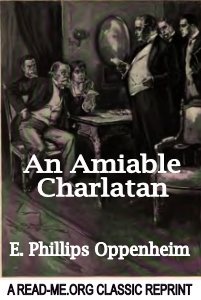
An Amiable Charlatan

By E. Phillips Oppenheim.

“An Englishman is enjoying his dinner at Stephano's, at which he is a regular diner. A man enters quickly, sits at his table, starts eating his food, and hands him a packet underneath the table! So begins Paul Walmsley's acquaintance - and adventures - with American adventurer Joseph H. Parker and his lovely daughter, Eve.”

Boston: Little, Brown and Co., 1916.341p.

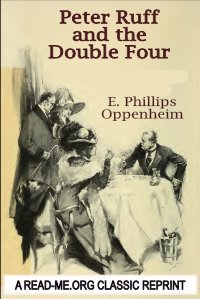
Peter Ruff and the Double Four

By E. Phillips Oppenheim.

“… Opposite him, at the other end of the table, sat his wife, Mrs. Barnes, a somewhat voluminous lady with a high colour, a black satin frock, and many ornaments. On her left the son of the house, eighteen years old, of moderate stature, somewhat pimply, with the fashion of the moment reflected in his pink tie with white spots, drawn through a gold ring, and curving outwards to seek obscurity underneath a dazzling waistcoat.”

Boston: Little, Brown, 1912. 424p.

The Ball And The Cross

By G.K. Chesterton.

When two men decide to fight for their respective beliefs, they discover to their astonishment that an unbelieving world won’t let them, and they find themselves partners and fugitives from the law in this steampunk satire. Penned by G.K. Chesterton in 1909, this whimsical and biting novel eerily foreshadows a world in which “tolerance” is the only god and all those who believe ideas are worth dying for are forced to stand together to defend freedom of speech and belief.

New York: J. Lane, 1909. 436p.

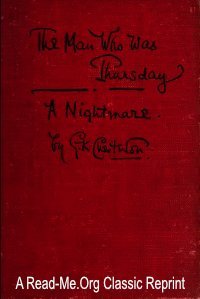
The Man Who was Thursday: A Nightmare

By G.K. Chesterton.

It is very difficult to classify The Man Who Was Thursday. It is possible to say that it is a gripping adventure story of murderous criminals and brilliant policemen; but it was to be expected that the author of the Father Brown stories should tell a detective story like no-one else. On this level, therefore, The Man Who Was Thursday succeeds superbly; if nothing else, it is a magnificent tour-de-force of suspense-writing. However, the reader will soon discover that it is much more than that. Carried along on the boisterous rush of the narrative by Chesterton’s wonderful high-spirited style, he will soon see that he is being carried into much deeper waters than he had planned on; and the totally unforeseeable denouement will prove for the modern reader, as it has for thousands of others since 1908 when the book was first published, an inevitable and moving experience, as the investigators finally discover who Sunday is.

Bristol: J.W. Arrowsmith, 1908. 329p.

The Bride of the Sun

By Gaston Leroux.

Young engineer Raymond Ozoux, accompanied by his uncle, arrives in Peru to meet his fiancée, Marie-Thérèse. Meanwhile, descendents of the Incas are preparing a great feast during which a virgin will be sacrificed to the Sun, walled up alive in a secret temple. At the same time, a mysterious Inca bracelet is sent to Marie-Thérèse purporting to be a gift of the Sun to his future bride.. The young girl is then kidnapped by the Incas and Raymond, his uncle and Marie-Thérèse's father set out on a trek across Peru to free her while a revolution shakes the country.

NY. Harrow and Heston Classic Reprint. (1912) 177 pages.