Open Access Publisher and Free Library
CRIMINAL JUSTICE.jpeg

CRIMINAL JUSTICE

CRIMINAL JUSTICE-CRIMINAL LAW-PROCDEDURE-SENTENCING-COURTS

ShotSpotter and the Misfires of Gunshot Detection Technology

By Helen Webley-Brown, Anna Sipek, Katie Buoymaster, Juliee Shivalker, Will Owen, Eleni Manis, PHD, MPA

U.S. cities are squandering money on ShotSpotter’s unproven gunshot surveillance technology. 

  • ShotSpotter surveillance increases police activity, but it wastes officers’ time. One major study of the technology showed that ShotSpotter fails as an investigative tool, providing no evidence of a gun-related crime more than 90% of the time and producing exceedingly few arrests (less than 1 per 200 stops) and recovered guns (less than 1 per 300 stops).

  • ShotSpotter fails the Black and Latinx communities where it appears to be disproportionately deployed. The tool increases police activity and the risk of police violence without producing any significant effect on firearm offenses or on shooting victims’ medical outcomes.

Wiretaps on Wheels

By Evan Enzer, Anna Sipek, Mahima Arya, Nina Loshkajian, David Siffert, Eleni Manis, PHD, MPA

New cars are surveillance on wheels, sending sensitive passenger data to carmakers and police. Cars also store enormous amounts of passenger data onboard, where police can extract it using specialized tools. We estimate that law enforcement agencies could have accessed car data hundreds of thousands of times in 2020.

  • Constitutional loopholes allow access to most data on cars without a warrant. Police can access information from car-connected phones and online accounts without the warrant typically required.

  • U.S. immigration agencies weaponize car data. Other law enforcement agencies are poised to follow suit if they are not already doing so.

  • New legislation, enforcement of existing data protection laws, and responsible car design and data storage policies can shift car data surveillance into reverse.

Privatizing The Surveillance State: How Police Foundations Undermine Rule of Law

Police foundations allow police departments to secretly fund controversial programs and equipment.

  • Foundations invest in dangerous surveillance tools like predictive policing software, digital surveillance platforms, cellphone hacking devices, and robotic spy dogs. 

  • Foundations allow departments and officers to accept gifts from contractors in a way that would normally be illegal for city employees.

  • Foundations violate good-government standards for city agencies and transparency standards for nonprofit organizations. Ideally, they should be abolished, but at a minimum, cities must end untraceable donations and corporate influence peddling.

The Trojan Horse

By Evan Enzer, Arjun Ravi, Julian Melendi, Sohini Upadhyay, Eleni Manis, PHD, MPA

“Smart home” devices record audio and video in the home—and even collect daily schedules and health details. Once collected, this data is less than a warrant or data breach away from police and hacker access. Across the board, smart home devices have superior, privacy-protecting alternatives that perform the same key functions. The law doesn’t protect smart home users. “Do not buy” is the best advice until it does

Obstructed Justice: NYC's Biased License Plate Enforcement

Eleni Manis, PHD, MPA, Alexander Hughes, PHD

As NYC relies increasingly on traffic cameras, the NYPD has pulled over more and more drivers for a minor traffic infraction—license plate obstruction—particularly in precincts with the most BIPOC residents.

  • This problem is only getting worse: NYPD’s racist enforcement gap doubled between 2016 and 2021.

  • Automated traffic enforcement shouldn’t lead to more in-person traffic stops. Cities should study cameras' effects and adjust policing policies to ensure that cameras don't contribute to the over policing of BIPOC communities.

Guilt By Association: How Police Databases Punish Black and Latinx

By Andy Ratto, Nino Loshkajian, Eleni Manis, PHD, MPA

  • Police increasingly replace stop-and-frisk practices with databases that crudely profile Black and Latinx youth based on their neighborhoods, peer groups, and clothing.

  • These databases ruin lives: police typecast minority youths as gang members without evidence, putting them at risk of false arrest and wrongful deportation.

  • Many police departments refuse to implement due process safeguards despite clear evidence that their databases are based on racial profiling, not evidence.

  • Even the most rigorous safeguards would be insufficient to mitigate the full range of harms that these databases pose. They must be eliminated in their entirety.

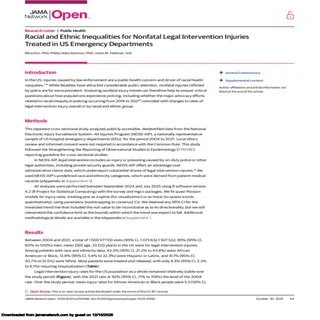
Racial and Ethnic Inequalities for Nonfatal Legal Intervention Injuries Treated in US Emergency Departments

By Mina Kim, PhD; Phillip Atiba Solomon, PhD; Justin M. Feldman, ScD

Introduction In the US, injuries caused by law enforcement are a public health concern and driver of racial health inequities.1-4 While fatalities have attracted considerable public attention, nonfatal injuries inflicted by police are far more prevalent. Analyzing nonfatal injury trends can therefore help to answer critical questions about how populations experience policing, including whether the major advocacy efforts related to racial inequity in policing occurring from 2014 to 20215 coincided with changes to rates of legal intervention injury overall or by racial and ethnic group. Methods This repeated cross-sectional study analyzed publicly accessible, deidentified data from the National Electronic Injury Surveillance System—All Injuries Program (NEISS-AIP), a nationally representative sample of US hospital emergency departments (EDs), for the period 2004 to 2021. Local ethics review and informed consent were not required in accordance with the Common Rule. This study followed the Strengthening the Reporting of Observational Studies in Epidemiology (STROBE) reporting guideline for cross-sectional studies. In NEISS-AIP, legal intervention includes an injury or poisoning caused by on-duty police or other legal authorities, including private security guards. NEISS-AIP offers an advantage over administrative claims data, which underreport substantial shares of legal intervention injuries.6 We used NEISS-AIP’s predefined race and ethnicity categories, which were derived from patient medical records (eAppendix in Supplement 1). All analyses were performed between September 2024 and July 2025 using R software version 4.2 (R Project for Statistical Computing) with the survey and mgcv packages. We fit quasi-Poisson models for injury rates, treating year as a spline (for visualization) or as linear (to assess trends quantitatively), using parametric bootstrapping to construct CIs. We deemed any 95% CI for the linearized trend line that included the null value to be inconclusive as to its directionality, but we still interpreted the confidence limit as the bounds within which the trend was expect to fall. Additional methodological details are available in the eAppendix in Supplement 1.Results Between 2004 and 2021, a total of 1 500 577 ED visits (95% CI, 1 073 632-1 927 522; 85% [95% CI, 60% to 100%] men; mean [SD] age, 33 [12] years) in the US were for legal intervention injuries. Among patients with race and ethnicity data, 42.3% (95% CI, 21.2% to 63.4%) were African American or Black, 13.9% (95% CI, 5.4% to 22.3%) were Hispanic or Latinx, and 41.1% (95% CI, 30.7% to 51.5%) were White. Most patients were treated and released, with only 4.3% (95% CI, 2.5% to 6.1%) requiring hospitalization (Table). Legal intervention injury rates for the US population as a whole remained relatively stable over the study period (Figure), with the 2021 rate at 92% (95% CI, 71% to 119%) the level of the 2004 rate. Over the study period, mean injury rates for African American or Black people were 5.3 (95% CI,4.6 to 6.2) times those of White people. Rates for Hispanic or Latinx people were 1.5 (95% CI, 1.2 to 1.7) times those of White people. While the point estimates for Black:White RR decreased by 6%, from 5.48 in 2004 to 5.13 in 2021, uncertainty was high, with the 95% CI ranging from a 42% reduction to 51% increase. For the Latinx population, the RR decreased from 1.94 in 2004 to 1.06 in 2021, corresponding to a 45% (95% CI, 12% to 66%) decrease.

JAMA Netw Open. 2025

Jurisdictions that Record Police Interrogations

By Brandon Garrett

Most jurisdictions in the United States now record interrogations, including all federal law enforcement agencies, thirty states, and the District of Columbia. This memo provides updated information about the state-level adoption of electronic recording requirements, in a table displayed below, through statutes, court rulings and rules, and police policies. In addition, many localities now require the recording of some of all interrogations. 1 Leading law, psychology, criminal procedure, and policing experts have long recommended electronically recording interrogations, preferably by videotaping the full interrogation. The American Psychology-Law Society has set out what is known about police-induced confessions and has recommended mandatory electronic recording. 2 The International Association of Chiefs of Police recommends recording “all interviews involving major crimes” and prefers video recordings.3 The American Law Institute’s Principles of Policing set out the principle that: “Written policies should set out the procedures for the recording of questioning, and for the disclosure and the retention of recorded evidence.” 4 A large body of high-profile exonerations of innocent persons have occurred in cases in which false confessions were obtained during interrogations that were not recorded. In cases of “confession contamination,” law enforcement falsely reports that a suspect had volunteered supposedly inside information during an interrogation. Almost all of the persons exonerated by post-conviction DNA testing, who had falsely confessed, also had reports by law enforcement that the defendant had volunteered key crime scene details. We now know, with the benefit of DNA testing, that law enforcement contaminated these interrogations through the use of leading questions or feeding facts to the suspect. And none of the interrogations in those cases of DNA exonerations had been recorded in their entirety.5 Recording police questioning assists law-enforcement agencies by furthering the important goal of documenting evidence and ensuring the conviction of those who commit wrongdoing.6 Video recordings also empower judges to better assess the reliability of interrogation evidence, both to reject false claims of police overreaching and to examine potential wrongful convictions. 7 Agencies have reported positive experiences with recording interrogations because it provides powerful documentation that interrogations are conducted professionally and non-coercively.8 Fears that “few would allow themselves to be interviewed or interrogated” if it were known that interviews and interrogations are recorded have not been realized in jurisdictions in which recording has been introduced. 9 That said, the Principles of Policing noted that some flexibility with reluctant witnesses may be important. In addition, it may be increasingly feasible to conduct video recording in the field, as body-worn cameras are utilized more widely by agencies. And that said, states do often provide for exceptions due to exigent circumstances, equipment malfunction and the like.10 As summarized below, state statutes increasingly have required recording at least some categories of police questioning of Justice has a memorandum setting out a policy for recording interrogations; several states have done the same. Although the Principles of Policing took no position on the admissibility of unrecorded statements, others have. For example, the Alaska Supreme Court has ruled that judges should suppress unrecorded statements unless failure to record is excused by good cause; other courts have adopted court rules or rules of evidence requiring electronic recording of interrogations. 12 The table below summarizes these statutes, court rulings, rules, and policies.

Durham, NC: Wilson Center for Science and Justice Duke University School of Law. 2024. 7p.

Wrongful Convictions in North Carolina:: Lessons Learned and Recommendations for Continued Reform

By Marcus Pollard and Angie Weis Gammell

Guilt beyond a reasonable doubt is the bedrock principle of the American criminal legal system, and yet, thousands of innocent people have been convicted of crimes they did not commit. These wrongful convictions undermine the integrity of our criminal legal system. The National Registry of Exonerations (National Registry) has tracked every known exoneration since 1989 and reports that there have been 3,348 exonerations amounting to 29,950 years lost to wrongful incarceration. 1 This includes 75 exonerations in North Carolina since 1989, representing a combined 963 years of wrongful confinement. 2 In response to high-profile cases and exonerations, North Carolina implemented significant reforms in the early 2000s and became a leader in preventing wrongful convictions. During this time, North Carolina implemented open file sharing and established the North Carolina Innocence Inquiry Commission (“Commission”). North Carolina also enacted the Electronic Recording Act, the DNA Databank Act, and the Eyewitness Identification Reform Act. Several Innocence Project organizations were also established in North Carolina to represent individuals with wrongful convictions claims. One of those organizations, the Duke Wrongful Convictions Clinic, went on to become a founding member of the Innocence Network, which is a network of innocence organizations that work to combat wrongful convictions. 3 Since 2006, however, there have been 58 exonerations, 11 of which had their underlying conviction occurring after 2006, despite having these reforms in place. 4 These most recent wrongful convictions could result from the stall in reforms in North Carolina since the early 2000s.This report describes the wave of legislation that occurred in North Carolina in the early 2000s, considering both the improvements that were made and the gaps that remain. It then analyzes the 11 documented cases of wrongful convictions since the establishment of the Commission in 2006 to identify the reforms that North Carolina still needs. This report emphasizes that to reclaim its role as a national leader in conviction integrity, North Carolina should amend its open-file discovery policy, police interrogation practices, plea process, use of eyewitnesses and police informants, and use of forensic evidence. Finally, this report offers recommendations on ways to prevent wrongful convictions and make relief more accessible for those with plausible claims of factual innocence to ensure that those who have been wrongfully convicted have a genuine opportunity to prove their innocence. Overall, this report underscores the importance of taking proactive steps to prevent wrongful convictions and providing relief to those who have been wrongly convicted.

Durham, NC: Wilson Center for Science and Justice Duke University School of Law. 2024. 52p.

Compensating Exonerees in the United States

After 44 years in prison for a conviction of rape in the small town of Concord, North Carolina, Ronnie Long was released from prison in 2021. Four months later, the Governor granted him a full pardon on the grounds of innocence.1 That pardon made it possible to obtain compensation from a state commission, which awarded Long $750,000. This amount was the maximum available under state law that permitted compensation of $50,000 per year of incarceration, but with an upper limit of $750,000.2 After his exoneration, Long also filed a civil rights lawsuit in federal court. This federal case against the city settled for $22 million in 2024. Long also received $3 million from the North Carolina State Crime Lab as a result of its “role in hiding evidence from Mr. Long and his legal team that proved his innocence.”3 This substantial settlement made Long Compensating Exonerees in the United States highly unusual among exonerees in the United States. Most exonerees, if they are compensated, received something more along the lines of the $50,000 per year available under the state law that initially compensated Long, and nothing more. Many exonerees receive no compensation at all. Academics have long criticized the traditional lack of compensation for wrongful conviction in the United States.4 In 1932, Edwin Borchard wrote that the United States needed national legislation regarding compensation for wrongful convictions.5 For many decades, no such legislation existed, however. Civil rights litigation, like the case brought by Long, was uncommon, and compensation under statutory schemes was similarly rare. This changed once exonerations became much more common, including those based on post-conviction DNA evidence, in the 1990s. In general, many of the exonerees that have received substantial compensation, like Ronnie Long, have brought civil rights lawsuits in federal, not state court. For example, of the first 250 DNA exonerees, 60% received some type of compensation, and of those, half of them obtained it in federal court.6 However, exonerees are increasingly seeeking compensation under state compensation statutes. In this fact sheet, we describe how compensation for exonerees has evolved in the past several decades, including through successful litigation efforts and through the enactment of compensation legislation, in thirty-nine states, Washington D.C., and by the federal government.We summarize each of these state and federal statutes in the table at the end of this document. To date, 39 states have enacted such compensation statutes, in addition to Washington D.C. and the federal government. In addition, five of the remaining 11 states currently have pending legislation on the issue. The figure below shows which jurisdictions have these statutes currently, and which have these statutes currently, and which have legislation pending

Durham, NC: Wilson Center for Science and Justice Duke University School of Law2025. 20p.

Evaluation of Fayetteville’s ShotSpotter Installation: Results from the First 18 Months

By Jessica Gettleman and Tyler Kendall

The Wilson Center for Science and Justice at Duke Law has released Evaluation of Fayetteville’s ShotSpotter Installation: Results from the First 18 Months, an independent analysis of the gunshot detection system’s use in Fayetteville, North Carolina. The report was commissioned by the City of Fayetteville to examine how ShotSpotter operated across three designated coverage zones from September 2023 through March 2025.

The evaluation reviewed data from 911 firearm-related calls for service, ShotSpotter’s internal “Ground Truth Tracking Workbook,” and Fayetteville’s public Open Data Portal. The study compared patterns before and after installation, both inside and outside ShotSpotter zones.

Key findings include:

  • Incidence trends: Gunshot-related incidents declined citywide beginning in 2022, consistent with national trends. Incident levels remained relatively stable within the ShotSpotter coverage zones during the evaluation period.

  • Notification volume: While the 911 call volume related to gunshots decreased citywide over the period being evaluated, the Fayetteville Police Department received a significantly increased number of ShotSpotter gunshot-related notifications in the ShotSpotter coverage zones compared to an equivalent period of time prior to the evaluation period.

  • Response times: Police were dispatched and arrived more quickly following ShotSpotter alerts compared to 911 calls. alone. However, the available data do not allow assessment of whether these faster responses affected investigative or victim outcomes. In addition, officers spent more time on scene when responding to incidents reported through both a ShotSpotter alert and 911 call compared to those reported through only one source.

  • Investigation and victim outcomes: Evidence collection, victim identification, and arrests occured most frequently when ShotSpotter alerts were accompanied by 911 calls. ShotSpotter-only alerts produce comparatively fewer investigative or victim-related outcomes, reflecting challenges including possible false alarms.

  • Resource use: Many ShotSpotter-only alerts involve detection of a small number of rounds or “probable gunfire” only. These are associated with lower productivity in terms of evidence collection and victim identification. Strategic prioritization of alerts—such as deprioritizing single-shot alerts lacking 911 confirmation—may improve efficient use of police resources.

The report also notes important limitations. The available data did not include comparable outcomes for 911-only calls, nor confirmation rates for whether reported gunshots were verified on scene. As a result, the evaluation cannot directly compare the relative accuracy or effectiveness of ShotSpotter alerts versus 911 calls.

Ultimately, ShotSpotter provides Fayetteville with increased numbers of alerts about possible gunfire incidents and facilitates faster police response times in targeted zones. However, its impact on reducing gun violence and improving investigation and victim outcomes is limited when alerts are unaccompanied by traditional 911 calls. The Wilson Center’s report does not make recommendations about whether Fayetteville should continue using ShotSpotter but provides data and analysis to inform that decision.

“Cities face difficult choices about public safety, and it is essential that those decisions are guided by data,” said Brandon Garrett, Faculty Director of the Wilson Center. “We are grateful to provide evidence-based research and evaluations that can help communities like Fayetteville weigh their options and determine which approaches work best for them.”

Durham, NC: Wilson Center for Science and Justice at Duke Law;, 2025 68p.

The Changing Use of Jails in Safety and Justice Challenge Counties 

By Brandon Martinez, Rebecca Tublitz. Emily West

The majority of people in local jails around the country are awaiting their criminal trial. This means they have not been convicted of the crimes that brought them in. Many also do not pose a danger to public safety, nor a significant risk of flight, but remain in custody because they cannot afford bail or bond—making incarceration a fact of financial ability, not of safety.

In fact, keeping those in jail who could be better served in the community can cause long-term instability. Well-established research demonstrates the harms of pretrial detention, including worse criminal legal system outcomes, disruption in employment, poorer mental and physical health, and strained social and familial relationships. Unnecessarily overcrowding jails also means those who actually do need attention—especially for risk factors such as mental health, substance use, and housing instability—aren't given the resources they need to avoid landing back in jail.

Given this research, cities and counties involved in the John D. and Catherine T. MacArthur Foundation’s Safety and Justice Challenge (SJC) have engaged in collaborative, multi-agency efforts to safely shrink their local jail populations and increase equity across the system. This includes using resources to promote fairer and more just pretrial decision-making, address the needs of system-involved people, and establish a robust array of alternative options.

These efforts have yielded impressive results: in these SJC cities and counties, nearly 18,000 fewer people are in jails today compared to the start of the initiative. This reduction was driven largely by fewer people being booked into jail. Progress has been slower on reducing racial and ethnic disparities, though in many sites there are fewer people of color in jail than there were prior to the start of the initiative. Importantly, SJC research has established that throughout nearly a decade of the initiative, people released pretrial were no more likely to return to jail than before the SJC, including for violent crime—demonstrating that data-driven and cross-agency collaborative planning efforts can lead to positive outcomes for individuals while keeping communities safe.

Looking back at 10 years of work, CUNY ISLG analyzed individual-level jail data from five participating counties to explore trends in three key indicators:

  1. Who gets booked into jail;

  2. How they are released from custody (e.g., money bond, pretrial supervision);

  3. How long they stay.

We also examine whether change in these domains varied for different racial and ethnic groups. The sites included in this analysis are Allegheny County, PA; Charleston County, SC; Palm Beach County, FL; New Orleans, LA; and Pima County, AZ. This brief presents the findings from the analysis.

New York: CUNY Institute for State and Local Governance. 2025. 

Prison Education in England: Educational Background, Characteristics, and Criminogenic Needs

By The Ministry of Justice

Prison education plays a key role in the purposeful activity provided in prison. It helps to prepare people for work on release and evidence shows that prisoners who take any form of learning activity have a significantly lower reoffending rate on release from prison than their peers. This report looks at the participation and achievement in core prison education programmes of two populations of prison leavers in England.

The statistics have been produced to build evidence on who is engaging in prison education, in what ways, and how this relates to their educational background and other characteristics. Understanding who is participating in prison education is crucial to building an evidence base which can better support the provision of prison education shaped towards the needs of prisoners. Doing this ensures that budgets are used to their best effect, maximising value for money.

The main data source is the prison education management information system, CURIOUS, which has been linked to information from other administrative sources including probation services, the Offender Assessment System (OASys) and the MOJ-Department for Education (DfE) data share.

This work has been completed by the Ministry of Justice: Better Outcomes through Linked Data (BOLD).

1.2 Methodology

This report examines the demographics, criminogenic and educational needs, as well as the educational background of participation and achievement in accredited prison education courses, for two offender cohorts:

Cohort 1: Adult offenders released from 1 January 2024 to 31 December 2024, after serving sentences of at least 3 months in public prisons in England.

Cohort 2: Adult offenders aged 18 to 35 who were released from June 2019 to December 2020, after serving sentences in public prisons in England, and for whom DfE data has been linked to provide information on education experiences while in school.

1.3 Headline findings

Cohort 1:

  • Of 16,810 adult offenders released from custody in 2024, having completed sentences of at least 3 months, over half (65%) had participated in at least one accredited education course whilst in prison. 56% of prison leavers successfully achieved at least one qualification.

  • Levels of participation in prison education courses were higher for female (74%) than male prison leavers (65%) (although only 5% of prison leavers included were women).

  • Of those with at least one criminogenic need recorded, 65% participated in education courses compared to 72% of those with no needs identified.

  • The lowest participation in education courses is seen for those with an alcohol misuse need (62% of prison leavers); in contrast, the highest level of participation was observed for those with a drug misuse need (66%), as well as those with an employment need (66%).

  • 55% of prison leavers recorded on OASys assessments as having significant difficulties in reading, writing or numeracy in education courses participated in education courses, compared with 66% of those recorded as having no difficulties in these areas.

  • Upon release from custody, half (50%) of prison leavers who reported no prior qualifications had passed an accredited course: 18% of prison leavers had successfully achieved a functional skills qualification in English, 17% had achieved a functional skills qualification in maths and 36% had achieved a vocational qualification.

  • When considering offenders leaving prison after serving less than 3 months in custody as a comparison, only 16% achieved any accredited course, less than half the rate or those serving 3 to 6 months (35%) and compared to almost three quarters (73%) of those leaving prison after 2 or more years.

Cohort 2:

  • 9% of prison leavers matched to NPD records at the end of key stage 4 (year 11) had achieved 5 or more GCSEs or equivalent qualifications at grades A*-C (or 9-4 in newer qualifications) and 2% had achieved 2 or more A levels when aged 16 to 18. In contrast, 18% had not achieved any passes at key stage 4.

  • Six in ten (60%) of those who had not achieved 5 or more A*-C GCSEs or equivalent qualifications participated in an accredited education course while in prison, higher than the participation rate for those holding these prior qualifications (53%).

  • Four in ten (42%) of prison leavers with no passes at key stage 4 left prison with a pass in at least one accredited qualification. The most common level to achieve in functional skills English and maths were entry level qualifications.[footnote 1]

  • A large majority (78%) of prison leavers matched to NPD records had special educational needs (SEN) identified while attending school. A higher proportion of prison leavers who had SEN recorded while in school participated in functional skills maths and English courses in prison (18% and 19% respectively) than those with no recorded needs (14% and 15% respectively).

  • Six in ten (62%) of prison leavers who were ever severely absent from school (for more than 50% of sessions in a year) participated in education in prison and 43% of those severely absent from school achieved at least one course.

  • 43% of prison leavers who had been permanently excluded from school achieved at least one course in prison.

  • Nearly 6 in 10 (59%) were ever eligible for free school meals (FSM) in the years captured in the data (meaning their household received certain qualifying out-of-work benefits) and over 9 in 10 (93%) had lived in the most deprived 20% of areas based on the proportion of families claiming low-income related benefits (Income Deprivation Affecting Children Index, IDACI).

This report presents descriptive statistics only. It looks at patterns of participation in prison education across different groups and settings, without making causal claims or conducting inferential statistical testing.

London: Ministry of Justice, 2025. 21p.

From Victim to Defendant: How Justice Falls Short for Women 

By Sarah Anderson and Lisel Petis

For decades, the justice system has failed to recognize how deeply intertwined women’s victimization and criminalization are. A serious response requires policies that account for trauma, economic instability, relational dynamics, health differences, and other factors that drive many women into the system. Executive Summary Far too often, when a woman meets the justice system, it is first as a victim of violence and later as a defendant charged with criminal activity. As victims, it is not uncommon for women to find their voices lost in the criminal justice discussion. As defendants, relevant context, including trauma, coercion, and the fight to survive, is rarely considered in courtrooms—especially in cases of self-defense, substance misuse, and human trafficking. This lack of acknowledgment leaves women doubly failed: They are denied justice when harmed, and they are punished harshly if victimization later shapes their actions. The rapid increase of women in the justice system over the past 40 years has exposed how poorly equipped current policies are to respond to the realities of women’s experiences and specific needs. Traditional reforms have focused on men in the justice system, overlooking that women’s pathways into the system are frequently rooted in abuse, caregiving pressures, and economic instability. By failing to recognize the distinctneeds of women, the system has expanded incarceration without improving public safety or addressing the underlying drivers of women’s involvement in the justice system. This policy paper explores women’s involvement with the justice system in three primary contexts: as victims, as defendants, and as both. Across these forms of justice system involvement, common themes emerge: low reporting and conviction rates for gender-based violence; rising rates of female incarceration tied to poverty, substance misuse, and punitive policies; and persistent issues in offering effective approaches for victim-defendants (i.e., those whose criminal behavior stems from abuse). The result is a system that broadly fails to deliver safety, fairness, or legitimacy. Key Policy Recommendations: • Strengthen victims’ rights and recourse by enacting notification laws, guaranteeing rights to proceedings, training system practitioners in trauma-informed approaches, and expanding the availability of victimcentered alternatives to prosecution • Improve justice for female defendants by integrating gender-responsive programming and reentry practices, providing access to gender-specific health supplies and services, adopting clear policies and oversight around pregnancies, and investing in specialized courts • Protect and support victim-defendants by granting victim immunity, passing survivor justice laws, adjusting mandatory arrest laws and laws meant to prevent sexual abuse in carceral settings, and training criminal justice professionals in trauma-informed practices.

R Street Policy Study No. 335 Washington,DC: R Street, 2025. 18p.

Washing Away Crime: Money Laundering in the Western Balkans

By Anesa Agovic

Money laundering remains a key enabler of organized crime in the Western Balkans, allowing criminal networks to legitimize illicit profits and integrate them into the formal economy. This report examines current trends, typologies and vulnerabilities shaping the region’s illicit financial flows.

The study outlines how systemic corruption, weak regulatory oversight, and a sizeable informal economy create fertile ground for laundering proceeds from drug trafficking, firearms smuggling, human trafficking, migrant smuggling, tax evasion and cyber-enabled crime. Key sectors, including construction, real estate and cash-intensive businesses, are often exploited, with typologies such as bulk cash smuggling, corporate layering, trade-based money laundering, underpriced real estate transactions and loan-back schemes featuring prominently.

Professional enablers, such as notaries, accountants, attorneys, and even entertainment celebrities, facilitate the integration of dirty money. The infiltration of law enforcement, misuse of remittance channels and the rise of digital currencies further complicate detection and prosecution.

The report also explores gender dynamics, highlighting the increasing role of women in money laundering activities. While some women play direct roles in financial transactions, others support criminal networks through their positions in professional sectors.

Hotspots for money laundering are often found in capitals, major cities and tourist destinations, where high-value real estate transactions and significant cash flows occur. The impact of global affairs, such as geopolitical shifts and technological advances, has amplified existing vulnerabilities.

The study calls for intensifying the prosecution of money laundering as a standalone crime, strengthening asset recovery, and reinforcing transparency across financial systems. Enhanced cooperation at the regional and international levels is vital to tackle transnational laundering schemes effectively.

This publication is part one of a two-part study of illicit finance and anti-money laundering in the Western Balkans, produced by the GI-TOC’s Observatory of Illicit Economies in South Eastern Europe with the support of the UK government’s Integrated Security Fund.

Understanding the methods and networks behind money laundering empowers governments, law enforcement, prosecutors, policymakers and civil society to disrupt the cycle of organized crime. The report underscores that combating money laundering requires addressing its root causes, from organized corruption to the misuse of legal entities and professional enablers, and demands more resilient institutions, independent regulatory bodies and robust civil society oversight.

Geneva, SWIT: Global Initiative Against Transnational Organized Crime. 2025. 72p.

Minneapolis Community Safety Ecosystem Asset and Gap Analysis: Findings and Action Plan

By Alexander Heaton, Michael Thompson, Freya Rigterink

The Minneapolis Safe and Thriving Communities Report and Plan provides a vision for the future of community safety and wellbeing. The plan also delivered an actionable framework for how Minneapolis can design and build a robust continuum of services and solutions that work “upstream” to prevent social challenges from manifesting as crime and disorder; “midstream” to respond to acute law, order, and safety incidents; and “downstream” to help heal trauma and build resilience for communities in the aftermath of these challenges. The service continuum in the plan was grouped in three categories:  Preventive: Services such as peacemakers, violence prevention, diversion, etc., that address near-term social, health, and economic challenges before they manifest as criminal behavior.  Responsive: Services that address community safety incidents in real time through virtual response, civilian response, multi-disciplinary co-response, and sworn officer response.  Restorative: Services that over the long term heal trauma from violence, address the root causes of community safety challenges, and help build the capacity for community resilience. These three categories of services form a service ecosystem to holistically and equitably “wrap around” individuals, families, and communities to bring new solutions to neighborhood safety challenges and foster thriving families and communities. Through rigorous and in-depth analysis of current Minneapolis community safety services and programs, and the systems that govern them, this Findings and Action Plan identifies existing barriers and opportunities for advancing the City’s community safety goals. The analysis focuses, amongst other areas, on opportunities to improve community safety services and efficiency; address equity issues in service delivery and provision; promote transparency and use of evidence-based practices; and improve the integration of resources into a holistic ecosystem with coordinated and accountable governance structures.

Policing Project at NYU School of Law

Minneapolis: City of Minneapolis Government, 2024.142p.

The Hidden Web of Criminal Legal System Fines and Fees in Kentucky

By ASHLEY SPALDING, PAM THOMAS, PATIENCE MARTIN, SCOTT WEST and KAYLEE RAYMER

A new report from the Kentucky Center for Economic Policy reveals how this convoluted and opaque system extracts millions from the communities least able to bear the burden — including nearly $60 million collected from a single standard court fee imposed on all cases between 2022 and 2024. The report also highlights $91.4 million in unpaid court debt as of 2019, underscoring the long-term impact of these obligations. Geography also plays a role, with counties often charging fees that vary widely across the state, meaning that the same offense and same court experience can have very different costs, depending on where a person is arrested.

The authors offer a set of urgent policy recommendations, including eliminating jail as a consequence for unpaid fines and fees, implementing ability-to–pay assessments, and increasing data transparency and accountability across the system.

Berea: Kentucky Center for Economic Policy, 2025. 27p

Policy Shifts in Pretrial Detention: Lessons from the 2019 Harris County, Texas Misdemeanor Bail Policies

By Lindsay Bass-Patel.

Since 2019, Harris County, Texas, the third largest urban jurisdiction in the United States, has eliminated a required cash bail schedule for misdemeanors, as a result of the ODonnell v. Harris County settlement. Instead, most people arrested for misdemeanors are now entitled to be released promptly without a hearing. People charged with misdemeanors that potentially present public safety risks (e.g., repeat DWIs, family violence, prior bond violations or outstanding warrants) are not automatically released, but they receive a bail hearing, where they are represented by a public defender. This report analyzes how the system has changed after these misdemeanor-focused changes were enacted, including public safety outcomes; shares accounts of people experiencing the system since these changes; and examines how these changes can guide other jurisdictions. Looking at the period before the new bail policies (2015-2019) and the period since the institution of the new bail policies (2019-2024),

Durham, NC: The Wilson Center for Science and Justice at Duke Law, 2025. 31p.

Voting From Prison: Lessons From Maine and Vermont

By Kristen M. Budd, Rachel Didner-Jollie

Only two U.S. states – Maine and Vermont – do not disrupt the voting rights of their citizens who are completing a felony-level prison sentence.1 Incarcerated Mainers and Vermonters retain their right to cast absentee ballots in elections. Because of the states’ unique place in the voting rights landscape, The Sentencing Project examined how their Departments of Corrections facilitate voting. We sought to determine experiences and lessons to share nationally as momentum builds in states, such as Illinois, Maryland, and Oregon, to expand voting rights to people completing a felony-level sentence in prison or jail.2

Voting is one prosocial way to maintain a connection to the community, which is particularly important during incarceration, and it helps to build a positive identity as a community member.3 The right to vote is also an internationally recognized human right.4 While voting is a cornerstone of American democracy, an estimated 1 million citizens cannot vote because they are completing a felony-level sentence in prison.5 Given racial disparities in incarceration, people of color are disproportionately blocked from the ballot box due to voting bans for people with a felony-level conviction.6

This first-of-its-kind research is a culmination of a multi-year inquiry in Maine and Vermont about how voting rights are implemented in prisons. The Sentencing Project sought to answer two interrelated questions:

What are incarcerated residents’ views about voting and the voting process?

What are the facilitators and barriers to implementing voting rights within the Department of Corrections, according to Department of Corrections staff and other stakeholders?7

Past research has found low voter turnout among people incarcerated in these states, despite incarcerated residents retaining their voting rights while completing a felony-level sentence.8 This suggests that, in practice, the absentee ballot voting process may be more complex in correctional settings.9

Our findings are based on 21 interviews with staff from the Maine and Vermont Departments of Corrections and other stakeholders who collaborated with these agencies in voting rights work, as well as our survey of incarcerated Mainers and Vermonters in which 132 incarcerated people participated. This investigation revealed:

Nearly three quarters (73%) of incarcerated survey respondents said that voting during incarceration is important to them.

Almost half (49%) of incarcerated respondents said that they did not know how to vote at their facility.

Facilitators that supported voting within the Departments of Corrections included:

Involvement of the Secretary of State’s Office, non-profit groups, and individual volunteers.

Cooperation from the Departments of Corrections’ administration and staff.

Coordination of in-person voter registration drives to assist incarcerated residents with the voter registration process.

Barriers that hindered voting within the Departments of Corrections included:

Incarcerated residents’ lack of knowledge about their voting rights and how to navigate the multiple-step process to vote absentee.

Limited information about candidates to inform voters and a lack of guidance on voting dates and deadlines.

A lack of staff training on incarcerated residents’ voting rights and how to assist incarcerated residents with voting.

Additional logistical challenges included:

Limited access to the paperwork needed to vote (e.g., registration forms, ballot requests).

Delays caused by prison mail and mail external to the facility.

A lack of person-power or capacity by corrections staff and other stakeholders to conduct voting rights work across all facilities.

Based on these findings, The Sentencing Project recommends providing more equitable access to voting and democracy during imprisonment by:

Establishing on-site polling locations in all correctional facilities that have eligible voters.

Expanding education for incarcerated residents about their voting rights and how to vote using an absentee ballot method.

Training corrections staff on incarcerated residents’ voting rights and on the process of assisting residents who are voting from prison.

Increasing access to candidates and candidate information, including hosting candidate forums within the prison.

Permitting and providing access to official government websites as additional avenues to register to vote, request ballots, track ballots, and learn about state and local ballot initiatives.

Such a vision for voting in prisons is attainable. A movement is already underway to increase access to the ballot in jails.10 Due to the fluidity of jail populations – where an average stay is 32 days – coordinating voting efforts in jails can be even more complex.11 Yet, even with such hurdles, turnout in jails with on-site polling locations has surpassed citywide turnout rates in places like Cook County, Illinois and Washington, DC.12 The successful implementation of jail-based voting demonstrates that prison-based voting is possible. Every eligible American citizen should be able to cast a ballot in elections regardless of conviction or incarceration status. In the words of one incarcerated resident in Maine, “I believe strongly [that] voting is a fundamental right for every American citizen. Being incarcerated does not mean you forfeit that right so I voted in here and will most definitely vote out of here.”

Washington, DC: The Sentencing Project, 2025. 36p.

Collaboration, Understanding, and Support: The Innovative Employment Solutions Program and a New Approach to Workforce Development for People Affected by the Justice System

By Douglas Phillips, Gabriel Weinberger, Michelle S. Manno

Evidence shows that employment can help keep people on parole or probation from coming back in contact with the justice system. But people who have a history of such involvement may lack educational credentials or have little work history, and must contend with employers’ bias against hiring them. Furthermore, they may require additional support—such as housing or transportation—to be ready to handle the demands of employment.

The Los Angeles County Innovative Employment Solutions Program (INVEST), established in February 2018, is designed to address the range of employment and supportive-service needs people on probation may have and support them in pursuing their employment and career goals. It operates at selected career centers in Los Angeles County. The program combines features of traditional workforce programs with some additional components. Most notably, it offers intensive training to prepare staff members to work with people on probation, collaboration between probation officers and employment staff members who work together in the same space, and additional funding for supportive services.

This report presents the findings of an evaluation of the INVEST program, which consisted of an implementation study and an outcomes study. The implementation study finds that the INVEST program is being implemented as intended, making a variety of employment services and training and educational opportunities available to clients, along with supportive services. It also finds that clients do not always take advantage of program services. The program services most frequently used are those related to finding employment quickly and services that take place as part of enrollment or very soon thereafter. Only about one-third of INVEST clients enrolled in any type of training program, and fewer than half of INVEST received any type of supportive service. This pattern suggests that people receiving services from INVEST need income from employment quickly, and may need financial support to be able to participate in education or training.

The outcomes study tracks employment and earnings for 1,232 INVEST clients who enrolled between March 1, 2018, and February 28, 2021, and compares their results with those of a group who were referred to INVEST but did not enroll. People who enrolled in INVEST had higher employment rates (by 12 percentage points) and higher earnings (by $1,931) over the course of a follow-up year (beginning about a year after enrollment and ending about two years after enrollment). This difference overwhelmingly reflects results among one subgroup of individuals who did not have any reported earnings when they enrolled. However, the comparison group for this part of the study was not constructed rigorously, so it is difficult to say with any confidence that the INVEST program is the reason for these improvements.

It was also not possible to construct a rigorous comparison group for outcomes related to involvement in the legal system. Compared with a similar group in another MDRC study in Los Angeles County, INVEST clients were less likely to be involved in the legal system in the year after enrolling. About three-quarters of INVEST clients avoided any arrest during that year.

Future research using a more rigorous study design—that was able to draw on more comprehensive data—could help to determine the program’s impacts on employment, earnings, and involvement in the criminal legal system, and to identify whom the program helps most.

New York: MDRC, 2025, 62p.