
Open Access Publisher and Free Library
HUMAN RIGHTS.jpeg

HUMAN RIGHTS

Human Rights-Migration-Trafficking-Slavery-History-Memoirs-Philosophy

Posts tagged community safety
Waste Crime and Trafficking Re-Punished for the Past: How Criminal Records Increase Prison Terms and Racial Injustice

By Nazgol Ghandnoosh, Bobby Boxerman and Celeste Barry
Prior criminal records account for a large share of already lengthy prison sentences, often adding years or even decades to sentences, without evidence of community safety benefits.

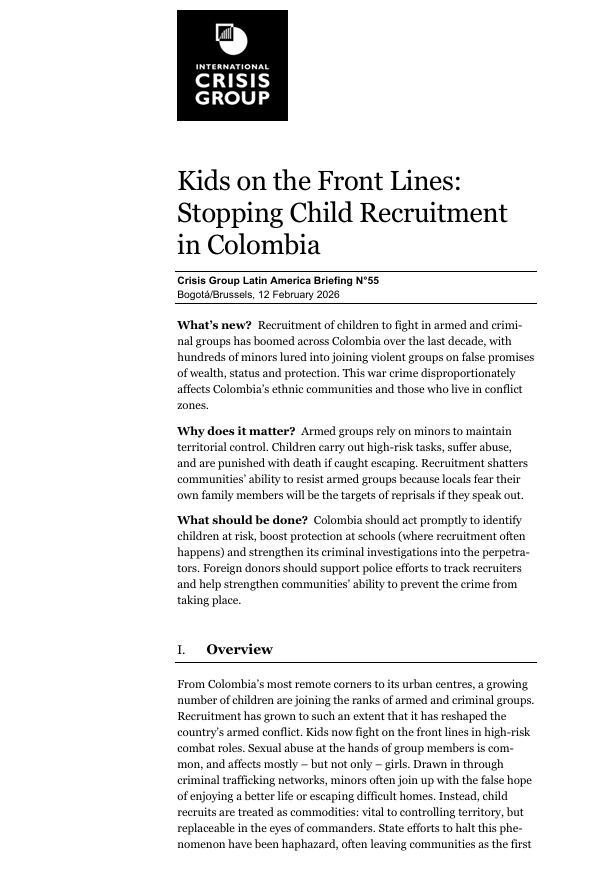
What’s new? Recruitment of children to fight in armed and criminal groups has boomed across Colombia over the last decade, with hundreds of minors lured into joining violent groups on false promises of wealth, status and protection. This war crime disproportionately affects Colombia’s ethnic communities and those who live in conflict zones.

Why does it matter? Armed groups rely on minors to maintain territorial control. Children carry out high-risk tasks, suffer abuse, and are punished with death if caught escaping. Recruitment shatters communities’ ability to resist armed groups because locals fear their own family members will be the targets of reprisals if they speak out.

What should be done? Colombia should act promptly to identify children at risk, boost protection at schools (where recruitment often happens) and strengthen its criminal investigations into the perpetrators. Foreign donors should support police efforts to track recruiters and help strengthen communities’ ability to prevent the crime from taking place.

International Crisis Group, 2026, 28p.

Federal local partnerships on immigration law enforcement: Are the policies effective in reducing violent victimization?

By Eric P. Baumer, Min Xie

Research Summary

Our understanding of how immigration enforcement impacts crime has been informed exclusively by data from police crime statistics. This study complements existing research by using longitudinal multilevel data from the National Crime Victimization Survey for 2005–2014 to simultaneously assess the impact of the three predominant immigration policies that have been implemented in local communities. The results indicate that the activation of Secure Communities and 287(g) task force agreements significantly increased violent victimization risk among Latinos, whereas they showed no evident impact on victimization risk among non-Latino Whites and Blacks. The activation of 287(g) jail enforcement agreements and anti-detainer policies had no significant impact on violent victimization risk during the period.

Policy Implications

Contrary to their stated purpose of enhancing public safety, our results show that the Secure Communities program and 287(g) task force agreements did not reduce crime, but instead eroded security in U.S. communities by increasing the likelihood that Latinos experienced violent victimization. These results support the Federal government's ending of 287(g) task force agreements and its more recent move to end the Secure Communities program. Additionally, the results of our study add to the evidence challenging claims that anti-detainer policies pose a threat to violence risk.

Criminology & Public Policy, 22, 417–455. 2023, 39p.