
Open Access Publisher and Free Library
HUMAN RIGHTS.jpeg

HUMAN RIGHTS

Human Rights-Migration-Trafficking-Slavery-History-Memoirs-Philosophy

Posts tagged global awareness
New Directions in Research on Immigration and Crime

By Charis E. Kubrin

The main objective of the project is to improve understanding of the immigration-crime relationship by addressing several important areas of inquiry. These areas of inquiry represent key omissions in the literature that merit attention. For example, next to no research has examined the robustness of the immigration-crime relationship across a substantially large and diverse range of neighborhoods across the U.S., which reflect different immigration contexts and histories. At the same time, with few exceptions, research largely lumps all immigrants together and neglects important differences across groups, whether by immigrant status or demographic or socio-economic background. Finally, little is known about how the immigration-crime relationship may be context dependent, and how immigration-related policies and practices may condition the immigration-crime relationship. Using data from a variety of sources over many years (2000-2016), we conduct a series of analyses that refine and advance our understanding of the immigration-crime relationship. These analyses address a variety of research questions including: How robust is the immigration-crime relationship? What are the appropriate ways to capture varied effects of immigrant groups on neighborhood crime rates? Does citizenship status matter? How do levels of assimilation impact how immigration and crime are associated? Which immigrant groups have crime reducing effects in neighborhoods? Which have crime enhancing effects? Another set of analyses consider the extent to which the broader city-context of reception as well as immigration-related policies and practices condition the immigration-crime relationship. These analyses address research questions including: Which city-level characteristics matter most for impacting the neighborhood immigration-crime relationship? How does immigration enforcement condition the relationship between immigration and crime? Do “sanctuary cities” attract crime-prone immigrants, reducing public safety overall? To achieve these goals and begin to answer these research questions, we collected, cleaned and merged data from many sources including crime data from police departments, public use Census and American Community Survey data, restricted data from the Census Data Center at UC Irvine, historical business data from Reference USA, and TRACFed data, among others. After considerable effort, we collected data for a sample of 415 cities in 2020 with at least 10,000 population, a sample of 480 cities in 2010, a sample of 168 cities in 2000, a subset of 310 cities with longitudinal data in 2010 and 2018, and a subset of 139 cities with longitudinal data in 2000 and 2010. No comparable neighborhood crime data set that covers such a large and diverse range of contexts currently exists.  (continued)    

Washington, DC: U.S. National Institute of Justice, Office of Justice Programs, 2025. 45p.
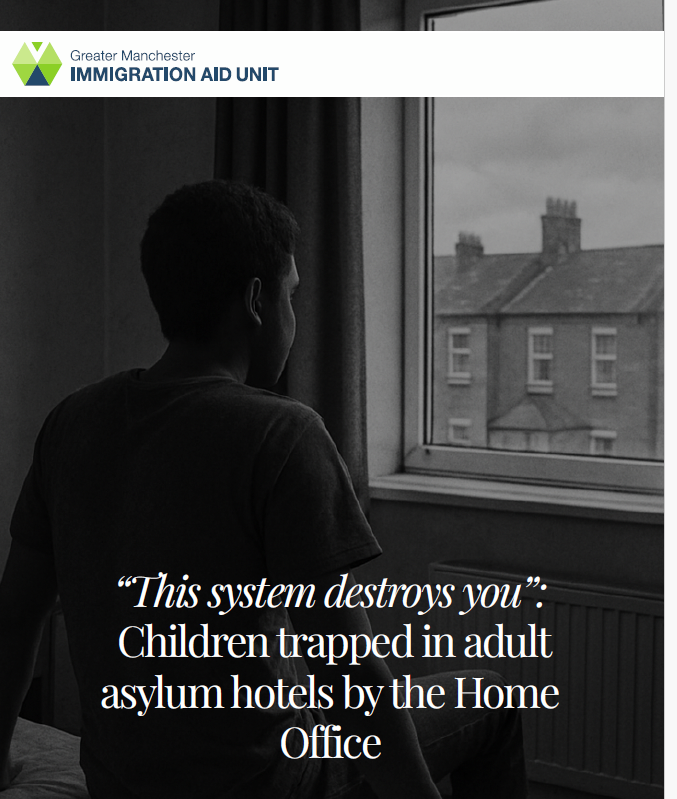
This system destroys you”: Children trapped in adult asylum hotels

By The 

Greater Manchester Immigration Aid Unit

Over recent years, thousands of children have been wrongly treated as adults by the Home Office. These children are in the UK on their own seeking asylum. Following decisions made by UK border officials that they are “significantly over 18” they have been sent alone to adult asylum accommodation, usually hotels. This is a report about children housed in adult hotels after these decisions at the border, based on Greater Manchester Immigration Aid Unit’s legal and place-based expertise and experience, and on the experiences that the children we work with have shared.  EXECUTIVE SUMMARY “You can’t stop feeling sad. You have to feel sad and angry when someone says you are a liar. It is in your heart.” Between January 2024 and February 2025, at least 296 children were wrongly sent to adult asylum accommodation, usually hotels, in the North West. This is a report about what children experience in asylum hotels, how theyare sentthere,andthe supportthey needtoget out. We are sounding the alarm – as others have done before us – that these children are being put at significant risk. Much harm has already been done, and must be acknowledged; and the government, local authorities andaccommodationprovidersmustact now topreventfurther harm. We are sounding the alarm – as others have done before us – that these children are being put at significant risk. Much harm has already been done, and must be acknowledged; and the government, local authorities and accommodation providers must act now to prevent further harm.

Our recommendations:

To the Home Office:

  • The Home Office must admit children are wrongly treated as adults at the border and suspend all “significantly over 18” decisions until investigated.

  • Repeal recent changes to age assessments introduced by the Nationality and Borders Act, and end the for-profit asylum housing model.

  • Meanwhile, the Home Office should notify local authorities when children are placed in hotels and publish clearer data on age disputes.

To accommodation providers:

  • Immediately refer to the local authority when staff become aware that a potential child is in adult asylum accommodation.

  • Take all possible measures to safeguard potential children.

  • Update training for hotel staff so they are aware of the high likelihood of children being treated as adults.

To local authorities: 

  • Ensure social workers’ decisions and training include an understanding of the child’s experience in the UK, including being traumatised by Home Office age assessment practice.

  • Ensure that potential children are not held to higher thresholds in assessments when local authority capacity is stretched.

  • Do not refer children to the National Age Assessment Board (NAAB).


Manchester, UK: Greater Manchester Immigration Aid Unit, 

2025. 49p.

A Guide to Human Rights Education

By Paul D. Hines & Leslie Woods

"A Guide to Human Rights Education" by Paul D. Hines and Leslie Wood, published in 1969 , is a comprehensive resource designed to integrate human rights concepts into social studies curricula at elementary and secondary levels . The guide emphasizes the importance of universal human rights and provides historical context, from Hammurabi's Code to post - World War II developments [1] . It includes discussions on key human right s documents, the role of the United Nations, and practical strategies for educators to promote human rights awareness in the classroom

National Council For The Social Studies, 1969, 151p.