Open Access Free Library
TERRORISM.jpeg

TERRORISM

Terrorism-Domestic-International-Radicalization-War-Weapons-Trafficking-Crime-Mass Shootings

Posts tagged United Nations
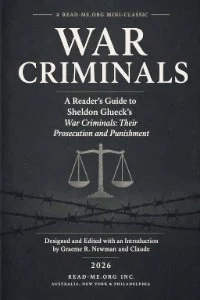
War Criminals: Their Prosecution and Punishment (Mini-Classic)

A Reader’s Guide to Sheldon Glueck’s WAR CRIMINALS: Their Prosecution and Punishment (Read-Me.Org Mini-Classics) by Graeme R. Newman

The book that predicted Nuremberg — a year before it happened.

In September 1944, with the outcome of the war no longer in doubt but the fate of its architects still unresolved, Harvard criminologist Sheldon Glueck sat down to answer a question no Allied government had yet settled: what do you actually do with the men who ordered the century's worst atrocities?

His answer — War Criminals: Their Prosecution and Punishment — argued for an international court built on customary law rather than a treaty that didn't yet exist, individual liability regardless of rank or official position, and a sharply narrowed defense of "just following orders." Fourteen months later, the Nuremberg Charter adopted nearly all of it, in places almost word for word.

This Read-Me.Org Mini-Classic is your guide to that forgotten argument. Inside:

  • Who Glueck really was — an immigrant criminologist, not an international lawyer, and how he got there

  • The failed 1919 Leipzig trials that haunted his every recommendation

  • His chapter-by-chapter case against sovereign immunity, "acts of State," and superior orders

  • The direct line from his 1944 proposals to Nuremberg, the Eichmann trial, the Pinochet case, and the modern International Criminal Court

  • Review questions for classroom or study-group use

Book One in the Read-Me.Org Mini-Classics series — short, faithful guides to significant but neglected books, for readers who want the argument without the 250 footnoted pages.

This is an independent reader's guide and critical companion. It is not a reprint of the original 1944 text; no claim is made as to that text's current copyright status.

Read-Me.Org Inc. New York-Philadelphia-Australia. 2026. p. 69p.

War Criminals: Their Prosecution and Punishment

by Sheldon Glueck

First published in 1944, War Criminals: Their Prosecution and Punishment by Harvard professor Sheldon Glueck is a landmark examination of one of the defining legal questions of the Second World War: how should those responsible for atrocities and violations of the laws of war be brought to justice?

Written while the war was still raging, Glueck examines the historical and legal foundations for prosecuting war criminals, the liability of political and military leaders, superior orders, international criminal courts, appropriate forms of trial, and the principles governing punishment and correction. The book also considers the failures of attempts to prosecute German war criminals after the First World War and argues for a more effective international system of justice.

Both a historical document and an important contribution to the development of international criminal law, this book captures the legal thinking that helped prepare the ground for the postwar prosecution of Nazi leaders and the emergence of modern international criminal justice.

New York Knopf. 1944. 261p.

Assessment of the Response to Illicit Weapons Trafficking in the Gulf of Aden and the Red Sea

By The UNODC Global Programme on Criminal Network Disruption and the Global Maritime Crime Programme (Border Management Branch).

The Republic of Yemen has been embroiled in a violent conflict since September 2014 when Houthi forces took military control of the capital city Sana’a and displaced the government of interim President Abdrabuh Mansour Hadi. According to the United Nations Development Programme (UNDP), Yemen’s protracted conflict has claimed at least 377.000 lives, most of them civilians, and plunged Yemen, already the poorest country of the Arabian Peninsula, into a complex humanitarian catastrophe. The Houthis, who call themselves Ansar Allah (Partisans of God), originally were a revivalist Zaidi Shia religious movement formed in the Sa’dah governorate in the 1990s under the leadership of prominent cleric Hussein al-Houthi. Critical of Yemen’s long-term President Ali Abdullah Saleh (in office from 1990 to 2012), an order for the arrest of their leader led to a low-level insurgency resulting in the killing of Hussein al-Houthi by government forces in September 2004. Following his death, the political leadership of the movement passed on to his brother Abdul-Malik al-Houthi. The Houthis reportedly formed close political and military ties with the Islamic Republic of Iran and the Lebanese movement Hezbollah and continued to challenge Saleh, exploiting the frustration of large parts of the Yemeni population with his government. They succeeded in capturing parts of the mountainous north of the country before a popular uprising linked to the Arab Spring swept the old regime from power in February 2011. In the wake of this regime change, which brought Hadi to power, the Houthis increased their presence in Sana’a and formed alliances with other groups, while simultaneously clashing with tribesmen loyal to other political movements, in particular those of the Sunni Islamist Al-Islah party (“The Yemeni Congregation of Reform Party”), a Yemeni affiliate of the Muslim brotherhood. Following the ouster of President Hadi and his subsequent flight to Aden, the Houthis consolidated their dominance over large parts of northern Yemen and significantly strengthened their military power through absorbing parts of the country’s armed

forces. In March 2015, fearing a further deterioration of the security situation, a group of nine Arab countries led by the Kingdom of Saudi Arabia deployed military forces as part of Operation “Decisive Storm” with the aim to restore the authority of Yemen’s internationally recognized government. Meanwhile in the coastal province of Hadramawt, militants of Al-Qaeda in the Arabian Peninsula (AQAP) exploited the political vacuum and seized control of the local capital of Mukalla in April 2015, which they held for more than one year before being forced out by military forces backed by the United Arab Emirates.4 While the Coalition reversed some of the Houthi advances, the Houthis managed to consolidate their positions in the mountainous north of the country. The period from 2016/2017 onwards, saw a significant increase in the military capabilities of the Houthis, which included the launch of ballistic missiles and uncrewed aerial vehicles (UAVs)5 against targets in Saudi Arabia, as well as the deployment of anti-ship missiles and waterborne improvised explosive devices (WBIED)6 against ships flying the flag of Coalition states in the Red Sea. While these attacks have done relatively little material damage, they allowed the Houthis to some extent to counterbalance the superiority of the Coalition forces and to project power beyond the immediate battlefield. (continued)

Vienna: UNODC, 2024. 30p.

The Banality of Good: The UN's Global Fight against Human Trafficking

By Lieba Faier 

 In The Banality of Good, Lieba Faier examines why contemporary efforts to curb human trafficking have fallen so spectacularly short of their stated goals despite well-funded campaigns by the United Nations and its member-state governments. Focusing on Japan’s efforts to enact the UN’s counter-trafficking protocol and assist Filipina migrants working in Japan’s sex industry, Faier draws from interviews with NGO caseworkers and government officials to demonstrate how these efforts disregard the needs and perspectives of those they are designed to help. She finds that these campaigns tend to privilege bureaucracies and institutional compliance, resulting in the compromised quality of life, repatriation, and even criminalization of human trafficking survivors. Faier expands on Hannah Arendt’s idea of the “banality of evil” by coining the titular “banality of good” to describe the reality of the UN’s fight against human trafficking. Detailing the protocols that have been put in place and evaluating their enactment, Faier reveals how the continued failure of humanitarian institutions to address structural inequities and colonial history ultimately reinforces the violent status quo they claim to be working to change.

Durham, NC; London:  Duke University Press,  2024