
Open Access Free Library
TERRORISM.jpeg

TERRORISM

Terrorism-Domestic-International-Radicalization-War-Weapons-Trafficking-Crime-Mass Shootings

Posts in war crimes
War for the World

by Israel Zangwill (Author), Graeme R. Newman (Introduction)

A forgotten wartime witness from the author of Children of the Ghetto
In the summer of 1916, with Europe two years into a war that had already devoured a generation, Israel Zangwill — one of the most celebrated and contentious literary voices of his day — sat down to argue with his moment. The War for the Worldis the result: forty-six essays, poems, and public letters that refuse every easy wartime position on offer.

Zangwill was no propagandist. A lifelong admirer of German culture forced to reckon with German militarism, he wrote as a man arguing with himself as much as with his readers — skeptical of slogans from every side, unable to leave a comfortable opinion alone when it could be pushed to its uncomfortable conclusion.

Inside this collection:

  • The mechanics and psychology of modern warfare, from the armaments trade to the illusions of security through escalation

  • Sharp, often self-implicating essays on British and German militarism alike

  • Culture conscripted for war — the stage, the novel, even the slogan, examined as propaganda in disguise

  • The wartime suffrage movement, and what happens when a nation asks its women to labor for a vote it still won't give them

  • Urgent, anguished reporting on Jewish communities caught between empires at war — conscripted into armies that, in Russia's case, were also complicit in pogroms against their own families

Written with the same close observation that made Children of the Ghetto a landmark of its era, The War for the Worldis Zangwill at his most combative and most human — a writer refusing to let wartime do his thinking for him.

About this edition: This Read-Me.Org Classic Reprint has been newly typeset from a digitized copy of the 1916 Macmillan first edition held by HathiTrust, with OCR correction and light editorial standardization for the modern reader.

Read-Me.Org Inc. New York-Philadelphia-Australia. 2026. p245.
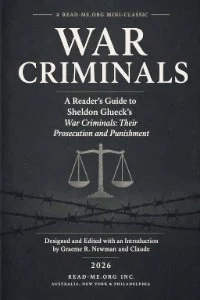
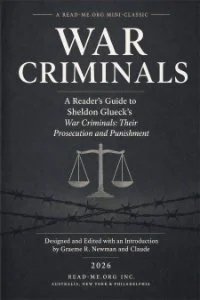
War Criminals: Their Prosecution and Punishment (Mini-Classic)

A Reader’s Guide to Sheldon Glueck’s WAR CRIMINALS: Their Prosecution and Punishment (Read-Me.Org Mini-Classics) by Graeme R. Newman

The book that predicted Nuremberg — a year before it happened.

In September 1944, with the outcome of the war no longer in doubt but the fate of its architects still unresolved, Harvard criminologist Sheldon Glueck sat down to answer a question no Allied government had yet settled: what do you actually do with the men who ordered the century's worst atrocities?

His answer — War Criminals: Their Prosecution and Punishment — argued for an international court built on customary law rather than a treaty that didn't yet exist, individual liability regardless of rank or official position, and a sharply narrowed defense of "just following orders." Fourteen months later, the Nuremberg Charter adopted nearly all of it, in places almost word for word.

This Read-Me.Org Mini-Classic is your guide to that forgotten argument. Inside:

  • Who Glueck really was — an immigrant criminologist, not an international lawyer, and how he got there

  • The failed 1919 Leipzig trials that haunted his every recommendation

  • His chapter-by-chapter case against sovereign immunity, "acts of State," and superior orders

  • The direct line from his 1944 proposals to Nuremberg, the Eichmann trial, the Pinochet case, and the modern International Criminal Court

  • Review questions for classroom or study-group use

Book One in the Read-Me.Org Mini-Classics series — short, faithful guides to significant but neglected books, for readers who want the argument without the 250 footnoted pages.

This is an independent reader's guide and critical companion. It is not a reprint of the original 1944 text; no claim is made as to that text's current copyright status.

Read-Me.Org Inc. New York-Philadelphia-Australia. 2026. p. 69p.

War Criminals: Their Prosecution and Punishment

by Sheldon Glueck

First published in 1944, War Criminals: Their Prosecution and Punishment by Harvard professor Sheldon Glueck is a landmark examination of one of the defining legal questions of the Second World War: how should those responsible for atrocities and violations of the laws of war be brought to justice?

Written while the war was still raging, Glueck examines the historical and legal foundations for prosecuting war criminals, the liability of political and military leaders, superior orders, international criminal courts, appropriate forms of trial, and the principles governing punishment and correction. The book also considers the failures of attempts to prosecute German war criminals after the First World War and argues for a more effective international system of justice.

Both a historical document and an important contribution to the development of international criminal law, this book captures the legal thinking that helped prepare the ground for the postwar prosecution of Nazi leaders and the emergence of modern international criminal justice.

New York Knopf. 1944. 261p.