Open Access Publisher and Free Library
TERRORISM.jpeg

TERRORISM

Terrorism-Domestic-International-Radicalization-War-Weapons-Trafficking-Crime-Mass Shootings

TRACIT’s 2025 Illicit Trade Index

By  The Transnational Alliance to Combat Illicit Trade (TRACIT)  

The 2025 Illicit Trade Index provides governments, policymakers, and enforcement agencies with actionable insights to tackle the challenges of illicit trade. Covering 158 countries—from emerging markets to advanced economies—the Index highlights vulnerabilities, strengths, and trends across national systems. Its data-driven analysis and practical recommendations aim to strengthen policies, enhance enforcement, and promote international collaboration.

Evaluating countries across six key categories and 37 benchmarks, the Index provides a comprehensive framework for assessing resilience. In addition to rankings, it offers regional and economic group analyses, identifying shared challenges and performance trends.

New York: Transnational Alliance to Combat Illicit Trade  2025. 67p.. 

Download
The Prevalence of Fentanyl in New York City’s Unregulated Drug Supply as Measured Through Drug Checking Offered at Syringe Service Programs

By Yarelix Estrada, Jeffery Sauer, Leonardo Dominguez, Izza Zaidi, Andrew J. Trinidad, Hannah Helmy, Alex Harocopos

Background: Drug checking is a harm reduction strategy that provides people who use drugs (PWUD) information about the composition of a substance. Drug checking has been identified as a key public health response to the continually evolving overdose crisis.

Methods: The New York City Health Department of Health and Mental Hygiene (DOHMH) partnered with existing syringe programs to launch a drug-checking pilot study. The study offered multiple point-of-care drug-checking technologies including fentanyl test strips (FTS) and Fourier-transformed infrared (FTIR) spectrometry, as well as secondary laboratory testing. Fentanyl positivity in major drug types was assessed for each drug-checking technology.

Results: Between November 2021 and December 2023, a total of N = 397 unique participants and drop-off samples contributed a total of N = 1644 samples for drug checking. The majority of samples were sold as opioids (n = 908), with fewer sold as cocaine (n = 314) and methamphetamine (n = 62). 95.3 % (852/894) of opioid samples produced positive FTS. FTIR and secondary laboratory testing resulted in a similarly high prevalence of fentanyl in opioid samples at 84.7 % (769/908) and 89.3 % (519/581), respectively. We did not observe the unexplained presence of fentanyl in samples sold as cocaine or methamphetamine. Further, we describe instances where discussions between technicians and PWUD provided important context that explained the presence of fentanyl in non-opioid samples.

Conclusion: The majority of opioid samples submitted to DOHMH's drug-checking pilot study contained fentanyl. Comparatively, there was little evidence suggesting fentanyl in samples sold as cocaine and methamphetamine. The drug-checking pilot study's point-of-care service delivery model was effective in providing information to PWUD.

Drug Alcohol Depend 10.1016/j.drugalcdep.2025.112578. Epub 2025 Jan 27, 47 p.

Download
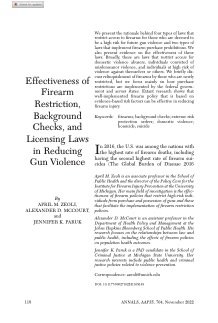
Effectiveness of Firearm Restriction, Background Checks, and Licensing Laws in Reducing Gun Violence

By  APRIL M. ZEOLI, ALEXANDER D. McCOURT, and JENNIFER K. PARUK 

We present the rationale behind four types of laws that restrict access to firearms for those who are deemed to be a high risk for future gun violence and two types of laws that implement firearm purchase prohibitions. We also present evidence on the effectiveness of these laws. Broadly, these are laws that restrict access for domestic violence abusers, individuals convicted of misdemeanor violence, and individuals at high risk of violence against themselves or others. We briefly discuss relinquishment of firearms by those who are newly restricted, but we focus mainly on how purchase restrictions are implemented by the federal government and across states. Extant research shows that well-implemented firearm policy that is based on evidence-based risk factors can be effective in reducing firearm injury 

  ANNALS, AAPSS, 704, November 2022  

Download
“I STILL CAN’T SLEEP AT NIGHT” THE GLOBAL ABUSE OF ELECTRIC SHOCK EQUIPMENT 

By Amnesty International

A wide variety of electric shock devices are specifically designed for and marketed to law enforcement. These range from electric shock stun guns, batons and shields, and body-worn electric shock devices which deliver electric shocks through direct contact with the body; to projectile electric shock weapons (PESWs) which can be fired from a distance. Despite the clear human rights risks associated with this equipment, there are no global regulations controlling what type of electric shock law enforcement equipment is permitted to be manufactured and used, or where equipment which can have a legitimate role in law enforcement can be traded. There is an urgent need for legally-binding, global regulations – a Torture-Free Trade Treaty - which prohibits the production of and trade in inherently cruel, inhuman and degrading devices, such as direct contact electric shock equipment, and strictly controls the trade in PESWs to law enforcement agencies to ensure

London: Amnesty International, 2025. 72p..  

download
Managing exits from violent extremist groups: lessons from the Lake Chad Basin

By Remadji Hoinathy, Malik Samuel and Akinola Olojo

  Some Lake Chad Basin countries (Cameroon, Chad, Niger and Nigeria) have been dealing with violent extremism for over a decade. Disarmament, demobilisation, repatriation, reintegration and resettlement processes in these countries may offer useful lessons for other West African contexts, including Mali and Burkina Faso, or more recently affected countries such as Benin, Côte d’Ivoire and Togo. Such lessons include incentivising defections, coordinating at national and regional levels, gender sensitivity, appropriate legal frameworks and community engagement.

Key findings Understanding the circumstances that lead people to join and leave violent extremist groups, and their experiences in those groups, is key to crafting incentives for disengagement. The willingness to leave violent extremist groups is often clouded by uncertainty, as well as long waiting periods between disengagement and enrolment in programmes for disarmament, demobilisation, repatriation, reintegration and resettlement (DDRRR). Waves of defection from Boko Haram caught Lake Chad Basin (LCB) states unprepared. DDRRR processes were thus implemented under pressure, hindering early coordination at a regional level. Women are treated mainly as victims, despite some voluntarily joining and playing active roles in Boko Haram, including volunteering as suicide bombers. DDRRR implementation in the LCB has revealed gaps in legal frameworks that require revisions. DDRRR lacks public support in some LCB countries, as many people view it as blanket amnesty for Boko Haram members. 

Recommendations Non-military means of countering violent extremism should incorporate incentives and opportunities for associates to leave these armed groups. By depleting these groups’ human resources, their fighting capacity is reduced. To encourage defection, clear processes for screening, prosecution and integration are needed. National ownership of these processes, inclusivity, adaptation to local context and adequate resourcing are key, from inception to implementation. National ownership should not lead to isolated approaches, but rather create bridges between countries to enable a cohesive regional approach. Organisations such as the Economic Community of West African States, the Liptako-Gourma States Integrated Development Authority, the G5 Sahel and the Accra Initiative could offer relevant regional frameworks for this. Authorities in charge of DDRRR programmes should consider the diverse needs and backgrounds of ex-associates. Distinguishing individuals according to why they joined and their roles within the groups is important for providing appropriate treatment. The specific needs of women and children should be taken into account. Affected West African countries should proactively formulate relevant legal and institutional frameworks. International and regional provisions and standards should be taken into account, including the need for transparent and predictable screening, prosecution and rehabilitation processes. Due to their position connecting the LCB and West Africa, Niger and Nigeria could play a key role in sharing lessons learned from DDRRR implementation. Community organisations, platforms, and media should be used by the DDRRR authorities to raise public awareness of the reintegration process. This would help prevent perceptions of general amnesty for Boko Haram members and preconceived ideas about the disengaged from undermining the process. 

Pretoria: Institute for Security Studies, 2023. 12p.

download
Armed groups and illicit economies in Nigeria:  Insights from Kaduna, Katsina and Zamfara mining communities 

By ENACT Africa

  Summary Armed groups’ involvement in illegal mining in Nigeria has exacerbated arms smuggling, consequently increasing insecurity and violent conflict in the country and across the Sahel. It’s also seen a rise in the kidnapping of women and girls for forced labour in the mines. Governments must deal with the socio-economic and political factors that sustain banditry in Nigeria’s North West Region, the involvement of armed groups in illegal mining and the transnational dimensions of the crime. Key points • Armed groups engage in illegal mining due to corruption by state actors and community members, as well as poverty and a lack of opportunities. • Inconsistencies in Nigeria’s mining sector regulations, specifically between the Nigerian Minerals and Mining Act, 2007, and the Land Use Act, 2004, exacerbate the problem. • Armed groups’ control of mining areas undermines government legitimacy and stability. • Militarisation has been unproductive and security forces are compromised by corruption. • Illegal mining fuels security problems and the proliferation of small arms and light weapons. • The transnational criminal market for illegally mined gold extends to Chad, India, Lebanon, Niger and the United Arab Emirates. • The use of girls in mining violates international labour laws.

ENACT Africa, 2024. 24p.

download
Extremely Confused :The Government’s new counter-extremism review revealed

By Andrew Gilligan and Paul Stott

  • The Government’s “Rapid Analytical Sprint” to determine its policy on extremism has been leaked to Policy Exchange. • It says the UK’s approach to extremism should no longer be based on “ideologies of concern” but on a very wide range of “behaviours,” including violence against women and girls, “spreading misinformation and conspiracy theories,” an interest in gore or extreme violence, misogyny, or involvement in “an online subculture called the manosphere.” It admits itself that many who display such behaviours are not extremist. • This approach could swamp already stretched counter-extremism staff and counter-terror police with thousands of new cases, increasing the risk that genuinely dangerous individuals are missed. It risks addressing symptoms, not causes. • The Sprint de-centres and downplays Islamism, by far the greatest threat to national security. It acknowledges “left-wing, anarchist and single issue (LASI) extremism,” “environmental extremism” and Hindu extremism as distinct phenomena that counter-extremist policy should tackle. The left may object to the first two; others will welcome it. • The Sprint will raise concerns over freedom of speech. It says claims of two-tier policing are a “right-wing extremist narrative.” It recommends the reversal of moves to cut police use of “non-crime hate incidents.” A new crime of making “harmful communications” online – rejected by the previous government on freedom of speech grounds - is floated. • The Sprint may have been influenced by the events of Southport. But as in the Prime Minister’s remarks after the killer’s guilty pleas last week, it risks confusing extreme violence with extremism, or extremism with any shocking crime, bad belief or nasty social phenomenon about which we are worried. • What happened in Southport was more an operational than a policy failing. The murderer had shown he was dangerous many times over several years before he killed anyone. In a more operationally effective policing and justice system, action would have been taken against him sooner, even without having to first label him an extremist. • There is a case, as the former counter-terror policing chief Neil Basu has said, for creating a “non-extremist” version of Prevent aiming to interdict people, such as the Southport killer, with an interest  in violence but no obvious ideological or political motivation. The recommendation by a previous reviewer of Prevent, William Shawcross, that the current programme is the wrong place for dealing with the psychologically unstable has been ignored, even repudiated, in the Sprint. It should be acted on. • There are several sensible proposals, including the creation of a new Ministerial Counter-Extremism Board to coordinate policy.   

London: Policy Exchange, 2025. 30p.

download
Communication of Intent to Do Harm Preceding Mass Public Shootings in the United States, 1966 to 2019

By Jillian PetersonGina Erickson; Kyle Knappand James Densley

Understanding the motivation of a mass shooter’s intent to do harm can help practitioners and policy makers develop more effective intervention strategies. OBJECTIVE To examine the prevalence of communication of intent to do harm, known as leakage, in a sample of 170 mass public shooters from 1966 to 2019; the characteristics of perpetrators who do and do not leak their plans; and whether leakage is a form of fame-seeking behavior or a cry for help among individuals who are in crisis or suicidal. DESIGN, SETTING, AND PARTICIPANTS This cross-sectional study included perpetrators who killed 4 or more people in a public space from 1996 to 2019 and were included in a comprehensive database of US mass shootings. That database was built from August 2017 to December 2019, and analysis took place from January to May 2021. MAIN OUTCOMES AND MEASURES Leakage was identified and coded using publicly available records. Any communication to a third party of an intent to do harm prior to the shooting was coded as leakage. Logistic regression models were used to examine the risk factors associated with leakage. Models estimating leakage were examined to assess the 2 hypothesized pathways to leakage (the cry-for-help model and the fame-seeking model). RESULTS The 170 participants in this sample included 166 (97.7%) male perpetrators and 3 (2.3%) female perpetrators, with a mean (SD) age of 34 (12) years. Overall, 161 participants had known race and ethnicity: 11 (6.8%) Asian individuals, 35 (21.7%) Black individuals, 14 (8.7%) Latinx individuals, 7 (4.4%) Middle Eastern individuals, 3 (1.9%) Native American individuals, 89 (55.3%) White individuals, and 2 (1.2%) individuals with other race and ethnicity. Overall, 79 mass shooters (46.5%) leaked their plans. Of perpetrators who leaked their plans, 35 (44.3%) leaked specific plans about a mass shooting, and 44 (55.1%) leaked nonspecific plans about generalized violence. The study findings indicate that leakage was associated with receiving counseling (odds ratio, 7.0; 95% CI, 2.0-24.8) and suicidality (odds ratio, 3.7; 95% CI, 1.0-13.6), suggesting that leakage may best be characterized as a cry for help from perpetrators prior to their act.  

JAMA Netw Open. 2021;4(11):e2133073. doi:10.1001/jamanetworkopen.2021.33073

download
Firearm Type and Number of People Killed in Publicly Targeted Fatal Mass Shooting Events

By Leslie M. Barnard; Erin Wright-Kelly; Ashley Brooks-Russell; et al

  Mass shootings (MS) account for less than 1% of firearm deaths in the US, but the frequency has increased.1 Risk factors for MS perpetration include societal discrimination, contagion effects, firearm access, mental illness, and substance abuse.2 Previous geographically and analytically limited studies found MS with handguns had higher fatality rates than those with rifles,3 and following an age-based assault weapons (AWs) restriction there was a reduction in firearm violence from AWs.4 Another study found that the 1994 federal AWs ban was associated with fewer MS.5 To further investigate the association between type of firearm and lethality of MS, this study examined what firearms were present at publicly targeted fatal MS and determined if AWs were associated with a higher number of injuries or deaths.

JAMA Netw Open. 2025;8(2):e2458085. doi:10.1001/jamanetworkopen.2024.58085 4p.

download
Gentrification, Gun Violence, and Drug Market

By Zachary Porreca

I demonstrate the linkage between gentrification and gun violence. As the underlying mechanism, I focus on gentrification's displacement effect on local drug markets. Using two-way fixed effects differences-in-differences estimators, I show the gentrification of one block increases violence across the surrounding neighborhood. I find that some 2,400 (8%) of Philadelphia's shootings between the years 2011 and 2020 can be attributed to spillover effects from the gentrification of drug blocks. This effect is nearly ten times stronger than that observed on blocks without high levels of drug crime. This study also contributes a new empirical measurement of gentrification drawn primarily from property sales, along with building, zoning, and alteration permit issuance and utilizes a novel nearest-neighbor network approach to identify spatial spillover effects.

Unpublished Paper, 2021, 53p.

download
Firearm Purchaser Licensing:  Research Evidence to Inform State Policy

By Silvia Villarreal, Amy Barnhorst, Richard Bonnie, Kami Chavis, Cassandra Crifasi, Shannon Frattaroli, Kelly Roskam, Jeffrey Swanson, Sylvia Washington, and Joshua Horwitz.  

  Firearm purchaser licensing (FPL) laws (sometimes referred to as permit-to-purchase) require an individual to obtain a license through an application process before purchasing a firearm. They are among the most effective policies at reducing gun violence. FPL laws create robust mechanisms of accountability among both prospective gun owners and sellers to ensure that those disqualified from firearm ownership can’t legally obtain a gun. This report compiles existing research to inform state policy. It includes an overview of state FPL laws and recommends core components of FPL laws to maximize public health benefits.

The authors recommend that state gun licensing laws include five core components to maximize public health benefits:

  • Firearms safety training

  • Fingerprinting

  • In-person application

  • Comprehensive background checks

  • Waiting periods between application and possession of a firearm

Currently 11 states—Connecticut, Delaware, Hawaii, Illinois, Maryland, Massachusetts, Michigan, Nebraska, New Jersey, New York, and Oregon—and Washington, D.C., have active firearm purchasing licensing laws. Of these, five states—Delaware, Hawaii, Massachusetts, New Jersey, Oregon—and Washington, D.C., have the five components recommended in the report.

“There is solid evidence from public health research suggesting that when states adopt firearm purchaser licensing laws with measures such as mandatory safety training, comprehensive background checks, and waiting periods, reductions in gun-related homicides and suicides follow,” says study lead author Silvia Villarreal, MPP, director of research translation at the Johns Hopkins Center for Gun Violence Solutions.

Gun violence is a significant cause of mortality for Americans, and the leading cause of death for children and young people ages 1 to 17. According to the Centers for Disease Control and Prevention, 46,728 people died from gunshots in the U.S. in 2023, the most recent year for which final statistics are available. The 2023 CDC data shows firearms were used in seven out of 10 homicides and 55% of suicides.

U.S. federal law requires background checks for would-be gun buyers at federally licensed gun stores but does not cover private sales or gun shows. Moreover, federal law generally allows a gun sale to proceed if the background check is still pending after three business days. 

The report cites evidence—in many cases generated by the report’s co-authors—that firearm purchaser licensing reduces gun violence. A 2018 study linked gun purchaser licensing laws to an 11% reduction in gun homicides in urban counties across the U.S. from 1984 to 2015. A 2020 study found that gun purchaser licensing laws were associated with 56% fewer mass shooting incidents and 67% fewer mass shooting victims on average. Another 2020 study linked Connecticut’s 1995 handgun purchaser licensing law to a 28% drop in the state’s gun homicide rate and a 33% drop in its gun suicide rate from 1996 to 2017.

Similarly, a 2014 study found that Missouri’s 2007 repeal of its handgun-buyer licensing law was followed by 25% increase in its gun homicide rate in the five years following enactment. A 2015 study found a 16% increase in Missouri’s gun suicide rate in the five years following the repeal.

“This report is an important resource that brings together the research, policy, and legal considerations about firearm purchasing laws,” says Josh Horwitz, JD, co-director of the Center for Gun Violence Solutions. “Our intent is to give policymakers and advocates all the guidance and evidence they need to bring these policies to fruition.” 

The researchers hope that the report will encourage state policymakers to maintain or strengthen existing firearm-purchaser licensing laws and enact firearm purchasing laws in states that don’t yet have them.

Baltimore, MD: The Johns Hopkins Center for Gun Violence Solutions 2025. 30p.

download
Assessing Links Between Alcohol Exposure and Firearm Violence: A Scoping Review Update

By Ellicott C. Matthay, Ariana N. Gobaud, Charles C. Branas, Katherine M. Keyes, Brita Roy, Magdalena Cerdá

  BACKGROUND: Firearm violence remains a leading cause of death and injury in the United States. Prior research supports that alcohol exposures, including individual-level alcohol use and alcohol control policies, are modifiable risk factors for firearm violence, yet additional research is needed to support prevention efforts. OBJECTIVES: This scoping review aims to update a prior 2016 systematic review on the links between alcohol exposure and firearm violence to examine whether current studies indicate causal links between alcohol use, alcohol interventions, and firearm violence-related outcomes. ELIGIBILITY CRITERIA: Following the Preferred Reporting Items for Systematic Reviews and Meta-Analyses Extension for Scoping Reviews (PRISMA-ScR) guidelines, a comprehensive search of published studies was conducted, replicating the search strategy of the prior review but focusing on studies published since 2015. The review included published studies of humans, conducted in general populations of any age, gender, or racial/ethnic group, that examined the relationship between an alcohol-related exposure and an outcome involving firearm violence or risks for firearm violence. Excluded were small studies restricted to special populations, forensic or other technical studies, non-original research articles such as reviews, and studies that relied solely on descriptive statistics or did not adjust for confounders. SOURCES OF EVIDENCE: The review included published studies indexed in PubMed, Web of Science, and Scopus. Eligible articles were published on or after January 1, 2015. The latest search was conducted on December 15, 2023. CHARTING METHODS: Using a structured data collection instrument, data were extracted on the characteristics of each study, including the dimension of alcohol exposure, the dimension of firearm violence, study population, study design, statistical analysis, source of funding, main findings, and whether effect measure modification was assessed and, if so, along what dimensions. Two authors independently conducted title/abstract screening, full-text screening, and data extraction until achieving 95% agreement, with discrepancies resolved through discussion. RESULTS: The search yielded 797 studies. Of these, 754 were excluded and 43 met the final inclusion criteria. Studies addressed a range of alcohol exposures and firearm violence-related outcomes, primarily with crosssectional study designs; 40% considered effect measure modification by any population characteristic. Findings from the 21 studies examining the relationship of individual-level alcohol use or alcohol use disorder (AUD) with firearm ownership, access, unsafe storage, or carrying indicated a strong and consistent positive association. Seven studies examined associations of individual-level alcohol use or AUD with firearm injury or death; these also indicated a pattern of positive associations, but the magnitude and precision of the estimates varied. Eight studies examined the impact of neighborhood proximity or density of alcohol outlets and found mixed results that were context- and study design-dependent. Two studies linked prior alcohol-related offenses to increased risk of firearm suicide and perpetration of violent firearm crimes among a large cohort of people who purchased handguns, and two studies linked policies prohibiting firearm access among individuals with a history of alcohol-related offenses to reductions in firearm homicide and suicide. Finally, four studies examined alcohol control policies and found that greater restrictiveness was generally associated with reductions in firearm homicide or firearm suicide. CONCLUSIONS: Findings from this scoping review continue to support a causal relationship between alcohol exposures and firearm violence that extends beyond acute alcohol use to include AUD and alcohol-related policies. Policies controlling the availability of alcohol and prohibiting firearm access among individuals with alcohol-related offense histories show promise for the prevention of firearm violence. Additional research examining differential impacts by population subgroup, alcohol use among perpetrators of firearm violence, policies restricting alcohol outlet density, and randomized or quasi-experimental study designs with longitudinal follow-up would further support inferences to inform prevention efforts.

Alcohol Research: Current Reviews,  2025;45(1):01, 29p.

download
Catch 22: Institutional Ethics and Researcher Welfare Within Online Extremism and Terrorism Research

ByJoe Whittaker, Elizabeth Pearson, Ashley A Mattheis, Till Baaken, Sara Zeiger, Farangiz Atamuradova, Maura Conway

Drawing from interviews with 39 online extremism and terrorism researchers, this article provides an empirical analysis of these researchers’ experiences with institutional ethics processes. Discussed are the harms that these researchers face in the course of their work, including trolling, doxing, and mental and emotional trauma arising from exposure to terrorist content, which highlight the need for an emphasis on researcher welfare. We find that researcher welfare is a neglected aspect of ethics review processes however, with most interviewees not required to gain ethics approval for their research resulting in very little attention to researcher welfare issues. Interviewees were frustrated with ethics processes, indicating that committees oftentimes lacked the requisite knowledge to make informed ethical decisions. Highlighted by interviewees too was a concern that greater emphasis on researcher welfare could result in blockages to their ‘risky’ research, creating a ‘Catch 22’: interviewees would like more emphasis on their (and colleagues’) welfare and provision of concomitant supports, but feel that increased oversight would make gaining ethics approval for their research more difficult, or even impossible. We offer suggestions for breaking the impasse, including more interactions between ethics committees and researchers; development of tailored guidelines; and more case studies reflecting on ethics processes.

New Media & Society Online First, February 28, 2025

download
The Lone Wolf Threat Posed by Former JI Members

By Irfan Idris and Kusumasari Ayuningtyas

The ideological influence of Jemaah Islamiyah continues to be a threat to security even after its disbandment in June 2024. Some of its former members may align with other extremist groups, while others may seek to operate as lone-wolf terrorists. The possibility of JI’s former members transitioning into lone wolf actors stems from the enduring power of its ideology and indoctrination process.

S. Rajaratnam School of International Studies, NTU Singapore, 2025, 3p.

Download
Reclaiming Asabiya to Counter Extremism and Foster Unity

By Noor Huda Ismail

The concept of asabiyya – group solidarity – originally articulated by Ibn Khaldun, has been hijacked by extremist groups in Southeast Asia to create division and promote radical ideologies. Reclaiming asabiya is crucial, redefining it as a tool for social cohesion and unity by drawing on cultural values that foster mutual respect and collective responsibility. Regional cooperation and digital counter-narratives are essential in countering extremism and fostering long-term peace in the region.

S. Rajaratnam School of International Studies, NTU Singapore, 2025. 4p.

Download
Buy It, Steal It, Print It: How Right-Wing Extremists in Europe Acquire Firearms and What To Do About It

By Annelies Pauwels and Merlina Herbach

This policy brief examines the methods of firearms acquisition by right-wing extremists (RWEs) in Europe between 2019 and 2024. Based on a dataset of 118 cases, it reveals that RWEs resort to diverse legal and illegal acquisition strategies, including the use of illicit markets, legal possession, theft from military and law enforcement sources, and private manufacture, particularly 3D printing. The policy brief further discusses current EU countermeasures and their effectiveness in addressing RWE-specific acquisition methods. It identifies gaps in existing policies and enforcement, particularly regarding background checks in issuing and reviewing weapon licences, screening of military and law enforcement personnel, and regulation of emerging technologies like 3D printing. The authors call for further research to increase the understanding of the RWE-firearms nexus and to develop more targeted prevention strategies.

The Hague: The International Centre for Counter-Terrorism (ICCT), 2024, 30p.

Download
Relief from Abuse Case Processing and Firearm Relinquishment 

By:Robin Joy and Monica Weeber

Domestic violence is a national and Vermont public health crisis. The Vermont Department of Health estimates that up to 16% of adult Vermonters have experienced either fear, control, or violence at the hands of an intimate partner. In Vermont, a victim may seek a Relief from Abuse Order (RFA) in the Family Division of Superior Court. As part of the process, the victim may also request that a defendant relinquish their firearms. This study examines general case processing statistics for RFAs, how often firearm relinquishment is requested, and if granted, who is the designated holder of the weapons. The report also documents the processes related to serving orders and storing and returning weapons. Methods Researchers worked with the Vermont Judiciary to create an extract of RFA cases to answer quantitative questions. They also conducted interviews with court personnel, police officers, and licensed firearms dealers. Findings • Bennington County has the highest rate of disposed RFA dockets per 1,000 of the population. Chittenden County has the lowest. • Seventy percent of denied temporary orders are not pursued to final orders. • Fifty-eight percent of all requested temporary orders are granted. • Most RFAs (59%) are between parties who are current or former household members. • Women are overrepresented as plaintiffs (74%) as compared to the general population. Men are overrepresented as defendants (75.8%). • The Judiciary does not record in the case management system whether a request to relinquish was made by the plaintiff. • The rate of relinquishment orders mirrors the estimated firearm ownership rates. • Essex and Orange Counties had the highest rate of firearm relinquishment orders. • Bennington and Rutland Counties has the lowest rate of firearm relinquishment orders. • Temporary RFAs with a relinquishment order are more likely to continue to a final hearing. Recommendations This is the first report on RFA and firearm relinquishment data in Vermont and the first report outlining the relinquishment and storage process. Based on the information CRG has developed suggestions for practice, policy, and further research 

Montpelier, VT: Crime Research Group, 2024. 22p.

download
Neighborhood Disorder as a Predictor of Perceptions of Firearm Access: Examining Peers Effects

By Thomas Wojciechowski

This study sought to examine the relationship between neighborhood disorder and perceptions of gun access. Further, this study focused on determining whether or not antisocial peer affiliation mediates this relationship.MethodsThe Pathways to Desistance data were analyzed. This is an 11-wave longitudinal study following 1,354 justice-involved youth across seven years post-adjudication. Generalized structural equation modeling was used to assess direct and indirect relationships of interest.ResultsGreater levels of neighborhood disorder were associated with increased perceptions of access to guns in the community. Affiliation with antisocial peers significantly mediated this relationship, accounting for about 15% of this relationship.ConclusionsAffiliation with antisocial peers may be greater in disordered neighborhoods and they may facilitate access to guns for youth living in such communities. Mentoring programs for youth living in disordered communities may have some capacity for attenuating this relationship.

Published in Injury, 2024 Aug;55(8):111701, 20p. 

download
Understanding EU Counter-Terrorism Policy

By Piotr Bąkowski


Faced with a persistent terrorist threat, the European Union (EU) is playing an increasingly ambitious role in counter-terrorism. While primary responsibility for combating crime and ensuring security lies with the Member States, the EU provides cooperation, coordination and (to some extent) harmonisation, as well as financial support, to address this borderless phenomenon. Moreover, awareness of the connection between development and stability, as well as between internal and external security, has come to shape EU action beyond Union borders. EU spending on counter-terrorism has increased over the years, to allow for better cooperation between national law enforcement authorities and enhanced support by the EU bodies in charge of security and justice, such as Europol, eu-LISA and Eurojust. The many new rules and instruments that have been adopted in recent years focus, among other things, on harmonising definitions of terrorist offences and sanctions, sharing information and data, protecting borders, countering terrorist financing and regulating firearms. However, implementing and evaluating the various measures is a challenging task. The European Parliament has played an active role not only in shaping legislation, but also in evaluating existing tools and gaps through the work accomplished by its Special Committee on Terrorism (TERR) in 2018. In line with the Parliament's recommendations, as well as the priorities set by the European Commission and its counter-terrorism agenda presented in December 2020, EU counter-terrorism action has focused on doing more to anticipate threats, counter radicalisation, and reduce vulnerabilities by making critical infrastructures more resilient and improving the protection of public spaces. The EU will also continue to address the online dimension of various forms of extremism, in line with the regulations on dissemination of terrorist content online and on the provision of digital services in the EU. This briefing updates an earlier one, entitled Understanding EU counter-terrorism policy, published in 2023.


Brussels: EPRS | European Parliamentary Research Service, 2025. 12p.

Download
Disinformation and Cognitive Warfare

By Alana Ford

An examination of the threat of disinformation and cognitive warfare in the Indo-Pacific, the brief unpacks how these tactics are reshaping national security and undermining democratic institutions. Drawing on global examples, it highlights the implications for regional stability and democratic resilience.

The briefing paper outlines Australia’s multipronged approach, including legislative reforms, international partnerships, and public education efforts, offering practical insights to counter these evolving security threats and safeguard democratic values across the Indo-Pacific.

Key messages

Disinformation and cognitive warfare are evolving security threats that undermine democratic institutions, polarise societies, and manipulate public trust at a global scale.

The digital revolution has amplified the speed, precision, and scale of disinformation campaigns.

Russia’s invasion of Ukraine demonstrates how cognitive warfare is deployed to legitimize unlawful acts of aggression and manipulate international narratives.

Democracies in the Indo-Pacific, including Australia, face heightened risks of disinformation and cognitive warfare due to their open information environments and the region’s complex geopolitical dynamics.

Effective countermeasures require coordinated domestic and international efforts, leveraging regulation and multilateral partnerships like AUKUS and the Quad.

Australia: Perth USAsia Centre, 2025.

Download