


By Haris Mohammad
This thesis examines the origins, activities, and societal impacts of Mexican drug cartels, while assessing the effectiveness of governmental and international responses to their development and influence. This thesis examines the evolution of the cartels, starting with their collaboration with traffickers in Colombia and concluding with their supremacy in the global drug trade. The investigation elucidates the social and
political factors that have facilitated their growth. These factors include pervasive corruption, economic
disparities, and inadequate governance, all of which have fostered an environment conducive to the emergence of cartels. This thesis examines the detrimental effects of cartel involvement on Mexican
communities. These impacts include pervasive violence, societal disintegration, public health challenges stemming from substance addiction, and economic exploitation. Furthermore, it critiques the limitations of military anti-narcotics approaches, emphasizing the unintended consequences of these measures, including heightened violence and the emergence of power vacuums within the system. The research elucidates
the recruitment methods, operational tactics, and the cartels' integration into Mexican society via the use of
sociological and criminological ideas. The thesis advocates for the implementation of a comprehensive plan to counteract cartel influence. This plan must include socioeconomic transformations, government transparency, and international collaboration. This thesis aims to enhance understanding of cartel dynamics to contribute to the global battle against organized crime and to provide sustainable solutions that foster stability and justice in Mexico.
By Riya Parashar
The shared border between Mexico and the United States plays a significant role in facilitating drug production, trafficking, and consumption. Most illicit drugs destined for the United States are either produced
in Mexico or transit through it, making the region a critical hub in the global drug trade. This strategic position
has long attracted various criminal organizations that exploit the border's extensive and often difficult-to monitor terrain to transport narcotics. In recent years, the growing involvement of organized
criminal groups in drug trafficking has emerged as one of the most pressing public concerns along the Mexico–U.S. border.
These groups have become increasingly sophisticated, employing advanced smuggling techniques and
corrupting officials to maintain their operations. While the majority of drug-related violence remains concentrated within Mexico, it has raised serious concerns among U.S. policymakers about the potential
“spillover” of violence into American border communities, threatening regional stability and public safety. This research aims to analyze drug trafficking from Mexico to the United States and to examine its impact on Mexican society. The paper begins with an overview of the Mexico–U.S. border, highlighting its geographical and political significance as a major point of transit and control. It then traces the historical development of drug trafficking in Mexico, exploring how shifts in policy, enforcement, and criminal networks have shaped the current landscape.
Following this, the study provides an examination of the current dynamics of the drug trade, including major sources, trafficking routes, and the roles of different cartels. The analysis extends to the evolving landscape of violence and organized crime in Mexico, emphasizing the social and human costs borne by Mexican citizens, such as displacement, insecurity, and economic disruption. In addition, the research explores governmental initiatives aimed at curbing drug trafficking, assessing their effectiveness and limitations amid complex political and social challenges. Finally, it examines the impact of the COVID-19 pandemic on drug trafficking networks, production, and distribution in Mexico, considering how global disruptions have contributed to a deeper understanding of the politics of drug trafficking in Mexico and its broader implications for regional security and bilateral relations. altered trafficking patterns and law enforcement responses. By addressing these dimensions, the paper seeks to contribute to a deeper understanding of the politics of drug trafficking in Mexico and its broader implications for regional security and bilateral relations.
By Iván Flores Martínez & Matthew Phillips
Research on ‘the War on Drugs’ in Mexico finds that military interventions increase lethal violence in the country. However, these studies fail to account for other processes that may be driving the behavior of lethal violence in the Mexican municipalities. We find confirmation that these rival processes influence the relative impact that military interventions have on lethal violence. In particular, we find that seasonality in violence, competition for scarce resources and PAN’s governance in the municipalities are associated with higher levels of lethal violence, as measured by the young male homicide rate. We argue that the literature may have overestimated the effect that military interventions have in lethal violence in municipalities and that other drivers of violence should be taken into account to accurately measure the impact that military interventions have on lethal violence.
By Yael Anahí López Torres
Mexico is grappling with a crisis of insecurity after over 30 years since its transition to democracy. Its top-down and frequently militarised policies have been ineffective, leading to calls by scholars to alter the state’s security paradigm that has not been able to fulfil the basic right of citizens to live in a secure country. As a response to these calls, this thesis goes beyond the common state-centric perspectives on security policies and instead it focuses on the often-overlooked subnational responses to criminal violence. In particular, I perform an analysis of bottom-up responses, considering the local dynamics of institutions and civil society. My research questions are: What is the role of bottom-up approaches in responding to criminal violence? And as an extension, what are the factors that enable or constrain their responses? To achieve these objectives, I conducted micro-level analyses and comparisons of two different case studies: Ciudad Juárez, Chihuahua and Monterrey, Nuevo León. These analyses explore variations in bottom-up responses, drawing on fieldwork in the form of 57 interviews with key state and societal actors and complementary documentary resources. The analysis emphasises Mexico’s subnational democratisation processes, considering its effects on the (un)rule of law and violence. My findings reveal that uneven democratisation hinders state capacity to address the security crisis, requiring organised society to intervene. In both cases, this contributed to countering and shaping the patterns of criminal violence. Local organised society pursued broader democratic goals by promoting the means for the rule of law, while high-risk collective mobilisation was fundamental in increasing political participation. The pre-existing institutions, the local actors and the alliances thatenabled these changes varied between cases, and followed waves of political urgency and electoral periods that both provided opportunities for change, but also disrupted ongoing projects. This contributes to the scholarship of criminal politics by bridging the literature of democratisation and state capacity.
By Romain Le Cour Grandmaison and Paul Frissard Martinez
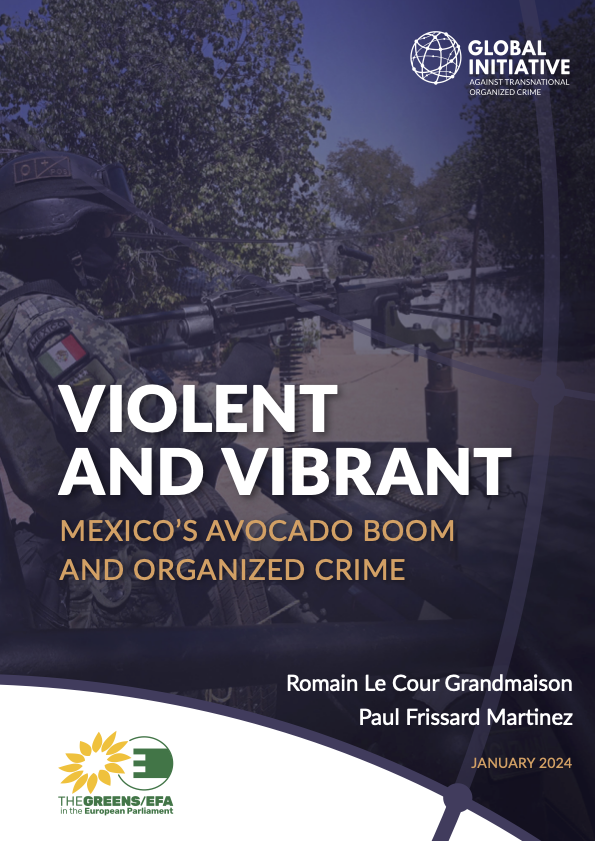
The contemporary boom of global avocado consumption has drawn attention to Mexico’s industry and the expanding criminal networks that surround it. In fact, avocado production and exports – both to the United States and the European Union − display worrying signs of criminal organizations being involved in the market, human rights violations, and environmental and health impacts.
By Araceli Vázquez-Ocaña and Alan Alberto Ramírez-Guevara
This study proposes a non-linear analytical framework, inspired by phase-transition theory, to explain abrupt regime shifts in organized violence within weak institutional systems.Using Mexico (2000-2024) as a primary case, we demonstrate that criminal violence does not escalate linearly but undergoes a "phase transition" once specific thresholds are crossed. We introduce the Criminal Nucleation Framework to model the emergence and persistence of criminal cells through three dimensions: the institutional activation barrier (ΔG), the critical organizational size (r*), and the growth constant (k). Empirical validation shows a structural rupture between 2007 and 2010, where homicide rates shifted from a stable regime (8.5–10 per 100k) to a chronic state (25–29 per 100k). By operationalizing a comparative Kinetic Risk Index (R = k/ΔG), the framework classifies cities into distinct systemic states rather than providing point predictions. The findings suggest that once a system exhibits hysteresis, reactive force is structurally insufficient; instead, policy must focus on increasing the activation barrier to prevent spontaneous criminal formation.
By CECILIA FARFÁN-MÉNDEZ
Nearshoring offers an opportunity to improve security conditions in Mexico. The historic trend of de-risking by U.S. manufacturers leaving China will produce a generational shift that will bring some manufacturing closer to the United States. This creates opportunities for new investment and economic growth that could potentially benefit Mexico. Yet, nearshoring investment to Mexico is not guaranteed and will depend on a variety of factors including but not limited to the security situation in the country. The American Chamber of Commerce in Mexico (AMCHAM) reports that 13% of its member companies are now spend- ing more than 8% of their entire operational budgets on security. Official data also shows that in 2021 the cost of crime for firms was equal to 0.67% of Mexico’s GDP. Most of this cost is from expenses incurred on preventive measures ranging from changing locks to hiring private security. In 2011 the percentage spent in preventive measures, as a measure of cost of crime, was 41.4%.
By 2021 that percentage increased to 58.1%. This means that most of the cost of crime in Mexico for the private sector derives from trying to protect their businesses from violence and insecurity in the country. Notably, Baja California was the state with the highest costs incurred due to crime in 2021 with an average cost of $5,180 compared to the national average of $3,246. The private sector has an important role to play in improving security, including: • Recognizing the crime-corruption nexus that feeds illicit activities beyond the alluring but incomplete narco-narratives (i.e. a small group of violent drug traffickers are solely responsible for violence and criminality in the country) • Rethinking security not only as the protection of physical infrastructure but also of personnel and in relation to the broader environments in which they operate. Five key ideas should be at the center of corporate decision making for future nearshoring investment in Mexico: • Too often, there are links between criminal actors and corrupt government officials, which undermines citizen security and the rule of law. Companies, whether national or international, cannot buy themselves out of this problem through private security companies.
Companies can improve security conditions in the communities where they currently operate or are considering relocating to through partnerships that help to fund and sustain evidence-based programs effective in mitigating violence and preventing recruitment into criminal groups and recidivism. • While it is an understandable decision to hire private security companies, it should be clear that doing so is not free of negative outcomes. Firearms and ammunition trafficking, particularly from the United States to Mexico, feeds the cycle of violence in Mexico and erodes business-friendly environments. • In order to promote citizen security and successful nearshoring, the private sector should advocate for public policies aimed at stemming the flow of illicit firearms and ammunition trafficking, particularly from the United States to Mexico, including supporting the Stop Arming Cartels Act that will prevent military-grade weapons from being sold and trafficked to illicit actors. • States with high levels of business victimization are also states with some of the main highways in the country critical for cross-border trade and commerce. • Latin America is the world’s most vulnerable.
By María Victoria Llorente and Jeremy McDermott, Raúl Benítez Manaut , Marta Lucía Ramírez de Rincón , John Bailey
Since the mid-2000s, violence related to drug trafficking and other transnational crime has increased exponentially in Mexico. By the end of the decade the public began to seriously doubt the government’s strategy and its ability to guarantee public safety. The nature and intensity of violence in Mexico brought forth memories of the 1980s and ’90s in Colombia, when the country was besieged by the Medellín and Cali drug cartels. Over the course of more than a decade, Colombia’s security situation has improved dramatically; it has become an “exporter” of security expertise and has trained thousands of military and police personnel in Mexico, Central and South America, and the Caribbean as well as around the world. What aspects of Colombia’s strategy and tactics for fighting organized crime in its own territory offer useful lessons for Mexico? What might Colombia’s steps and missteps offer by way of example or counter-example? What is unique about each case such that comparisons are misleading? What do current security challenges in Colombia suggest about the threat posed by organized crime more generally? In One Goal, Two Struggles: Confronting Crime and Violence in Mexico and Colombia, international experts address the utility of comparing Colombia and Mexico’s experiences and strategy for combatting organized crime and violence more generally.
By Barbara Kelemen | Ján Slobodník
Summary ▪ Mexico’s macroeconomic stability and abundant natural resources have made the country into an attractive destination for Chinese businesses. ▪ The country still suffers from a lack of internal security, most of it stemming from the Mexican Drug War, an ongoing multilateral lowintensity conflict between the Mexican government and a large number of criminal organizations. ▪ In some of Mexico’s states, pervasive violence and instability have resulted in a power vacuum. With the government being unable to guarantee security, non-state actors such as criminal organizations and/or civilian militias seize the opportunity to establish their own rule. ▪ When foreign companies operate in such troubled areas, they inevitably run into problems caused by Mexico’s security issues. ▪ Within this trend of foreign companies operating in Mexico, some level of tacit cooperation has been observed between Chinese businesses and non-state actors. This cooperation is often an outcome of localized security vacuums that are exploited by alternative security providers, such as criminal organizations, that can fill them and provide operational safety for local businesses. ▪ A growing body of research has identified the existence of Chinese illicit networks and their involvement in the trafficking of people, narcotics, and contraband goods, as well as money laundering and illegal arms trade in Mexico. ▪ Concealed under the guise of legal commercial activity, networks of Mexican criminal organizations and their Chinese business partners exploit the dire security situation in some areas of Mexico. ▪ Despite attempts by the Chinese and the Mexican governments to regulate certain sectors that contribute to the existence of the illicit networks in Mexico, there are still substantial opportunities that are ripe for exploitation by the criminal group-legitimate business partnerships.
By Nathan P. Jones and John P. Sullivan
Criminal cartels and gangs dominate the illicit economy in Mexico. These organized crime groups challenge the solvency (specifically capacity and legitimacy) of the state in Mexico. Organized crime in Mexico is involved in a range of activities including extortion, drug trafficking, human trafficking, and petroleum theft. Criminal cartels, often called drug trafficking organizations, have diversified into other illicit activities specifically petroleum theft. This paper provides an overview of the rise of a specialized organized criminal entity: huachicoleros. Huachicoleros specialize in fuel theft and like their narco counterparts use corruption and violence to protect their illicit market. The rise of Cártel de Santa Rosa Lima (CSRL) is discussed as a salient case study. The volatile mix of corruption, violence, and economic instability will be assessed, and government and national oil company (PEMEX) response is discussed
By Jan Slobodník
This study examines the militarised approach of the Mexican government in its struggle against organised crime between 2001 and 2016, focusing on the deployment of the armed forces and the implementation of the so-called kingpin strategy. It argues that the removal of cartel leaders, rather than weakening criminal networks, produced fragmentation, diversification, and militarisation within Mexico’s underworld—a process defined here as zetafication. The thesis uses the rise and evolution of Los Zetas as a case study to analyse how a criminal organisation born from army deserters introduced military tactics, hierarchical discipline, and extreme violence into organised crime, transforming the conflict’s character and the state’s response. Drawing on government reports, interviews with Mexican military officers and civilians, and contemporary scholarship, the study situates this phenomenon within Mexico’s political, legal, and socio-economic context, including the influence of U.S. security policy. It concludes that the use of the military as a policing tool produces short-term tactical gains but undermines long-term state stability, erodes public trust, and perpetuates cycles of violence.