
Open Access Publisher and Free Library
CRIME+CRIMINOLOGY.jpeg

CRIME

Violent-Non-Violent-Cyber-Global-Organized-Environmental-Policing-Crime Prevention-Victimization

Posts tagged Global Crime
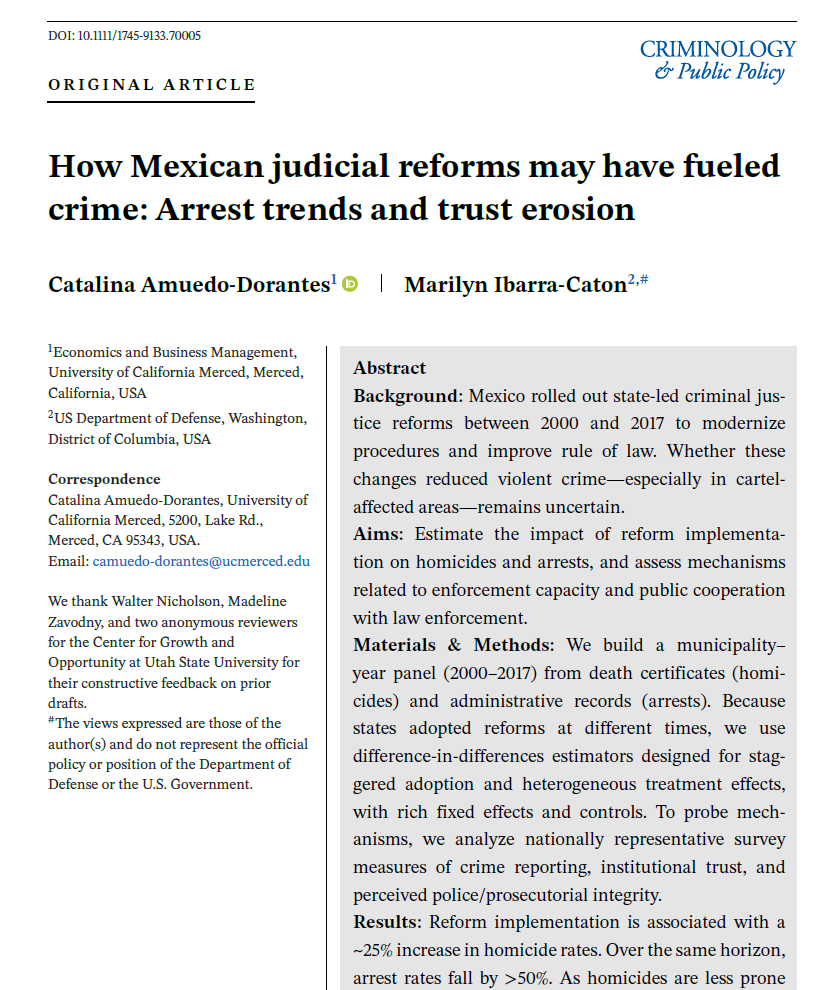
How Mexican judicial reforms may have fueled crime: Arrest trends and trust erosion

By Catalina Amuedo-Dorantes, Marilyn Ibarra-Caton

Background

Mexico rolled out state-led criminal justice reforms between 2000 and 2017 to modernize procedures and improve rule of law. Whether these changes reduced violent crime—especially in cartel-affected areas—remains uncertain.

Aims

Estimate the impact of reform implementation on homicides and arrests, and assess mechanisms related to enforcement capacity and public cooperation with law enforcement.

Materials & Methods

We build a municipality–year panel (2000–2017) from death certificates (homicides) and administrative records (arrests). Because states adopted reforms at different times, we use difference-in-differences estimators designed for staggered adoption and heterogeneous treatment effects, with rich fixed effects and controls. To probe mechanisms, we analyze nationally representative survey measures of crime reporting, institutional trust, and perceived police/prosecutorial integrity.

Results

Reform implementation is associated with a ~25% increase in homicide rates. Over the same horizon, arrest rates fall by >50%. As homicides are less prone to underreporting than other crimes, the homicide increase is unlikely to be a reporting artifact. Survey evidence shows reduced crime reporting, declining trust in institutions, and more negative views of police and prosecutors; effects are strongest in cartel-affected regions.

Discussion

The pattern is consistent with an erosion of effective enforcement capacity at rollout: fewer arrests and lower public cooperation raise expected returns to violent crime. In high-violence settings, reforms that change procedures without parallel boosts to investigative and prosecutorial capacity—and without safeguards for witnesses—can weaken deterrence.

Conclusion

Mexico’s staggered judicial reforms coincided with higher homicides and sharply lower arrests. Successful reform in violent contexts likely requires coordinated institutional strengthening (policing, prosecution, witness protection), phased implementation with measurable benchmarks, and strategies to sustain public trust and reporting.
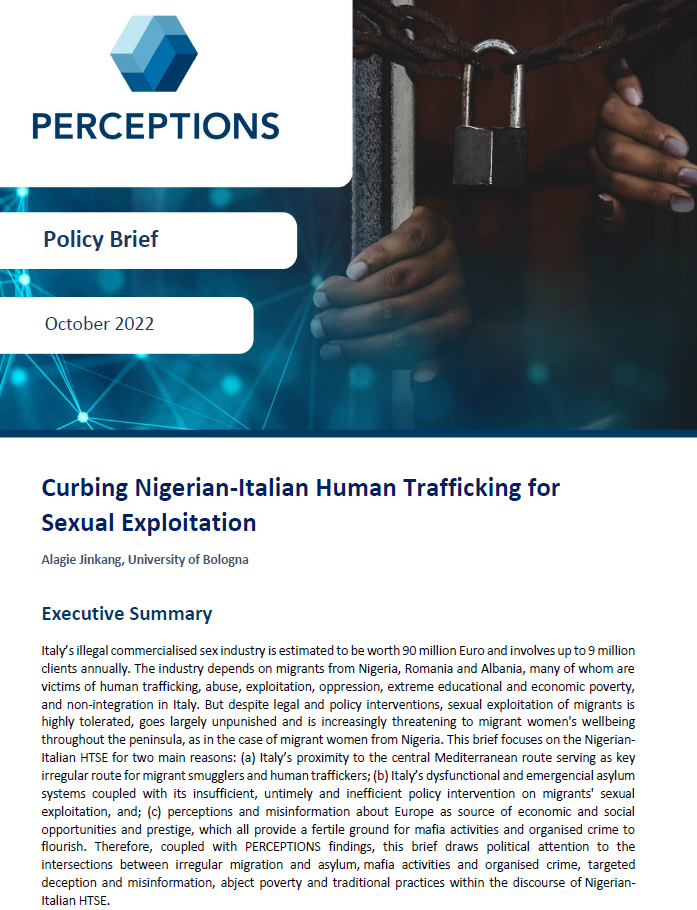
Curbing Nigerian-Italian Human Trafficking for Sexual Exploitation

By Alagie Jinkang

Italy’s illegal commercialised sex industry is estimated to be worth 90 million Euro and involves up to 9 million clients annually. The industry depends on migrants from Nigeria, Romania and Albania, many of whom are victims of human trafficking, abuse, exploitation, oppression, extreme educational and economic poverty, and non-integration in Italy. But despite legal and policy interventions, sexual exploitation of migrants is highly tolerated, goes largely unpunished and is increasingly threatening to migrant women's wellbeing throughout the peninsula, as in the case of migrant women from Nigeria. This brief focuses on the NigerianItalian HTSE for two main reasons: (a) Italy’s proximity to the central Mediterranean route serving as key irregular route for migrant smugglers and human traffickers; (b) Italy’s dysfunctional and emergencial asylum systems coupled with its insufficient, untimely and inefficient policy intervention on migrants' sexual exploitation, and; (c) perceptions and misinformation about Europe as source of economic and social opportunities and prestige, which all provide a fertile ground for mafia activities and organised crime to flourish. Therefore, coupled with PERCEPTIONS findings, this brief draws political attention to the intersections between irregular migration and asylum, mafia activities and organised crime, targeted deception and misinformation, abject poverty and traditional practices within the discourse of NigerianItalian HTSE.

Mixed Movements in Somalia: Dangerous Locations, Smuggling Dynamics and Access to Information and Assistance

By The Mixed Migration Centre

Drawing on more than 1,000 surveys with refugees and migrants, this infographic examines their perceptions of dangerous locations, direct experiences of abuse and harsh conditions and their interactions with and perceptions of smugglers. Additionally, it explores the sources of information that refugees and migrants relied on before and during their journey, as well as their access to assistance.

London/Denmark: Mixed Migration Centre, 2024. 6p.