Open Access Publisher and Free Library
CRIME+CRIMINOLOGY.jpeg

CRIME

Violent-Non-Violent-Cyber-Global-Organized-Environmental-Policing-Crime Prevention-Victimization

Posts in Human Trafficking
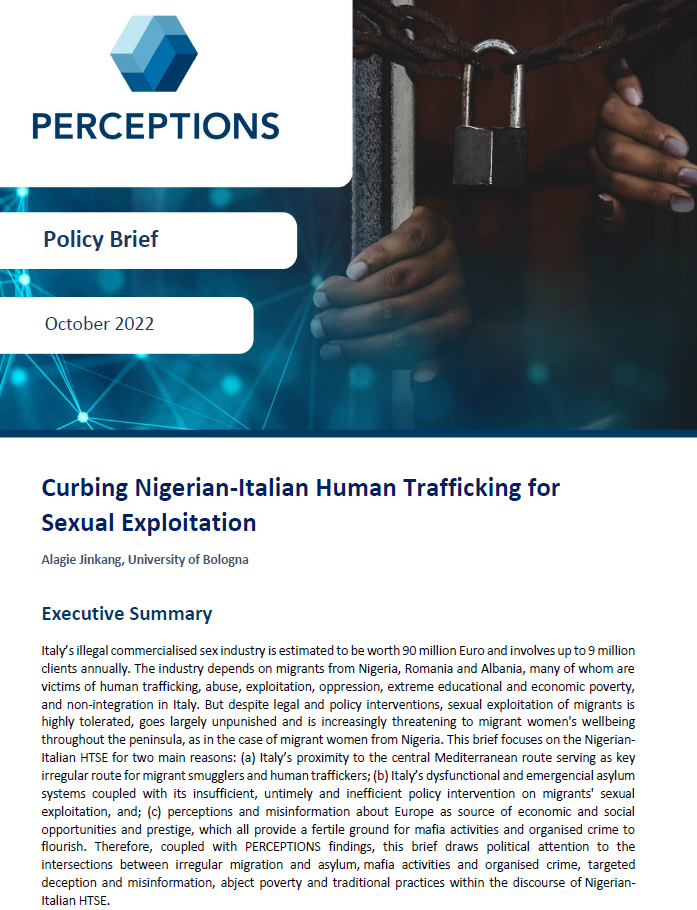
Curbing Nigerian-Italian Human Trafficking for Sexual Exploitation

By Alagie Jinkang

Italy’s illegal commercialised sex industry is estimated to be worth 90 million Euro and involves up to 9 million clients annually. The industry depends on migrants from Nigeria, Romania and Albania, many of whom are victims of human trafficking, abuse, exploitation, oppression, extreme educational and economic poverty, and non-integration in Italy. But despite legal and policy interventions, sexual exploitation of migrants is highly tolerated, goes largely unpunished and is increasingly threatening to migrant women's wellbeing throughout the peninsula, as in the case of migrant women from Nigeria. This brief focuses on the NigerianItalian HTSE for two main reasons: (a) Italy’s proximity to the central Mediterranean route serving as key irregular route for migrant smugglers and human traffickers; (b) Italy’s dysfunctional and emergencial asylum systems coupled with its insufficient, untimely and inefficient policy intervention on migrants' sexual exploitation, and; (c) perceptions and misinformation about Europe as source of economic and social opportunities and prestige, which all provide a fertile ground for mafia activities and organised crime to flourish. Therefore, coupled with PERCEPTIONS findings, this brief draws political attention to the intersections between irregular migration and asylum, mafia activities and organised crime, targeted deception and misinformation, abject poverty and traditional practices within the discourse of NigerianItalian HTSE.

Climate Chains: Mapping the Relationship between Climate, Trafficking in Persons and Building Resilience in the Philippines

By The International Organization for Migration

This report, Climate Chains: Mapping the Relationship between Climate, Trafficking in Persons and Building Resilience in the Philippines, explores the complex links between climate change, livelihood, vulnerability, migration and human trafficking in the Philippines. Commissioned by IOM under the Climate Resilience Against Trafficking and Exploitation (CREATE) project, this study forms part of a broader research focusing on Ethiopia and the Philippines – two countries facing distinct climate challenges: slow-onset droughts and sudden-onset typhoons, respectively.  

The research used a mixed-methods approach including household surveys, interviews and focus group discussions. The report puts forward a conceptual model that links climate events and trafficking through a series of intertwined steps. It identifies a causal chain where climate events disrupt livelihood, increase vulnerability and heighten migration intentions, which can lead to exploitation and trafficking. The research explores how factors linking climate and trafficking operate in the Philippines. 

This study provides critical insights and recommendations for policymakers, donors and organizations in the Philippines and internationally that are working to combat human trafficking and exploitation, while strengthening resilience to climate change

Climate Chains: Mapping the Relationship between Climate, Trafficking in Persons and Building Resilience in Ethiopia

By The International Organization for Migration

This report, Climate Chains: Mapping the Relationship between Climate, Trafficking in Persons and Building Resilience in Ethiopia, explores the complex links between climate change, livelihood, vulnerability, migration and human trafficking in Ethiopia. Commissioned by IOM under the Climate Resilience Against Trafficking and Exploitation (CREATE) project, this study forms part of a broader research focusing on Ethiopia and the Philippines – two countries facing distinct climate challenges: slow-onset droughts and sudden-onset typhoons, respectively.  

The research used a mixed-methods approach including household surveys, interviews and focus group discussions. The report puts forward a conceptual model that links climate events and trafficking through a series of intertwined steps. It identifies a causal chain where climate events disrupt livelihood, increase vulnerability and heighten migration intentions, which can lead to exploitation and trafficking. The research explores how factors linking climate and trafficking operate in Ethiopia. 

This study provides critical insights and recommendations for policymakers, donors and organizations in Ethiopia and internationally that are working to combat human trafficking and exploitation, while strengthening resilience to climate change.

Identifying human trafficking indicators in the UK online sex market

By Luca Giommoni, Ruth Ikwu

   This study identifies the presence of human trafficking indicators in a UK-based sample of sex workers who advertise their services online. To this end, we devel oped a crawling and scraping software that enabled the collection of information from 17, 362 advertisements for female sex workers posted on the largest dedicated platform for sex work services in the UK. We then established a set of 10 indicators of human trafficking and a transparent and replicable methodology through which to detect their presence in our sample. Most of the advertisements (58.3%) contained only one indicator, while 3,694 of the advertisements (21.3%) presented 2 indicators of human trafficking. Only 1.7% of the advertisements reported three or more indica tors, while there were no advertisements that featured more than four. 3, 255 adver tisements (19.0%) did not contain any indicators of human trafficking. Based on this analysis, we propose that this approach constitutes an effective screening process for quickly identifying suspicious cases, which can then be examined by more compre hensive and accurate tools to identify if human trafficking is occurring. We conclude by calling for more empirical research into human trafficking indicators

Trends in Organized Crime. 2024, 14pg