Open Access Publisher and Free Library
CRIME+CRIMINOLOGY.jpeg

CRIME

Violent-Non-Violent-Cyber-Global-Organized-Environmental-Policing-Crime Prevention-Victimization

Posts in ethnography
Femicidal violence in figures:  Latin America and the Caribbean.

By ECLAC

The purpose of the Femicidal Violence in Figures Bulletin is to disseminate data on femicide/feminicide or gender-related killings of women in Latin America and the Caribbean, and to report on the methodological advances made by national institutions in generating statistics on this form of violence. Responsible entities:  Gender Equality Observatory for Latin America and the Caribbean of the Economic Commission for Latin America and the Caribbean (ECLAC) and the UNiTE to End Violence against Women campaign.

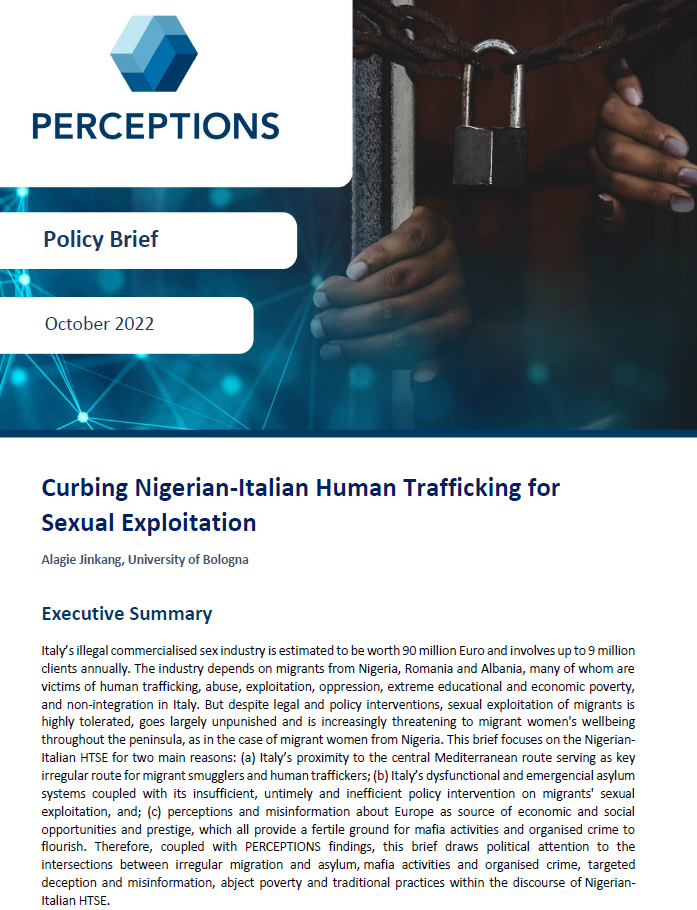
Curbing Nigerian-Italian Human Trafficking for Sexual Exploitation

By Alagie Jinkang

Italy’s illegal commercialised sex industry is estimated to be worth 90 million Euro and involves up to 9 million clients annually. The industry depends on migrants from Nigeria, Romania and Albania, many of whom are victims of human trafficking, abuse, exploitation, oppression, extreme educational and economic poverty, and non-integration in Italy. But despite legal and policy interventions, sexual exploitation of migrants is highly tolerated, goes largely unpunished and is increasingly threatening to migrant women's wellbeing throughout the peninsula, as in the case of migrant women from Nigeria. This brief focuses on the NigerianItalian HTSE for two main reasons: (a) Italy’s proximity to the central Mediterranean route serving as key irregular route for migrant smugglers and human traffickers; (b) Italy’s dysfunctional and emergencial asylum systems coupled with its insufficient, untimely and inefficient policy intervention on migrants' sexual exploitation, and; (c) perceptions and misinformation about Europe as source of economic and social opportunities and prestige, which all provide a fertile ground for mafia activities and organised crime to flourish. Therefore, coupled with PERCEPTIONS findings, this brief draws political attention to the intersections between irregular migration and asylum, mafia activities and organised crime, targeted deception and misinformation, abject poverty and traditional practices within the discourse of NigerianItalian HTSE.


What Do We Know About How Processes of Desistance Vary by Ethnicity?

By Stephen Farrall, Jason Warr, Abigail Shaw, Kanupriya Sharma


This paper reviews what is known about ethnic identity and the processes by which people cease offending. Whilst the past 30 years have seen dramatic growth in what is known about desistance, in many jurisdictions, there is a paucity of research which examines this in terms of ethnicity or ethnic variations. We therefore review what is empirically known about ethnicity and desistance. Whilst this review draws from the global literature, our focus is on what this literature tells us about ethnicity and desistance from a British perspective. We find that the majority of these have been undertaken in the United States (although there are some European and Australasian studies). Few studies, however, have fully unpacked the role of racism (in terms of institutional processes or overt prejudice and hostility) and that there have been very few studies of the roles played by ethnicity in processes of desistance.

The Howard Journal of Crime and JusticeVolume 64, Issue 3Sep 2025