Open Access Publisher and Free Library
CRIME+CRIMINOLOGY.jpeg

CRIME

Violent-Non-Violent-Cyber-Global-Organized-Environmental-Policing-Crime Prevention-Victimization

Posts tagged research and practice
Evaluating the Texas Risk Assessment System (TRAS) Predictors of Revocation and Early Release in Adult Felony Probation

By Sarah A. El Sayeda, Carley R. Sheltonb, and Michael F. TenEyck

Although much is known about recidivism risk, less is known about factors predicting early release. The current study analyses a sample of 2,070 adult felony probation clients to see if offense characteristics, domains from the Texas Risk Assessment System (TRAS), and demographic variables impact both revocation and successful early release. Results revealed that predictors of early release mirrored those of revocation with one exception—race. Specifically, Black clients were 27% less likely to be granted early release. The findings highlight the TRAS is an effective tool to help mitigate bias for revocation of probation but not for granting early release.

How Mexican judicial reforms may have fueled crime: Arrest trends and trust erosion

By Catalina Amuedo-Dorantes, Marilyn Ibarra-Caton

Background

Mexico rolled out state-led criminal justice reforms between 2000 and 2017 to modernize procedures and improve rule of law. Whether these changes reduced violent crime—especially in cartel-affected areas—remains uncertain.

Aims

Estimate the impact of reform implementation on homicides and arrests, and assess mechanisms related to enforcement capacity and public cooperation with law enforcement.

Materials & Methods

We build a municipality–year panel (2000–2017) from death certificates (homicides) and administrative records (arrests). Because states adopted reforms at different times, we use difference-in-differences estimators designed for staggered adoption and heterogeneous treatment effects, with rich fixed effects and controls. To probe mechanisms, we analyze nationally representative survey measures of crime reporting, institutional trust, and perceived police/prosecutorial integrity.

Results

Reform implementation is associated with a ~25% increase in homicide rates. Over the same horizon, arrest rates fall by >50%. As homicides are less prone to underreporting than other crimes, the homicide increase is unlikely to be a reporting artifact. Survey evidence shows reduced crime reporting, declining trust in institutions, and more negative views of police and prosecutors; effects are strongest in cartel-affected regions.

Discussion

The pattern is consistent with an erosion of effective enforcement capacity at rollout: fewer arrests and lower public cooperation raise expected returns to violent crime. In high-violence settings, reforms that change procedures without parallel boosts to investigative and prosecutorial capacity—and without safeguards for witnesses—can weaken deterrence.

Conclusion

Mexico’s staggered judicial reforms coincided with higher homicides and sharply lower arrests. Successful reform in violent contexts likely requires coordinated institutional strengthening (policing, prosecution, witness protection), phased implementation with measurable benchmarks, and strategies to sustain public trust and reporting.

Climate Chains: Mapping the Relationship between Climate, Trafficking in Persons and Building Resilience in the Philippines

By The International Organization for Migration

This report, Climate Chains: Mapping the Relationship between Climate, Trafficking in Persons and Building Resilience in the Philippines, explores the complex links between climate change, livelihood, vulnerability, migration and human trafficking in the Philippines. Commissioned by IOM under the Climate Resilience Against Trafficking and Exploitation (CREATE) project, this study forms part of a broader research focusing on Ethiopia and the Philippines – two countries facing distinct climate challenges: slow-onset droughts and sudden-onset typhoons, respectively.  

The research used a mixed-methods approach including household surveys, interviews and focus group discussions. The report puts forward a conceptual model that links climate events and trafficking through a series of intertwined steps. It identifies a causal chain where climate events disrupt livelihood, increase vulnerability and heighten migration intentions, which can lead to exploitation and trafficking. The research explores how factors linking climate and trafficking operate in the Philippines. 

This study provides critical insights and recommendations for policymakers, donors and organizations in the Philippines and internationally that are working to combat human trafficking and exploitation, while strengthening resilience to climate change

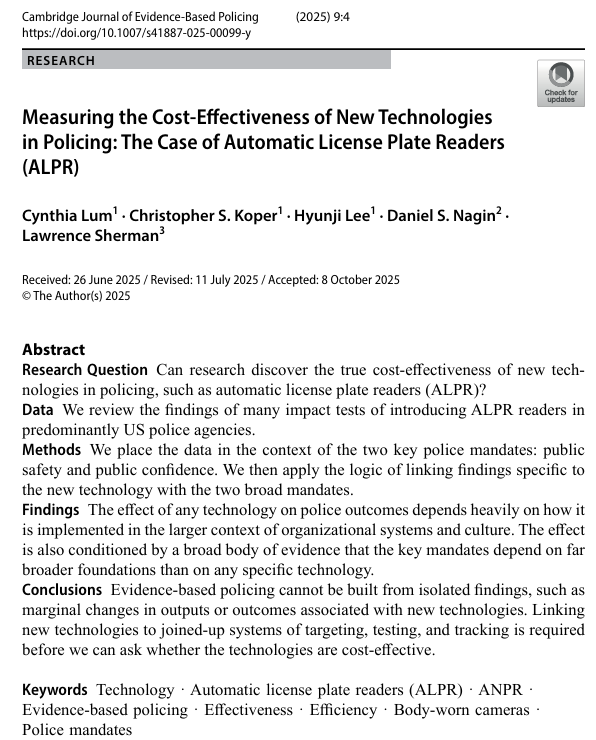
Measuring the Cost-Effectiveness of New Technologies in Policing: The Case of Automatic License Plate Readers (ALPR)

By Cynthia Lum, Christopher S. Koper, Hyunji Lee, Daniel S. Nagin, Lawrence Sherman

Research Question Can research discover the true cost-effectiveness of new technologies in policing, such as automatic license plate readers (ALPR)? Data We review the findings of many impact tests of introducing ALPR readers in predominantly US police agencies. Methods We place the data in the context of the two key police mandates: public safety and public confidence. We then apply the logic of linking findings specific to the new technology with the two broad mandates. Findings The effect of any technology on police outcomes depends heavily on how it is implemented in the larger context of organizational systems and culture. The effect is also conditioned by a broad body of evidence that the key mandates depend on far broader foundations than on any specific technology. Conclusions Evidence-based policing cannot be built from isolated findings, such as marginal changes in outputs or outcomes associated with new technologies. Linking new technologies to joined-up systems of targeting, testing, and tracking is required before we can ask whether the technologies are cost-effective.

Cambridge Journal of Evidence-Based Policing (2025)

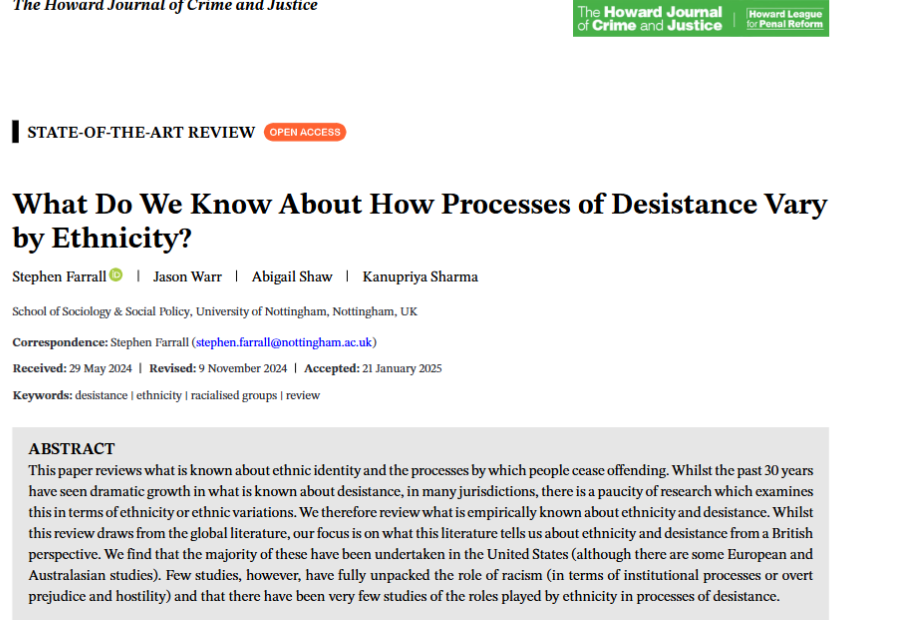
What Do We Know About How Processes of Desistance Vary by Ethnicity?

By Stephen Farrall, Jason Warr, Abigail Shaw, Kanupriya Sharma


This paper reviews what is known about ethnic identity and the processes by which people cease offending. Whilst the past 30 years have seen dramatic growth in what is known about desistance, in many jurisdictions, there is a paucity of research which examines this in terms of ethnicity or ethnic variations. We therefore review what is empirically known about ethnicity and desistance. Whilst this review draws from the global literature, our focus is on what this literature tells us about ethnicity and desistance from a British perspective. We find that the majority of these have been undertaken in the United States (although there are some European and Australasian studies). Few studies, however, have fully unpacked the role of racism (in terms of institutional processes or overt prejudice and hostility) and that there have been very few studies of the roles played by ethnicity in processes of desistance.

The Howard Journal of Crime and JusticeVolume 64, Issue 3Sep 2025