

Open Access Free Library
CRIME+CRIMINOLOGY.jpeg

CRIME

Violent-Non-Violent-Cyber-Global-Organized-Environmental-Policing-Crime Prevention-Victimization

Posts tagged crime control
"Another case of Ruthless Robbery…" Violence, Crime and the Local Press in a provincial City of Greece

Dr. Stratos Georgoulas

This paper͛s hypothesis is that the press, through the presentation of criminal incidents, transmits an evaluative knowledge determining this way, desirable objectives and propagating for canonistic types of behaviour. The daily knowledge as a constitutive element of the daily reality is a condition of interaction between the members of a society. In that sense, the local press that transmits this daily knowledge constitutes a dominant structuring factor of this reality.

The research which is based on content analysis of newspaper articles of the whole local press of Mytilene (the capital of the prefecture of Lesbos in Greece) published between January March 2004 and additional interviews from journalists aims to illustrate the following:

a. The concept of criminality is being constructed both qualitatively and quantitatively through local press and not vice versa.

b. The local press evaluates negatively illegal behaviours, positively the austerisation of social control, while in most cases it cancels any relevance with the social frame of criminality.

c. The local press with the dramatic narrations that uses it causes fear of victimisation.

d. The journalists transmit evaluative knowledge in an attempt to cover the lack of knowledge of real criminological data.

International Journal of Academic Research in Business and Social Sciences November 2013, Vol. 3, No. 11 ISSN: 2222-6990.
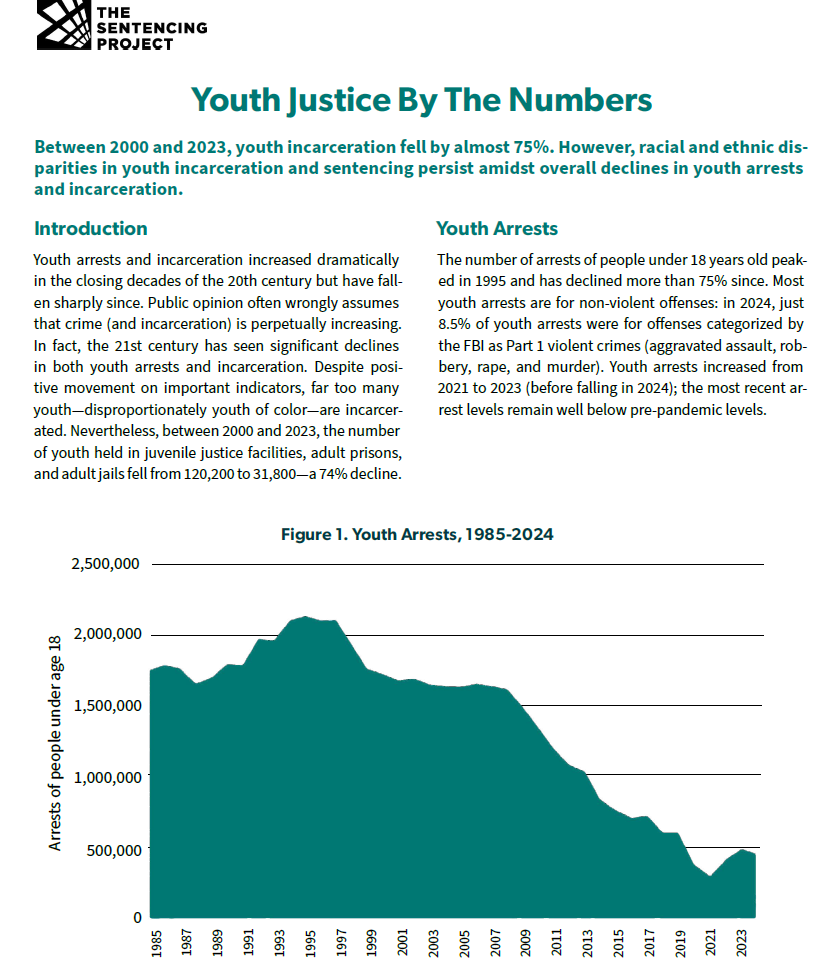
Youth Justice by the Numbers

By Joshua Rovner

Youth arrests and incarceration increased dramatically in the closing decades of the 20th century but have fallen sharply since. Public opinion often wrongly assumes that crime (and incarceration) is perpetually increasing. In fact, the 21st century has seen significant declines in both youth arrests and incarceration. Despite positive movement on important indicators, far too many youth—disproportionately youth of color—are incarcerated. Nevertheless, between 2000 and 2023, the number of youth held in juvenile justice facilities, adult prisons, and adult jails fell from 120,200 to 31,800—a 74% decline.

Popular Culture, Crime and Social Control

Edited by Mathieu Deflem

This volume contains contributions on the theme of popular culture, crime, and social control. The chapters in this volume tease out various criminologically relevant issues, pertaining to crime/deviance and/or the control thereof, on the basis of an analysis of various aspects and manifestations of popular culture, including music, movies, television, paintings, sculptures, photographs, cartoons, and the internet-based audio-visual materials that are presently available. Thematically diverse within the province of criminology, the chapters in this book are not restricted in terms of theoretical approach and methodological orientation. Using a variety of methodological and theoretical perspectives, the volume is diverse in addressing dimensions of popular culture in relation to important criminological questions.

Bingley, UK: Emerald Publishing, 2010. 308p.

Sydney in Ferment: Crime, Dissent and Official Reaction, 1788 to 1973

By Peter H. Grabosky.

Crime fascinates many members of the public. They are eager to know what forms it takes, whether kinds of crime change, what measures are taken to combat it. Sydney in Ferment draws widely on primary sources, many previously unpublished. It focuses on trends in criminal behaviour, political dissidence, collective violence and crime control policies in New South Wales from Phillip{u2019}s landing in 1788 to the early 1970s. It investigates variations in rates and types of crime and threats to public order and discusses changes in criminal law, the creation and development of police forces and trends in criminal procedure and penal form. Its conclusion on the relative weights to be given to the influence of short-term changes in policy on criminal justice and to fundamental social and economic factors will provoke spirited discussion. This book is a lively account both of crime itself and also of the changes in the moral attitudes of the officials and the public at large.

Canberra: Australian National University Press, 1977. 234p.