
Open Access Publisher and Free Library
CRIME+CRIMINOLOGY.jpeg

CRIME

Violent-Non-Violent-Cyber-Global-Organized-Environmental-Policing-Crime Prevention-Victimization

Posts tagged legal framework
Female Empowerment and Intimate Partner Violence

By Elisabetta Calabresi and Núria Rodríguez-Planas

The chapter reviews the economic literature on intimate partner violence (IPV), a widespread human rights violation affecting nearly one in three women globally and generating significant societal costs. It focuses on the relationship between various dimensions of female empowerment and IPV. The chapter begins by outlining key theoretical frameworks—including household bargaining, instrumental violence, male backlash, and exposure theories—as well as the main data sources used to study IPV. It then reviews empirical evidence on how factors shaping female empowerment at the individual, relationship, community, and societal levels influence IPV outcomes. Central themes include labor market dynamics, education, income shocks, family formation, legal frameworks, institutional access, and gender norms. The chapter also considers how these factors interact across levels and discusses additional drivers of IPV not directly linked to female empowerment. The goal is to provide an overview of causal evidence from the economic literature on IPV while emphasizing its complexity and the importance of a context-specific, intersectional approach to both its analysis and prevention.
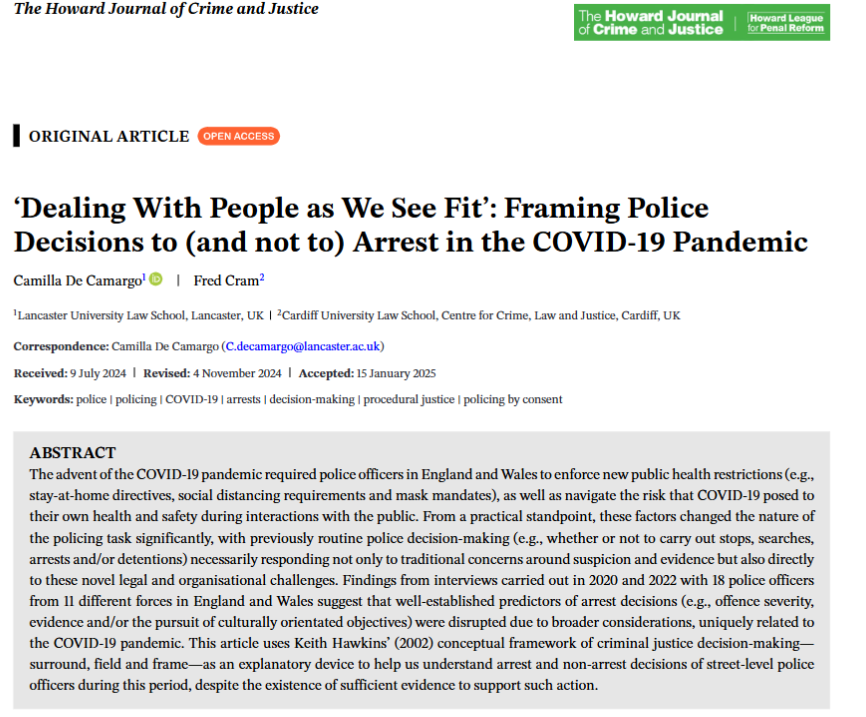
‘Dealing With People as We See Fit’: Framing Police Decisions to (and not to) Arrest in the COVID‐19 Pandemic

By Camilla De Camargo, Fred Cram

The advent of the COVID-19 pandemic required police officers in England and Wales to enforce new public health restrictions (e.g., stay-at-home directives, social distancing requirements and mask mandates), as well as navigate the risk that COVID-19 posed to their own health and safety during interactions with the public. From a practical standpoint, these factors changed the nature of the policing task significantly, with previously routine police decision-making (e.g., whether or not to carry out stops, searches, arrests and/or detentions) necessarily responding not only to traditional concerns around suspicion and evidence but also directly to these novel legal and organisational challenges. Findings from interviews carried out in 2020 and 2022 with 18 police officers from 11 different forces in England and Wales suggest that well-established predictors of arrest decisions (e.g., offence severity, evidence and/or the pursuit of culturally orientated objectives) were disrupted due to broader considerations, uniquely related to the COVID-19 pandemic. This article uses Keith Hawkins’ (2002) conceptual framework of criminal justice decision-making—surround, field and frame—as an explanatory device to help us understand arrest and non-arrest decisions of street-level police officers during this period, despite the existence of sufficient evidence to support such action.

The Howard Journal of Crime and Justice Volume 64, Issue 3 Sep 2025 Pages 277-417

Understanding Adult Sexual Assault Matters: Insights from Research and Practice: An Educational Resource for the Justice Sector

By Nina Hudson, Rachel Moody, Heather McKay, Rae Kaspiew

The guide presents research-based insights that challenge common stereotypes, highlighting the diverse experiences of victims and survivors and offering practical examples and approaches for professionals to implement in their practice. It is intended for use by professionals within the Australian justice sector, specifically police, lawyers, and judicial officers.

This resource aims to support a more trauma-informed, victim-centred approach within the Australian justice system, ultimately fostering a greater understanding of the complexities of sexual assault. It was developed in response to calls for improvements in the justice system's handling of sexual assault cases and draws on research from over 100 Australian and international sources.

Australian Institute of Family Studies, 2024. 83p.