Open Access Publisher and Free Library
CRIME+CRIMINOLOGY.jpeg

CRIME

Violent-Non-Violent-Cyber-Global-Organized-Environmental-Policing-Crime Prevention-Victimization

Posts in Violence & Oppression
The Limits of the Fight against Money Laundering in the European Union : State of Play, Challenges and Perspectives.

By Davin Nina and Péan Maxence

Money laundering is an activity that consists of legitimizing the proceeds of crime by integrating them into the economic system. The primary objective of this process is to conceal the origin of money from illegal activities (drug trafficking, insider trading, corruption, etc.). The proceeds of these crimes take different forms. It can be cash, financial assets or material objects (works of art, jewelry, etc.). Money laundering is most often carried out in three distinct stages: placement, layering and integration. The placement stage consists of placing the dirty money in the financial system. Most often, criminal organizations come through companies to increase the inflow of capital, which is then deposited in a banking institution. Afterwards, the stratification process takes place, which consists of a large series of conversions and movements of funds in order to mask the origin of these products. Finally, once the money is laundered, it is reused by criminals to finance their activities. Today, the emergence of new information and communication technologies (NICT) in particular is giving a new boost to money laundering activities. The advent of online payment systems, crypto-currencies and dematerialized cash transfers make it even more difficult to track down illegal money transfers. Moreover, the multiplication of online auctions or gambling sites greatly facilitates money laundering. Faced with the development of these new methods, the authorities of European countries are trying to set up a new system to fight against money laundering, in particular by strengthening their cooperation. In addition, following the numerous attacks that occurred in the decade 2010-2020, the fight against the financing of terrorism has become the focus of these institutions. Despite the strengthening of the fight against money laundering and terrorist financing (AML/CFT), the latter "has weaknesses1". These weaknesses are based on "institutional fragmentation and insufficient coordination at the European Union level2" but also because the EU bodies have "limited tools". Furthermore, following the work of many researchers, it is estimated that today the fight against money laundering and terrorist financing is liberticide. Indeed, as early as 2003, a report by the CNIL pointed out the numerous liberticidal measures to fight against money laundering. In this paper, we will first present the framework of the fight against money laundering and terrorist financing in the European Union (I), then we will describe the main flaws of this system (II), and finally we will demonstrate that this fight is today deeply liberticidal, notably because of the tools it uses (III)

IEP Aix-en-Provence - Sciences Po Aix - Institut d'études politiques d'Aix-en-Provence, 2022. 22p.

Strengthening the Role of Victims and Incorporating Victims in Efforts to Counter Violent Extremism and Terrorism

By Alex P. Schmid

Following terrorist attacks, governments are often quick to express their solidarity with victims of terrorism but as the memory of a terrorist atrocity fades, political attention for the victims also ebbs away – in both government and society. In this Research Paper, Dr. Alex P. Schmid explores the roles of victims of terrorism. The paper looks at various definitions of what it means to be a “victim” and also traces the various initiatives aimed at supporting victims over the last two decades. In many cases, the paper finds, such initiatives have been weak. Victims of terrorism are often one of the best positioned actors to counter violent extremism and their role in this respect is also analysed. While the importance of victims is slowly being recognised, this Paper concludes that there is still a lot more work to be done. The Paper ends with several recommendations which could enhance and improve the position of victims and their role in countering violent extremism

The Hague: The International Centre for Counter-Terrorism , 2012. 28p.

Hong Kong United Nations International Crime Victim Survey: Final Report of the 2006 Hong Kong UNICVS

By Roderic G. Broadhurst, Grigitte Bouhours, John Bacon-Shone, and Lena Y Zhong

This report presents the findings of the 2006 Hong Kong United Nations International Crime Victim survey. This was the first time the UNICVS was conducted in Hong Kong SAR China. For this reason, no trends in crime over time are available but where appropriate, the results are compared with those of other main cities in the developed and the developing world. The report shows crime victimization rates for ten types of common crimes: car theft, theft from car, household burglary and attempted burglary, robbery, personal theft, assault, and sexual victimization. In addition, the report examines non-conventional crimes such as corruption and bribery, and consumer fraud. A unique feature of the Hong Kong UNICVS is a set of questions on cyber victimization. The report also presents information on other topics related to criminal justice such as reporting to the police and the police response to victimization, fear of crime, crime prevention measures, and opinions about police and sentencing. Hong Kong’s residents attitudes to restorative justice and victims’ participation in the justice process are also examined. In 2006, the Hong Kong government conducted its regular Crime Victim Survey. This provides a unique opportunity to compare the results of the CVS and the UNICVS, and assess the ways in which different methodologies impact on the results of crime victimization surveys.

Hong Kong: University of Hong Kong and Canberra: Australian National University, 2010. 65p.

Illicit Markets and Targeted Violence in Afghanistan

By Ana Paula Oliveira

Afghanistan experienced a marked rise in violent crimes, including kidnappings and armed robbery in 2021. The reported increase in targeted attacks against civilians in the country, specifically regarding women human rights defenders and media workers, had already raised concerns in the period preceding the Taliban takeover. These events and the changing nature of the killings—from widespread casualties to targeted violence— underscored the need for a nuanced examination of the different ways conflict and crime converge to create conditions that incentivise violent actors and instability. This paper looks at these issues through the lens of illicit market violence in Afghanistan. It explores its potential as a key proxy to project current and future trends of other illicit and criminal market development in the country. The paper suggests a framework for further research to examine the evolution of illicit markets in Afghanistan by using a methodologically sound proxy indicator of such violence. First, it draws on a literature review on violence related to illicit markets and presents the methodology developed by the Global Initiative Against Transnational Organized Crime (GI-TOC) to research assassinations. Second, the paper undertakes a focused literature review on targeted violence in Afghanistan, focusing particularly on the 2020–2021 period.

Birmingham, UK: University of Birmingham, 2022. 22p.

Assessing Contemporary Maritime Piracy in Southeast Asia: Trends, Hotspots and Responses

By Carolin Liss

In PRIF Report No. 125 Assessing Contemporary Maritime Piracy in Southeast Asia: Trends, Hotspots and Responses Carolin Liss takes a close look at contemporary piracy in this region, examines the nature of pirate attacks and identifies recent piracy trends and hotspots. Has there been a shift or change in comparison to the last piracy boom in this region between the 1990s and the mid-2000s? And what could be done to ensure piracy does not worsen, to protect those targeted by attacks in the future and guarantee the safety of the region’s primary maritime shipping routes?

Carolin Liss demonstrates that, unlike in waters such as the wider Gulf of Aden area, there is no need for international warships or armed private security guards on ships in Southeast Asia. Instead, it is important to work out tailored responses to the specific types of attacks as well as adopt broader measures which address the root causes of piracy.

Frankfurt am Main, Germany: Peace Research Institute Frankfurt (PRIF), 2014. 40p.

Hong Kong International Violence Against Women Survey

By Roderic Broadhurst, Brigitte Bouhours, and John Bacon-Shone

Between 2003 and 2009, the International Violence Against Women Survey (IVAWS) has been conducted in 12 developed and developing countries. The IVAWS is a comprehensive instrument that measures women’s experiences of physical and sexual violence by men, including intimate partners, victims’ help-seeking behaviour and the response of.... was conducted in Hong Kong and, for this reason, no trends in violence over time are available; however, because the IVAWS uses standardised questions and data collection methods, results can be compared with those of the other countries that participated in the survey. The report shows rates of victimisation for seven types of physical..... who the perpetrator was, particularly whether it was an intimate partner, a relative, a friend or acquaintance, or a stranger. Women who had recent incident, such as whether they had reported the assault to the police or victim support services. Drawing on socio-demographic and behavioual information on both respondents and their partners, the report examines the predictors of violent victimisation by partners and non-partners.

Hong Kong: University of Hong Kong; Canberra: Australian National University, 2012. 110p.

Safe Reporting of Crime for Victims and Witnesses with Irregular Migration Status in Italy

By Sara Bianca Taverriti

Irregular migrants face particular challenges in interacting with law enforcement authorities to report a crime, as they fear detection and deportation. This fear, together with their generally precarious situation, makes them particularly vulnerable to crime. This report aims to explain the existing legislation, policy and practices impacting on migrants’ ability to access the Criminal Justice System in Italy, as either victims or witnesses, without running the risk of self-incrimination or deportation. In particular, the report focuses on ‘firewall’ practices – that is, measures that encourage reporting of crime by migrants with irregular status by neutralising the risk and the fear of deportation and expulsion as a consequence of reporting crime. This report is intended to analyse the strengths and weaknesses of these measures, in order to assess their effectiveness in facilitating safe reporting of crime by irregular migrants. Finally, the report will consider the potential of policy reforms in the area of safe reporting, including by considering the potential for implementation in Italy of local measures known as ‘sanctuary policies’. This research contributes to a project on safe reporting of crime for victims and witnesses with irregular migration status in Europe and the United States undertaken by the Centre on Migration, Policy and Society (COMPAS) at the University of Oxford.1 As well as Italy, this project examines the United States, Spain, the Netherlands and Belgium. The ultimate aim of the project is to promote learning of best practices and knowledge-exchange on this topic between countries. It also aims to evaluate the legal and political replicability of ‘firewall’ policies across different countries, and in particular the legal replicability of US experiences (for example, that of ‘sanctuary cities’) in European contexts.

Bristol, UK: COMPAS, Global Exchange on Migration and Diversity, 2019. 46p.

Safe Reporting of Crime for Victims and Witnesses with Irregular Migration Status in Spain

By Markus González Beilfuss

According to the European Union (EU) Victims-Directive, victims of crime have the right to be informed, supported and protected, as well as to participate in criminal proceedings. EU Member States retain notable scope for action to transpose these rights into their national legislation, but with the entry into force of this Directive in October 2012, victims' protection entitlements improved significantly within thre remit of EU Law. However, foreign victims with irregular migration status are still in a vulnerable position. Indeed, they are included in the Directive in a particular way. On the one hand, Member States have to take the necessary measures to ensure that the rights set out in the Directive are not conditional on the victim's residence status. According to Art. 1.1, the rights delineated shall apply to all victims in a non-discriminatory manner, including with respect to their residence status. Nevertheless, on the other hand the Directive does not address the conditions of the residence of crime victims in the territory of the Member States. As mentioned in the preamble of the Directive (Recital 10), ‘reporting a crime and participating in criminal proceedings do not create any rights regarding the residence status of the victim’. Victims of crime with irregular migration status fall under the scope of the EU's Return-Directive. As with any third-country nationals staying irregularly in their territories, Member States shall issue them with a return decision. As stated in Art. 6.4 of the Return-Directive, ‘compassionate, humanitarian or other reasons’ allow Member States to grant at any moment a residence permit or the right to stay to any person with irregular migration status. However, EU law does not directly grant these victims of crime the right to stay if they report the case to the police or the criminal justice system. The outcome of the existing legal framework can be particularly harmful for these crime victims, who are exposed to retaliation and can fear deportation if they report the crime to the police. But it also impacts upon the whole criminal justice system, which may lose crucial actors for the prosecution of crime. In the last decade, EU and international law have started to bring in some exceptions to this inconsistent and harmful legal system. According to Directive 2004/81/EC, victims of human trafficking have access to a so-called ‘reflection period’ that allows them to recover and escape from the influence of traffickers. During this period, it is not possible to enforce deportation orders of third-country national victims, and once the reflection period is finished, victims may under certain circumstances access a residence permit.

Oxford, UK: COMPAS, Global Exchange on Migration and Diversity, 2019. 33p.

Safe Reporting of Crime for Victims and Witnesses with Irregular Migration Status in the Netherlands

By Ruben Timmerman, Arjen Leerkes, and Richard Staring

Across Europe, irregular migrants experience considerable difficulty obtaining basic access to justice, protection, and services across a wide range of areas. The structural exclusion of irregular migrants from the integration strategies of European Union (EU) Member States serves in many situations to limit the full exercise of their basic rights, including in particular the right of an individual to safely report to the police if they have been a victim of or witness to crime.1 In recent years, however, efforts have been made to ensure that irregular migrants within Europe are guaranteed equal access to justice and basic rights should they fall victim to crime. Perhaps most notably, Directive 2012/29/EU of the European Parliament and of the Council of 25 October 2012 establishing minimum standards on the rights, support and protection of victims of crime (hereinafter, Victims’ Directive), which entered into force in 2015, sets out to ensure that the rights of all victims of crime are protected, regardless of nationality or residence status.2 Among other things, the EU Victims’ Directive signifies—at least on paper—the inclusion of irregular migrants within the wider purview of victims’ rights. However, there remain significant challenges and barriers to access to justice and rights for irregular migrant victims of crime within Europe, and there is much work still to be done in effectively realising the vision set out by the EU Victims’ Directive. In particular, it has long been observed by human rights observers, scholars, and practitioners in the field of migration that irregular migrants are often hesitant or unwilling to contact or interact with law enforcement authorities to report crime, either as victims or as witnesses, out of fear of arrest or deportation.3 As a result, these irregular migrants are unable to exercise their basic rights to necessary services, protection, and justice, and are often more vulnerable to perpetrators who are able to exploit their reluctance to report crime. Moreover, the lack of opportunity for irregular migrants to safely report crime results in a lack of crucial intelligence about criminal activity for law enforcement, and significantly reduces authorities’ insight into crime and public safety issues in their communities. As a result of these challenges, both in the United States and across Europe innovative and diverse initiatives have been developed—particularly at the local level—to promote ‘safe reporting’ of crime among irregular migrants, and in turn to ensure greater access to justice for victims.4 In particular, many localities have developed what are commonly referred to as ‘firewall policies’.

Oxford, UK; COMPAS, Global Exchange on Migration and Diversity, 2019. 46p.

Interventions Against Child Abuse and Violence Against Women: Ethics and culture in practice and policy

Edited by Carol Hagemann-White, Liz Kelly and Thomas Meysen

This book offers insights and perspectives from a study of “Cultural Encounters in Intervention Against Violence” (CEINAV) in four EU-countries. Seeking a deeper understanding of the underpinnings of intervention practices in Germany, Portugal, Slovenia and the United Kingdom, the team explored variations in institutional structures and traditions of law, policing, and social welfare. Theories of structural inequality and ethics are discussed and translated into practice.

Leverkusen-Opladen, Verlag Barbara Budrich, 2019. 320p.

Not the ‘golden years’: Femicide of older women in Canada

By Myrna Dawson

“She was Toronto’s homicide No. 70 of 2019. We only found out after her husband died of COVID-19 in jail.” The above headline appeared in the Toronto Star on April 19, 2021. No. 70 was 75-year-old Zohra Derouiche who had been fatally stabbed in her Scarborough home on Dec. 10, 2019. Her husband was charged with second degree murder when Zohra died 10 days after the stabbing. Until April 19, 2021, almost 1.5 years later, the public did not know about her death. The Toronto police did not release any information at the time of the stabbing. They did not issue a press release when she died or when her husband was charged. There was no coverage of her femicide. Her name was never made public. No one knew what she looked like because no photo of her in life was ever published. The Toronto Star only learned about the case because her 85-year-old husband died in custody in March 2021 after contracting COVID-19. His death will now be the subject of a coroner’s investigation. It is not clear if any investigation will ever occur into Zohra’s death. The Toronto police provided no specific reason for their failure to report Zohra’s death. It is likely that both sexism and ageism played a role. This research paper is about women like Zohra – older women who are killed mostly by men, but also by acquaintances and strangers, and sometimes by those in professional caregiving roles.

Ottawa: Office of the Federal Ombudsman for Victims of Crime, 2021. 54p.

Strengthening Understanding of Femicide: Using research to galvanize action and accountability

By Monique Widyono

This publication provides an overview of a conference on femicide convened jointly by PATH, the Inter-American Alliance for the Prevention of Gender-based Violence (InterCambios), the Medical Research Council of South Africa (MRC), and the World Health Organization (WHO) in Washington, DC, April 14–16, 2008. The conference brought together activists, researchers, and forensic professionals from 13 countries, with the aim of identifying common ground for strengthening research and galvanizing global action to prevent femicide and end the impunity so often granted to perpetrators. Participants agreed on three outcomes: a publication with an overview of the meeting and a collation of presentations; the convening of an ad hoc International Working Group on Femicide; and an addendum to the PATH/World Health Organization manual, Researching Violence against Women: A Practical Guide for Researchers and Activists, that focuses on femicide research.

Seattle: Program for Appropriate Technology in Health (PATH); Geneva: World Health Organization (WHO), 2009. 120p.

Femicide: Volume VI. Violence Against Girls in Flight

Edited by Veronika Bezinsky, Andrada Filip, Luma Kamel, Claire Laurent, Saide Mobayed, Kathryn Platzer, Michael Platzer

FEMICIDE Volume 6: Violence Against Girls contains the speeches delivered at these side events, at which high-ranking officials and experts on GBV presented comprehensive ways of reducing the risk of such violence, increasing the quality of protection for girl victims, and ending the impunity for perpetrators. It also includes the most recent and most effective prevention and mitigation strategies on gender-based violence against underage girls. In this volume of FEMICIDE we pay particular attention to girl refugees, displaced girls and migrant children, and the specific forms of violence and abuse occurring in the context of their flight. The refugee and migration flows in 2015 and 2016 have often been accompanied by abuses of the rights of children, and girls in particular. In such extreme situations as armed conflict, natural disasters, and other emergencies, girls are especially vulnerable to forced marriage, sexual exploitation, trafficking, psychological and physical intimidation, during all stages of their displacement. As girls are the most vulnerable of the vulnerable and are less likely to seek protection and a remedy, this publication focuses specifically on transnational aspects of violence against children, which are often neglected.

Vienna: Academic Council on the United Nations System (ACUNS) Vienna Liaison Office, 2016. 78p.

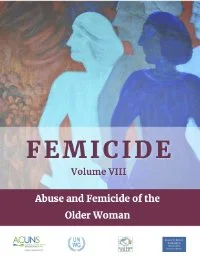
Femicide: Volume VIII. Abuse and Femicide of the Older Women

Edited by Helen Hemblade

Although violence against and murder of older women is a widespread phenomenon across the world, it receives little targeted attention. The simple fact that women get older than men, and as a result must live alone longer, makes them more vulnerable to exploitation, fraud, robbery and even physical abuse. As such, the abuse and femicide of older women is one of the most widespread unpunished crimes, affecting women of all backgrounds, cultures and countries. In many societies, elderly widows are physically and mentally abused, robbed of their right to inherit their assets - eventually losing their societal status. Due to poor education and no independent income, they are financially insecure and dependent on their children or relatives. FEMICIDE Volume VIII aims to analyse the ways in which women, over the age of 55, are psychologically and physically mistreated all around the globe, often resulting in death.

Vienna: Academic Council on the United Nations System (ACUNS) Vienna Liaison Office. 2017. 80p.

Femicide: A Global Issue that Demands Action. Volume VII: Establishing a Femicide Watch in Every Country.

Edited by: Helen Hemblade, Andrada Filip, Andrew Hunt, Marie Jasser, Fritz Kainz, Markus Gerz, Kathryn Platzer and Michael Platzer

Unless there is accurate and comparable data collection on a given crime, there will be no proper understanding of it and no effective strategy with which to combat it. Having clear data helps law makers and government officials win the public’s support for tackling it through targeted prevention and investigation resources. Femicide has been defined as murder of a woman by an intimate partner or family members and the targeting of women by criminal gangs or as a weapon of war. It has been universally recognised as a crime. But how do horrific crimes of this type so often slip under the radar? Why is it so difficult to collect data on such an abhorrent criminal activity and, subsequently, to arrest the perpetrators? On 25 November 2016 in Vienna, Austria, experts from around the world gathered for an ACUNS/OSCE UNODC symposi um entitled “Combating Femicide”; Dr. Šimonović reiterated the importance of establishing a Femicide Watch in each country. Excerpts from this conference are featured in this publication; they include UNODC Deputy Executive Director Aldo Lale-Demoz, the Austrian Ambassador Clemens Koja. and Biljana Branković, member of the Group of Experts on Action against Violence against Women and Domestic Violence.

Vienna: Academic Council on the United Nations System (ACUNS) Vienna Liaison Office. 2017. 80p.

Femicide: A Global Issue that Demands Action. Volume II

Edited by Simona Domazetoska, Michael Platzer and Gejsi Plaku

This is the second volume of Femicide: A Global Issue That Demands Action. This “resource book” will contribute to the worldwide campaign to stop Femicide

Vienna: Academic Council on the United Nations System (ACUNS) Vienna Liaison Office, 2014, 136p.

Femicide: A Global Issue that Demands Action. Volume I

Edited by: Claire Laurent, Michael Platzer and Maria Idomir

This publication is the result of this symposium and comprises the speeches and presentations of the various experts of the symposium. They discussed the issue of femicide from different perspectives, addressed the problems related to femicide including impunity and proposed comprehensive ways to fight this crime efficiently. In addition to the speeches this publication contains further information about the major forms of femicide. These short articles give an overview of the various crimes, including a description of the extent of the respective form of femicide and best practice examples to fight this crime.

Vienna: Academic Council on the United Nations System (ACUNS) Vienna Liaison Office, 2013. 156p.

Femicide: A Global Issue That Demands Action. Volume V

By Academic Council on the United Nations System (ACUNS)

Violence against women is the most atrocious manifestation of the systematic and widespread discrimination and inequality that women and girls around the world continue to face. Women and their children continue to die as victims of gender related killing, often in cruel ways. The weaknesses of national prevention systems, lack of proper risk assessment and the scarcity or poor quality of data are major barriers in preventing gender-related killing of women and developing meaningful prevention strategies. These weaknesses result in misidentification, concealment and underreporting of gender-motivated killings thus perpetuating impunity for such killings. For that reason, I call all States to establish a ‘Femicide Watch’ and to publish on each 25 November – International Day on the Elimination of violence against Women – the number of femicides or gender related killing of women per year, disaggregated by age and sex of the perpetrators, as well as the relationship between the perpetrator and the victim or victims. Information concerning the prosecution and punishment of perpetrators should also be collected and published. Most importantly, each case of gender-related killing should be carefully analysed to identify any failure of protection in view of improving and developing further preventive measures. In the collection, analysis and publication of such data, States should co-operate with NGOs and independent human rights institutions working in this field, academia, victims’ representatives, as well as relevant international organizations and other stakeholders.

Vienna: Academic Council on the United Nations System (ACUNS) Vienna Liaison Office, 2016. 97p.

Global Study on Homicide: Gender-related killing of women and girls

By United Nations Office on Drugs and Crime (UNODC)

Homicide represents the most extreme form of violence against women, a lethal act on a continuum of gender-based discrimination and abuse. As this research shows, gender-related killings of women and girls remain a grave problem across regions, in countries rich and poor. While the vast majority of homicide victims are men, killed by strangers, women are far more likely to die at the hands of someone they know. Women killed by intimate partners or family members account for 58 per cent of all female homicide victims reported globally last year, and little progress has been made in preventing such murders. Targeted responses are clearly needed..

Vienna: UNODC, 2018. 64p.

FEMICIDE Volume X: Contemporary Forms of Enslavement of Women & Girls

By Academic Council on the United Nations System (ACUNS)

Since 2013 the ACUNS Vienna Liaison Office has worked hard to provide a platform for those who dedicate their resources to fighting gender-related violence against women and girls, including the killing of women (femicide), its most severe manifestation. Hence, over the years FEMICIDE has become an important resource book for international institutions, scholars and practitioners. Connecting the right people has always been at the top of our agenda. We are convinced that it is only by working together that we can end gender-related violence worldwide. FEMICIDE X reflects this important principle. International organisations, NGOs and independent researchers have come together to help produce this awareness-raising publication on contemporary forms of slavery, which touches upon many important and, sadly, overlooked issues. In the first part of this Volume important statements give an overview of past actions to eliminate violence against women and what needs to be done in the future. There then follows a collection of reports and articles on modern-day enslavement of women and girls, a practice that is still commonplace in too many parts of this world. Further, we provide a review of the ACUNS Vienna Liaison Office symposium on "Ending Impunity for Gender-related Killing of Women and Girls - State Responsibility and Accountability", which took place in May 2018. There is then a short preview of our next volume on cyber bullying as a form of violence against women. The last section of FEMICIDE X is dedicated to the efforts and achievements of the civil society to combat femicide. FEMICIDE X is meant to be a wake-up call and provides a glimmer of hope at the same time. Countless women and girls suffer slavery and other horrible situations every day. However, the hard work being undertaken on so many sides to combat violence against women has not been in vain. Much has changed as a result of this work; many have been saved, and many more will be saved in the future.

Vienna: Academic Council on the United Nations System (ACUNS), 2018. 100p.