Open Access Publisher and Free Library
CRIME+CRIMINOLOGY.jpeg

CRIME

Violent-Non-Violent-Cyber-Global-Organized-Environmental-Policing-Crime Prevention-Victimization

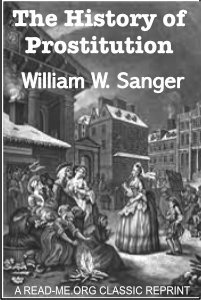
The History of Prostitution

By William W. Sanger.

Its Extent, Causes and Effects Throughout the World. “The history of prostitution around the world from the earliest Egyptian Courtesans to those night houses or street vendors of the late to 19th century. Arguments are unnecessary to prove the existence of prostitution. The evil is so notorious that none can possibly gainsay it. But when its extent, its causes, or its effects are questioned, a remarkable degree of ignorance or carelessness is manifested. Few care to know the secret springs from which prostitution emanates; few are anxious to know how wide the stream ex tends; few have any desire to know the devastation it causes. Society has formally laid a prohibition on the subject, and he who presumes to argue that what affects one may injure all; he who believes that the malady in his neighbor's family to-day may visit his own to-morrow ; he who dares to intimate that a vice which has blighted the happiness of one parent, and ruined the character of one daughter, may produce, must inevitably produce, the same sad results in another circle ; in short, he who dares allude to the subject of prostitution in any other than a mysterious and whispered manner, must prepare to meet the frowns and censure of society.”

New York: The Medical Publishing Co., 1899. 709p.
download part 1
download part 2
download part 3
Observations on the phrenological development of Burke, Hare, and other atrocious murderers

By Thomas Stone, M.D

Measurements of the Heads of the most notorious thieves Confined in the Edinburgh jail and bridewell, And of various individuals, English, Scotch, and Irish, Presenting an extensive series of facts subversive of phrenology. Read before the royal medical society of Edinburgh. ““Assail our facts, and we are undone; Phrenology admits of no exceptions.”(Phrenological Journal, vol. iii. p. 256).

Edinburgh: Robert Buchanan, 1829. 85p.

download
Studies in Forensic Psychiatry

By Bernard Glueck.

“ Forensic Psychiatry is a classic psychology history text by Bernard Glueck. When, in 1810, Franz Joseph Gall said: "The measure of culpability and the measure of punishment can not be determined by a study of the illegal act, but only by a study of the individual committing it," he expressed an idea which has, in late years, come to be regarded as a trite truism. This called forth as an unavoidable consequence a more lively interest on the part of various social agencies in the personality of the criminal, with the resultant gradually increasing conviction that the suppression of crime is not primarily a legal question, but is rather a problem for the physician, sociologist, and economist.”

Boston: Little, Brown, & Co. 1916. 269p.

download
The Psychology of Murder

By Andreas Bjerre.

A Study in Criminal Psychology. “The subject has attracted many writers before Bjerre—philosophers, doctors, lawyers and essayists. But Bjerre has approached the problem from an entirely new point of view. He has not contented himself with wide generalizations, or with the treatment of such second-hand material as criminal statistics, reports of trials, hospital and prison journals or other superficial data, however obtained He has devoted many years of his life to first-hand study in Swedish prisons in order by constant personal association with criminals to solve the riddles hidden away in the dark places of their psychic lives.” (Preface).

Longmans, Green and Co. ltd., 1927. 182p.

download
Sidelights on Criminal Matters

By John Cuthbert Goodwin.

“There is good—much good—in every man, and in every woman. Even in cases where it seems non-existent it is but shyly waiting to be coaxed up to the surface. Some there may be, others there will be, who will see in this volume, as in the daily newspapers, the stage, the kinema, and in parts of the Old Testament itself, a veiled incentive towards wrongdoing. With the sensitive, the apprehensive, and all who, speaking perhaps with authority, and not as the scribes, see a healthy purpose in nothing and a sinister motive in everything, I do not attempt to argue. Crime is a difficult subject to handle in such a manner that its presentation satisfies all, offends none, and withholds secrets which prudence demands should remain secrets, but I have endeavoured to incorporate in my mosaic of deeds and misdeeds nothing that is not already known to the criminal but unknown to the majority of the public. I would, however, assure my readers that they need not expect a tedious pageant of ancient exposures masquerading as palate-tickling novelties.”

London: Hutchinson & Co., 1923. 336p.

download
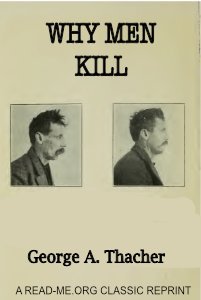
Why Men Kill

By George A. Thacher.

Murder Myusteries Revealed. “I did not feel confident that the list was entirely accurate, but I realized that every day association with the prisoners probably made the designation of defective by these men worthy of thoughtful consideration at least. In jotting down the names of these prisoners I asked what offenses they had committed. In this list approximating 70 defective prisoners 36 were serving sentences for rape and of the 36 there were 13 who had raped their own daughters. One prisoner was serving his third term for this same offense. Seventeen of these prisoners were guilty of the offense which has made ancient Sodom a byword through the centuries. Six of these men had committed murder and all of the six were sex perverts. Naturally these defective beings often have a defective moral sense. My observation has often confirmed that fact. Kraft Ebing remarks that this psychic degeneration, however, has a more profound pathological foundation, because often it can be referred to distinct cerebro-pathologic conditions, and often enough is associated with anatomic signs of degeneration.”

Portland, OR: Press of Pacific Coast Rescue and Protective Society, 1919. 121p.

download
Pathological Lying, Accusation, and Swindling

By William Healy and Mary Tenney Healy.

A Study in Forensic Psychology. “Careful studies of offenders make group-types stand out with distinctness. Very little advancement in the treatment of delinquents or criminals can be expected if typical characteristics and their bearings are not understood. The group that our present work concerns itself with is comparatively little known, although cases belonging to it, when met, attract much attention. It is to all who should be acquainted with these striking mental and moral vagaries, particularly in their forensic and psychological significances, that our essay is addressed. In some cases vital for the administration of justice, an understanding of the types of personality and of behavior here under discussion is a prime necessity. The whole study of characterology or the motivation of conduct is extremely new, and there are many indications of immense values in uncovered fields. Some appreciation of this fact may be gained from the following pages which show the possibility of tracing one form of behavior to its source.”

Boston: Little, Brown and Co., 1917. 286p.

download
Mental Conflicts and Misconduct

By William Healy.

“The great value of understanding] the foundations of conduct is clearly shown by such living facts as are gathered together in this volume. Bearing upon one type of causation of misconduct, we have here not only a rational psychological theory, but also abundant concrete material. An important field is opened before us, especially interesting because of the revelation (a) of potent subconscious mental mechanisms working ac- cording to definite laws of mental life, and (6) of types of hidden early experiences which definitely evoke these mental processes that are forerunners of misconduct. Troublesome behavior, originating in the experiences and mechanisms here under discussion, ranges widely from mere faults of social attitude to severe delinquency and crime dependent upon uncontrolled anti-social motivation or impulse. Cases having this causation occur so frequently that specific knowledge of their nature should be part of the equipment of all who have to pass judgment or to advise concerning misdoing and misdoers.” Boston: Little, Brown and Co. 1917. 330p.

download
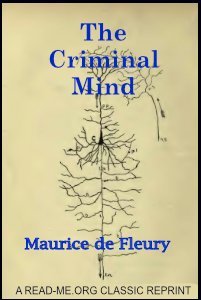
The Criminal Mind

By Maurice de Fleury.

“The science of the human brain has assumed such importance within a quarter of a century, it has so quickly reached so high a degree of precision, it results from so thorough and unanimous an agreement among biologists of all countries, it throws so strong a light upon the phenomena of the mind, that it would now be quite impossible to dispense with it in treating of general psychology, and more especially of criminal psychology. That knowledge—attended at first sight with disconcerting difficulties and alarms, by reason of its complexity—may, nevertheless, be easily simplified and placed within the reach of the least studious minds. For those who go deeply into it, the knowledge of the functions of the brain quickly assumes the pure lines, the harmonious proportions and the symmetrical arrangement of a typical French gardzn, with its straight walks, cut out in the dim forest of the old classical psychology.! Let us walk together in that garden, keeping a few plans, mere rudimentary drawings, under our eyes, lest we should lose our way. Here is one, in the first place, which represents the topography, the geography of one half of the brain,” or, to employ the phrase in use, the cerebral localizations on the left hemisphere.”

London: Downey & Co., 1901. 196p.

download
Abnormal Man

By Arthur Macdonald.

Being Essays on Education and Crime and Related Subjects, With Digests of Literature and a Bibliography. The present work may perhaps be considered as an introduction to abnormality in general, giving a description, diagnosis, and synthesis of human abnormalities, which seem to be constant factors in society.

Washington, DC: U.S. Bureau of Education, Government Printing Office, 1893. 463p.

download
Crime and Criminals 1887

By J. Sanderson Christison.

“Last winter I contributed a series of articles to the Chicago Tribune under the caption of "Jail Types," which were so favorably noticed, both in Europe and America, that my friends have urged their appearance in book form. With some typographical corrections, the articles are here presented in their original text, with a number of additional sketches. While they do not constitute a systematic treatise on the subject of criminology, they present the points of most importance in a form and style intended to attract and interest the general reader, who will find much to reflect upon in the line of duty as a member of society at large.” (from Preface)

Chicago: THE W. T. Keener Co. 1897 117p.

download
Criminals and Crime

By Robert Anderson.

Some Facts and Suggestions,. “It is to the public therefore that this volume is addressed. For if the public became alive to the fact that all the principal offences against property are the work of small bands of professional criminals, and that the professional criminal is the creature of our punishment of crime system, we should soon have a popular outcry in favour of the reforms here advocated.” (from Preface)

London: James Nisbet & Co., 1907. 204p.

download
Crime and Criminals

By Clarence Darrow

An Address Delivered to the Prisoners in the Chicago County Jail. “Some of my good friends have insisted that while my theories are true, I should not have even them to inmates of a jail. Realizing the force of the suggestion that the truth should not be spoken to all people, I have caused these remarks to be printed on rather good paper and in a somewhat expensive form. In this way the truth does not become cheap and vulgar, and is only placed before those whose intelligence and affluence will prevent their being influenced by it. “ Clarene Darrow, Preface.

Chicago: Charles H. Kerr & Co., 1910. 36p.

download
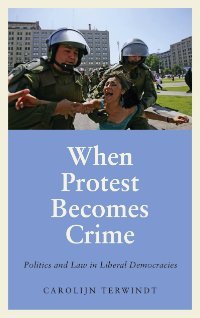
When Protest Becomes Crime

By Carolijn Terwindt.

Politics and Law in Liberal Democracies.How does protest become criminalised? Applying an anthropological perspective to political and legal conflicts, Carolijn Terwindt urges us to critically question the underlying interests and logic of prosecuting protesters. The book draws upon ethnographic research in Chile, Spain, and the United States to trace prosecutorial narratives in three protracted contentious episodes in liberal democracies. Terwindt examines the conflict between Chilean landowners and the indigenous Mapuche people, the Spanish state and the Basque independence movement, and the United States' criminalisation of 'eco-terrorists.' Exploring how patterns and mechanisms of prosecutorial narrative emerge through distinct political, social and democratic contexts, Terwindt shines a light on how prosecutorial narratives in each episode changed significantly over time. Challenging the law and justice system and warning against relying on criminal law to deal with socio-political conflicts, Terwindt's observations have implications for a wide range of actors and constituencies, including social movement activists, scholars, and prosecutors.

London: Pluto Press, 2020. 305p.

download
Piracy in World History

Edited by Stefan Amirell, Hans Hägerdal, Bruce Buchan.

In a modern global historical context, scholars have often regarded piracy as an essentially European concept which was inappropriately applied by the expanding European powers to the rest of the world, mainly for the purpose of furthering colonial forms of domination in the economic, political, military, legal and cultural spheres. By contrast, this edited volume highlights the relevance of both European and non-European understandings of piracy to the development of global maritime security and freedom of navigation. It explores the significance of ‘legal posturing’ on the part of those accused of piracy, as well as the existence of non-European laws and regulations regarding piracy and related forms of maritime violence in the early modern era. The authors in Piracy in World History highlight cases from various parts of the early-modern world, thereby explaining piracy as a global phenomenon.

Amsterdam: Amsterdam University Press, 2021. 290p.

download
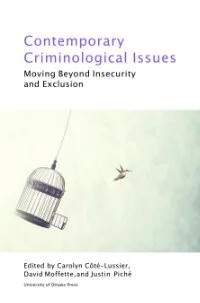
Contemporary Criminological Issues: Moving Beyond Insecurity and Exclusion

Edited by Carolyn Côté-Lussier, David Moffette, and Justin Piché.

Contemporary Criminological Issues tackles some of today’s most pressing social issues, from the criminalization of Indigenous peoples to interpersonal violence, border control, and armed conflicts. This book advances cutting-edge theories and methods, with the aim of moving beyond the scholarship that reproduces insecurity and exclusion. The breadth of approaches encompasses much of the current critical criminological scholarship, serving as a counterpoint to the growth of managerial and administrative criminologies and the rise of explicitly exclusionary and punitive state policies and practices with respect to ‘crime’ and ‘security.’ This edited collection featuring two books, one in English and one in French, includes important contributions to knowledge and public policy by eminent experts and emerging scholars.

Ottawa: University of Ottawa Press, 2020. 322p.

download
Murder in America: a history

By Roger Lane.

This book is a history of criminal homicide, or murder, in America. Murder is one of the two most common forms of intentional homicide, defined simply as the killing of one human being by another; the other is war. The third, capital punishment, is linked to both; death may be decreed either for failing to kill when a society demands it or for killing when a society forbids it. All three forms are linked in other, sometimes surprising ways. But while war has been a main—perhaps the main— subject of traditional history, historians have only newly turned their attention to criminal homicide.

Columbus, OH: Ohio State University, 1997. 399p.

download
National Reconviction Statistics and Studies in Europe

Edited by Hans-Jörg Albrecht, Jörg-Martin Jehle.

Nationale Rückfallstatistiken und -untersuchungen in Europa. Recidivism belongs to the main categories of criminology, crime policy and criminal justice. If the target of preventing offenders from reoffending is taken seriously crime policy should be measured by success of certain penal sanctions in terms of relapses. Also institutions that deal directly with crime and offenders need to get basic information on the consequences of their actions; particularly general knowledge about offender groups at risk of reoffending. All these are reasons why representative recidivism studies are needed. Meanwhile a lot of European countries gather systematic and comprehensive information on recidivism, periodically and on a national level. This volume presents an exemplary collection of such endeavors: Austria, Estonia, France, Germany, Switzerland and a comparative study of England and Wales, the Netherlands and Scotland.

Universitätsverlag Göttingen 2014, 249p.

download
Cocaine: From Coca Fields to the Streets

Edited by Enrique Desmond Arias and Thomas Grisaffi.

The contributors to Cocaine analyze the contemporary production, transit, and consumption of cocaine throughout the Americas and the illicit economy's entanglement with local communities. Based on in-depth interviews and archival research, these essays examine how government agents, acting both within and outside the law, and criminal actors seek to manage the flow of illicit drugs to both maintain order and earn profits. Whether discussing the moral economy of coca cultivation in Bolivia, criminal organizations and drug traffickers in Mexico, or the routes cocaine takes as it travels into and through Guatemala, the contributors demonstrate how entire ways of life are built around cocaine commodification. They consider how the authority of state actors is coupled with the self-regulating practices of drug producers, traffickers, and dealers, complicating notions of governance and of the relationships between economic and moral economies. The collection also outlines a more progressive drug policy that acknowledges the important role drugs play in the lives of those at the urban and rural margins. Contributors. Enrique Desmond Arias, Lilian Bobea, Philippe Bourgois, Anthony W. Fontes, Robert Gay, Paul Gootenberg, Romain Le Cour Grandmaison, Thomas Grisaffi, Laurie Kain Hart, Annette Idler, George Karandinos, Fernando Montero, Dennis Rodgers, Taniele Rui, Cyrus Veeser, Autumn Zellers-León.

Durham, NC: Duke University Press, 2021. 377p.

download
Defining and Registering Criminal Offences and Measures Standards for a European Comparison

Edited by Jörg-Martin Jehle / Stefan Harrendorf.

The study presented in this book is a direct response to the needs for defining and registering criminal and judicial data on the European level. Based upon work done by the European Sourcebook experts group in creating the European Sourcebook of Crime and Criminal Justice Statistics (ESB), the project intended to improve and complement the standards developed so far for definitions and statistical registration in four fields, in order to contribute to the picture of criminal justice in Europe. It utilized questionnaires filled by an established European network.

Gottingen, GER: Universitätsverlag Göttingen 2010 302p.

download