Open Access Free Library
Fiction+Mediajpg.jpg

FICTION and MEDIA

CRIME AND MEDIA — TWO PEAS IN A POD

Posts in literature
Washington Square

By Henry James

From Wikipedia: The story of Washington Square by Henry James is told with a nuanced perspective of characters with individual rationalizations and sometimes undisclosed motivations. There is a subtle ambiguity to the internal logic of the participants in the story and none are altogether depicted as outright villainous.

In 1840s New York City, naive, introverted Catherine Sloper lives with her respected physician father, Dr. Austin Sloper, in Washington Square, a then newly established neighborhood near Greenwich Village. After the deaths of his wife and son, Dr. Sloper raises Catherine with his widowed sister, Mrs. Penniman, who is charged with Catherine's education. Although never disclosed directly to Catherine, the Doctor does not hold her personality or appearance in high regard, finding her a cheap substitute for her mother. This evaluation is never challenged in the narrative and Catherine is depicted as a simple, reserved individual……

NY. Harper. 1880. 266p.

The Portrait of a Lady

By Henry James

From Wikipedia: The Portrait of a Lady is a novel by Henry James, first published as a serial in The Atlantic Monthly and Macmillan's Magazine in 1880–81 and then as a book in 1881. It is one of James's most popular novels and is regarded by critics as one of his finest.

The Portrait of a Lady is the story of a spirited young American woman, Isabel Archer, who, "affronting her destiny,"[1] finds it overwhelming. She inherits a large amount of money and subsequently becomes the victim of Machiavellian scheming by two American expatriates. Like many of James's novels, it is set in Europe, mostly England and Italy. Generally regarded as the masterpiece of James's early period,[2] this novel reflects James's continuing interest in the differences between the New World and the Old, often to the detriment of the former. It also treats in a profound way the themes of personal freedom, responsibility, and betrayal.

  • Isabel Archer, from Albany, New York, is invited by her maternal aunt, Lydia Touchett, to visit Lydia's rich husband, Daniel, at his estate near London, following the death of Isabel's father. There, Isabel meets her uncle, her friendly invalid cousin Ralph Touchett, and the Touchetts' robust neighbor, Lord Warburton. Isabel later declines Warburton's sudden proposal of marriage. She also rejects the hand of Caspar Goodwood, the charismatic son and heir of a wealthy Boston mill owner. Although Isabel is drawn to Caspar, her commitment to her independence precludes such a marriage, which she feels would demand the sacrifice of her freedom…….

The Bostonians

By Henry James

The Bostonians is a novel by Henry James, first published as a serial in The Century Magazine in 1885–1886 and then as a book in 1886. This bittersweet tragicomedycentres on an odd triangle of characters: Basil Ransom, a political conservative from Mississippi; Olive Chancellor, Ransom's cousin and a Boston feminist; and Verena Tarrant, a pretty, young protégée of Olive's in the feminist movement. The storyline concerns the struggle between Ransom and Olive for Verena's allegiance and affection, though the novel also includes a wide panorama of political activists, newspaper people, and quirky eccentrics.

  • Henry James originally entered into an agreement with the Boston publisher James R. Osgood & Co. to publish the book in the United States for $4,000. Osgood made a separate agreement with The Century for the magazine to serialize the novel. In May 1885, before the serialization had finished and James had been paid any of the money owed to him, Osgood's firm went bankrupt.[1] James was able to recover part of the lost sum by selling the copyright to Macmillan and Co., which published The Bostonians in a three-volume edition in Britain in February 1886, and in a one-volume edition in the US in May 1886.[1] James was not, however, able to recover any money for the serialization in The Century.[2]

  • Mississippi lawyer and Civil War veteran, Basil Ransom, visits his cousin Olive Chancellor in Boston. She takes him to a political meeting where Verena Tarrant delivers a feminist speech. Ransom, a strong conservative, is annoyed by the speech but fascinated with the speaker. Olive, who never has set eyes on Verena, is equally fascinated. She persuades Verena to leave her parents' house, move in with her and study in preparation for a career in the feminist movement. Meanwhile, Ransom returns to his law practice in New York, which is not doing well. He visits Boston again and walks with Verena through the grounds of Harvard College, including the impressive Civil War Memorial Hall. Verena finds herself attracted to the charismatic Ransom. Basil eventually proposes to Verena, much to Olive's dismay. Olive has arranged for Verena to speak at the Boston Music Hall. Ransom shows up at the hall just before Verena is scheduled to begin her speech. He persuades Verena to elope with him, to the discomfiture of Olive and her fellow-feminists. The final sentence of the novel shows Verena in tears – not to be her last, James assures us.

London. Macmillan . 1886. 419p.

Some Short Christmas Stories

By Charles Dickens

The opening of “A Christman story”. I have been looking on, this evening, at a merry company of children assembled round that pretty German toy, a Christmas Tree.  The tree was planted in the middle of a great round table, and towered high above their heads.  It was brilliantly lighted by a multitude of little tapers; and everywhere sparkled and glittered with bright objects.  There were rosy-cheeked dolls, hiding behind the green leaves; and there were real watches (with movable hands, at least, and an endless capacity of being wound up) dangling from innumerable twigs; there were French-polished tables, chairs, bedsteads, wardrobes, eight-day clocks, and various other articles of domestic furniture (wonderfully made, in tin, at Wolverhampton), perched among the boughs, as if in preparation for some fairy housekeeping; there were jolly, broad-faced little men, much more agreeable in appearance than many real men—and no wonder, for their heads took off, and showed them to be full of sugar-plums; there were fiddles and drums; there were tambourines, books, work-boxes, paint-boxes, sweetmeat-boxes, peep-show boxes, and all kinds of boxes; there were trinkets for the elder girls, far brighter than any grown-up gold and jewels; there were baskets and pincushions in all devices; there were guns, swords, and banners; there were witches standing in enchanted rings of pasteboard, to tell fortunes; there were teetotums, humming-tops, needle-cases, pen-wipers, smelling-bottles, conversation-cards, bouquet-holders; real fruit, made artificially dazzling with gold leaf; imitation apples, pears, and walnuts, crammed with surprises; in short, as a pretty child, before me, delightedly whispered to another pretty child, her bosom friend, “There was everything, and more.”  This motley collection of odd objects, clustering on the tree like magic fruit, and flashing back the bright looks directed towards it from every side—some of the diamond-eyes admiring it were hardly on a level with the table, and a few were languishing in timid wonder on the bosoms of pretty mothers, aunts, and nurses—made a lively realisation of the fancies of childhood; and set me thinking how all the trees that grow and all the things that come into existence on the earth, have their wild adornments at that well-remembered time.

London. Chapman and Hall Christmas Stories edition, Volume 1, 1911. 69p.

Nicholas Nickleby,

By Charles Dickens

From Wikipedia. Nicholas Nickleby, or The Life and Adventures of Nicholas Nickleby, is the third novel by Charles Dickens, originally published as a serial from 1838 to 1839. The character of Nickleby is a young man who must support his mother and sister after his father dies.

London. Chapman and Hall. 1839. 954p.

Our Mutual Friend

By Charles Dickens

From Wikipedia: Our Mutual Friend, written in 1864–1865, is the last novel completed by Charles Dickens and is one of his most sophisticated works, combining savage satire with social analysis. It centres on, in the words of critic J. Hillis Miller, quoting the book's character Bella Wilfer, "money, money, money, and what money can make of life".[1]

Most reviewers in the 1860s continued to praise Dickens's skill as a writer in general, but did not review this novel in detail. Some found the plot both too complex and not well laid out.[2] The Times of London found the first few chapters did not draw the reader into the characters. In the 20th century, however, reviewers began to find much to approve in the later novels of Dickens, including Our Mutual Friend.[3] In the late 20th and early 21st centuries, some reviewers suggested that Dickens was, in fact, experimenting with structure,[4][5] and that the characters considered somewhat flat and not recognized by the contemporary reviewers[6] were meant rather to be true representations of the Victorian working class and the key to understanding the structure of the society depicted by Dickens in the novel.[6][7]

London. Chapman & Hall. 1865. 970p.

Hard Times

By Charles Dickens

From Wikipedia: “Hard Times: For These Times (commonly known as Hard Times) is the tenth novel by Charles Dickens, first published in 1854. The book surveys English society and satirises the social and economic conditions of the era. Hard Times is unusual in several ways. It is by far the shortest of Dickens's novels, barely a quarter of the length of those written immediately before and after it.[1] Also, unlike all but one of his other novels, Hard Times has neither a preface nor illustrations. Moreover, it is his only novel not to have scenes set in London.[1] Instead the story is set in the fictitious Victorian industrial Coketown, a generic Northern English mill-town, in some ways similar to Manchester, though smaller. Coketown may be partially based on 19th-century Preston. One of Dickens's reasons for writing Hard Times was that sales of his weekly periodical Household Words were low, and it was hoped the novel's publication in instalments would boost circulation – as indeed proved to be the case. Since publication it has received a mixed response from critics.

London. Chapman and Hal. 1905. 304p.

Dombey and Son

By Charles Dickens

From Wikipedia: “The story concerns Paul Dombey, the wealthy owner of the shipping company of the book's title, whose dream is to have a son to continue his business. The book begins when his son is born and Dombey's wife dies shortly after giving birth. Following the advice of Mrs Louisa Chick, his sister, Dombey employs a wet nurse named Mrs Richards (Toodle). Dombey already has a six-year-old daughter Florence, but, bitter at her not having been the desired boy, he neglects her continually. One day, Mrs Richards, Florence, and her maid, Susan Nipper, secretly pay a visit to Mrs Richards' house in Staggs's Gardens so that Mrs Richards can see her children. During this trip, Florence becomes separated from them and is kidnapped for a short time by Good Mrs Brown, before being returned to the streets. She makes her way to Dombey and Son's offices in the City and there is found and brought home by Walter Gay, an employee of Mr Dombey, who first introduces her to his uncle, the navigation instrument maker Solomon Gills, at his shop The Wooden Midshipman. The child, named Paul after his father, is a weak and sickly child….”

London. Bradbury & Evans. 1848.

The Chimes: A Goblin Story

By Charles Dickens

“…When he came therefore to think of his new story for Christmas time, he resolved to make it a plea for the poor ... He was to try and convert Society, as he had converted Scrooge, by showing that its happiness rested on the same foundations as those of the individual, which are mercy and charity not less than justice…” (Wikipedia)

Chapman and Hall. 1844. 175p.

The Dressmaker

By Rosalie Ham

Sydney. Duffy and Shellgrove. 2000. 302p.

"The Dressmaker" is a novel by Australian author Rosalie Ham, first published in 2000. The book tells the story of Tilly Dunnage, a talented dressmaker who returns to her hometown in rural Australia after years of living abroad. As she settles back into her old life, Tilly must confront the demons of her past and navigate the complex social dynamics of a small town that has never fully accepted her.

The novel is a darkly comic satire that skewers the hypocrisies and prejudices of small-town life. Ham's vivid descriptions of the characters and setting bring the town to life, and her use of irony and satire add a sharp edge to the story's humor. At its heart, though, "The Dressmaker" is a story about the power of self-expression and the importance of being true to oneself, even in the face of opposition from others.

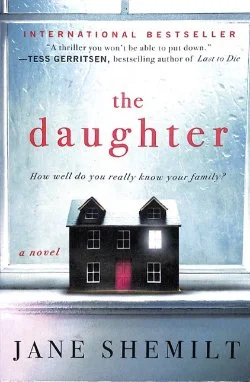
The Daughter

By Jane Shemilt

London. Penguin. 2014. 342p.


"The Daughter" is a novel by Australian author Jane Shemilt, first published in 2014. The book tells the story of a successful doctor named Jenny, whose daughter Naomi disappears one day without a trace. As Jenny searches for her daughter and tries to unravel the mystery of her disappearance, she must confront the painful secrets and hidden truths that have been simmering beneath the surface of her seemingly perfect family.

The novel is a gripping psychological thriller that explores themes of loss, grief, and the complexities of family relationships. Shemilt's skill as a writer is evident in her deft handling of the novel's multiple narrative threads, as well as her ability to create a sense of tension and unease that keeps the reader engaged from start to finish.

German Classics of the 19th and 20th Centuries: Masterpieces of German Literature. Vol. XVIII

Editor-in-Chief, Kuno Francke

NY. The German Publication Society. 1914.

The collection includes works by famous authors such as Johann Wolfgang von Goethe, Friedrich Schiller, Thomas Mann, and Franz Kafka. It also includes lesser-known works by writers such as Adalbert Stifter, Gottfried Keller, and Gerhart Hauptmann.

Each work in the collection offers a unique perspective on the cultural, social, and political issues of its time, and reflects the distinctive style and voice of its author. The works in the collection range from romantic poetry and lyrical prose to philosophical essays and modernist fiction.

Silas Marner. The Lifted Veil. Brother Jacob.

By George Eliot III

Silas Marner is George Eliot's (1819-1880) short novel of 1861, in which the protagonist is obliged to leave his small religious community after being falsely accused of theft. He settles in Raveloe, where he works diligently as a weaver for 15 years and manages to accumulate and hoard a substantial amount of gold.
“The Lifted Veil” concerns themes of fate, extrasensory perception, the mystery of life and life after death. Eliot's interest in these themes stemmed partly from her own struggles with religious faith, as she was an extremely devout Christian as a child and young adult who later renounced Christianity completely. “Brother Jacob'“raises issues of perennial concern to George Eliot as an author who was also a woman. In particular, this fabular tale about a hapless confectioner and his imbecilic broth- er exposes the pitfalls in women's relationship(s) to cultural authority, 'the strange bright fruits of knowledge' (Woolf 160). As a fable whose hero is distinguished by fraudulence and guile, 'Brother Jacob' reflects its author's attitude towards plagiarists and other impostors with pre- tensions to authorship. Even as Marian Evans disguised herself as George Eliot, the 'silly lady novelist' of her day is disguised in the story's protagonist, David Faux.

London. Oxford University Press. 1861., 1859, 1860. 318p.

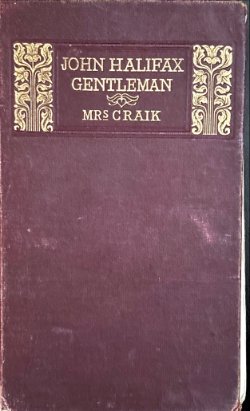
John Halifax, Gentleman

By Mrs. Craik.

The action is centred on the town of Tewkesbury, scarcely disguised by the fictional name Norton Bury, in Gloucestershire. The story is narrated by Phineas, a friend of the central character. John Halifax is an orphan, determined to make his way in the world through honest hard work. He is taken in by a tanner, Abel Fletcher, who is a Quaker, and thus meets Phineas, who is Abel's son. John eventually achieves success in business and love, and becomes a wealthy man. (Wikipedia)

London: Ward, Lock and Co. 1856. 449p.

Kangaroo

By D. H. Lawrence

Kangaroo is D. H. Lawrence's eighth novel, set in Australia. He wrote the first draft in just forty-five days while living south of Sydney, in 1922, and revised it three months later in New Mexico. The descriptions of the country are vivid and sympathetic and the book fuses lightly disguised autobiography with an exploration of political ideas at an immensely personal level. Based on a collation of the manuscript, typescripts and first editions, this text of Kangaroo is closest to what Lawrence would have expected to see in print. There is a full textual apparatus of variants, a comprehensive introduction giving the background and history of composition and publication and a summary of contemporary reviewers' opinions. Explanatory notes elucidate the many geographical, political and literary allusions in the text; there are three maps and an appendix detailing Australian locations.

London. Thomas Seltzer Inc. 1923. 367p.

The 100-Year-Old Man who climbed out the window and disappeared

By Jonas Jonasson. Translated by Rod Bradbury

A larger-than-life old man with a fondness for vodka goes on an unexpected adventure in this whimsical novel -- perfect for fans of Forrest Gump and A Man Called Ove.. The international publishing sensation -- more than six million copies sold worldwide! A reluctant centenarian much like Forrest Gump (if Gump were an explosives expert) decides it's not too late to start over . . .

After a long and eventful life, Allan Karlsson ends up in a nursing home, believing it to be his last stop. The only problem is that he's still in good health, and in one day, he turns 100. A big celebration is in the works, but Allan really isn't interested (and he'd like a bit more control over his vodka consumption). So he decides to escape. He climbs out the window in his slippers and embarks on a hilarious and entirely unexpected journey, involving, among other surprises, a suitcase stuffed with cash, some unpleasant criminals, a friendly hot-dog stand operator, and an elephant (not to mention a death by elephant).

It would be the adventure of a lifetime for anyone else, but Allan has a larger-than-life backstory: Not only has he witnessed some of the most important events of the twentieth century, but he has actually played a key role in them. Starting out in munitions as a boy, he somehow finds himself involved in many of the key explosions of the twentieth century and travels the world, sharing meals and more with everyone from Stalin, Churchill, and Truman to Mao, Franco, and de Gaulle. Quirky and utterly unique, The 100-Year-Old Man Who Climbed Out the Window and Disappeared has charmed readers across the world.

NY. Hachette. 2009, 2012. 381p.

Coonardoo

By Katharine Susannah Prichard

From the jacket: No writer has painted a more vivid picture of the tragic meeting of primi­tive and civilized humanity than Katharine Susannah Prichard in Coonardoo. First published in 1929, this remarkable novel has become an Australian classic, as moving in its deli­cate portraiture of an aboriginal girl as it is revealing in its authentic know­ledge of the outback scene in north­western Australia. The little black girl Coonardoo and the boy Hugh are childhood play­mates, and the relationship that gradually develops from their early bond is compelling and disastrous. Coonardoo has her tribal partner; Hugh, the station-owner, must marry. This drama is played out in the deserts and cattle country of the north­west, a cruel story redeemed by the poetic quality-of Coonardoo and her devotion to the man whose race dealt so harshly with hers.

Melbourne. Angus and Robertson. 1929.

Frenchman's Creek

By Daphne Du Maurier

From Amazon: This "highly personalized adventure, ultra-romantic" story from the author of Rebecca tells the tale of a woman looking for adventure, only to find it in the arms a rebellious criminal (New York Times). Bored and restless in London's Restoration Court, Lady Dona escapes into the British countryside with her restlessness and thirst for adventure as her only guides. Eventually Dona lands in remote Navron, looking for peace of mind in its solitary woods and hidden creeks. She finds the passion her spirit craves in the love of a daring French pirate who is being hunted by all of Cornwall. Together, they embark upon a quest rife with danger and glory, one which bestows upon Dona the ultimate choice: sacrifice her lover to certain death or risk her own life to save him.

U.K. Gollancz. 1941. 208p.

Madam Bovary: Provincial Manners

By Gustav Flaubert

"She longed t o rush into his arms. to take refuge in his strength as ir the incarnation of bertect love. tc cry aloud to him- 'Take me away ! Oh, take me away!'" Madame Bovary is the story of a beautiful young woman who marries a luckless and loutishcountry doctor. She attempts to escape the narrou confines of her lifethrough a series of passionate affairs, hoping to find in other men the romantic ideal she has alwavs dreamed about. Her reckless. n e s s comes back to haunt her. however. and the strong-willed and independent Emma finds herself in a desperate fight for existence. Flaubert's daring depiction of adultery and sinfulness caused a national scandal when it was first published, and the author was put on trial for offending public morality. One hundred and fifty years later, this masterpiece of realist literature has lost none of its impact.

Michel Lévy Frères (in book form, 2 Vols). 1857. 322p.

Jamaica Inn

By Daphne Du Maurier.

Many of Daphne dimario's novels are set in Cornwall probably because she had made her home in the area and her writing seems to have absorbed so much of the atmosphere of that land of mystery and dark deeds. From Chapter 1: “It was a cold grey day in late November. The weather had changed overnight, when a backing wind brought a granite sky and a mizzling rain with it, and although it was now only a little after two o’clock in the afternoon the pallor of a winter evening seemed to have closed upon the hills, cloaking them in mist. It would be dark by four. The air was clammy cold, and for all the tightly closed windows it penetrated the interior of the coach. The leather seats felt damp to the hands, and there must have been a small crack in the roof, because now and again little drips of rain fell softly through, smudging the leather and leaving a dark-blue stain like a splodge of ink. The wind came in gusts, at times shaking the coach as it travelled round the bend of the road, and in the exposed places on the high ground it blew with such force that the whole body of the coach trembled and swayed, rocking between the high wheels like a drunken man….”

U.K. Gollancz. 1936.189p.