
POLICE ADMINISTRATION: Part III of the Cleveland Foundation Survey of Criminal Justice in Cleveland
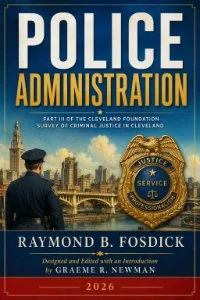
Raymond B. Fosdick. Designed and Edited with an Introduction by Graeme R. Newman and Claude.
A landmark classic in the history of policing, public administration, and criminal justice reform.
When Raymond B. Fosdick published Police Administration in 1921 as part of the renowned Cleveland Foundation Survey of Criminal Justice, he delivered one of the most penetrating examinations ever undertaken of an American police department. More than a century later, his analysis remains remarkably relevant.
Confronted by rising crime and concerns about police effectiveness, Cleveland commissioned an independent investigation of its law enforcement system. Fosdick responded with a rigorous, evidence-based study that compared American policing with the more professionalized police systems of Europe. His conclusions were blunt: crime was not simply the product of social conditions, but also of outdated organization, weak leadership, inadequate training, political interference, and a failure to adapt policing to the demands of the modern city.
This groundbreaking work examines every major aspect of police administration, including:
Police organization and leadership
Recruitment, selection, and training of officers
Promotion and discipline systems
Patrol operations and crime prevention
Detective bureau management
Personnel administration and record keeping
Accountability, professionalism, and public service
Fosdick's recommendations anticipated many reforms that would shape twentieth-century policing: merit-based advancement, professional training academies, modern management practices, specialized investigative units, and the use of data and performance measurement in public administration.
This new edition includes a substantial introduction by criminologist Graeme R. Newman, placing Fosdick's work in historical context and exploring its continuing significance in contemporary debates over police reform, professionalism, accountability, and governance.
More than a historical document, Police Administration is an essential source for understanding the origins of modern policing and the enduring challenges of managing police organizations in democratic societies.
Ideal for readers interested in:
Police history
Criminal justice
Criminology
Public administration
American legal history
Progressive Era reform
Law enforcement studies
Government and public policy
A century after its publication, Fosdick's classic reminds us that effective policing depends not only on laws and officers, but on leadership, organization, and the intelligent administration of justice.
Read-Me.Org Inc. New York-Philadelphia-Australia. 2026. p.104.