Open Access Free Library
CRIMINAL JUSTICE.jpeg

CRIMINAL JUSTICE

CRIMINAL JUSTICE-CRIMINAL LAW-PROCDEDURE-SENTENCING-COURTS

Posts in Supreme Court
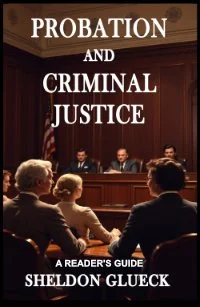
PROBATION AND CRIMINAL JUSTICE: Mini-Classic

By Graeme R. Newman and Claude AI.

Long before probation became the most widely used criminal sanction in America, leading criminologists, judges, lawyers, social workers, psychiatrists, and probation administrators gathered to answer a fundamental question:

Could offenders be rehabilitated in the community instead of being sent to prison?

Originally published in 1933 as a tribute to pioneering probation leader Herbert C. Parsons, Probation and Criminal Justicebrought together some of the most influential voices in early twentieth-century criminal justice. Their essays explored sentencing, rehabilitation, probation administration, judicial discretion, psychiatric treatment, casework methods, and comparative probation systems in the United States, England, France, Belgium, and Germany.

Nearly a century later, the book reads with surprising relevance. The contributors debated many of the same issues that continue to dominate criminal justice policy today: overcrowded prisons, evidence-based sentencing, risk assessment, officer training, community supervision, recidivism, and the tension between punishment and rehabilitation.

This Mini-Classic edition presents an expertly condensed and accessible version of the original volume, preserving the essential arguments, insights, and debates while making them available to modern readers.

Inside you will discover:

  • The origins and early development of probation in America and Europe

  • Sheldon Glueck's influential critique of punishment and rehabilitation

  • The legal and constitutional issues raised by probation

  • How probation officers were selected, trained, and supervised

  • Competing views of sentencing from judges and criminologists

  • Early psychiatric and social-work approaches to offender treatment

  • Comparative probation systems in England, France, Belgium, and Germany

  • A modern commentary examining what has and has not changed since 1933

Part historical document, part policy debate, and part blueprint for reform, Probation and Criminal Justice captures a pivotal moment when criminal justice thinkers were struggling to replace purely punitive responses to crime with more individualized and humane approaches.

For students, scholars, practitioners, and anyone interested in the history of corrections and criminal justice reform, this volume offers a fascinating window into ideas that continue to shape probation and community supervision today.

Crime and Justice Mini-Classics bring influential but often overlooked works in criminology, policing, punishment, and criminal justice history back into print in concise, accessible editions for contemporary readers.

Read-Me.Org Inc. New York-Philadelphia-Australia. 2026. p.83.

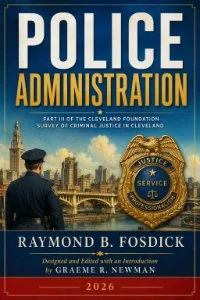
POLICE ADMINISTRATION: Part III of the Cleveland Foundation Survey of Criminal Justice in Cleveland

Raymond B. Fosdick. Designed and Edited with an Introduction by Graeme R. Newman and Claude.

A landmark classic in the history of policing, public administration, and criminal justice reform.

When Raymond B. Fosdick published Police Administration in 1921 as part of the renowned Cleveland Foundation Survey of Criminal Justice, he delivered one of the most penetrating examinations ever undertaken of an American police department. More than a century later, his analysis remains remarkably relevant.

Confronted by rising crime and concerns about police effectiveness, Cleveland commissioned an independent investigation of its law enforcement system. Fosdick responded with a rigorous, evidence-based study that compared American policing with the more professionalized police systems of Europe. His conclusions were blunt: crime was not simply the product of social conditions, but also of outdated organization, weak leadership, inadequate training, political interference, and a failure to adapt policing to the demands of the modern city.

This groundbreaking work examines every major aspect of police administration, including:

  • Police organization and leadership

  • Recruitment, selection, and training of officers

  • Promotion and discipline systems

  • Patrol operations and crime prevention

  • Detective bureau management

  • Personnel administration and record keeping

  • Accountability, professionalism, and public service

Fosdick's recommendations anticipated many reforms that would shape twentieth-century policing: merit-based advancement, professional training academies, modern management practices, specialized investigative units, and the use of data and performance measurement in public administration.

This new edition includes a substantial introduction by criminologist Graeme R. Newman, placing Fosdick's work in historical context and exploring its continuing significance in contemporary debates over police reform, professionalism, accountability, and governance.

More than a historical document, Police Administration is an essential source for understanding the origins of modern policing and the enduring challenges of managing police organizations in democratic societies.

Ideal for readers interested in:

  • Police history

  • Criminal justice

  • Criminology

  • Public administration

  • American legal history

  • Progressive Era reform

  • Law enforcement studies

  • Government and public policy

A century after its publication, Fosdick's classic reminds us that effective policing depends not only on laws and officers, but on leadership, organization, and the intelligent administration of justice.

Read-Me.Org Inc. New York-Philadelphia-Australia. 2026. p.104.

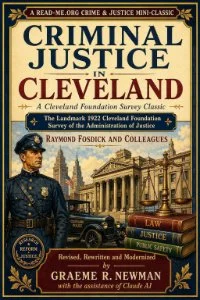
Criminal Justice in Cleveland-Mini-Classic

By Graeme R. Newman and Claude AI.

A landmark investigation into how America's criminal justice system actually worked, and why it often failed.

In 1921, a series of scandals and rising public concern about crime prompted the Cleveland Foundation to commission an unprecedented examination of the administration of justice in Cleveland, Ohio. Directed by two of the most influential legal minds of the twentieth century, Roscoe Pound and Felix Frankfurter, the resulting study became one of the most important reform documents in American criminal justice history.

Originally published in 1922, Criminal Justice in Cleveland was the first comprehensive effort to analyze an entire urban justice system as an interconnected whole. Drawing on detailed investigations of police, prosecutors, courts, corrections, probation, legal education, medical science, and the press, the survey revealed a system plagued by inefficiency, poor record-keeping, fragmented authority, political influence, and a startling lack of accountability.

This modernized edition, edited and introduced by Graeme R. Newman, makes this classic study accessible to today's readers while preserving its most important findings, statistics, and arguments. Readers will discover:

• How police departments operated in major American cities during the early twentieth century
• Why so many criminal cases disappeared before reaching trial
• The hidden influence of politics, public opinion, and newspapers on justice
• Early debates over probation, parole, rehabilitation, and sentencing reform
• The origins of evidence-based criminal justice research
• Reform proposals that continue to resonate more than a century later

Written during the Progressive Era but strikingly relevant today, Criminal Justice in Cleveland demonstrates that many of the challenges confronting modern police, prosecutors, courts, and correctional institutions are far older than most people realize. Its authors recognized that successful reform requires more than replacing individuals; it requires understanding how institutions work, how they fail, and how they can be improved.

Essential reading for students of criminology, criminal justice professionals, legal scholars, historians, policymakers, and anyone interested in the evolution of the American justice system.

More than a century after its publication, this pioneering study remains one of the most insightful examinations ever written of crime, law, and urban justice in America

Read-Me.Org Inc. New York-Philadelphia-Australia. 2026. p.90.

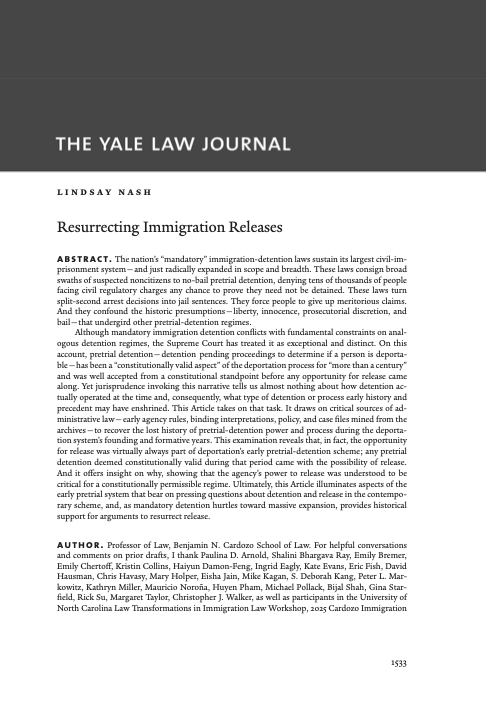
Resurrecting Immigration Releases

By Lindsay Nash

The nation's "mandatory" immigration-detention laws sustain its largest civil-imprisonment system-and just radically expanded in scope and breadth. These laws consign broad swaths of suspected noncitizens to no-bail pretrial detention, denying tens of thousands of people facing civil regulatory charges any chance to prove they need not be detained. These laws turn split-second arrest decisions into jail sentences. They force people to give up meritorious claims. And they confound the historic presumptions-liberty, innocence, prosecutorial discretion, and bail-that undergird other pretrial-detention regimes. 

Although mandatory immigration detention conflicts with fundamental constraints on analogous detention regimes, the Supreme Court has treated it as exceptional and distinct. On this account, pretrial detention-detention pending proceedings to determine if a person is deportable-has been a "constitutionally valid aspect" of the deportation process for "more than a century" and was well accepted from a constitutional standpoint before any opportunity for release came along. Yet jurisprudence invoking this narrative tells us almost nothing about how detention actually operated at the time and, consequently, what type of detention or process early history and precedent may have enshrined. This Article takes on that task. It draws on critical sources of administrative law-early agency rules, binding interpretations, policy, and case files mined from the archives-to recover the lost history of pretrial-detention power and process during the deportation system's founding and formative years. T

his examination reveals that, in fact, the opportunity for release was virtually always part of deportation's early pretrial-detention scheme; any pretrial detention deemed constitutionally valid during that period came with the possibility of release. And it offers insight on why, showing that the agency's power to release was understood to be critical for a constitutionally permissible regime. Ultimately, this Article illuminates aspects of the early pretrial system that bear on pressing questions about detention and release in the contemporary scheme, and, as mandatory detention hurtles toward massive expansion, provides historical support for arguments to resurrect release.

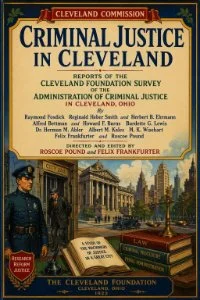
Criminal Justice in Cleveland

Criminal Justice in Cleveland was one of the most influential studies of the American criminal justice system produced during the Progressive Era. Published by The Cleveland Foundation, the volume brought together leading legal scholars, reformers, and public officials, including Raymond Fosdick, Roscoe Pound, Felix Frankfurter, and others, to examine the administration of justice in Cleveland, Ohio. The work was directed and edited by Roscoe Pound and Felix Frankfurter.

Rather than focusing solely on crime, the study investigated the entire machinery of justice, including police, prosecutors, courts, probation services, corrections, and related public institutions. The authors sought to determine how effectively these agencies worked together, where delays and inefficiencies occurred, and what reforms were needed to create a more fair, efficient, and accountable system of justice.

The survey became a landmark in empirical legal research because it relied on systematic investigation rather than anecdote or political opinion. Its findings helped shape twentieth-century reforms in policing, court administration, criminal procedure, and corrections, making it essential reading for historians, criminologists, legal scholars, and students of public administration.

Today, Criminal Justice in Cleveland remains a classic study of urban criminal justice and a foundational text in the movement to evaluate government institutions through rigorous research and evidence-based reform.

Appellate Review of Daubert Rulings

By Steven M. Klepper

The Supreme Court of Maryland adopted the federal Daubert standard for admission of expert testimony in 2020.1 Given that Daubert rulings are discretionary, the abuse-of-discretion standard governs appellate review of expert testimony.2 During the summer of 2023, the Supreme Court of Maryland issued three opinions holding that trial judges abused their discretion—at least in part—when they admitted or excluded expert testimony.3 In the last of the three cases, Justice Brynja Booth authored a concurring opinion noting how the Court was applying less deference than in other discretionary contexts, and she urged her colleagues to clarify the nature of review.4 This article posits that Daubert errors fall into two main categories: procedural and substantive. Procedural errors occur when a trial court misunderstands an aspect of the Daubert framework.5 In effect, the trial judge has misread Maryland Rule 5-702, which governs expert testimony. 6 A misreading of an evidentiary rule is a legal error that is reviewed de novo, meaning without deference. 7 Substantive error occurs when a trial judge follows the Daubert framework but reaches a result to which an appellate courts cannot defer because either the trial judge has abused their8 discretion in the traditionalsense or the Supreme Court of Maryland has decided to draw a boundary circumscribing all trial judges’ discretion.9 Such vocabulary not only accurately describes the nature of judicial review but also reduces friction between trial judges and appellate courts